
Recent events, including the proposal that the federal government live-stream the public execution of a convicted terrorist, are corroding our nation’s long enlightenment heritage.
We can now officially say farewell to American Exceptionalism. The idea that the United States is a uniquely enlightened nation, seeking to build a shining city on a hill as a template for the rest of the world, has always been self-serving and more than a little hypocritical. Still, at the moment the concept is so threadbare as to be ludicrous — if it weren’t just tragic.
America is:
— waging an undeclared war against another sovereign nation — including the killing (decapitation) of its leadership — begun while diplomatic negotiations were underway. Sneak attacks, like Japan’s on the American fleet at Pearl Harbor in 1941, used to be regarded as days that “will live in infamy.” The current administration’s air war against Iran violates the war powers clauses of the Constitution and the 1973 Congressional War Powers Resolution. (Undeclared wars indeed have, since President Truman’s “police action” in Korea beginning in 1950, been the rule rather than the exception, but they violate one of the most important principles of our constitutional order);
— infiltrating our cities with masked and unidentified federal agents who pluck people (some of them American citizens) off the streets without warrants, and occasionally kill unarmed individuals who are deemed to be resisting arrest or interfering with immigration enforcement. In addition to warrantless searches (one of the precipitating causes of the American Revolution), these extrajudicial arrests and detainments violate a foundational principle of Western civilization: habeas corpus, which dates back at least to the 12th century. Some of the detainees are then shipped off to countries to which they have no affiliation, to be locked up in prisons that have an international reputation for brutality.
— using the Justice Department to harass and indict domestic political “enemies,” merely to please the president of the United States. What have Arizona Senator Mark Kelly or former White House aide Cassidy Hutchinson done to deserve institutional assault by the U.S. Justice Department? Or, for that matter, Olympic athlete David Hearn, for allegedly vandalizing the defective new liner of the reflecting pool on the Washington Mall? The charges against Hearn were so flimsy that one of the current president’s croniest cronies, U.S. Attorney Jeanine Pirro, refused to prosecute the case.
— and, more recently, announcing the United States government’s intention to live stream the public execution of a convicted terrorist.
Is This Your America? Is This the America You Want To Live In?
“I believe that a sight so inconceivably awful as the wickedness and levity of the immense crowd collected at that execution could be imagined by no man. … It was so loathsome and repulsive that I came away with a belief that the sight was totally depraving to everyone who looked at it.
Charles Dickens in letter to Times of London, 1849
Almost every other first-tier nation, in fact, almost every nation on earth, has suspended or abolished capital punishment. Nations that still execute criminals, some of them in public, include China, Iran, Saudi Arabia, Yemen, Egypt, Kuwait, Singapore, Somalia, and North Korea. Is this the club of nations we want to belong to?
First, there was the bungled execution (by lethal injection) of a woman named Christa Gail Pike on September 30, 2026, at Riverbend Maximum Security Prison in Nashville. Twice injected, still alive, and mad as hell, as you might expect. This isn’t the first time this has happened. To cite just one example, on May 21, 2026, a man named Tony Carruthers survived his execution (also in Tennessee) when his executioners failed to locate the necessary veins in his body. After 90 minutes, the execution was abandoned — at least for a year. Insane though this may sound, a firing squad may be a more humane way to end another person’s life.
A few weeks ago, the U.S. Defense Department announced that it planned to live stream the execution of convicted terrorist Nidal Malik Hasan, who killed 13 and wounded 32 others at Fort Hood in Texas on November 5, 2009. More recently, after nearly universal condemnation of this horrifying plan, President Trump announced that Hasan’s execution will go ahead on December 3, but it will not be live-streamed.
We should not feel relieved that the Trump administration has decided not to stream the execution of Hasan. We should feel appalled and outraged that the idea was announced to the American people (and the world). We should feel outraged that the idea was considered — even for an instant — in the darkest corners of the Defense Department and Pete Hegseth’s black soul. If we were a truly enlightened nation, Hegseth’s blasphemous announcement should at least have cost him his job as Secretary of Defense and (if we were a parliamentary system) one can imagine it even bringing down the government.
How did we descend into this kind of barbarism?
The whole world is watching. None of our allies abroad are talking about a “shining city on a hill” on this side of the Atlantic. Our closest friends in the world are shocked, bewildered, sickened, and aghast. What moral standing in the world do we retain in the face of a government that appears to appease our enemies and pick ugly fights with our traditional friends? What kind of nation attempts to lower short-term (self-inflicted) diesel fuel prices by degrading the ability of Ukraine to defend itself against Russian aggression?
Who are we now?
The Eighth Amendment prohibits “cruel and unusual punishments.” In what tortured view of constitutional “originalism” is live streaming an execution by firing squad regarded as not-cruel and not-unusual?
Born in the Enlightenment
The United States was born at the Enlightenment’s high-water mark (1680-1826). The aim was to create the most rational, humane, just, equal, inclusive, and free political system in human history. The great French encyclopedist Denis Diderot declared, “Everything must be examined. Everything must be shaken up, without exception and without inhibition.” Thomas Jefferson, who prided himself on exploring the best Enlightenment thinking, said all human constructs and institutions must be reformed “with a single eye to reason and for the good of those for whose government it was framed.”
America’s Founding Fathers were indebted to the pioneering judicial reforms of the Italian humanist Cesare Beccaria (1738-1794), who published his groundbreaking Dei delitti e delle pene (On Crimes and Punishments) in 1764, at age 26. Thomas Jefferson leaned heavily on the treatise when he revised the entire Virginia law code between 1777 and 1781. Beccaria was the first person in Western civilization to argue that capital punishment should be abolished altogether.
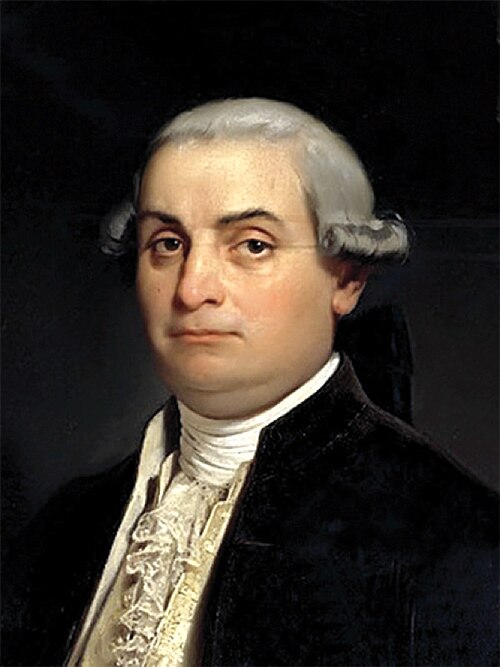
Beccaria’s argument against capital punishment:
— The purpose of a penal system is not to seek revenge against the perpetrator, but to discourage crime. The state must never be vindictive, even against the most hardened criminals. (Are you listening, Mr. Hegseth?)
— The swiftness and the certainty of punishment are a more effective deterrent than state violence.
— Execution is less effective in discouraging crime than prolonged imprisonment.
— Capital punishment brutalizes and coarsens a society that permits it.
— The state should use the least punishment needed to protect the health and order of the society it superintends.
If you add to Beccaria’s seemingly irrefutable logic that we now know, thanks to DNA and other sophisticated forensic advancements, many individuals have been executed in America for crimes they did not commit; that our use of capital punishment has been disproportionately employed against African Americans (all other things being equal); and that the often interminable delay between sentencing and the carrying out of capital punishment violates the fundamental principle that punishment swift and certain is a much greater deterrent than punishment endlessly postponed — it would seem both sane and humane to discontinue capital punishment once and for all in the United States.
In 2025, there were 47 executions in the United States, 19 in Florida alone. Lethal injection is the most common — 39 of the 47 in 2025. Lethal gas was used in five executions. There were three by firing squad (all in South Carolina). None were executed by electrocution or hanging in 2025. Of the 47 executed individuals, 32 were white, 13 Black, one Latino, and one person of mixed race.
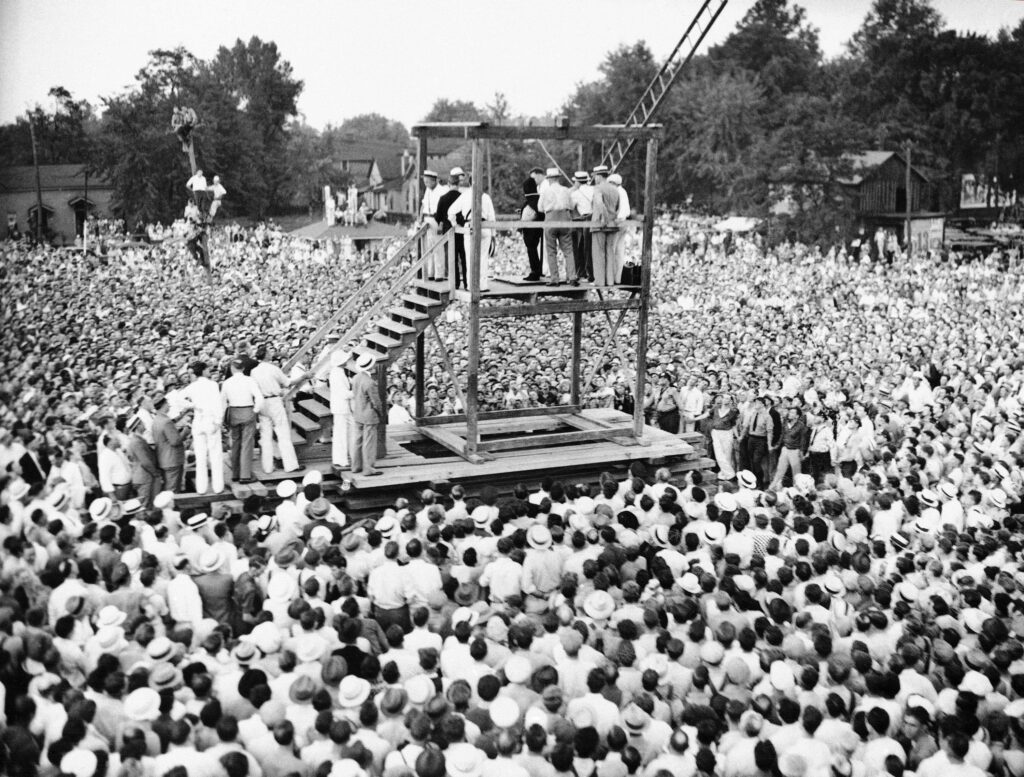
Mr. Hegseth might wish to know that the last public execution in the United States occurred on August 14, 1936 (90 years ago), when a 26-year-old Black man named Rainey Bethea was hanged for raping and murdering a 70-year-old white woman. Later investigations have confirmed that Bethea probably committed both crimes. The electric chair would have executed him, but the white establishment in Owensboro, Kentucky, pushed hard for a public hanging, which was then legal in cases of rape. People traveled long distances to witness the hanging, including whole families with young children. More than 20,000 spectators crowded into the killing field to see a Black man die. Refreshments were sold. Part of the sensation was that the local sheriff was a woman, Florence Thompson, though (to the disgruntlement of some) she did not spring the trap door.
Even then, there was sufficient public outrage that two years later Kentucky abolished public executions.
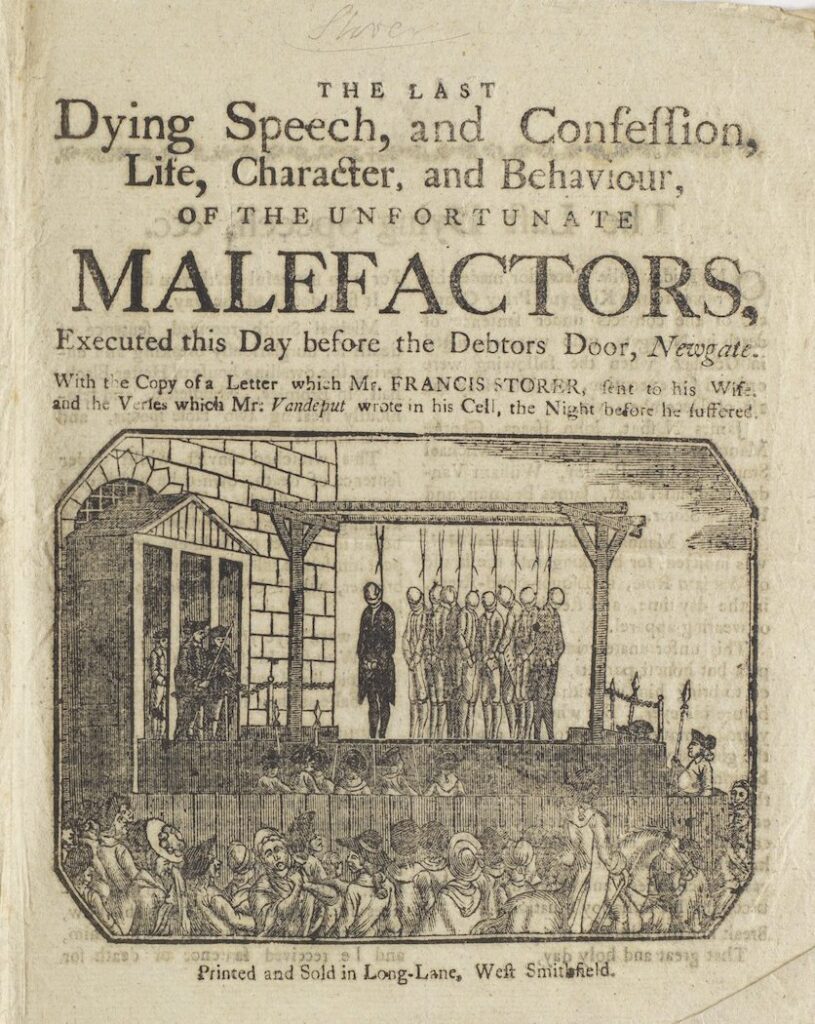
My long study of English literature provides ample evidence of the coarsening effect of public executions. The great English diarist Samuel Pepys (1633-1703) witnessed the brutal execution of one of the men who had condemned King Charles I to a public beheading in 1649. On October 13, 1660, after the Restoration of Charles II, Pepys watched as Thomas Harrison was hanged, drawn, and quartered before a large crowd. Afterward, Pepys took two friends to the Sun Tavern for an oyster dinner.
Another English diarist, James Boswell (1740-1795), biographer of Dr. Johnson, was squeamish, sensitive, and neurotic, but he could not resist a public execution. Thanks to what he called an “irresistible impulse,” he attended at least 21 public hangings in his lifetime, involving at least 57 individuals. Group hangings were quite popular then. In some cases, the “drop” did not break the condemned man’s neck. Some twisted and writhed for many minutes before they were finally asphyxiated. On a number of occasions, friends and families of the condemned came forward to grab and pull on his legs to tighten the noose and shorten the agony. Boswell reports that cold sweat nightmares typically haunted him for a week or weeks following one of these grotesque spectacles. On one occasion in 1763 he begged his friend Andrew Erskine to sleep in the same bed with him: “gloomy terrors came upon me so much, as Night approached, that I durst not stay by myself; so I went and had a bed or rather half a one from honest Erskine, which he most kindly gave me.”
The great English novelist Charles Dickens (1812-1870) attended public hangings in 1840 and 1849. Appalled by the gleeful reactions and general festivity of these executions, Dickens wrote a famous letter to the Times of London:
“I believe that a sight so inconceivably awful as the wickedness and levity of the immense crowd collected at that execution could be imagined by no man. When the two miserable creatures who attracted all this greeting and sport came out upon the scaffold, the people passed through a web of horror and disgusting behavior that I cannot separate from the place. It was so loathsome and repulsive that I came away with a belief that the sight was totally depraving to everyone who looked at it. Long before dawn, the streets surrounding the gallows were choked with a surging mass of humanity. Hot dog vendors pushed through the throngs, and children sat on their parents’ shoulders for a better view. When the trapdoor finally sprung, a wild cheer went up from the crowd. People rushed the scaffold, tearing at the black hood that had covered the condemned man’s face to collect scraps of it as souvenirs.”
Britain abolished public hanging in 1868.
I mean no cheap shot when I suggest that if Pete Hegseth’s public persona is a true mirror of his character, I doubt that he would lose any sleep after watching a group of U.S. Army riflemen shoot the life out of Nidal Malik Hasan at Fort Hood.
How much further are we willing to repudiate the Enlightenment and descend into the abyss?