
Surprisingly, I did not spend the Fourth of July in America this year. But being thousands of miles away made the promise of our exceptional nation clear.

Milan, Italy — America is a great nation going through a rough patch, if I may put it in the least pessimistic way. We’ve always been an unfinished and perplexing republic. Somehow, we have lost our way, perhaps even our confidence. And yet the American people are so energetic, creative, enterprising, inventive, and essentially optimistic that I believe we will — to use Thomas Jefferson’s favorite metaphor — soon enough right the ship and sail into an amazing future.
I’ve been making notes about the unresolved issues in American life — the widening gap between the few and the many, the corrosive power of money in our politics, the continuing racial divide, the unaffordability of the American Dream for tens of millions of younger Americans, our broken Constitution, the ways that our breathtaking technology gets ahead of our moral compass and values, our suddenly uncertain role in the world arena, etc. But that’s for next week, after the last bottle rockets and Roman candles are tucked away for another year.
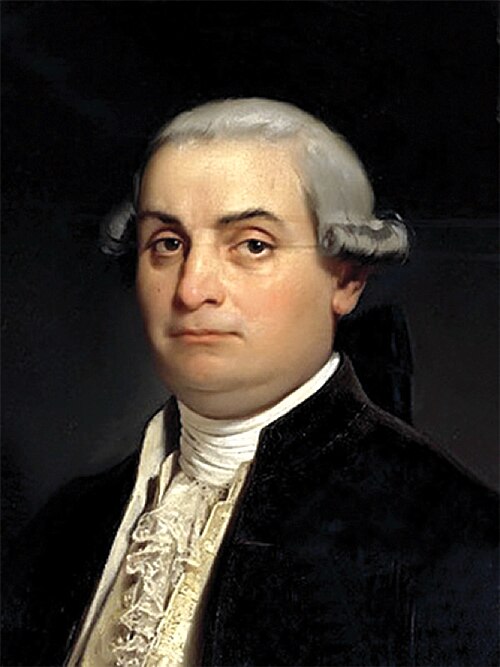
I did not spend the Fourth of July in America this year, which may seem perverse, given that it is our 250th birthday. I was invited to Italy to engage in an imaginary dialogue between Jefferson and the Italian humanist Cesare Beccaria (1738-1794), who was the first person in Western civilization to denounce the death penalty. The conversation took place at the Hall of Justice in Milan, a monumental stone building that bears the architectural style of Italian fascism.
Beccaria talked about his famous treatise On Crime and Punishment (1764), which inspired and influenced the American Founding Fathers. Jefferson, Madison, and Franklin, in particular, were deeply inspired by Beccaria.
Jefferson delivered up the American mission statement — “All men are created equal”; the blessings of self-government; freedom of the press, freedom of speech, freedom of conscience, the illimitable progress of the human mind, the magnificence of the American landscape, particularly west of the Appalachian Mountains, a unique American destiny that will be played out to the hundredth and the thousandth generation. … “All eyes are open or opening to the rights of man.”
As I spoke these words, I became deeply moved by their capacity to inspire and empower the human project. I got choked up before 75 intelligent Milanians gathered to discuss America and the destiny of nations. I thought, maybe we are actually equal to the challenge of the human project. Maybe reason and good sense, science and civil discourse, a determination to try to live up to the standard of our best selves and to subordinate our self-interest to the higher values of the commonwealth — maybe we can, as Abraham Lincoln put it at Gettysburg, commit ourselves to a rebirth of freedom of, by, and for the people. As I looked out on friendly but skeptical Europeans, I could see that they, too, were inspired as I articulated these Jeffersonian ideals, but they were all slightly shaking their heads as they thought about the currently debased state of American democracy and our international recklessness.
Afterward, several Italian men and women told me over dinner that they still believe in America’s destiny and the American Dream. They said they love America and the American people, but they don’t understand how we have walked away from Europe and our closest allies and friends, how and why we have elected leaders (not just the current president) who seem determined to deconstruct (or implode) the golden vision of America and its Founding principles. They reminded me that the ideals of America were conceived on this side of the Atlantic in the European Enlightenment (1680-1826), but were first actually planted in the New World. In the fertile soil of America. They noted that America has a historical duty (a sacred destiny) to prove that “liberty,” “equality,” “peace,” “civility,” “progress,” and the “dignity of the common citizen” are not just lofty rhetoric but the actual mission of life on earth. As Jefferson put it in his last, still breathtakingly optimistic letter in June 1826, these great ideals will eventually triumph, in some places sooner, in some places later. Not without rivers of blood as their price, but eventually everywhere, from Idaho to Istanbul, from Paris to Peru, from Cleveland to Calcutta.
These thoughtful citizens of Italy said that the whole world is watching to see whether we Americans will vindicate or squander the great dream of mankind.
The Architecture of the Architect of the American Dream
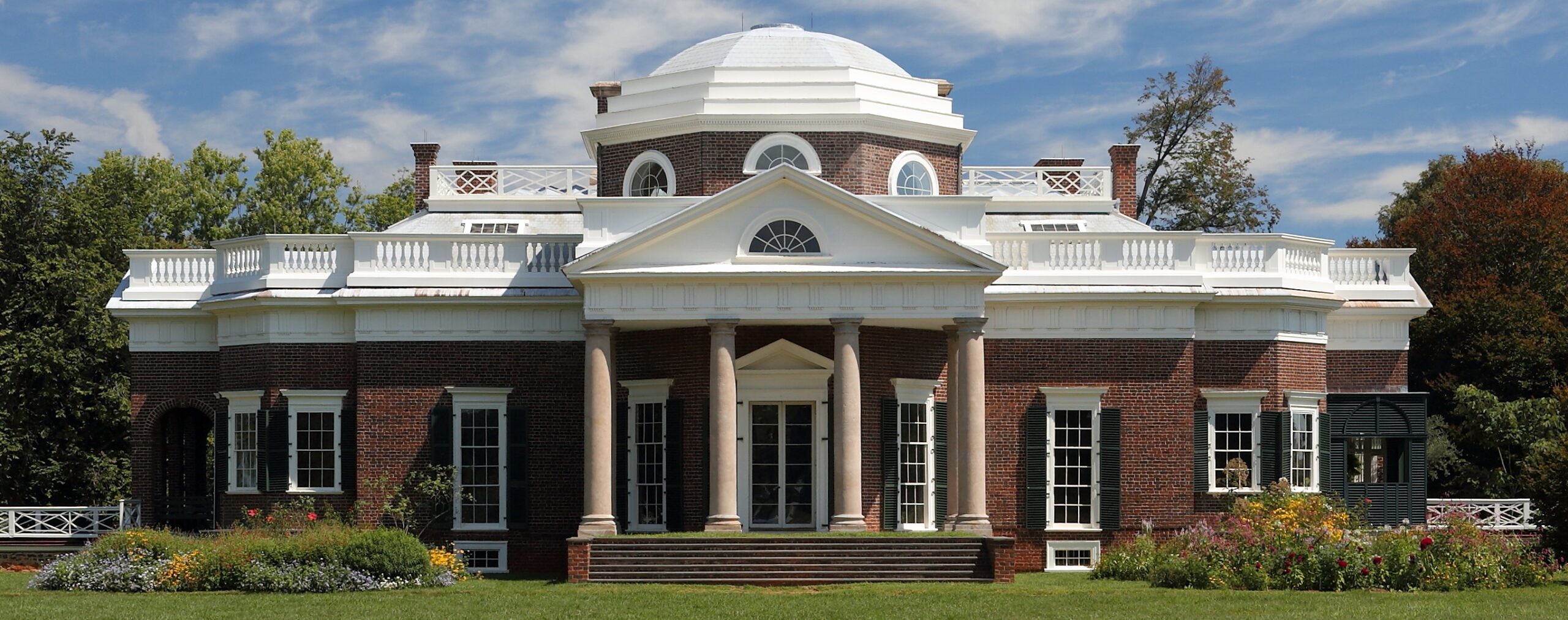
Thomas Jefferson not only envisioned the American republic but also sought to design the physical template for a free and enlightened people. He gave us our decimal coinage system — pennies, dimes, dollars, etc. — so that the average person could compute his wages and not be cheated by his employers. He gave us the cadastral rectilinear land survey system that divided and subdivided our vast landscape into square and orderly townships, section lines, quarter sections, etc. He wanted every state west of the Appalachians to be perfectly square or at least rectangular — think of Four Corners, where Colorado, New Mexico, Utah, and Arizona meet. He gave us a city design according to the checkerboard — straight streets and square blocks, with plenty of green space within the city limits.
And he gave us our neoclassical monumental architecture. He designed the Capitol of Virginia at Richmond, based on the Maison Carree at Nimes in southern France — the “most precious morsel of antiquity,” he said. He gave us the Rotunda, the masterpiece of his last great creative project, the University of Virginia, based on the Pantheon in Rome. He even submitted a design for the President’s House in Washington, DC, which would have been red brick with a neoclassical dome, like Monticello. Unfortunately, he submitted that design anonymously so as not to win the competition merely by his reputation as America’s first great architect — and lost to the less pleasing design of our current White House by the Irish-American architect James Hoban.
Fully 39 of our 50 state capitols have domes. That’s the influence of Jefferson. My North Dakota has an 18-story Capitol tower — snarky visitors from elsewhere swear it looks like an insurance building in Des Moines, Iowa. Nebraska, Louisiana, and Florida also have towers. The rest: neoclassical.
And So to the Source
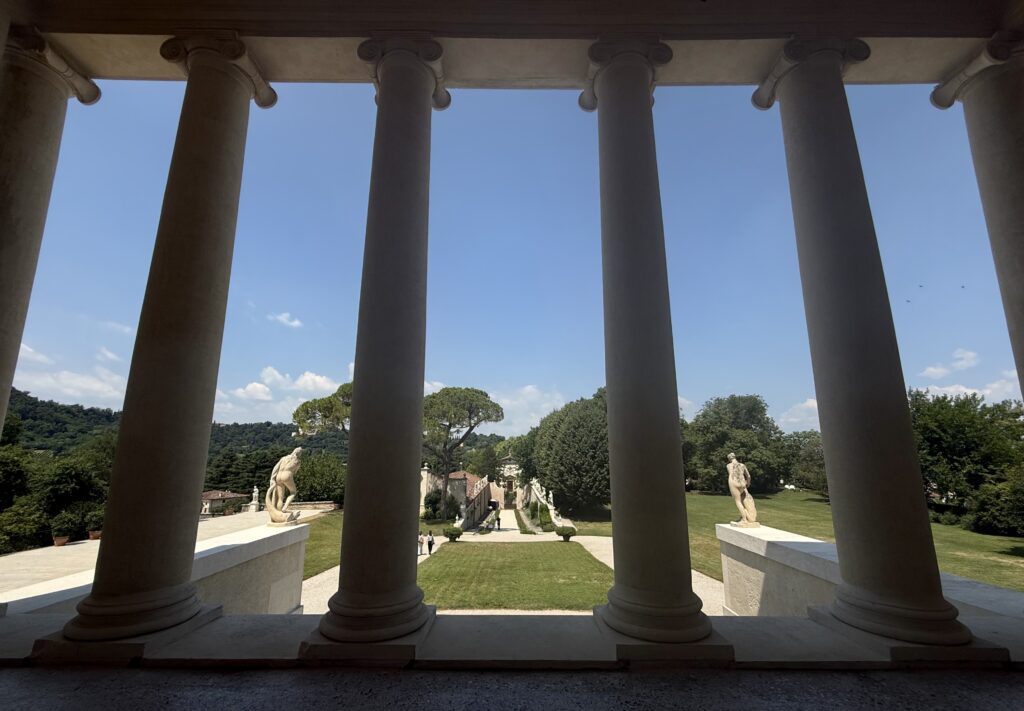
So on the Fourth of July my great friend Marzio Mian of Milan, who just won his fifth award for his latest book, Volga Blues: A Journey into the Heart of Russia, declared that he was taking me to see the Villa Rotonda at Vicenza, Italy, one of the masterworks of Andrea Palladio (1508-1580), the Italian architect who more than anyone else inspired Jefferson and American neoclassicism. I have wanted to see the Palladian villas in northern Italy for 30 years. Now it was finally happening. It was a long drive during which we gabbed incessantly about America and the future of the human project, while Marzio’s favorite classical radio station lifted our thoughts into a rarified atmosphere. Just the way to spend the Fourth of July — talking earnestly about the possibilities of the human search for more perfect unions and the pursuit of public happiness. Our fireworks were all linguistic. Marzio’s English is pretty good. My Italian is, well, imperfect. I can say “spaghetti” and “Boccaccio!”
When we finally negotiated a huge roundabout and saw the Villa Rotonda for the first time (he, too), I nearly swooned. The strange thing is that Jefferson came from Paris to northern Italy in the spring of 1787, got as far as Milan, but somehow did not visit Vincenza. He spent a whole day watching the manufacture of Parmesan cheese in Milan, and he fell into a swoon over a strain of upland rice, but he did not venture to the motherload of Palladian villas. He said he only allowed himself “a peep into Elysium.” Think of that. Jefferson turned back for Paris because, as a public servant (the American ambassador to France) he did not want to pursue private interest at public expense! I guess he read the emoluments clause of the new U.S. Constitution!
The Villa Rotonda is sublime. Marzio and I toured it inside and out — on a hot, humid day with a million cicadas providing a sense of the uncanny. Villa Rotonda is a square edifice of blond stone on a hill, with six Ionic columns on each side and a lovely dome. Jeffersonian! The inside is a bit too ornate for the spare and classical Jefferson, but the outside (which he only saw in Palladio’s magnificent volume, Four Treatises on Architecture) is everything he admired: rectilinear, symmetrical, rational, orderly, proportional, clean in its lines.
I took a gazillion pictures. We made plans to return next year (or at least soon) to take the Brenta River Cruise to see dozens of Palladian villas or Palladian-inspired buildings in a single afternoon and evening.

Afterward, we stopped in the nearest village and had a superb light luncheon of pasta with mushrooms and truffles, an excellent glass each of a local light red wine, and just-made gelato with blackberry sauce.
It was one of the most Jeffersonian days of my life, and yet I was 4,300 miles from Jefferson’s Monticello, 4,895 miles from Bismarck, North Dakota. North Dakota was once the most Jeffersonian state in America, back when we gave our lives to family farming. Our state motto then might have come from Jefferson’s Notes on the State of Virginia: “those who labour in the earth are the chosen people of God.” And we were an equal distance from Mount Rushmore, where the current president of the United States said our greatest enemy is communism. Communism? I thought that all ended in 1989. I’m with Abraham Lincoln:
“At what point then is the approach of danger to be expected? I answer. If it ever reach us it must spring up amongst us. It cannot come from abroad. If destruction be our lot, we must ourselves be its author and finisher. As a nation of freemen, we must live through all time, or die by suicide.”
In the last few days, I have seen buildings and ruins of buildings now 2,000 years old. America is a new country. At 250, we are, in some sense, just beginning. Time to get our act together and prove to the world that we deserve to be the hegemon and to extend “the blessings of liberty” to everyone who finds their way to our shores.
And so begins the second quarter of the millennium.