
Editor’s Note: Our roving humanities scholar Clay S. Jenkinson is typically dedicated to the truth and nothing but the truth, but his visit to Wind Cave National Park seems to have addled his brain. No other visitor on his recent tour reported meeting Dante and Virgil at the Seventh Circle of the cave.
My Phase One Roosevelt Conservation plan is to visit TR sites in South Dakota, Wyoming, and Colorado. A three-week tour. I write this four days into that journey. Phase Two will be in Montana and Idaho in July. Phase Three in the Four Corners area in October.
So on Night One, I slept in the southern badlands in a place Roosevelt traversed dozens of times during his years in the North Dakota badlands. See last week’s article. The second night, I stayed in Spearfish, South Dakota, not far from the Roosevelt Friendship Tower, built in honor of TR soon after his death by his old cowboy friend, Seth Bullock. TR died on January 6, 1919, in his home on Long Island. His son Archie cabled the other children: “The old lion is dead.” Seth Bullock represented to Roosevelt “a true Westerner, the finest type of frontiersman.”
On the third night, I camped at a small family RV park a few miles from Wind Cave National Park. I would have camped in the park’s sole campground, but these days it is harder to reserve a national park campsite than a table at Delmonico’s.
Wind Cave National Park was my first significant stop in my quest to visit as many Theodore Roosevelt conservation sites as possible in the American West. Wind Cave was the second of Roosevelt’s five national parks, which he added to the original five established during the presidencies of his predecessors: Rainier, Sequoia, Yosemite, Yellowstone, and General Grant. Only Congress can establish a National Park. Roosevelt would have created many more if Congress had cooperated. That’ s one reason he quipped, “It would be so much easier to run this country without Congress.” The Speaker of the House of Representatives, Joseph Cannon of Illinois, said, “Not one cent for scenery.” When Congress balked, Roosevelt designated some of his favorite western landforms as National Monuments, which he was legally entitled to do under the 1906 National Monuments and Antiquities Act. He came to see National Monument status as a first step towards later graduation to full National Park status.
Congress established Wind Cave National Park on December 3, 1902.
At the Wind Cave NP interpretive center, I carefully studied the exhibits and signed up for the last cave tour of the day at 5 p.m. During the interim, I ventured to the Crazy Horse Monument site 28 miles away. More on that in a week or so here at LTAmerica.org.
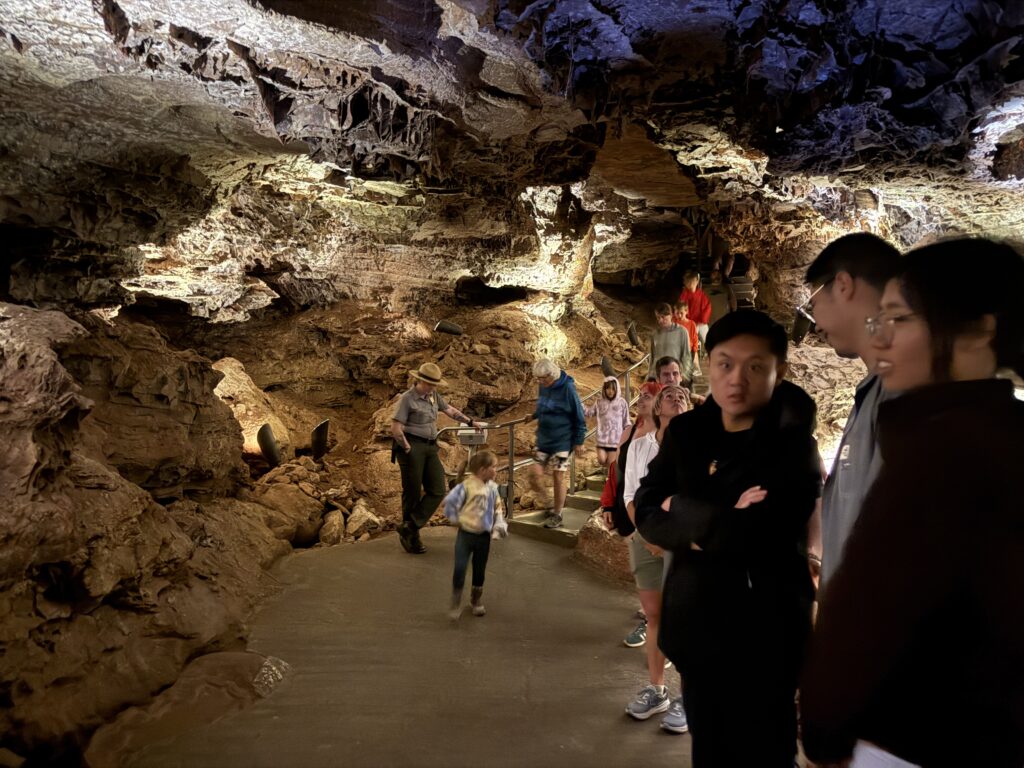
We gathered at 4:50 p.m. at the portal of the cave, a motley group of about 25, including people in every physical condition, most of them wearing the official uniform of the American tourist: shorts and t-shirts, some of the shirts letting the rest of us know great places they have been (Cappadocia, Sedona, Four Corners, the National Tabasco Sauce Museum), some of them rude, along lines of “Don’t Blame Me: I Didn’t Vote For Him,” or “Bankers Do It With Interest.” The foreign tourists were all dressed respectfully.
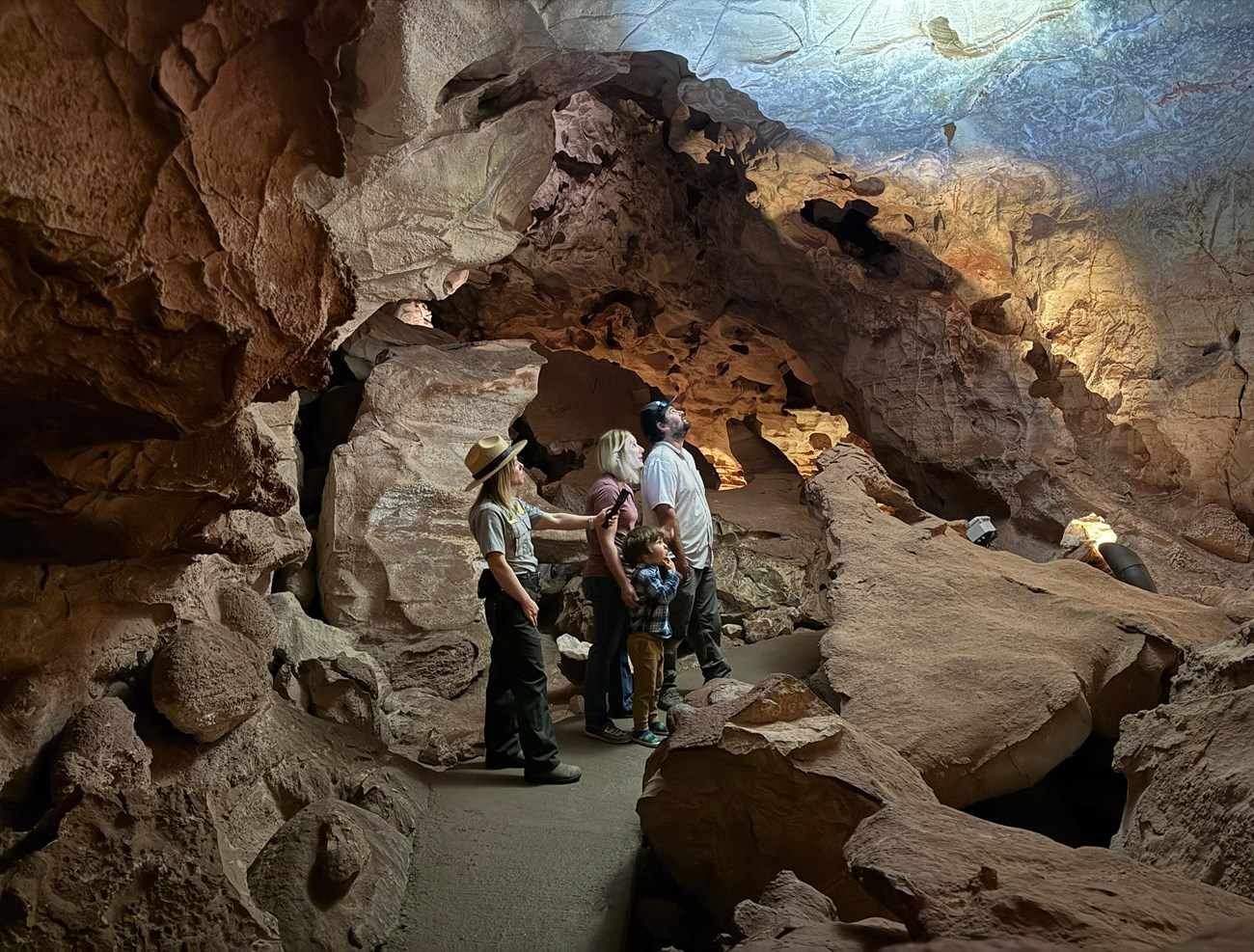
A very sparky young woman appeared in full National Park Service uniform to serve as our Ranger guide. Her fourth year at Wind Cave. Loves it. Wasn’t a spelunker before, but now is getting into it. She uttered some stern commandments about not straying, not touching anything on penalty of federal prison time, and not collecting samples. Thus chastened, we entered the great cave. I had been there once before, many decades ago, on a disastrously satisfying family vacation, but fortunately, I had repressed all memories of the actual cave tour.
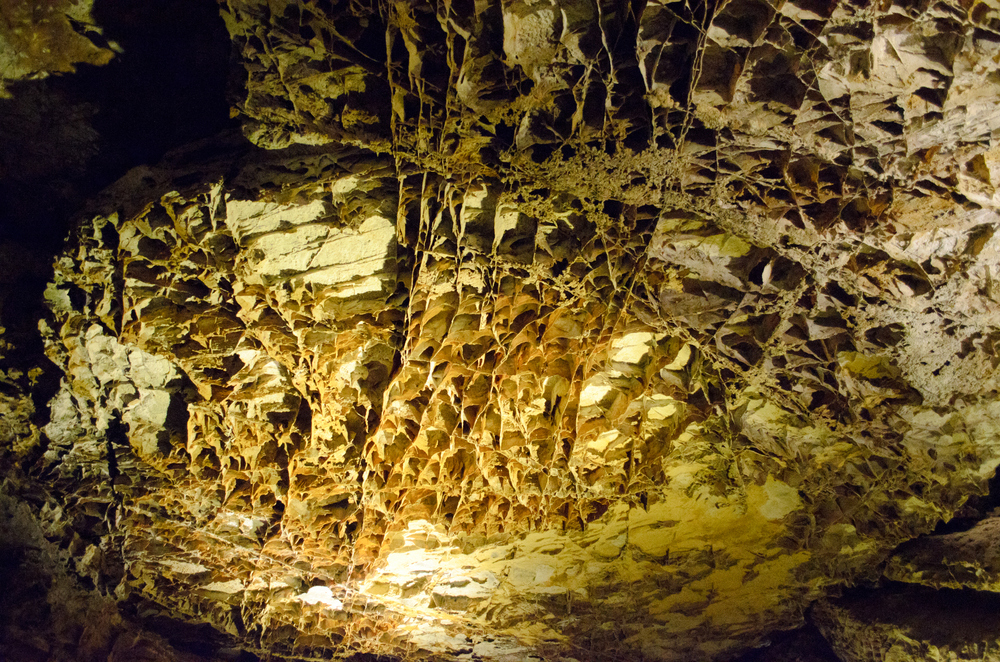
Our ranger told us six or seven (hundred?) times that the boxwork lace is the true treasure of Wind Cave. In fact, 90% of all the world’s boxwork lace is within Wind Cave. It looks as delicate as fine porcelain. It resembles a honeycomb. She offered an outstanding simile. “It’s as if they built a brick wall with elongated sugar cubes held in place with cement mortar. Water has dissolved the sugar cubes and left the hard mortar in place.” A trope worth remembering.
Somehow, I had it in my addled brain that a good cave is a horizontal thing. You enter from the side of a bluff or mountain and then move back into the heart of the cave at or just below ground level. If there were any ups and downs, it would be no more strenuous than living in a New York apartment on the third floor with no elevator. I did not remember that Wind Cave cannot really be experienced unless you descend a rather long distance into what might be called “the bowels of the earth.” The descent is like walking down the stairs of a 16-story skyscraper. We went down a few preliminary flights of stairs, carved out of limestone and, as often as not, wet and slippery. All this with no more illumination than your bathroom nightlight.
Every five stories or so, we would stop in some large underground amphitheater to do a body count and to hear more about the world’s great concentration of boxwork lace. Our ranger routinely ended her commentary by asking if there were any questions. We all had only one question, but we were afraid to utter it: How the ##@X%X are we ever going to get out of here?
Our questions were lugubrious. How many people have died in here? How many people have gotten lost and were never seen again? How often are there cave-ins? Are the bats rabid? Are the bats mean? Are there vampire bats? Has anyone been murdered in here? Were any of them pesky rangers? And so on.
And then down some more steep dark stone stairs to the next nearly identical amphitheater with a brilliant display of … well, boxwork lace. Now I don’t want to appear to be a speleological philistine, and I’m sure I am now inviting the most horrendous rebukes, and it’s true that I’ve only been in six or seven caves in the whole course of my life, but at about 45 minutes into the tour I had concluded that when you have seen one array of boxwork lace you have pretty much seen them all (ad nauseum); and I’m very nearly of the same opinion on caves per se. I suppose this is as ignorant as saying there is only one type of desert or only one type of volcano.
My memory may be faulty, and at some point, I seem to have lapsed into a fugue state, perhaps from oxygen deprivation, but it seemed to me that we just kept descending into the abyss farther and farther from all that makes life worthwhile. At one point, we passed Grendel licking his wounds after his ordeal with Beowulf. Then the Loch Ness Monster swam by in one of the many underground lakes in Wind Cave, and half an hour after that, we passed Dante and Virgil debating whether they were in the seventh circle of the Inferno or the eleventh. We passed a plaque on the wall: “Jules Verne turned back here, said he just couldn’t take it any more.” And we saw a plexiglass case containing 10 taxidermied canaries. A little girl asked her mother why they were there. Her mother said, “I’ll tell you when we get to the resort.”
It Was a long Way Down
I kept hoping for some big climax — an amphitheater the size of the Coliseum, or the world’s finest pure echo chamber, or at least a light show, a prayer for world peace, and some Lee Greenwood. But no.
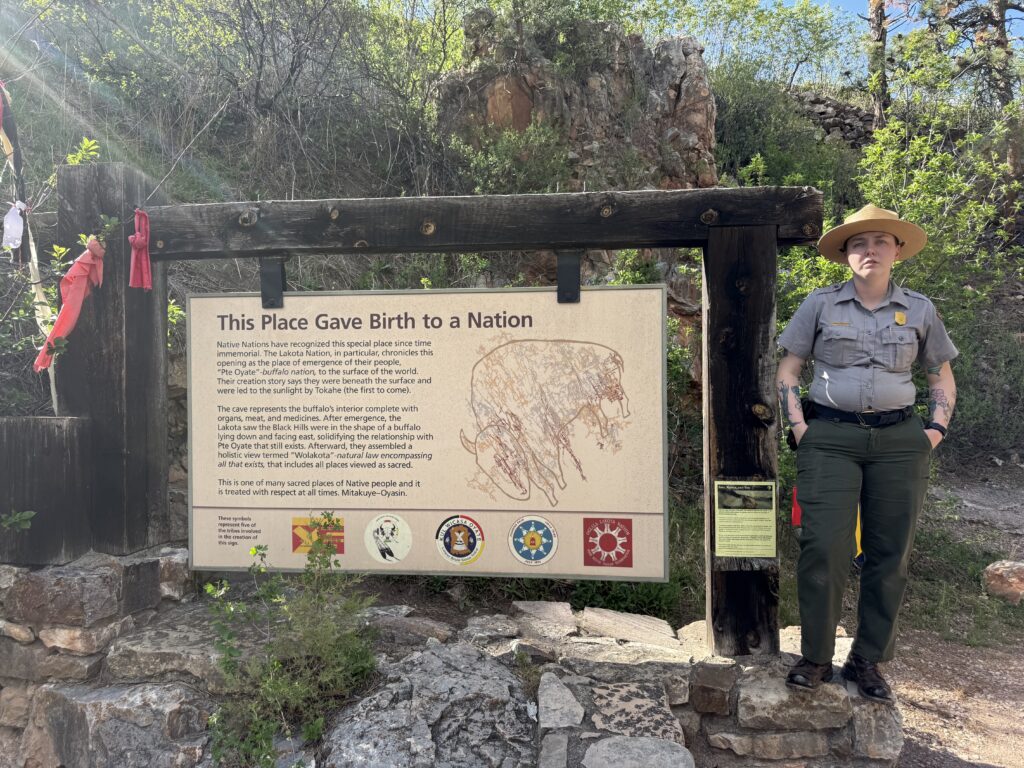
Our excellent guide explained two versions of the Lakota origin story involving the cave, and provided the usual early National Park narrative:
— Sacred to indigenous people.
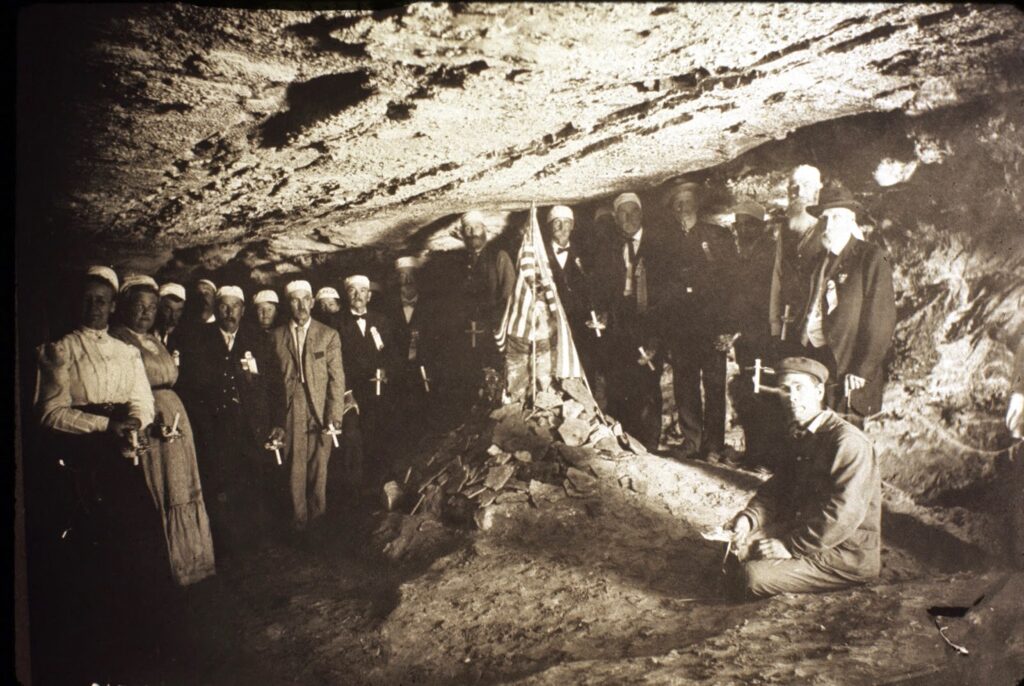
— White ranchers happened upon it one day, and the out-rush blew their cowboy hats off, literally. Our ranger said the hat part may be apocryphal.
— These pioneers fought off two distinctive American species: the Scenic Wonder Opportunist, who tried to wrest control of the cave to commercialize access; and the speculative miners who explored every nook and cranny in search of gold.
— The pioneer family explored the cave whenever possible, and generously took anyone who turned up down into the cave.
— Somebody finally said, “Hey, maybe we should bring government in to preserve this scenic wonder from base economic exploitation.”
Voila.
Some version of this is the narrative of dozens of National Parks and Monuments, including Mesa Verde National Park, established by Congress on June 29, 1906, during Roosevelt’s second term.
On January 9, 1903, President Roosevelt signed the enabling legislation for Wind Cave National Park. He had little to do with this one, but he was eager to create new National Parks during his tenure, and he liked the idea of expanding the definition of National Park from geyser-like scenic wonders to unusual phenomena scientists could study to advance knowledge and better understand the Earth’s dynamics. Roosevelt never visited Wind Cave.
Our ranger talked about all the early white people who glommed onto Wind Cave (for purposes high and low), and she noted that scientific teams are still exploring the Wind Cave complex, with only 10% (at most) of it properly investigated. But at no point did she say the name Theodore Roosevelt, the 26th president of the United States, on whose watch this National Park was established, who set aside 230 million acres of the American West for permanent federal protection during his tenure. William McKinley wouldn’t have done it. William Howard Taft wouldn’t have done it. Woodrow Wilson wouldn’t have done it. Warren Harding wouldn’t have done it. Close your eyes and try to imagine America’s public lands if Theodore Roosevelt had never been born.
I felt mildly aggrieved that in all that commentary, Roosevelt was never invoked. I did not clear my throat and sing his praise. But the next time she waxed on about the glories of boxwork lace, I snorted. Take that.
I know there are people who like to visit underground structures — the catacombs in Rome and Paris, the St. Peter Scavi Tour at the Vatican (excellent), salt mines turned into museums, sections of the London Underground that were developed and never used — now a site for quirky weddings, sometimes in Klingon. My interest in the subterranean is limited. As perhaps is evident. I don’t suppose my enthusiasm was increased by all the recent news about the seven individuals trapped in a flooded cave in Laos. Until this crisis, I had never even heard of the National Cave Rescue Association, but there wouldn’t be such an entity unless humans pretty frequently got lost or trapped in caves. Still, I was glad I did the tour. If you go to Wind Cave National Park and decline the cave tours, you are not really bringing the right spirit to these adventures.
At some point, as we approached the Center of Earth, our ranger uttered one more encomium to the boxwork and announced that we would descend no farther. Turns out there is an elevator to shoot us out of the cave and back onto terra firma. I stopped in the gift shop, and nearly bought a souvenir that said, “I Came from Europe to Visit Wind Cave, and All I Got Was Carbon Monoxide — and This T-shirt.”
“Leave it as it is. The ages have been at work on it, and man can only mar it.”
Teddy Roosevelt
It was a beautiful evening. One of the unintended benefits of the creation of Wind Cave National Park is that the rolling hills on the surface — the perimeter of the park footprint — preserve some of the most beautiful remaining unplowed plains grassland in America. The park is home to more than 300 buffalo, as well as plenty of prairie dogs, burrowing owls, pronghorn antelope, coyotes, and several species of deer. If there were no cave, it would still be worth visiting for the lovely little Serengeti of the surface. President Roosevelt believed that Wind Cave NP needed an additional draw for visitors, so he pushed for the American Bison Society to place 15 bison from the Bronx Zoo on the surface acreage. Not only did this increase the appeal of the national park, but the park sanctuary was instrumental, too, in bringing the buffalo back from the brink of extinction.
The next day, I visited Jewel Cave National Monument, about an hour west of Wind Cave. Here, the interpretive center paid solid tribute to Theodore Roosevelt, including a facsimile of his executive order establishing the monument. Jewel Cave was his 12th National Monument (February 7, 1908), just after Pinnacles in California, now a National Park, and just before Natural Bridges in Utah. Fortunately, the Jewel Cave tours were booked up until 2029, or so, so I did not have to face the shame of declining a second journey to the core of the Earth.
We live in the Age of Disillusionment. Theodore Roosevelt is taking some hits these days for some of the things he wrote about Native Americans, for his supposed jingoism and warmongery, for his very brief flirtation with the pseudoscience of eugenics, and for his sometimes-excessive hunting habits. Fair enough, but the truth is that Roosevelt evolved on questions of race and indigenous peoples, moved some distance toward treating a camera only as his principal hunting tool, left eugenics behind long before most of his contemporaries, and won the Nobel Peace Prize in 1906 for helping to end the Russo-Japanese War. Very few presidents grow in office. TR was one of those few. It would be a mistake to judge his character and achievement by a list of some of his least attractive pronouncements, most of which he uttered as a young hothead.
Roosevelt’s conservation achievement is stunning. Not only did he co-found the first national conservation organization in the United States, the Boone and Crockett Club (1887), and convene the first National Governors’ Conservation Conference in 1908, but he and the Smithsonian’s William Hornaday played a critically important role in saving the bison from extinction. He wrote some of the finest prose about the Little Missouri River badlands in western North Dakota — prose so superb that it is constantly quoted by those who love the badlands but can’t improve on his descriptions. He told us correctly that the redwood forests, the Tetons, the Grand Canyon, and Yosemite “are America’s cathedrals,” which we must cherish with as much care and sensitivity as Notre Dame and Chartres. And at the Grand Canyon, which he saw for the first time on May 6, 1903, he said, “Leave it as it is. The ages have been at work on it, and man can only mar it.”
That should be the motto over the entrance station of every National Park. There have been many heroes in the history of the public lands in America, but none achieved more than Theodore Roosevelt.