
Memorial Day weekend 2026: Clay and the LTA Airstream hit the trail, following Teddy Roosevelt’s legacy in the American West.
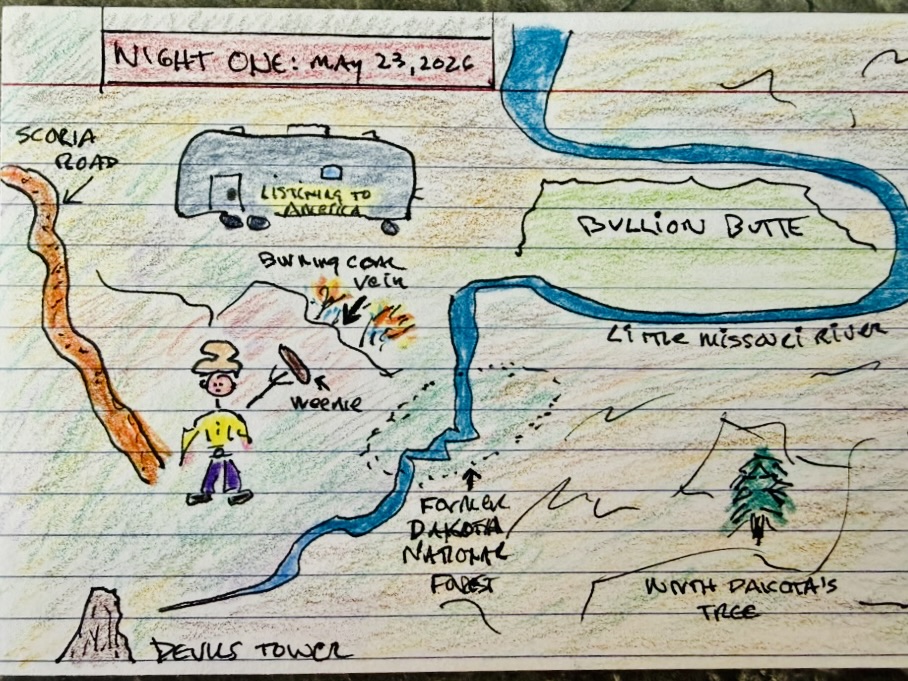
First night in Theodore Roosevelt’s West — I write this first summer dispatch of 2026 from the Burning Coal Vein National Forest campground in the southern badlands of North Dakota. Many western states have badlands of greater and lesser badness. South Dakota is the home of Badlands National Park, one of 63. North Dakota’s kinder, gentler badlands embrace the Little Missouri River — sacred to me — which flows north from Devils Tower in Wyoming (Roosevelt’s first National Monument) up through edges of South Dakota and Montana, before carving its way to its confluence with the Missouri River at Twin Buttes, North Dakota.
I left Bismarck about 1 p.m. Saturday, hauling the rig for the first time in eight months, drove 150 miles west and then south, through Amidon (which competes for the honor of being the first or the second smallest county seat in America, population ca. 18), and then 13 miles on gravel roads up to the Burning Coal Vein campground. I arrived about 4 p.m. Mountain Daylight Time, found the campground empty, and “practiced” my trailer backing-up skills (for about 45 minutes!) and settled in.
I chose this site for my first night out for two reasons. First, Roosevelt was here several times during the 1884-06 period, and Roosevelt’s conservation agenda is my theme for this summer’s travels. He came out to Dakota Territory in September 1883, age 24, to kill a buffalo, got one not 30 miles from here after a comically difficult hunting campaign, and meanwhile fell in love with the broken landscape. He considered this patch of the West — 175 miles long, 25 or so wide, on both sides of the Little Missouri — as one of the last remnants of the American frontier. He believed (along with Frederick Jackson Turner) that the frontier was the most important dynamic in the shaping of the American character. His boyhood heroes were men like Daniel Boone and Davy Crockett. Roosevelt wanted to get a transfusion of frontier dynamics before it was too late. He impulsively established first one and then (next year) another ranch along the Little Missouri, and later declared that he would never have become president of the United States had it not been for his time in North Dakota.
My second reason for choosing this campground for my first night out is that I love it here. I first came here as a callow youth of 17, with my mentor Mike Jacobs, North Dakota’s foremost journalist. He explained that the narrow lignite coal seams in badlands outcroppings occasionally catch fire, usually due to lightning strikes, and then burn for two days, two months, two years, or 20 years, until they burn themselves out. When I was growing up in North Dakota, there were three or four burning coal veins smoldering at various points in the badlands. Now they are all extinguished.
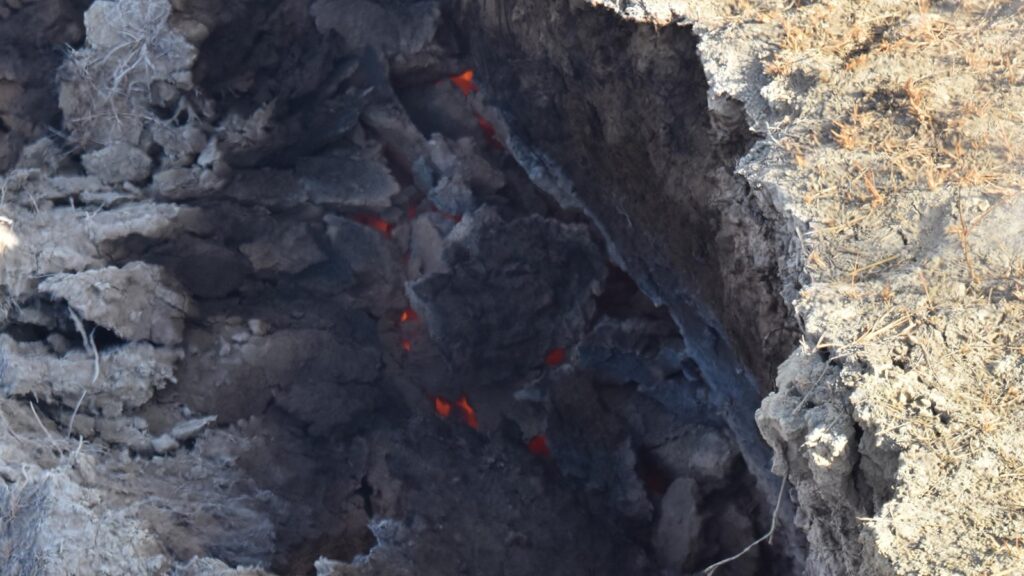
So here I am nestled in a handful of trees not far from Bullion Butte, the largest grass mesa in North Dakota. (Up here, we call them buttes.) It was on the northwest face of Bullion Butte that Roosevelt killed his first bighorn sheep. The giant butte forces the Little Missouri River to make a huge detour around its base. On his horseback journeys from Medora, North Dakota, to the ranch where he had headquartered during the 1883 buffalo hunt, Roosevelt typically took a cutoff on the western flank of the butte, but once he rode all 45 miles around the base just for the fun of it.
When Theodore Roosevelt wrote to extoll “the strenuous life,” he meant it. He lived it. In his 60 short but hectic years of adventure, he banged up his body in all sorts of ways, never with any regret.
The Burning Coal Vein campground is adjacent to the legendary Logging Camp Ranch, owned by close friends of mine, one of the valley’s most historic ranches, now both a working and a guest ranch.
You should know that North Dakota is the most treeless state in the United States. And yet, President Roosevelt designated a bit of the zone where I am camped as the Dakota National Forest (November 24, 1908). This is what might be called an aspirational forest nomination. Not far from here, the forest service established a tree nursery organized in the manner of the later Civilian Conservation Corps (CCC) camps. The next president, Woodrow Wilson (not a man of the West), withdrew the National Forest designation.
So, in my 2026 summer and autumn quest to visit Theodore Roosevelt Conservation properties in the American West, I have begun propitiously in the southern badlands of North Dakota.
- He got his first buffalo near here.
- He later shot his first bighorn sheep here.
- Not far from this campsite in June 1884, he was measured for “an authentic buckskin shirt” (a TR obsession) by a strenuous frontier woman named Mrs. Maddox. You can see photographs of him in that shirt in all the books about his adventures in the West.
- As president, he created a patch of the Dakota National Forest here.
- He rode his horse, Manitou, around the base of Bullion Butte on a lark and would have passed within a mile of my campsite.
A good start!
Not Universally Loved Out West
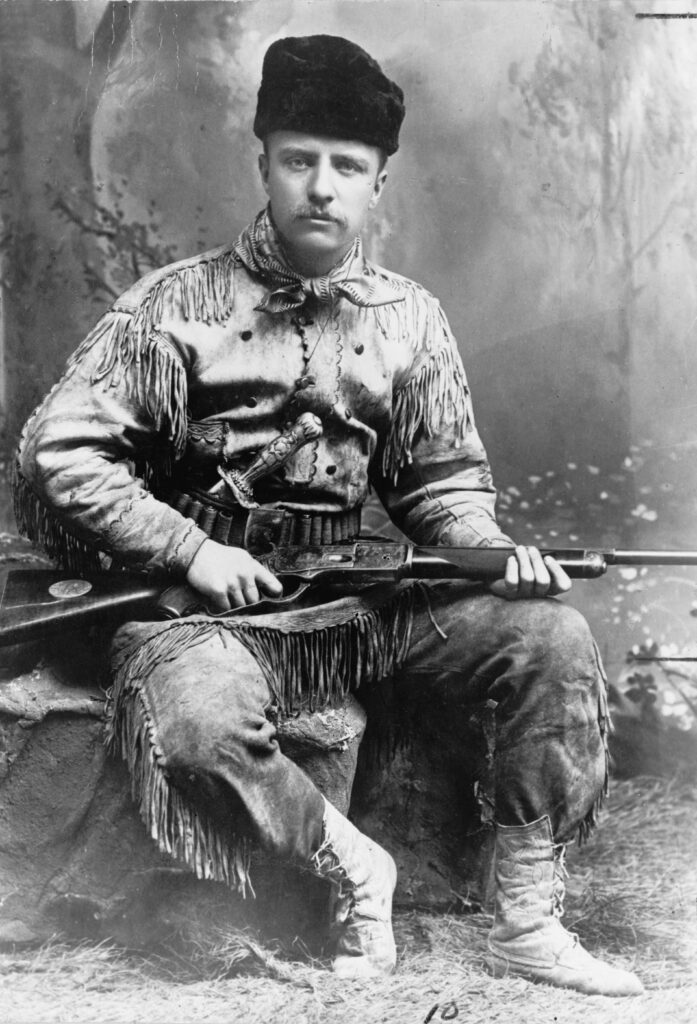
Roosevelt was not (and in fact is not) universally loved out here. Many of the hardened true pioneers of this region regarded him as yet another wealthy outsider rolling in to “play cowboy” until the hard times came. He was ridiculed for his accent, his Harvard-derived language, the falsetto quality of his voice when he got excited (and, of course, he was always excited), and his thick spectacles. They called him Four Eyes and Storm Windows. He insisted that every one of his friends out here all call him Mr. Roosevelt.
One of his detractors operated a great horse ranch just a few dozen miles from here. His name was A.C. Huidekoper. For some reason, Huidekoper, a serious frontiersman who was possessed of a strong sense of self, became an immediate Roosevelt skeptic. There was always a whiff of the ridiculous about TR. From an early time in his adult life, he became something of a caricature of himself — rattling on about dime novels, his training as a pugilist, and the place of authentic buckskin tunics in the saga of America; a bespectacled chap with outsized teeth, sporting a Bowie knife hand-engraved by Tiffany’s, prone to bite off phrases like “Dee-lighted to meet you,” “hasten forward quickly there,” bully this and bully that. For the tough actual pioneers who were trying to prove up this difficult segment of the West, men and women who could not simply hop the train out of here whenever something back east caught their attention, Roosevelt seemed at first like a slightly silly New York dude. An interloper. Much later, Huidekoper fulminated against President Roosevelt’s conservation agenda, which he said locked up whole swaths of the American West, including here (the short-lived Dakota National Forest).
Roosevelt’s great conservation achievement — 230 million acres of the public domain set aside for permanent protection — and the resistance of those who deplore federal protections of public lands, then and now, will be one of the themes of my articles, dispatches, and video contributions over the next months. Roosevelt signed into law the National Monuments and Antiquities Act in 1906, and named the first 18 (by executive order); invented the National Wildlife Refuge System (then called Federal Bird Sanctuaries), and named the first 51 (by executive order). He designated 150 million acres of National Forest (by executive order), created four national game preserves, and welcomed five new National Parks into the system, though each of those had to be established by Congress.
This summer and fall, I intend to visit all 18 TR National Monuments, many of the National Forests in the West, plus his five National Parks, beginning (this week) at Wind Cave NP in South Dakota. If you want to read along, the best book on the subject is Douglas Brinkley’s Wilderness Warrior: Theodore Roosevelt and the Crusade for America.
On the Road Again
After I set up camp, by which I mean pulled a folding camp chair out of my pickup and poured myself a gin and tonic, I sat out reading a fabulous book about Antarctic exploration: Aspley Cherry-Garrard’s The Worst Journey in the World. (Boy, was it!) The evening light was perfect. For whole quarters of an hour, I put down the book and simply gazed at the outlier bluffs of Bullion Butte, the perfect early summer sky, and the badlands cuts and coulees in every direction. And listened to the silence, by which I mean the absence of industrial noise.
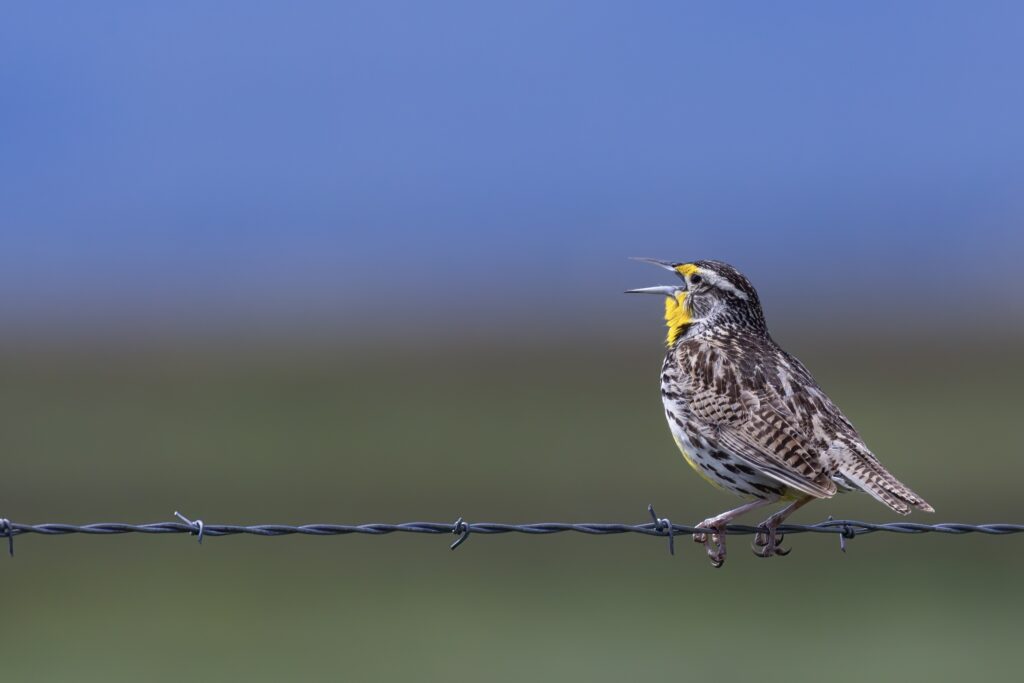
Roosevelt was one of America’s great ornithologists; I one of its least. I was serenaded with the sounds of a half dozen different birds, only one of which I recognized. The Western Meadowlark is the characteristic bird of the Great Plains. It has a beautiful, instantly recognizable liquid bird call. Whenever I am driving home from somewhere else in America, the Meadowlark’s song is my homing signal. When I first hear it every year, it makes me ache with joy and nostalgia.
At some point, I warmed up a simple can of soup for dinner, along with a few crackers and a square of sharp cheddar cheese. I was going to bring a bottle of wine, but when I stopped at a big gas station-convenience store in Belfield, there were only three different wines among a vast sea of beer and the no-nonsense hard stuff. One of the wine options was Mogan David, the others at $6.99 and not very inviting.
Before the last squibs of the sunset faded, I was in bed — clean sheets, my own sheets! — with the Norton Book of American Autobiography. I read for most of an hour, and when the book fell from my hands onto my chest for the fourth time, I reckoned it was time for sleep.
Morning
Once I finish this report, I will fry an egg or something, work on my calendar for the next three weeks, and then drive south towards Buffalo, South Dakota, where I will probably spend the night. If you have followed my Airstream travels over the last two years, you know that John Steinbeck raced around the perimeter of the United States in 1960, covering 11,500 miles, often seeming to be in a hurry. Last year, I retraced the Lewis and Clark expedition from Poplar Forest in Virginia to Astoria, Oregon, and back again. This year, I intend to adopt a less hurried pace so I can read, write, muse, hike, daydream, draw, and listen to America.
By the time I write to you next week, I’ll be at Devils Tower, TR’s first and one of my very favorite National Monuments.
See you down the trail.