
Struck by the breathtaking speed of change in American life since World War II, Clay is writing a series of essays about what has transpired within a single humanities scholar’s lifetime. This week he writes about how our media channels shape our sense of history, current events, and national outlook.
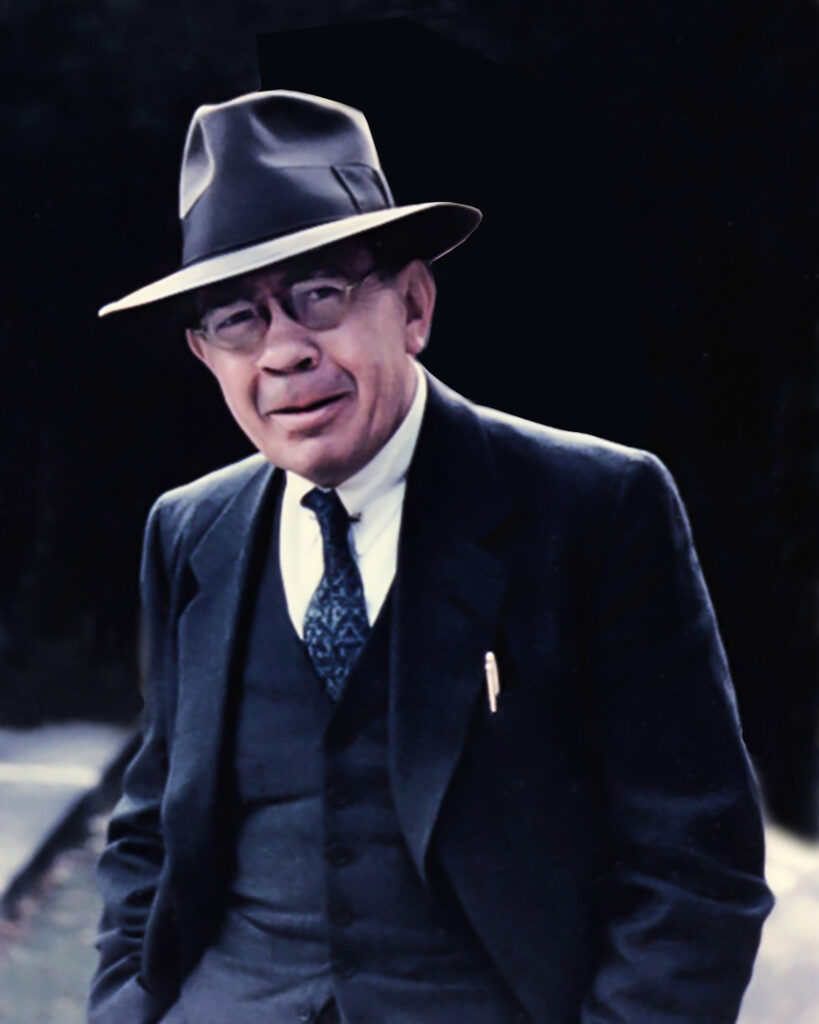
Not long ago, I purchased a new biography of Bernard DeVoto, an American historian and “man of letters” who was a key figure in the Lewis and Clark world. The book is entitled This America of Ours: Bernard and Avis DeVoto and the Forgotten Fight to Save the Wild. In 1953, after completing an award-winning trilogy of books about the westward movement in America, DeVoto agreed to edit the journals of Lewis and Clark in a one-volume abridgement. The result was his Journals of Lewis and Clark, the first book that gave the reading public access to what Lewis and Clark actually wrote in their journals. Before that, the only readily accessible account of their heroic 1804-1806 transcontinental journey of exploration was a polite paraphrase of the journals first published in 1814.
Finally, we could read the authentic journals of William Clark, one of the worst spellers in American history, and Meriwether Lewis, who had a strangely compelling sense of humor and who often wrote with a kind of explorer’s grandiloquence. Savor Clark’s “Musquetors excessively troublesom so much so that the men complained that they could not work at their Skins for those troublesom insects. and I find it entirely impossible to hunt in the bottoms, those insects being so noumerous and tormenting as to render it imposseable for a man to continue in the timbered land” (August 4, 1806), and “!O how Tremendious is the day. This dredfull wind and rain Continued with intervales of fair weather” (November 28, 1805); and then Lewis’s entry for April 7, 1805, as the expedition entered what he regarded as terra incognita: “we were now about to penetrate a country at least two thousand miles in width, on which the foot of civillized man had never trodden.”
Clark spelled mosquito 17 different ways, and Sioux more than 25.
No mere paraphrase can do justice to the journals or the journey. Until the University of Nebraska published its 13-volume definitive edition of the Journals of Lewis and Clark (1983-2001), DeVoto’s one-volume abridgment was the standard Lewis and Clark.
The Rest of the Story is Even Better
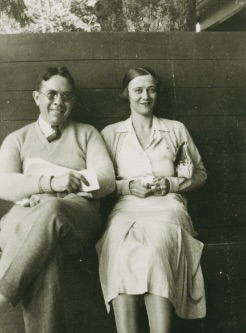
But this impressive work on Lewis and Clark was a relatively minor part of Bernard DeVoto’s amazing achievement. Schweber’s subtitle prepares the way: Bernard and Avis DeVoto and the Forgotten Fight to Save the Wild. It is the story of a great marriage and literary partnership. Avis DeVoto was no helpmate. She typed and edited her husband’s manuscripts, provided incisive creative input, hosted salon dinner parties at their home in Cambridge, Massachusetts, and handled almost all of his voluminous correspondence. Avis joined Bernard (Bennie, as his friends called him) on western adventures, including a life-changing 1946 auto reconnaissance along the Lewis and Clark Trail, at a time when the roads were primitive out West, and the hospitality infrastructure dicey. When Julia Child, from Paris, responded to a magazine column by Bernard DeVoto, by sending him a fan letter (and a high-quality kitchen knife!), Avis replied for her husband. Thus began a 30-year friendship between the two talented women, hundreds of letters of which are now available in As Always, Julia: The Letters of Julia Child & Avis DeVoto.
Welcome to the New Land Grab
This America of Ours could not have appeared at a more critical time. Public lands were under attack by the forces of economic greed then (1946-1951), and they are under attack again now (2016- ). Schweber’s book is an important reminder that this is not the first time a cadre of resource-extraction agents has attempted to privatize public lands and gut regulatory protocols to line the pockets of their “friends.”
During their 1946 auto trek through the American West, DeVoto learned that a group of political conservatives, led by Senator Patrick McCarran of Nevada, Wyoming Congressman Frank Barrett, and a few others, were attempting to gut grazing regulations on federal property, return much of the public land to individual states, and strip the National Forest System of any lands on which cattlemen (many of them absentee “landlords”) might graze their critters. McCarran and his army of property-obsessives might have succeeded if not for DeVoto.
Sound familiar?

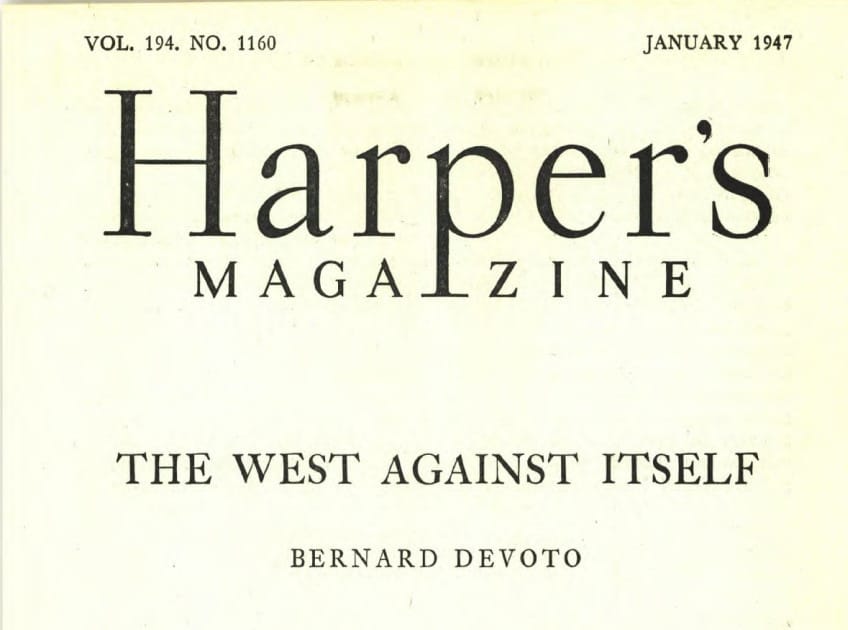
DeVoto made it his quest to stop what he called the western land grab. Employing his pen alone, he took on the forces of economic extraction in the pages of Harper’s Magazine. At the time Harper’s had a circulation of about 140,000, but it was one of the most influential journals in America. In the next few years, DeVoto wrote a series of great essays, including the still relevant The West Against Itself (January 1947), which did more than anything to arouse public condemnation of the behind-the-scenes legislative maneuvering of McCarran and his buddies. DeVoto’s essays between 1946 and 1951 were so effective in galvanizing public outrage that the privatization movement largely failed. He had not acted alone, of course, but Secretary of Agriculture Clinton Anderson declared that DeVoto had single-handedly stopped the land grab cold. Senator Richard Neuberger of Oregon called DeVoto the greatest (i.e., most effective) conservationist of the 20th century.
Attempts to privatize public lands, turn them over to individual states, or hollow out federal public-lands regulations come in waves in American history. Fueled by the “liberty” rhetoric of Project 2025, the Trump Administration has reduced two of America’s most recent National Monuments by more than 90% — Bears Ears and Grand Staircase Escalante. Secretary of Interior Doug Burgum, formerly the governor of North Dakota, when he is not misaccusing innocent individuals of vandalizing the Washington, D.C., reflecting pool, is trying to carve out a portion of Yosemite National Park to help a developer “improve” a proposed private resort in the park. There is talk of oil and gas extraction within the National Parks. And more.
I know there are principled individuals who believe that the public lands should be returned to the states, that our public lands are over-regulated, that we probably have enough National Monuments, that the liberal-environmental-complex is trying to lock up whole swaths of the American West, and that we are going to need less restrictive resource development to maintain our economy and national security. Unfortunately, I believe forces of runaway capitalism are using these honest citizens in the way DeVoto outlined in his essay, The West Against Itself.
The Medium is the Message
Who is our Bernard DeVoto today? What writer (or, for that matter, podcaster) has ‘voice’ and the platform to change the trajectory of American life? Or even to call the full nation’s attention to the crisis?
Who are the contemporary analogues to Reinhold Niebuhr, George F. Kennan, Walter Lippman, Martin Marty, Rachel Carson, James Baldwin, William H. Buckley, Jr., Robert Penn Warren, Norman Mailer, Gore Vidal, Lewis Mumford, and Lionel Trilling today? At one time, The New Yorker, The Saturday Evening Post, The Nation, The New Republic, The New York Review of Books, and Harper’s Magazine established and clarified the national conversation.
How is it that DeVoto, who wrote for a journal with under 150,000 subscribers, was so much more influential than, say, Heather Cox Richardson, who has 2.9 million subscribers?
The answer is mostly about technology and partly about the over-stimulation of the American public. Throw a corn kernel in any gathering of 25 or more people today and you are likely to hit an influencer or a podcaster. Does anyone today not have a blog or a podcast? The digital revolution has made it possible for everyone to publish their views, thoughtful or moronic, factual or deliberately misleading, well-researched or just spewed from the reptilian core of the brain. Heather Cox Richardson may be one of our best national commentators. Still, she has to compete with 10,000 or a hundred thousand others, all competing for attention with increasingly sensationalist postings.
Meanwhile, we have found a gazillion ways to distract ourselves. When I was growing up in a small town on the Great Plains, we had AM radio and two television channels — and you had to get up out of your chair to change the channel. Then came basic cable (13 at the beginning) and soon hundreds of options. And that was before streaming on demand made virtually everything in media available — for a price. Today most young people don’t need or want television sets. Their portal to the world is a 6×3-inch screen. They will watch Lawrence of Arabia or Titanic on a smartphone. You can, if you want, watch the complete films of Stanley Kubrick in the course of a single week, when in my youth you had to wait the whole year to see The Wizard of Oz on a Sunday afternoon in the spring — and if you missed it, well, there was next year. If you had told the American social thinker Reinhold Niebuhr in 1948 that the time would come when you could watch 15-22 episodes of Real Housewives of Dallas (five seasons, 81 episodes) or any of the 10 other Real Housewives series, he would have said the End Times are approaching. But if you had told P.T. Barnum that you could watch every episode of Honey Boo Boo or Mama June: From Hot to Not on demand, he would have demanded of the cosmos why he had died so soon (1891).
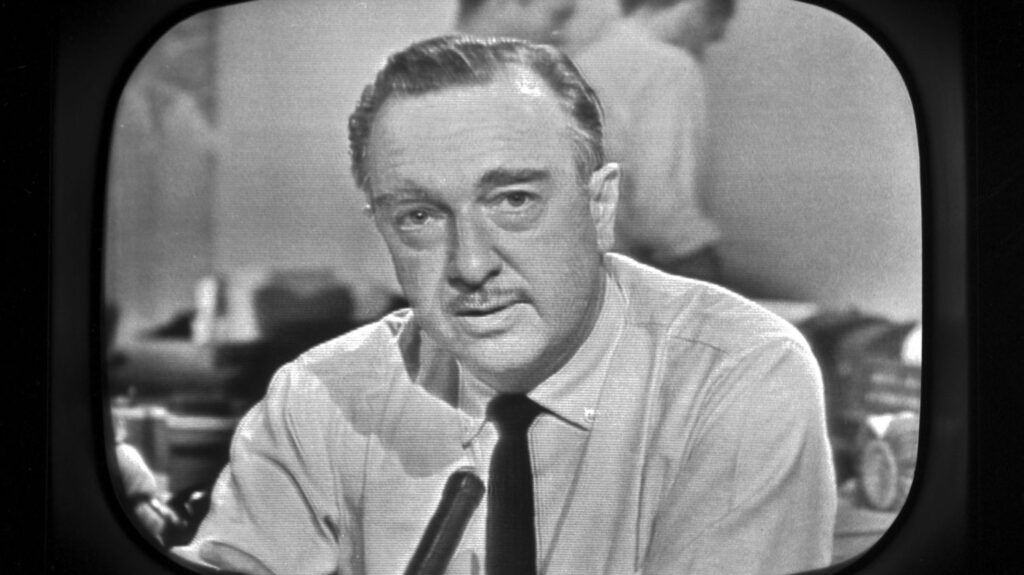
When I was growing up in the late ’60s and ’70s, we made sense of public events (elections, catastrophes, wars, social trends, riots, and assassinations) by watching the one-hour (after 1963) evening news on CBS, NBC, and (later) ABC. When something big happened we wanted to hear what John Chancellor had to say on NBC, or Huntley and Brinkley, and on CBS Walter Cronkite, who was voted “most trusted man in America.” We waited for Cronkite to turn to Eric Sevareid (my fellow North Dakotan), and say, “For perspective on the Watts riots, we turn to our colleague Eric Sevareid. Eric?” Sevareid and Chancellor were essentially America’s Greek chorus in those years — the clearinghouse for intelligent, largely nonpartisan, and often wry commentary on the unsettled world around us.
Where do we turn today? Sean Hannity? Laura Ingraham? Jesse Watters? Chris Hayes? Lawrence O’Donnell? Chris Cuomo? Mark Levin? Some of these commentators are better (and of course worse) than the others, but where would we turn now for a reliable, thoughtful, centrist analysis of public events? The siloing of American public discourse exacerbates our political divisions, reinforces narrow thinking, demonizes the other faction, and (above all) ignores the 60-70% of the American people who live in the disenfranchised middle of the political spectrum, who are not sure what they think about most issues, but are willing to be convinced by honest and civil argument. There is so much disinformation now that we are beyond fact-checking.
We want to believe what Ralph Waldo Emerson is said to have said, “Build a better mousetrap, and the world will beat a path to your door.” We want to believe that if we had a brilliant social commentator today who wrote excellent prose, they would rise to national prominence and save the republic. One of the last commentators whose analysis would make us stop and listen was George Will, now 85. There was also Susan Stamberg on NPR. Or Cokie Roberts. In my view, Bernard DeVoto wouldn’t stand a chance today. Nor would Eric Sevareid.
Marshall McLuhan was right: the medium is the message. The message today, such as it is, is hopelessly fractured and fragmented, sensationalized and trivialized, accompanied by heroic graphics (“Breaking News: Apple Releases a New Smartphone”). Where should a thoughtful American turn for wisdom? In this media universe, “the best lack all conviction, while the worst are full of passionate intensity,” as the poet Yeats wrote in 1919.
The leaders of the groundswell to save our public lands today will come from the bottom up, not the top down. But we are not going to save the republic between episodes of Love After Lockup. The most important thing to remember about public lands is that once they are divvied up to the highest private bidder, they are gone forever.
The Problem Is Much Bigger Than the Public Lands
Politics are politics, but the revolution in the way we sort out the great questions of modern life has been damaged by the sheer proliferation of pundits, platforms, posts, and commentary threads that bombard us until we are reduced to numbness and a kind of weary indifference. My point in these essays is to try to assess how the world has changed in the last 75 years — in technology, in our social structure, our national narrative, our social interactions, in our mobility, in the ways we communicate with each other, in our stature in the world’s arena, in the ways we wage war, and in how we entertain ourselves.
If you are looking for escape, I suggest the journals of Lewis and Clark (DeVoto’s abridgment is still available). On any given day, William Clark is infinitely more interesting than the luckless aspirants on Real Housewives or Storage Wars.
Note: I’ve been writing a long essay about the achievement of Bernard DeVoto for the Lewis and Clark quarterly journal We Proceeded On. I’m the editor. You can subscribe to WPO by joining the Lewis and Clark Trail Alliance at lewisandclark.org. The price is right! $40 per year. See you on the Trail.