
As the nation approaches its 250th birthday this July 2026, Clay suggests it might serve the country well to revisit details of our Constitution.
Editor’s Note: Clay Jenkinson has been advocating a new constitutional convention for more than a decade. This spring, he will be offering two online courses on this subject: first, a four-week course on whether such a convention is even possible in our era, and how we might handle the logistics. The second course will be an informal convention of self-selected delegates that will attempt to revise, clarify, or replace clauses in the Constitution that have proved ambiguous or problematic. Watch for all the details at LTAmerica.org. In the essay that follows, Clay presents some of the issues that a consultation amendment process should address.
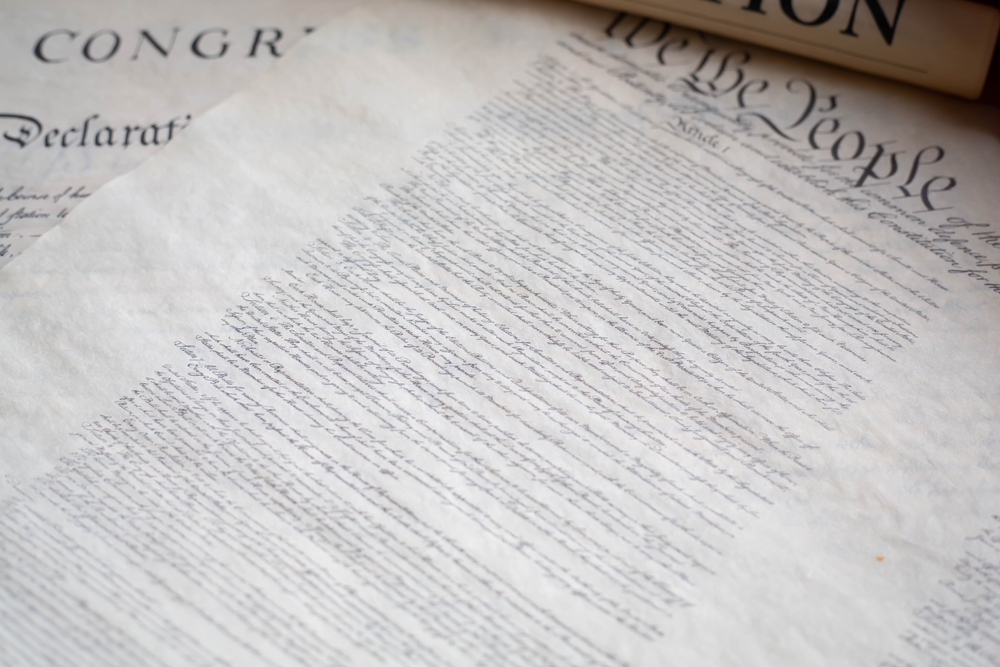
For a couple of years, I have been saying that the greatest gift we could give ourselves on July 4, 2026, is a spanking-new constitution for the United States. The one we crafted back in 1787 and then amended only 27 times (10 right off the bat, the Bill of Rights) is broken. In her new tome, We the People: The History of the U.S. Constitution, historian Jill Lepore argues that the Founders never intended the Constitution they wrote to last forever. They knew it was flawed and anticipated that its weaknesses would emerge over time. These were men in wigs and buckled shoes who lived in a three-mile-per-hour world. They expected the Constitution they wrote to be amended frequently, and they provided a mechanism for those amendments in Article V.
Thomas Jefferson, who was not in Philadelphia in the summer of 1787, wrote a famous letter to his closest friend James Madison (September 6, 1789) arguing that because “the earth belongs to the living, not the dead,” the Constitution should be torn up once every 19 years or so, to “keep pace with the times.” Jefferson later said, “We might as well require a man to wear still the coat which fitted him when a boy as a civilized society to remain under the regimen of their barbarous ancestors.” Madison was not convinced.
The American people are strangely conservative about the U.S. Constitution. They regard it, as Jefferson feared, “like the ark of the covenant, too sacred to be touched.” The last amendment (#27) came in 1992, and it wasn’t about anything very important. Because we are now a world empire not an isolationist agrarian republic, and because today’s world is almost infinitely more rapid-fire and dangerous than it was in the early national period (when a musket was a high-tech weapon); and because we are in a prolonged state of national governmental paralysis, it is time seriously to consider a major constitutional review and revision. Our semiquincentennial gives us a golden opportunity to rethink the whole thing.
What Needs Serious Review?
Here are a few things we would want to clarify, revise, refine, or replace if we cracked open the Constitution.
– War Powers
As this essay goes to press, the United States has invaded the sovereign nation of Venezuela and kidnapped its national leader. One of the primary goals of the Founding Fathers was to kennel the Dogs of War, to ensure that any military action we undertake as a nation is our last resort, after we have bent over backwards again and again to find a peaceful solution to our foreign crises. The last melancholy resort. The Founders insisted that any war must begin in the U.S. House of Representatives (not the executive branch), that the war department must be reauthorized every two years, and that the House and Senate must have the power of the purse to fund or refuse to fund military action proposed by the president. These key principles of the Constitution have been repeatedly violated since 1900, particularly beginning with the Korean War (1950–1953). This president sent military sorties into Venezuela (and kidnapped their executive) without even consulting Congress.
Context matters. It is clear that war in the 21st century is not the same as war in the Age of Jefferson and Jackson, but the principle that the people’s branch of government (the Senate and especially the House) must have a primary, fundamental, and determinative role in military action undertaken by the American republic.
If we revise the Constitution, we can devise new restraints and controls to make sure that Congress is never ignored in military affairs — and yet give the president the power he or she needs to respond to sudden and fast-changing crises.
– Impeachment
There have been four presidential impeachments in American history, but in each case, the Senate has declined to remove the president: Andrew Johnson (1868), William Jefferson Clinton (1998), Donald J. Trump I (2019), and Donald Trump II (2021). Leaving these three individuals out for the moment, it seems certain that we have had presidents who should have been impeached and removed. The specific language (“Treason, Bribery, or other high Crimes and Misdemeanors”) has been considered too narrow and specific to convict presidents who were grossly incompetent, contemptuous of constitutional norms and sometimes actual constitutional principles, etc. Jefferson thought a few cheerful impeachments would protect the American republic from charlatans, corruptionists, and demagogues. Either we should find a better, more nonpartisan impeachment system, or remove the impeachment clause altogether and let electoral politics prevail.
– Representation
Wyoming has 587,617 people. And two U.S. Senators. California has 40 million people. And two U.S. Senators. The Great Compromise at the Constitutional Convention (June 16, 1787) dictated that each state would be guaranteed two Senators, regardless of geographic area, population, GDP, or strategic importance. The Father of the Constitution, James Madison, thought this was a ruinous idea because it violated the fundamental principle of equal representation. The small states were so adamant about this that a clause was embedded in the Constitution (Article V) stating that this formula can never be changed without the explicit consent of the states in question. Good luck with that.
If you do the math and add up the population of the least populated 21 states, the total barely equals that of California. Thus, 42 Senators from the least-populated states equal just two in California. And yet those 21 states (mostly Red heartland states) can hold up any piece of national legislation under the filibuster rule. My own North Dakota has 780,000 people. That’s one Senator for every 390,000 Dakotans. In California, there is one Senator for every 20 million people. A North Dakotan, therefore, has as much senatorial power as 51 Californians. Can this be said to be fair?
I’ve thought about this for a long time and have attempted to imagine a more equitable system. You could, for example, give five Senators to California, Texas, and Florida; four to Illinois, New York, and Pennsylvania; three Senators for the next tier of states; then two; and finally one Senator only for the 10 least populated states. As a loving cheerleader for North Dakota, I reckon I’d be burned at the stake if I were influential enough to get national attention (much less traction) for this idea.
But no matter what we decide to do, the existing population differential is enough to make it impossible to declare that the USA is a democracy or even a republic. Something needs to give.
– The Electoral College
The Electoral College was created for two purposes. First, the United States was so geographically dispersed and its national infrastructure so weak in 1787 that the Founders agreed it would be impossible to gather all the votes of all the citizens on a single day. The Electoral College made it possible for the votes to come in over a series of weeks, then to be counted and confirmed (or not) by a “college” of wise electors. Think of the College of Cardinals that elects a new pope. Second, because the Founders distrusted “the people,” they wanted to create a body of responsible men (all white men then) that could effectively veto the “choice of the people” if they regarded him as a threat to the American republic. Today, laws have been passed throughout the United States to prevent what are called “faithless electors.” In other words, if Jimmy Carter wins the popular vote in California, state law requires that the electors affirm his victory when the Electoral College meets.
Thus, the two historic purposes of the Electoral College have both disappeared. In recent years, the person who won the popular vote (Hillary Clinton, Al Gore) has lost in the Electoral College, which affords greater weight to small (usually Red) states over clear popular majorities.
Solid arguments are made for retaining the Electoral College with a few legislative (not constitutional) adjustments, but the day is coming when someone wins the popular vote by five or 10 million votes and still loses in the Electoral College. In other words, the day is likely to come when there is very widespread disillusionment with this antiquated, anti-democratic quirk of the 1787 Constitution.
– Pardons
The Founders wanted it to be possible for the president to pardon people who have been wrongly convicted, have served long enough, have shown unambiguous remorse, or should be released for humanitarian (often health-related) reasons. Donald Trump has used the pardon power extensively and often recklessly to release cronies, deep-pocket “supporters,” and reality TV stars (the Chrisleys, for goodness’ sake!). But Trump is by no means the only perverter of this huge, unchecked power of the presidency. Think of Bill Clinton’s 2001 pardon of Marc Rich, convicted of fraud and tax evasion, but who gave large sums to the Democratic Party and Clinton’s presidential library. It would be possible to require the president to vet his proposed pardons through a nonpartisan commission that had limited capacity to question his or her judgment, or we could prohibit pardons in the last two months of a presidential administration.
– The Amendment Process
The Founding Fathers wanted to make it possible to amend the Constitution when necessary. Under the old Articles of Confederation (1781–1789) amendment had required the unanimous consent of all 13 states — essentially an impossibility. The Founders lowered the bar — two-thirds of both houses of Congress, plus three-fourths of all the states. We’ve had 27 successful amendments, the last in 1992, but we have probably needed 37, 47, or even 57 amendments over the last 239 years. The difficult challenge is to set the bar high (to avoid frivolous amendments or responses to mere “issues of the day”), but not to set it too high to be effective. Plenty of people agree that we need to make amendments to the Constitution easier, but since that would take a constitutional amendment and it is now almost impossible to conceive of any proposed amendment being ratified, we are stuck in a very severe paradox (Catch-1787!).
– Term Limits
We are becoming a gerontocracy. 119 members of Congress are 70 years old or older (22%). The current president is 79 years old and in unmistakable decline. The previous president left office at 82 and in palpable decline. Five of the nine Supreme Court justices are 65 years old or older. Only 5.6% of Fortune 500 CEOs are 70 years old or older. Do we think running General Electric (mandatory retirement at 65) is less important than being a senior officer of the most consequential nation in the world? A constitutional revision would probably want to explore term limits for Supreme Court justices and other federal judges, for members of Congress, and for presidential candidates. What can an octogenarian know about the aspirations, the habits, the predilections, and the challenges of the rising generation(s)? Both of our most recent presidents have at times been literally asleep at the wheel.
– Emoluments
The emoluments clause was written into the Constitution to forbid national officers from taking bribes from foreign countries. Other nations seldom give lavish gifts to a president without expecting a significant quid pro quo. Modern presidents hold significant financial interests in a range of areas that make it difficult to apply and enforce the emoluments clause, but most presidents still conform to the principle. But if a president were to accept a $400 million Boeing 747 jetliner from a Middle Eastern country, for example, and a few months later the U.S. granted that nation a military training base in Idaho, that would be an absolutely undeniable violation of both the spirit and the letter of the emoluments clause.
In a constitutional revision, it would be possible to insert strong disincentives into the emoluments clause, including making the acceptance of such gifts a clear impeachable offense.
– The Powers of the President
The Founding Fathers insisted that of the three branches of the national government, the legislative branch was the most important, and that the other two branches (the executive and the judicial) were to be far less important to our self-government. This is called legislative supremacy. That’s why the Founders enumerated the powers and the portfolios of the legislative branch in Article I of the Constitution. And in the legislative branch, the Founders wanted the House of Representatives to be more powerful than the Senate, because it is the body closest to the people, kept on a short leash by needing to face the electorate every two (not six) years.
Beginning with Abraham Lincoln (in the greatest crisis in American history) and ballooning in a big way with the presidency of Theodore Roosevelt (1901–1909), the executive branch has taken primacy over the legislative branch. During the presidency of George W. Bush, we first heard of the Unitary Executive doctrine, which effectively gives the president almost unlimited political power. This was decidedly never intended by the Founders, who had had enough of kings.
Emboldened by having survived two impeachments and having been decisively re-elected after a four-year interim, President Trump has asserted executive power in truly unprecedented ways. He has been assisted by a dangerously compliant Republican legislative majority and an acquiescent Supreme Court, which granted the president (July 1, 2024) nearly complete immunity for acts that can in any way be considered “official presidential actions.”
– The Second Amendment
If the people of the heartland became aware that constitutional revision must inevitably address the problem of the Second Amendment (44,000+ gun-related deaths in the U.S. in 2024 and 425 mass shootings in 2025, according to the Gun Violence Archive definitions — though the FBI’s numbers are significantly lower), there might be riots in the streets of America. The Second Amendment is widely seen as the “third rail” of American politics. I’m not sure what should be done about “the right to keep and bear arms,” but I know this much with certainty: if we had no historic memory of the Second Amendment and were creating a U.S. Constitution now for the first time, there is no likelihood that today’s “Founders” would grant the American people a virtually unlimited “right” to acquire and use firearms.
Conclusion
I’m a realist. I know it is unlikely that we will undertake constitutional revision in 2026 — or in the foreseeable future. But here’s the rub. If we don’t attend to the vulnerabilities and flashpoints of our outdated Constitution, the national paralysis will continue. We’ll be subjected to one constitutional crisis after another. The executive branch will become increasingly powerful and unrestrainable. Due process and the rule of law will continue to erode. Our political system will become a zero-sum game, winner-take-all, and the winner ride roughshod over the opposition. The federal courts (especially the Supreme Court) will become still more powerful and more purely political. Big money will buy elections even more than it already does.
And the thin flame of our republic will diminish and perhaps even blink out.