
Clay traveled to England last week to attend his daughter’s graduation ceremony, where she received her PhD from Oxford University.
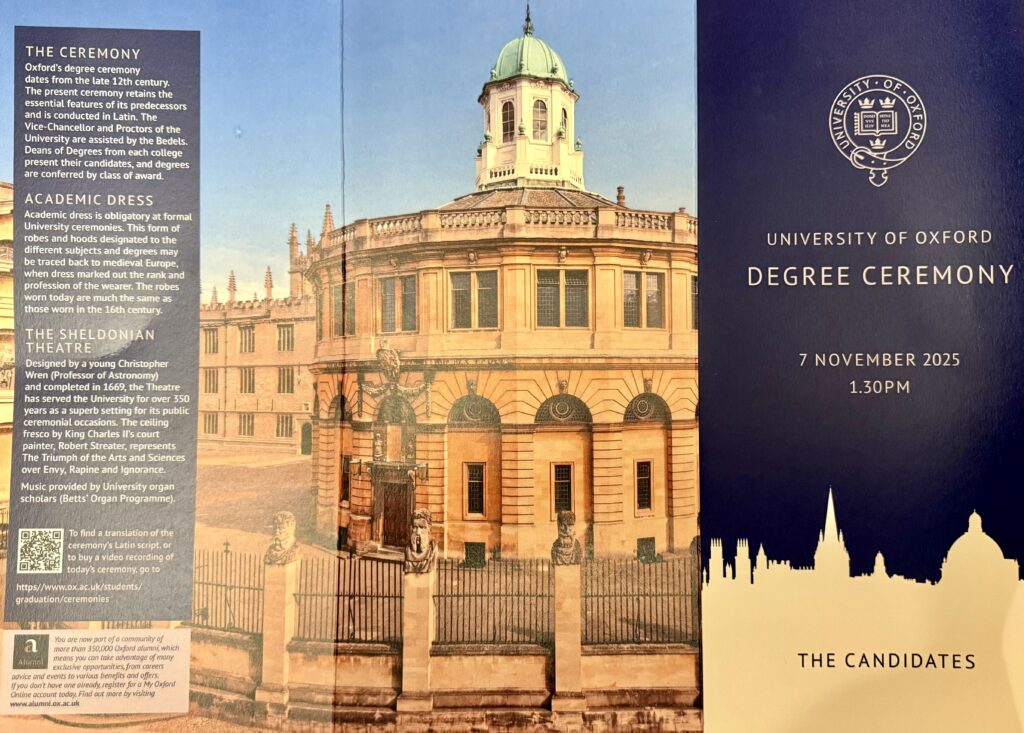
I had the joy yesterday, Friday, November 7, 2025, of seeing my beloved daughter take her degree at the seventeenth-century Sheldonian Theatre in Oxford.
My daughter wrote her doctoral dissertation on the Tower of London in the age of Elizabeth I and James I. The degree was conferred in February, but the graduation ceremony was held this week.
Several decades ago, I went through the ceremony at a lower level, with my parents in attendance all the way from North Dakota.
Oxford is an ancient university, dating back to around 1230 AD or so, depending on how you count. The Sheldonian Theatre was designed by the eminent English architect Sir Christopher Wren (1632–1723), who also built Saint Paul’s Cathedral in London.
I had forgotten how beautiful it is inside.
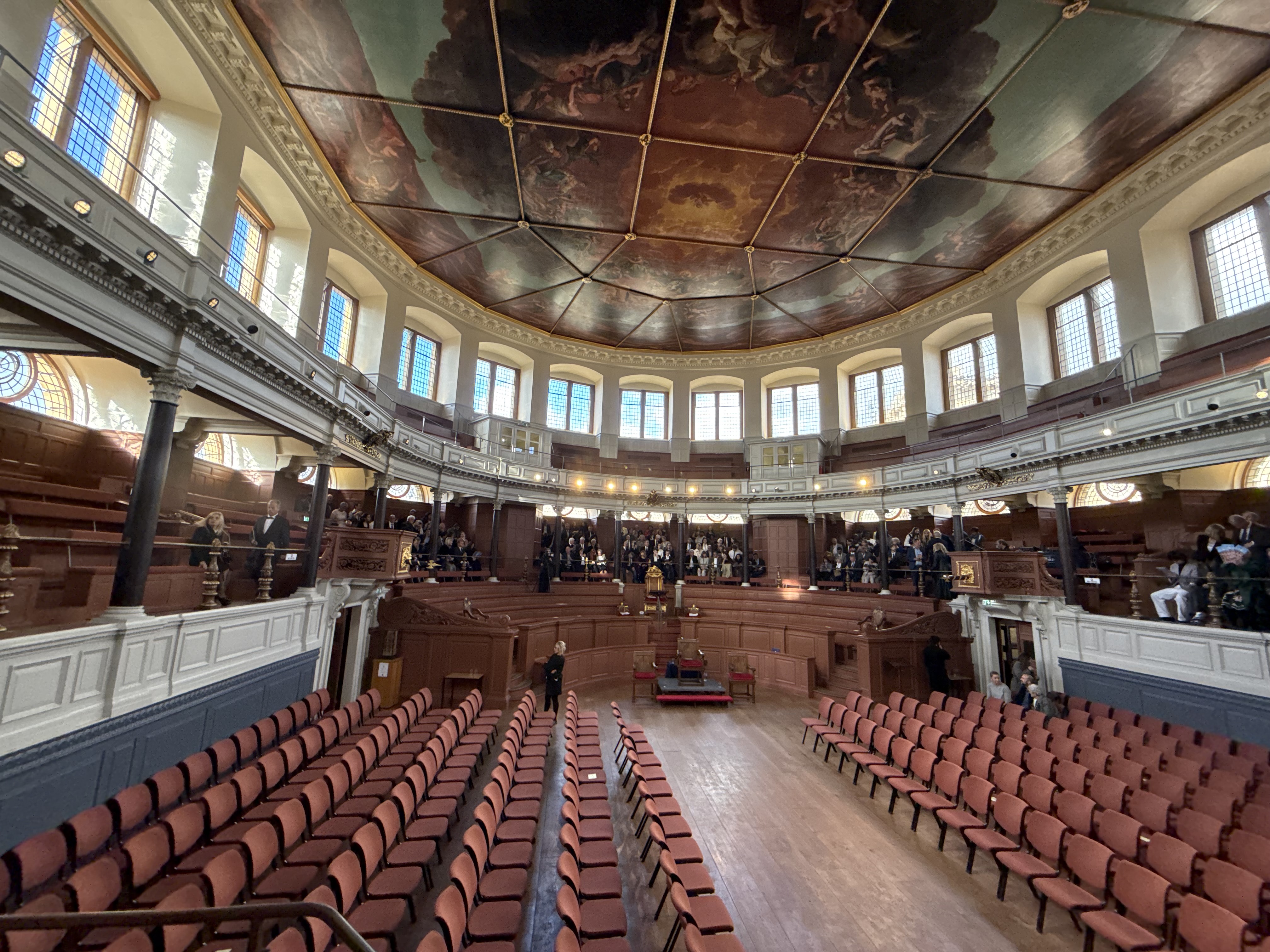
So here were several hundred parents, friends, and professors sitting on cushioned bleachers, looking down into the cockpit where the degree ceremony takes place. The ceremony is conducted almost entirely in Latin. The university’s associate vice-chancellor, Jonathan Michie, in his brief English homily, made the case for maintaining the Latin tradition. Some events in life are so important that they deserve to be embraced in special commemorative rites and procedures. Graduation from Oxford is a kind of secular sacrament with roots in the Middle Ages. Until the eighteenth century, Latin was the language of science and learning throughout the European world—and beyond. Someone from Slovenia could communicate (including orally) with someone from Sicily, who could talk with someone from Hamburg, who could talk with someone from Naples, who could communicate with someone from Istanbul. Latin was the universal language of the intelligentsia, of what was then called the Republic of Letters, with a particular emphasis on questions of salvation and divinity.
Nowadays, nobody can really understand the Latin discourse used in the Sheldonian ceremony, including some of the Oxford faculty representatives who have to use it on these special occasions. Nevertheless, it adds a level of severe grandeur to this extremely important rite of passage.
My daughter was one of about forty individuals who had earned their DPhil (PhD) in one discipline or another. They all came in wearing their black commoners’ gowns and left after some important preliminary discourse. When they returned, they were wearing the gorgeous scarlet and blue gowns of those who were now being formally welcomed into the highest echelons of Oxford scholarly life.
So here were hundreds and hundreds of well-wishers, most of us complete strangers to everyone else in the room, anxiously waiting for their scholar to take their degree while trying to take a few clandestine photographs.
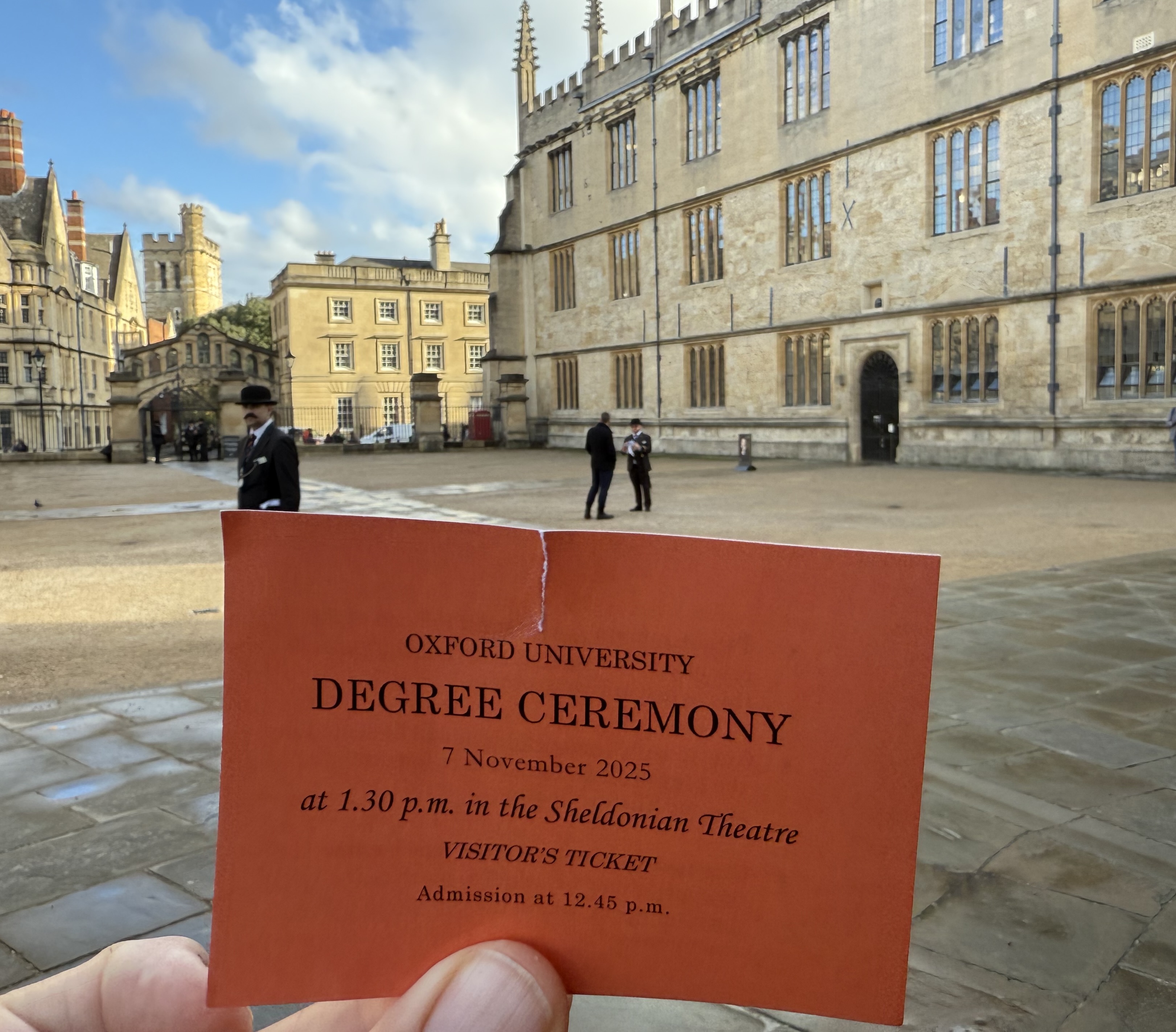
There is an important gravitas to this grand celebration of the life of the mind. Almost everyone in the theatre was an adult, some proud parents in ones and twos, and some grandparents. Everyone in the audience was dressed with appropriate decorum, most of the men in ties, many of the women in skirts and dresses. There were only a handful of children in attendance, mostly because tickets are extremely difficult to obtain. The Sheldonian has a capacity of 1,000. Each student gets two tickets. Before the doors opened promptly at 12:45 p.m., one boy, about four or five years old, in the queue outside was standing with his father waiting to see his mother take her master’s degree. He knew something important was about to happen, but he was not quite sure what. He asked many questions of the sort you would expect: “Is mama coming?” “When will it start?” “Is that the tallest building?” and “Are those clouds moving or is the building about to fall down?”
This gave me some pause, but during the two full hours of the ceremony in a foreign language, he said not a peep and was never admonished for any childish behavior or squirming. Throughout the event, there was no ruckus of any sort in the room.
And here’s what impressed me the most:
In the two hours we sat there, no graduate did a fist pump or attempted to high-five the associate vice-chancellor or lifted her or his gown to show combat boots or shouted out “Free Palestine!” or “We’re Americans, we’re so sorry for the way we have disturbed the universe.” Nobody did a skip. Nobody mooned the audience. No parents shouted, “You finally made it!” or “We’re as surprised as you,” or “Go, Manchester United!” (a premier English soccer team).
I’ve been to several dozen graduations in America at public universities and private universities, and I’ve never seen one in which there was no outburst of joy or sarcasm. The British are not always so decorous. I’ve been to soccer matches, for example, where rowdyism is virtually synonymous with the rabid fanbase. The British still have a great regard for higher education, particularly at their beloved Oxford and Cambridge. But on this day, there was not a single whoop or triumphant gesture. It made me want to go home and read the complete works of Tolstoy or translate a Roman epic. At a time when the humanities are in steep decline worldwide, including to a certain extent even at Oxford and Cambridge, this cultural respect was deeply moving.
Afterwards, we took approximately 725 photographs, then queued up for the official university photographs of every permutation of our little party: mother and daughter, mother and second daughter, mother and both daughters, mother and father, father and daughter, graduate with fiancé, fiancé with parents, etc.
Then we went to my daughter’s college reception at Lincoln College, one of the 39 Oxford colleges. There were cucumber sandwiches and coronation chicken salad sandwiches. Plus champagne.
It was a profoundly moving experience.
After the reception, we walked into North Oxford to the Royal Oak pub, where we had reserved a table in a corner room. A dozen of my daughter’s closest mates were waiting to celebrate her achievement in a more convivial way. There were several toasts and a great deal of joyous laughter. But what moved me most was that two of her Oxford history professors—both eminent in their field with worldwide reputations for scholarly excellence—made brief appearances to congratulate her and tell her parents how exceptional she has been.
Was all this worth a trip across the Atlantic? Absolutely. What will she do next? Unclear, though she has a four-year postdoctoral research fellowship at Pembroke College, Oxford, in a guest room of which I write this account. Her doctorate is in Early Modern History. She’d like to teach in a university, of course, but given the grim state of academic employment in the English-speaking world, her outlook is flexible. For whatever happens next, she is exceedingly well prepared.
Confession: I would have liked to whoop in the Sheldonian, because (as you see) my immense pride needs to express itself, but I am not by nature a whooper, and I was too busy choking up during the procession. Besides, how do you whoop in Latin?