
Clay ponders the “Truth Taser.” The best invention since the Veg-O-Matic?

“Any man is liable to error; only a fool persists in it.”
Cicero
Too tired to read, too awake to sleep, I turned on PBS last night and found, to my delight, a documentary on how the Dallas and national media covered the first hours and days following the assassination of President John F. Kennedy on November 22, 1963. It’s a gripping and upsetting story. Nobody has ever really figured out just what happened that day in Dallas and how many shooters there were, if Oswald did not act alone. I have never been satisfied with the lone gunman narrative. When Oswald said he was a “patsy,” he was, I believe, telling the truth.
It is fascinating to observe, in the PBS documentary, the beginnings of a number of great careers. Bob Schieffer was working for the Fort Worth Star-Telegram. He was at the city desk when a woman called, asking for a ride to the newsroom. Schieffer informed her, with some snark, that the Star-Telegram did not operate a taxi service, but when she revealed that she was the mother of Lee Harvey Oswald, he jumped in his car, raced to her house, picked her up, and scored an amazing scoop.
And there is young Dan Rather, who was the first to announce the death of the president on national television. He was just a raw kid then, a second-tier novice local reporter, but when he saw the motorcade speed off to Parkland Hospital, he rushed to a Dallas TV station where he made contact with a switchboard operator, a surgeon, and a priest at Parkland. They confirmed that the president was dead. CBS New York fretted about going live with such an unconfirmed, momentous announcement, but they did it — and Dan Rather never looked back.
National crises create big journalistic careers. After 9/11, ask Ashleigh Banfield and Wolf Blitzer, among others.
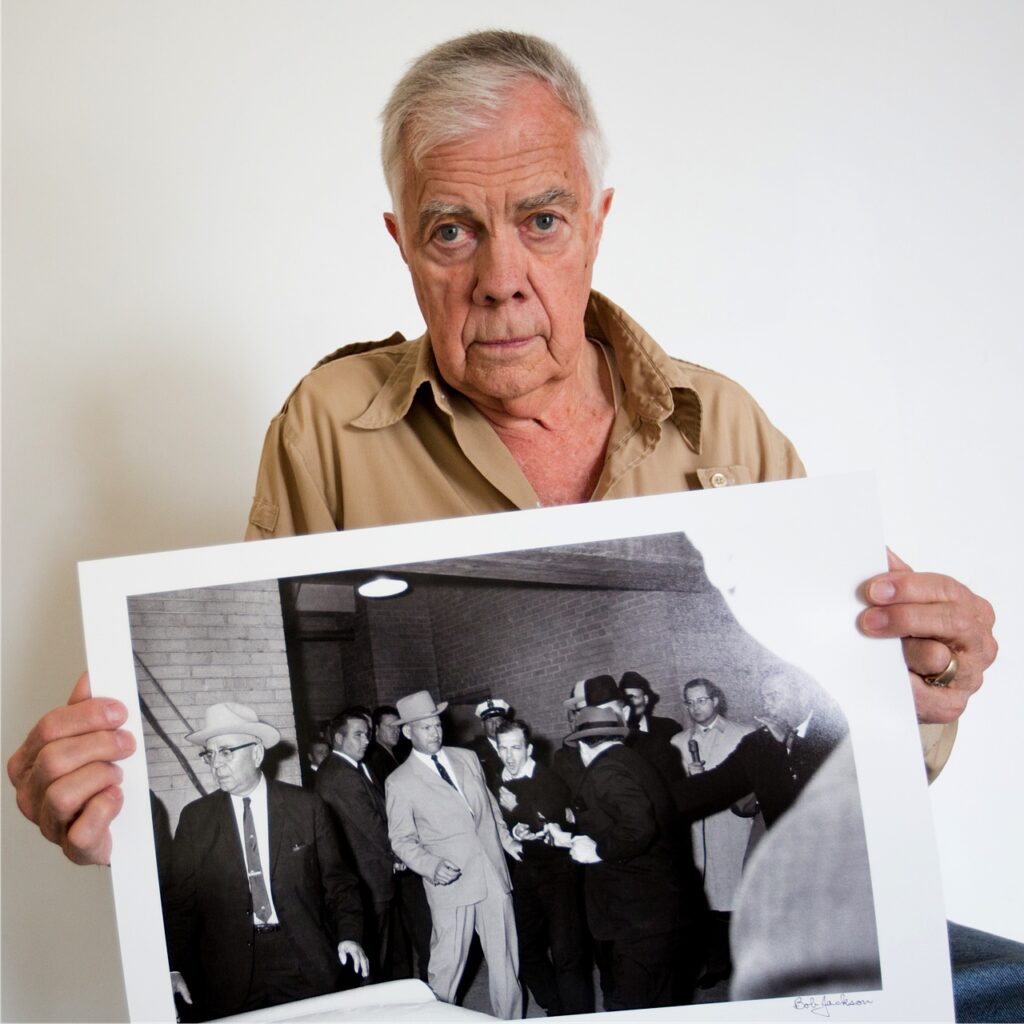
A couple of weeks ago, I delivered a Zoom lecture on the ten greatest Pulitzer Prize-winning photographs for the Smithsonian Associates. One of them was Bob Jackson’s famous photograph of the moment Lee Harvey Oswald was shot at 11:21 a.m. on Sunday, November 24, in the basement of the Dallas Police Station. Someone in the Smithsonian Zoom audience asked in the chat if I was watching live at the moment Oswald was killed that Sunday morning. I answered honestly that I was not sure, but that I probably wasn’t. I explained that human memory is notoriously inaccurate in such situations (e.g., the moon landings, Woodstock, voting for or against Richard Nixon, etc.). I said that the shooting was indeed shown live (the first live murder on TV) that morning, on ABC, but that I probably didn’t see it until later in the day. We were a CBS family. It’s not even clear that we watched the coverage that morning, since this was expected to be a routine transfer of the prisoner from one facility to another. But within minutes, the footage was being rebroadcast by all three national networks.
Well, last night I learned, from an unimpeachable source, that it was not ABC but rather NBC that covered the incident live. I blushed in my own living room. I probably knew that at some point in the past (I hosted a public humanities symposium on JFK several years ago), but more recently, I erroneously got it into my head that it was ABC. Harmless error, but one should always try to get it right.
So much of what one says in a hectic life is based on a neurological retrieval system that is far from reliable. If one had to fact-check everything that comes out of one’s mouth, there would be a great deal of silence in the land. My memory for facts such as these is good (I’m usually amazed at what I can dredge out of the recesses of my noggin), but very far from infallible. And growing older doesn’t do mental acuity any favors.
Smart Alecks
A few days ago, I gave a lecture in Medora, North Dakota, for the Smithsonian on Theodore Roosevelt and the Dakota Badlands. Approximately 40 senior citizens from all over the country made the long journey to North Dakota to see the Little Missouri River Valley and the three units of Theodore Roosevelt National Park (TRNP). In providing a brief history of TRNP’s origins, I mentioned that President Harry S. Truman vetoed the enabling legislation in 1946 because he did not believe the Little Missouri River badlands were of sufficient scenic value to justify national park designation. Afterwards, one of the guests of the Smithsonian — they are nothing if not confident — took me aside and assured me that Truman’s reason was not the suitability of the badlands for national park status, but because the original proposal did not include either the Maltese Cross Ranch (TR’s first ranch investment, 1883) or the Elkhorn Ranch, which he established as his headquarters in 1884-85. I said I was pretty sure the main reason was a perceived lack of scenic majesty. The man who had pulled me aside assured me that Truman’s veto was primarily because the two proposed units of the park did not include either of TR’s badlands ranches.
We left it at that. Since I got home, I have puzzled over this. I might well be wrong, of course, so I looked up Truman’s veto message online. If I were bad, I’d be really embarrassed because I have lectured on this issue many times and always said the following:
A: President Truman vetoed the legislation primarily because he felt, and many at the National Park Service had long felt, that the North Dakota badlands were not magnificent or distinctive enough to deserve national park designation.
B: When the enabling legislation was amended to include the Elkhorn Ranch site, Truman signed it into law in 1947 as Theodore Roosevelt National Memorial Park. So there is some validity to the idea that including TR’s northern ranch made a difference.
C: Even then, the president insisted that it be called a national memorial park, something a tier below the status of Yosemite, Glacier, or Yellowstone.
D: It wasn’t until 1978 that the Theodore Roosevelt National Memorial Park graduated to full status as Theodore Roosevelt National Park.
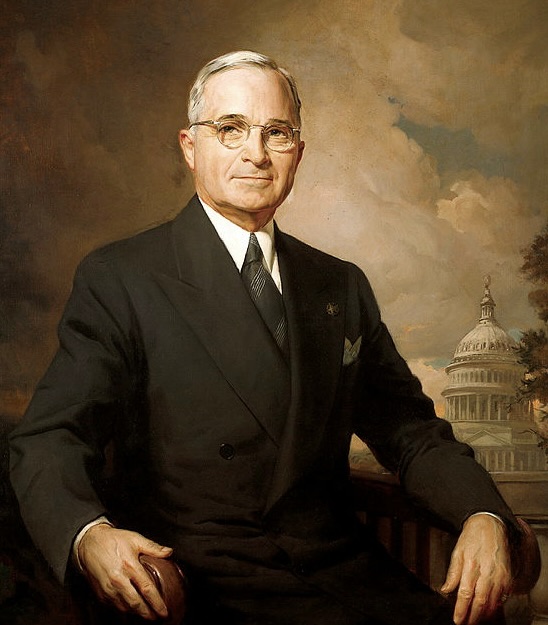
So I googled up Truman’s 475-word veto message. Here are the pertinent bits: “I HAVE WITHHELD my approval from H.R. 4435 … The area that would be established by this bill as the Theodore Roosevelt National Park does not possess those outstanding natural features or scenic qualities that would justify its establishment as a national park. … and has no direct historical association with Theodore Roosevelt.” And: “The area is largely of a badlands character, the formations being rounded, mostly dark red in color, and interspersed with grass-covered flats and plateaus. It is not of national park caliber. … Existing or authorized national parks contain or relate to areas that possess scenic, scientific, or historic features of outstanding national significance. The same high standards should be maintained whenever national parks are established in the future. I feel strongly, therefore, that to confer national park status upon the area described in H.R. 4435 would be an unwise departure from sound policy. If a national park is to be established in honor of Theodore Roosevelt, it should more fully measure up to the standards developed and maintained in the past for national parks.”
You do the math. We may feel that Truman was wrong in 1946, but it is important to face facts. Thanks to the digitization of culture (and the internet), it is now possible to pursue the truth as doggedly as Theodore Roosevelt did when he sought his first buffalo in those very badlands in 1883.
To Err Is Human, To Correct Divine
It was the Roman republican Cicero (106-43 BCE) who said, “any man is liable to error; only a fool persists in it.”
Last night I performed as my favorite Chautauqua character, J. Robert Oppenheimer, in Pueblo, Colorado. In telling the story of the first atomic test at the Trinity site at Alamogordo, I blurted out that this was a uranium-235 gun mechanism device. A couple of minutes later, when I was discussing events that occurred long after the Trinity test, it dawned on me that it was actually a plutonium implosion device (I knew that! and have said so several hundred times!), but now it was too late, and I just let it pass. Harmless error? I didn’t need to look it up this morning to know that I had misspoken, but I was ashamed to make such a rookie mistake. Such is life.
Dr. Johnson (1709-1784) knew something about the fragility of the human mind. He wrote, “As all error is meanness, it is incumbent on every man who consults his own dignity, to retract it as soon as he discovers it.” “Meanness,” then meant “lack of evidence,” or “lack of true discipline.”
Dignity, pah!!
Getting things right — being strictly accurate — is always important. It is important in casual conversation, more important in public presentations, and exceedingly important in published writing. I wish there were a little harmless taser button we could wear — like a diabetes monitor — that would give me a teeny little shock when I was imprecise, a bigger one when I was in error, and a very big one when I make mistakes in public (oral or written). Of course, I would mostly be on the floor flopping around!
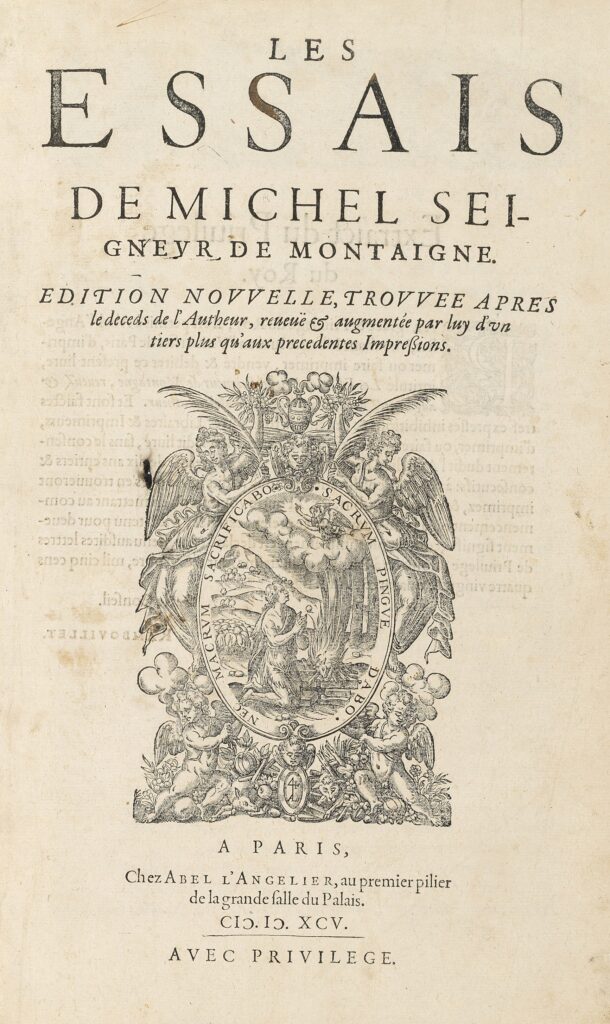
Thomas Jefferson wrote, on several occasions, “I think it is Montaigne who has said that ignorance is the softest pillow on which a man can rest his head.” I have always loved that statement, but until now I have never looked it up in Montaigne (1533-1592). I know the Essais of Michel Eyquem de Montaigne well (in my current downsizing, I have found five complete editions). Still, before the internet, it would have taken some mighty labor to find that lone sentence in his essays (1,392 pages in the Everyman Library edition, approximately 13,000 sentences and 327,000 words). I have even wondered, from time to time, whether Jefferson had it right. Silly me. It is never a good idea to doubt Jefferson’s scholarly accuracy. So I googled it and found it in his long essay on “Presumption.” Here it is: “L’ignorance est le plus doux oreiller sur lequel un homme puisse reposer sa tête,” or “I do not pose as a man of letters, and in that I am less presumptuous than in anything else. Ignorance is the softest pillow on which a man can rest his head.” Go, Jefferson, go!
We live at a time when the average person has at their fingertips the tools to look up almost everything, get it right, and hunt down facts, quotations, and context on nearly any subject. One has to know where to look, of course, and how to sort truth from all the dross out there, but being accurate is easier now than at any previous moment in the history of civilization.
And yet, you see where we are. There is a world of difference between unintended error (uranium 235) and deliberate error (largest crowd at any inauguration). The Washington Post counted 30,573 lies or misleading claims in the public discourse of President Trump in his first term. We now live in a universe of “alternative facts,” and political fact checkers are busier and more harried than air traffic controllers.
Mr. Jefferson also wrote, “Ignorance is preferable to error, and he is less remote from the truth who believes nothing than he who believes what is wrong.”
My Truth Taser idea (patent pending!) would be the best invention since the Ronco Veg-O-Matic. I’d wear one every day, and I’d love to put one on every politician in the country as they give speeches to their constituents, speak on the floor of Congress, or conduct news conferences. It would be like listening to a mosquito zapper on a July night in Arkansas.