
The new historical novel Agrippa, by bestselling author Robert Harris, brings to life the engineering marvels of Classic Rome, many of which still stand today.
Serendipity is a strange phenomenon, akin to déjà vu and other non-rational experiences that are hard to explain. Driving across the whole of Montana yesterday (talk about irrational), I listened to the audio version of Robert Harris’ latest book, Agrippa: A Novel of Rome’s Descent into Despotism. I don’t usually read historical fiction, mostly because I am afraid what is fictional will perhaps register in my mind as fact. Then I’ll mischaracterize the historical moments I’m trying to understand. But a close friend urged me to listen to the book, and I always take his suggestions seriously.
Robert Harris is best known for his trilogy of novels about the great Roman senator and last-gasp Roman republican Marcus Tullius Cicero, as well as many other historical fiction bestsellers.
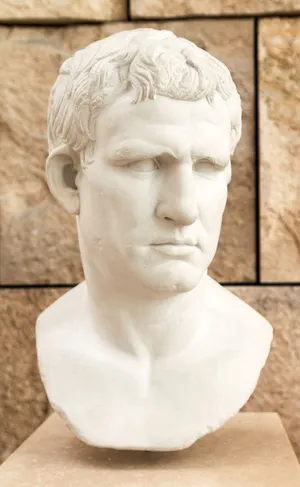
Marcus Vipsanius Agrippa (63-12 B.C.E.) was one of the ancient world’s greatest military strategists, public administrators, and engineers. He was also the emperor Augustus’ closest friend. Because he is less colorful (or infamous) than Pompey the Great, Julius Caesar, Marcus Junius Brutus, Cleopatra, Cato the Younger, Cicero, or Augustus, Agrippa often gets overlooked in accounts of the last years of the Roman Republic and the advent of the Roman Empire. He deserves better.

Where does serendipity come in? During the cultural tour I led in Thomas Jefferson’s France a couple of weeks ago, we visited the Pont du Gard, the great aqueduct near Nîmes, one of the wonders of the ancient world. Agrippa did not build that one — he had been dead for 30 years when it was constructed — but it was based on the process he and others had used to build the Aqua Julia (33 B.C.E., 14 miles) and the Aqua Virgo (19 B.C.E., 13 miles), both of which supplied water to the city of Rome. According to legend, the Aqua Virgo was so named because a young girl showed Roman soldiers the location of the spring that supplied the water. The Aqua Virgo has been delivering water into the heart of Rome continuously for more than 2,000 years! If you have ever been to the famous Trevi Fountain in Rome, you are seeing the legacy of the emperor’s right-hand man.
Although Augustus (Octavian) was Rome’s first and arguably greatest emperor, he was not, like his great-uncle Julius Caesar, an outstanding warrior or military strategist. He was not physically robust. His genius lay in administration, not war. His fragile health meant he could not participate vigorously in the wars he undertook, first against Julius Caesar’s assassins, Brutus and Cassius, and later against Marc Antony and Cleopatra. Agrippa won the battle of Actium against Antony and Cleopatra in 31 B.C.E., the decisive battle that propelled Augustus to sole control of the Roman Empire.
Agrippa had to live in Augustus’s shadow. We don’t know how much this bothered him, if at all, but Harris’ novel explores that central question. Like most leaders in history, Augustus took credit for all the positive achievements under his rule, even those in which he played a minor or subordinate role. However, absent evidence to the contrary, Agrippa seems content to subordinate his ego to that of the great man who was his lifelong friend and patron.
It is unlikely that Augustus could have defeated his many rivals and risen to the top of the Roman world without Agrippa at his side. He certainly could not have won those pivotal battles without a lieutenant of Agrippa’s military genius. It is certain that we would never have heard of Agrippa if Octavian (before he was Augustus) had not plucked him from social obscurity. Augustus’s primary advantage in life was that his great-uncle Julius Caesar adopted him as heir in 45 B.C.E., just six months before his assassination. He could never have risen to power without that unexpected, somewhat surprising, endorsement.
When you gaze at the Pont du Gard or any other fragments of the ancient aqueducts, you are amazed at their strength, durability, and beauty — surprising, considering they are essentially water conduits — but their perfection as engineering projects is most impressive. They were built to exceedingly exacting specifications.
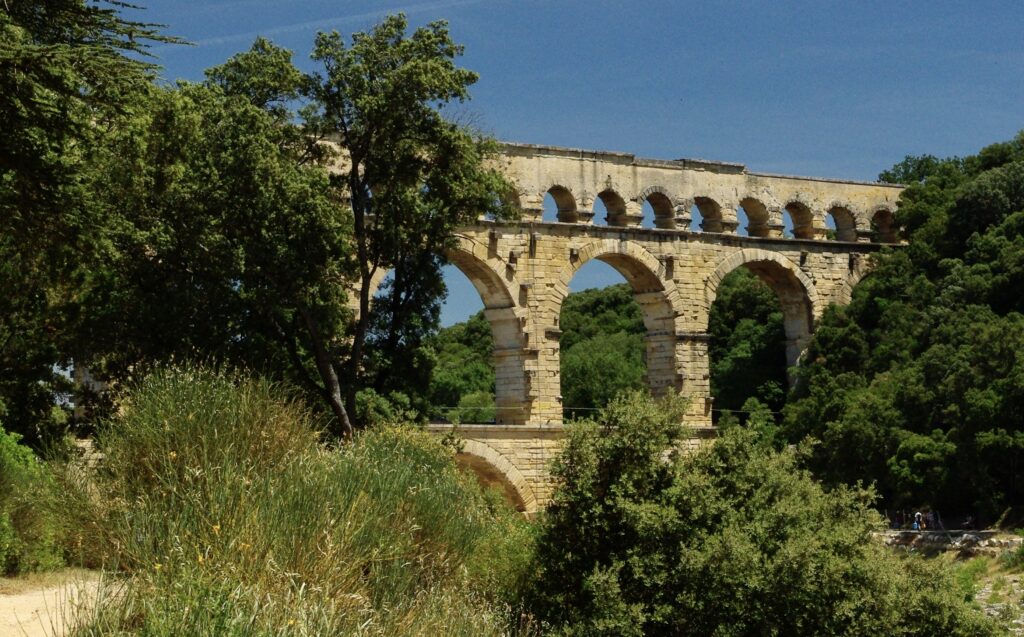
The Pont du Gard, for example, is 31 miles long, but it drops only 56 feet in that entire transit, 1.8 feet per mile. The Romans built aqueducts without pumps, so they operated entirely by gravity. So, for 31 miles, following the irregular contours of the hills and valleys it flows through, the water has to make a careful, gradual descent to its final destination. Make the gradient too slow, and the water never gets to town. Make it too steep, and the water will accelerate out of control and break up the aqueduct. To see what can happen, just Google the Tacoma Narrows Bridge collapse in 1940, when winds generated wave forms known technically as aeroelastic flutter. Welcome to the challenges of fluid dynamics.
Building an aqueduct would be difficult using modern tools and materials — lasers, theodolites, slide rules, calculators, and computer modeling; seamless metals and plastics; not to mention cranes, bulldozers, backhoes, forklifts, explosives, and a range of other machines made possible by the internal combustion engine, first available around 1860, just 2,000 years after the Romans created these public works the old-fashioned way — with slave labor numbering in the tens of thousands per project. Add to that the challenge of the Roman Numeral system. For example, how do you multiply XXXIII by DCCXLIII (the 743 Roman miles from Nîmes to Rome)? Europe didn’t use the infinitely superior Arabic numeral system until at least 976 (A.D.).
A newish Pont du Gard interpretive center sits on the site. It’s one of the best museums I have ever visited. If you give it a full day (or two), you can learn an enormous amount about Roman engineering. It is aesthetically and historically superb. If your question is, “how were they able to build this thing?” you will learn what you need to know in this museum.
I’ve been to the Pont du Gard several previous times — Thomas Jefferson was enamored of it, and all the Roman ruins in southern France — but this time we were permitted to walk (with a guide) through the former water tunnel at the top of the aqueduct, from one side of the Gardon River to the other. It was thrilling, and even a little unsettling, to be in that tunnel through which 10 million gallons of water flowed per day.
Ah, but the Pantheon
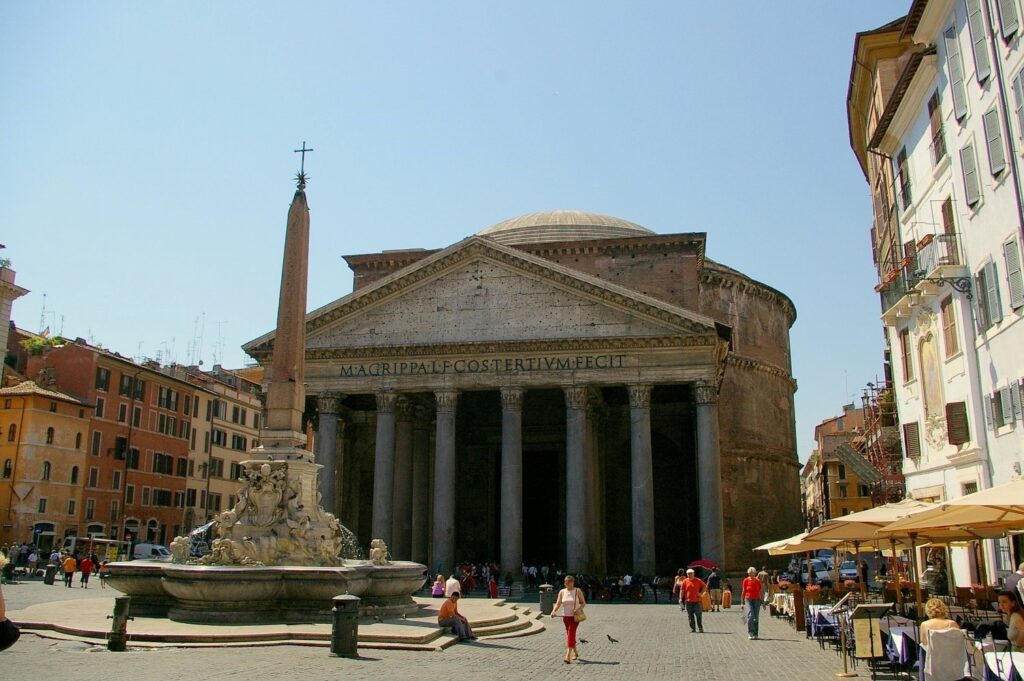
Agrippa’s masterpiece is the Pantheon in Rome, finished in 25 B.C.E., partly to celebrate Augustus’s victory at Actium. It’s the first place I visit whenever I return to Rome. In fact, about noon every day, I sit at one of the cafes in the piazza across from the Pantheon and order a modest plate of Cacio e pepe, a bit of bread (with oil) and a glass of house red wine. As you gaze at what one historian calls “the greatest of all surviving structures of ancient Rome, you see, emblazoned just below the pediment, “M * Agrippa * L * F * Cos * Tertium * Fecit,” which translates, “Made by Marcus Agrippa, the Son of Lucius, During his Third Consulship.” The Romans were just like us: Wrigley Field, MetLife Stadium, etc.
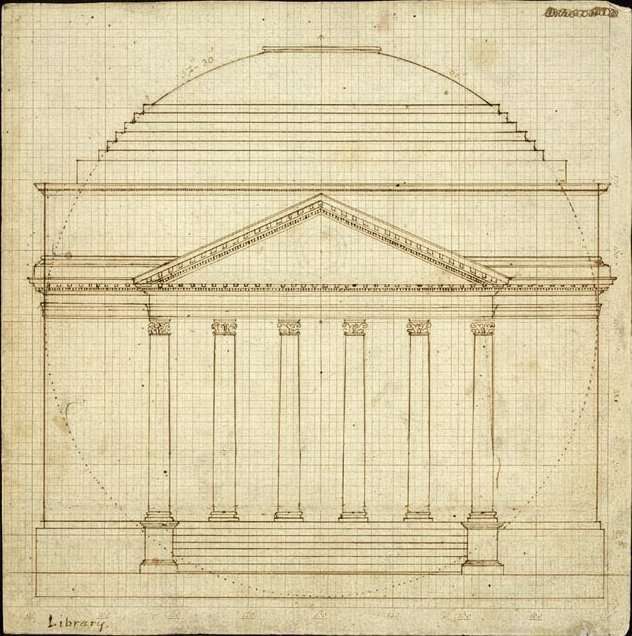
Everything about the Pantheon (a temple to “all the gods”) is monumental and magnificent, especially the dome — the largest unreinforced concrete dome in the world, even now. Jefferson, who loved classical symmetry and balance, understood that the Pantheon is a globe (sphere) inscribed in (embedded in) a cube, two perfect solids. Classical and neoclassical designs aim to evoke the cosmos’s underlying order. In creating the Pantheon, human architects paid homage to the universe’s deep geometric structures, not only to achieve beauty, but also to encourage individuals and cultures to seek order, regularity, and harmony in all they do.
The great dome has never collapsed, despite weighing 5,000 U.S. tons (9.9 million pounds), because it was built with something called hydraulic concrete. This was a kind of super concrete made with lime, rubble, mortar, and a sandy, highly reactive volcanic ash (called Pozzolana) that was mined near Mt. Vesuvius at Pompeii. It is unlikely that today’s typical concrete could withstand the enormous pressures of an unreinforced dome. We use rebar; they used pounded volcanic ash.
Agrippa did not invent hydraulic concrete, but he used it boldly, particularly in creating the Portus Julius on the northwestern shore of the Gulf of Naples in 37 B.C.E. Roman engineers somehow poured concrete underwater to build harbors and bridges. The Romans also figured out that this concrete formula hardened over time in seawater through a spontaneous chemical and mineral replacement process.
Note: The Pantheon we see today is not the one Agrippa built. That one burned in 80 A.D. (decades after his death), was rebuilt by Emperor Domitian, burned again in 110 A.D., and was rebuilt in its current form by Emperor Hadrian in 125 A.D. It would be interesting to see the original. However, the experts say Hadrian did what he could to honor Agrippa’s design, including giving Agrippa proper credit for the building on the façade.
Harris’ Agrippa is only partly about these engineering achievements, of course, but I found those passages particularly satisfying after my recent visits to southern France and (last December) Rome. I love serendipity in all of its visitations. Hundreds, perhaps thousands, of books cover the last years of the Roman Republic and the rise of the Roman Empire, including my friend Edward Watts’ outstanding (and thoroughly readable) Mortal Republic: How Rome Fell into Tyranny. Other favorites include Tom Holland’s Rubicon and his sequel, Dynasty. It is also worth reading anything by the English classicist Mary Beard (see SPQR: A History of Ancient Rome). But Agrippa: A Novel of Rome’s Descent into Despotism is the first book to examine this fascinating (and unfortunately too relevant) period of history through Agrippa’s lens. Harris contextualizes Augustus without diminishing him (the Emperor) — not an easy achievement — and he makes us aware of the profundity of Roman engineering — aqueducts, ports, temples, bridges, war machines, and of course the famous Roman roads, a fragment of which I saw in Narbonne two weeks ago. I sat on the pavement stones of that bit of road (the Via Domitia) for half an hour. Then I went into the amazing Narbonne covered market and ordered lunch at a place where butchers literally toss raw cuts of meat to the chef.
The one thing I disliked about Harris’ novel is his assertion that Agrippa was probably the natural son of Julius Caesar. There is absolutely no evidence to support this notion. If it were true, it would help explain why Caesar befriended Agrippa (who did not come from the senatorial class) and why Agrippa ended up at the same boarding school as the young Octavian. But at a time when people on both sides of the Atlantic are addicted to conspiracy theories and unsubstantiated mythologies, this gambit not only damages the novel for me, but forces any historian to wonder what else Harris has imagined and for what purpose. Still, I am so glad I listened to the novel. The minute I got home last night, I fetched four or five books on the last years of the republic from my library.
Now I’m scheming my next visit to Rome and Florence.