
I nearly ran out of gas yesterday on a remote highway in the Bitterroot Mountains. It was a winding, narrow road with no shoulder to pull off onto … but more of this crisis later in the story.

Running out of gas is not something I do very often, but I confess I am fascinated by how much gas is still in the tank after the yellow warning light comes on. I have thought it would be fun to bring five gallons in a red jerry can and see how many miles you really still have after the vehicle barks out its warning.
I always shudder a little when I see one of those signs in the American West, “Next gas 79 miles.” I glance nervously at my gas gauge. I tend to fuel up when the gauge approaches a quarter tank.
The Necessity of a Prenup
Long ago, I courted a very smart woman who owned an old classic blue-gray Volkswagen Beetle. It was early in the romance, and I was visiting her in far western Kansas. We drove around the countryside — a vast rolling grassland interrupted here and there by square fields irrigated by the celebrated Ogallala Aquifer. She drove. I noticed that the gas gauge indicated empty. No, she said, she reckoned she had about a quarter of a tank. Well, how would you know, I wondered. You see, she said, the gauge is broken, and she had done the math on the VW’s likely range, then taped a bit of old masking tape on the dashboard, scrawled with the odometer reading she thought would represent near-empty. What could go wrong? I should have bolted back to North Dakota right then. I tried to argue with her in a sweet young love sort of way: there were so many potential factors — steep hills, exceeding (as she routinely did) the speed limit, maybe even the quality of the gasoline. She assured me that I didn’t know nuthin’ about nuthin’ and we traveled on.
The next day, we went to town, five miles away on the farm-to-market road, past the town dump (this was decidedly not “landfill” territory) and the Schemm place. She drove of course. As we were cresting the last hill before town, the WV ran out of gas. She told me that if I got out and pushed it up over the crest, it would be all downhill after that, and maybe we could glide into the gas station on the southern edge of town. Again, what could go wrong? So I got out, left the passenger door open, ruptured several internal organs pushing the car over the hump until it began to pick up a little speed, sprinted forward, jumped in, and down we went to the filling station. We filled up, and she scratched out the odometer data on the masking tape, did a little math, and scrawled the new number on the tape.
As I performed this act of unsought and unrewarded chivalry, a number of local folks roared past us in both directions, and we were subjected to what might be called a variety of rural forms of satire. “Oh, looks like missy has found a ringer! She does this with all her suitors just to make sure they know who’s in charge.” That sort of thing, and interesting hand gestures, too, and some laughter of the har-har sort. As I say, I shoulda bolted right then. That was just the beginning. It soon transpired that she always parked on a hill because the starter was intermittent. I come from a family where the cars are all new and all their systems reliable. Getting rid of that VW was our only prenup.
The Long Walk
Flash forward 20-some years. I lived (still live) in Bismarck, North Dakota, but I had a job that took me once a month to Dickinson State University, 100 miles to the west. It had been a long day in the office. I was driving back to Bismarck on a beautiful September evening, the temperature was about 70 degrees. My mother called me out of the blue from a cabin down near Yellowstone National Park. We hadn’t talked for a while, and there was a lot to talk about — all good — and the call lasted for about 40 minutes.
If I may paraphrase Dr. Hunter S. Thompson (Fear and Loathing in Las Vegas), it was out around Glen Ullin where my totally reliable Honda Accord began to chug and lurch and chug. I glanced down and discovered that I had run out of gas. I did not wish to confess this unfortunate truth to my mother. “Gotta go for the moment, Ma. I’ll catch up with you later.” I lurched back and forth in the driver’s seat the way you would in a go-kart and managed to get the car over onto the wide shoulder before it stopped dead. I had run out of gas about 50 miles from home.
What to do? No spouse. No child nearby. No friend I wanted to inconvenience for a couple of late evening hours.
Fortunately, I had cell service. I looked up the local gas station’s number and called. It was 9:52 p.m. A woman answered. I went into that rapid-fire mode we take on when we want to get the whole message out before we get interrupted. “Hello, I’ve run out of gas on I-94 just at the off-ramp. I wonder if you would be willing to help me.” Long pause. “No, I’m just about to close up.” I said, “I’m so sorry. This is just one of those situations. I live in Bismarck, spent the day in Dickinson, and have stupidly run out of gas. Do you think you could help me out here?” “No.” “If you could just bring me a one or two-gallon container of gas, I’ll pay $50, and be glad to pay it.” “No,” she said, “this is one of those situations where nuthin’ good can come of it.”
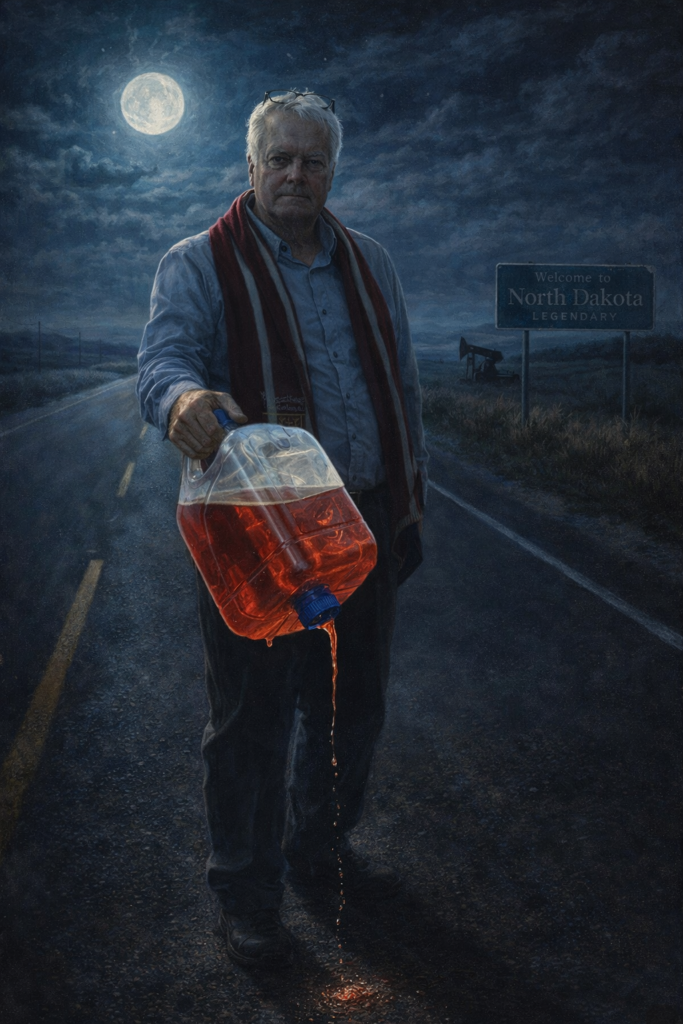
I said, “How about this? You bring the gas to a fencepost a quarter of a mile away, and I’ll have left three 20’s, even five, on top of it under a small rock. That way, you won’t have to get anywhere near me. I’m a fellow North Dakotan, and we North Dakotans help each other out.” “I’ll say no one more time. Ever since the oil boom came, I don’t trust nobody. I’m tired, and I’m ready to get home, and I have to close up.” “What should I do?” I asked. “Call the bar. Maybe someone there is drunk enough to come help you.” And she hung up.
OK then. I knew nothing would be open in town, but I reckoned that the gas station, like most in rural America now, would have a pump you could activate at any hour with a credit card. So all I had to do was walk to town (four miles), fill a container with gas, walk back (four miles), pour it into the car, and bingo! On the road again! Trouble was, I didn’t have a container in the trunk. After scrounging in the dark I did, however, find a battered empty plastic gallon-sized distilled water jug in the trunk. That would work.
It was now 10:30. As Huck Finn would put it, warn’t nothing to do now but walk on over to town, get the gas (assuming there was an auto-pump), walk back, etc. So I hiked to town. The temperature was dropping, and I hadn’t brought a jacket. It took just under an hour to get to Glen Ullin. Population 705. There was jukebox music coming from the bar on Main Street, and about 20 pickups parked outside. The pump worked. My credit was good. I filled the jug. Like all such jugs, it was thin and flimsy, and the fragile lid snapped on in a half-hearted and deliberately temporary sort of way.
Now all I had to do was walk back to the car.
Alas. I was holding the jug in both hands to keep it from jostling and it soon became clear in the inky darkness that it was leaking a little from the flimsy bottom seam. What to do? I decided to turn the jug upside down to stop the leak, but I knew that if I did that, the lid would not hold for more than a few seconds. The only thing to do was to grip the handle strongly with my right hand with two fingers over the bottom (now top) lip, and press the fragile lid up tight against the jug neck with my left hand, walk very slowly, and hope that the whole thing didn’t disintegrate halfway to the car. It was getting pretty chilly now.
Here’s where the humanities come in. I felt like the ancient fisherman in Hemingway’s The Old Man and the Sea, who catches a giant marlin, the marlin that would redeem his life, but it is eaten by sharks before he can row it to port. To pass the time on my nocturnal hejira, I tried to make a mental list of all of Hemingway’s novels.
By the time I got to my stranded Honda, the jug was only half full. It had leaked on my hands, shirt, and trousers. Had someone thrown a match at me, I would gone up like a Molotov cocktail.
Now my concerns were down to two. 1. Could I pour what gas was left into the tank without spilling most of it? And 2. Would half a gallon of gas be enough to start the car?
It worked somehow. I drove the four miles to Glen Ullin and filled the tank full, even though I wanted to throw a brick through the convenience store window.
An Interlude To Cheer Myself Up
A few years ago, my friend Alan Simpson, the Wyoming U.S. Senator and known smart aleck, said he and his wife were driving through Montana on their way to Minnesota, and would I meet them in Medora, North Dakota, and take them to Theodore Roosevelt’s remote Elkhorn Ranch site, which he had long wanted to visit. Of course I would. On the day in question, I was in Medora cooling my heels when the senator called. “I’ve made a rookie mistake for which I should be horse-whipped. I’ve run out of gas somewhere near Glendive, Montana. Can you help me?” Of course I could. When I arrived with five gallons of gas, I said, “Karma, Senator, you should have been more generous to Anita Hill!” He laughed his most hearty laugh and said, “You’re right. If you knew all I know about that sorry business …” He loved sitting on the grass within the perimeter of TR’s Elkhorn Ranch house with the cottonwoods a perfect golden yellow doing their symphony above us. We talked about the life and legacy of Theodore Roosevelt, America’s conservation president.
And Now Yesterday’s Near Debacle
When I arrived in Missoula yesterday, I intended to fill my pickup with gas. I had a few errands to run first, and then my friend and colleague Liz decided she would ride up to Lochsa Lodge with me, 56.3 miles west over the pass. We had a quick lunch, stopped to buy a few items, and started up one of the loneliest highways in America, U.S. 12 between Missoula, Montana, and Lewiston, Idaho. Liz and I hadn’t seen each other for five months. We were gabbing away. We were halfway there when my gas light popped on. I had forgotten to fill the tank! The dashboard estimator said I had 37 miles left in the tank, but we were climbing the mile-high pass, and I had no idea whether that would be enough gas to get us to the lodge.
It was a lovely winter day (35 degrees, no wind), so we weren’t going to be the Donner Party. But I did not want to run out of gas with Liz in the truck. Why? Because Liz is married to a man I’ll call Russ to protect the innocent. He makes Alan Simpson look like a Mormon Boy Scout choir boy in a Norman Rockwell painting. This “Russ” appears to enjoy nothing so much as making fun of me for what he seems to regard as foibles of one sort or another. And this “Russ” and I had nearly run out of gas three years ago near Miles City, Montana, when I had made another sort of rookie mistake. In his gentle way, Russ has reminded me (and anyone else handy) of the “incident” approximately 30 times per year. If Liz and I ran out of gas, I would never hear the end of it. In fact, I will never hear the end of it anyway, because that is how vicious Russ is. And he is one of the best friends I have ever known.
What to do? Again, here’s where the humanities matter in a complete life. Jack Kerouac is one of my favorite authors, and On the Road (1957) is one of my favorite books. You will remember that in part two of On the Road, Dean and Sal are broke (“beat”) heading west through the mountains, and at the top of the pass, Dean puts the car into neutral to coast down the western slope to save gas. He lets the big car build speed until they are careening around the switchbacks, and even Sal, who knows what there is to know about Dean, is terrified.
So I turned to Liz and said, “My friend, we are going to have to do a full Kerouac.” When we reached the top of the pass, I put the pickup in neutral and said, “I don’t know if all 19 miles to Lochsa Lodge are downhill, but we’re about to find out.” Liz said, “You know Russ is going to get wind of this.” To which I said, “I know, Liz. You know I love you and you know I know you cannot possibly keep a juicy secret like this. My only hope is that we don’t actually run out of gas and have to call the lodge for help, because that will double or triple the lifelong abuse that’s coming.”
There were a few flat spots where the truck slowed to 20 mph, and in two of those, I put it in drive for 30 or 40 seconds. The digital gas indicator had stopped providing useful data and was now settling into a steady flash of LOW, then LOW, then LOW. I was pretty sure we were doomed. And I would have rather died somewhere in the outback of Idaho than have to face Russ if we actually ran out of gas.
After holding our breath for the last five miles, we reached the Lochsa approach road, and I put the truck in drive and went straight for the gas pumps. Liz went in to get her keys and mine for our cabins at the lodge, and I put as much gas into the pickup as it would take and then some, until it brimmed less than a millimeter below the pickup fender.
Russ is not here yet. He’ll roll up with the rest of the retreat group in a yellow school bus later this afternoon. I’ve donned a truss and taken half a dozen tabs of Valium, because when we go around the room tonight welcoming guests to the retreat and doing introductions, I would bet the pickup in question that this little (very successful) incident will somehow “come up.” Liz has undoubtedly thrown me under the bus (and the pickup) by now. I’d be sorry if she didn’t.
But here’s the consolation. And my sincere advice to all of you. Immerse yourself in the humanities. Without Ernest Hemingway and Jack Kerouac, I’d be psychological roadkill. (Don’t think I’m joking, please.) Hemingway gave me consolation out near Glen Ullin, and Dean Moriarty taught me how to cheat fate — as long as you start to cheat it at the top of a pass somewhere in the American West.
Still, I do want to figure out how much farther I could have driven if there were no alternative.