
Clay remembers an early and influential mentor, Professor John Carey of Oxford University.
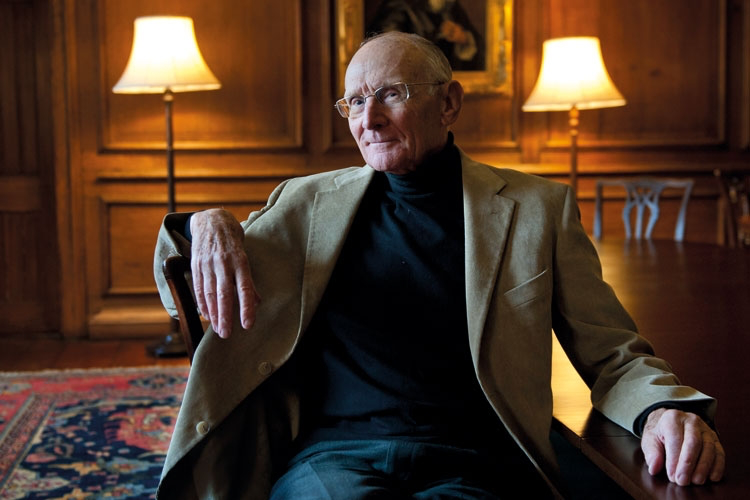
Bismarck, December 18, 2025 — I learned this morning from my daughter at Oxford University that my beloved mentor, John Carey, has died at the age of 91. I worked under his supervision for several years on my study of the sermons of the Elizabethan poet and Jacobean preacher John Donne. Carey was a tall, austere, gaunt, profoundly learned, witty, and sometimes caustic man. He treated me with generosity and respect.
Carey was the Merton Professor of English. Merton is one of Oxford’s 38 or so colleges and also one of its oldest. That he authored 15 highly regarded books of English literary criticism and biography does not do him justice. My favorite of those are: John Donne: Life, Mind and Art (1981); The Violent Effigy: A Study in Dickens’ Imagination (1973); and The Unexpected Professor (2014).
I walked into his suite at Merton one afternoon just after a British parliamentary election. His office was the template of a floor-to-ceiling gentleman’s library, just this side of a Renaissance study. He waved me in. He was on the phone with a London newspaper that wanted him to guess what prominent English writers would think of the result: Shakespeare, Donne, Dickens, and Henry Fielding. They asked about Milton. He cupped the phone and turned to me. Any thoughts? I said, “I don’t know, but he’d be an “acrimonious and surly republican.” Carey laughed out loud and spoke that into the phone. It was a literary allusion. The 18th-century poet and critic Samuel Johnson, who admired but did not like Milton, called him “an acrimonious and surly republican.” In other words, anti-royalist.
Carey also edited, with almost unbearable brilliance and erudition, The Shorter Poems of John Milton, and he translated from Latin Milton’s monumental De Doctrina Christiana (863 pages). De Doctrina is a dense, crabbed, theologically intricate work of Latin prose. First, you have to know Latin that well, and this was a special, theologically technical species of Latin you don’t get with Caesar, Livy, and Tacitus in grammar school. Translating it could not have been as joyful as translating Ovid or Virgil would have been, or anything else, for that matter. There must have been times when even John Carey wondered if he should throw up his hands, but he persevered, and Yale published it in 1973. That alone would have been a lifetime’s achievement, for a book that is seldom read even by Milton specialists. The range of his reading was staggering.

He could have been the quintessential Oxford don, but he didn’t quite succumb. He had a slight lisp, which only added to the charm. He laughed with great gusto. He rode around Oxford on one of those miniature fold-up bicycles when that was an unusual technology. One of my other mentors called him “the great stone face” for the seemingly lugubrious persona Carey had developed, but even then, I regarded that quip as jealousy.
He was actually pretty skeptical of academic literary judgment and the elitism of the British literary establishment. He sought other outlets for his work, and most of his books were written for the non-academic public. Probably nobody in the last 50 years has published more book reviews than Carey.
His lectures were standing room only. I attended them all. One was a series of four on the material excesses of the Elizabethan age, and I remember him inventorying, with great glee, the hundreds of yards of silk used in decorating principal royal courtiers; the elaborate and obscenely expensive masques and pageants her subjects organized to please Queen Elizabeth; the fireworks and animatronic swans and mythological creatures hung by pullies in the rafters. The sheer number of sheep, cows, deer, hares, partridges, hogs, and hogsheads of ale needed to host just one overnight by the Queen. This kind of hospitality — absolutely required of a titled aristocrat — nearly bankrupted some of them, but the queen, aware of the bargain, kept feeding them estates and licenses for Elizabethan monopolies. The lecture was mesmerizing (I remember it 40 years later). Once you understand the magnitude of Elizabethan excess, however, you could leave it for other commentary, but Mr. Carey, with a grimly bemused satisfaction, gave most of the lecture to those stats and stories.
His lecture style was a little formal, but his words were often hilarious. He knew the ironies of his literary analysis but presented them in a deadpan manner that added to the fascination we all felt in being in the presence of one of the giants of Oxford — in a place of giants — in his prime.
He began a course of lectures on 16th Century Prose and Poetry by saying there was no period of English literature more delightful and compelling than this one. I personally think the next century, the century of later Shakespeare, John Donne, George Herbert, Andrew Marvel, and of course Milton, is the great age of English literature, but in the course of the next few weeks, he made the works of Thomas Nashe, George Chapman, Edmund Spenser, and Sir Philip Sidney come to life. He had a special interest in the absurd, the grotesque, and the dark underbelly of Elizabethan London. No wonder he wrote a book about the imagination of Charles Dickens.
Carey believed that literary criticism must be lucid and comprehensible, that there was no room for academic jargon and deliberate obfuscation. He was as averse to “theory,” and yet he could hold his own with Terry Eagleton and the other young Turks who had fallen in love with Derrida and Foucault.
“Almost everything about bees is amazing. Worker bees fly up to three miles from the hive and visit ten thousand flowers in a day. Their wings beat two hundred times a second, and they perform elaborate dances on the face of the comb to tell other workers where and how far away food sources are. In summer, there are fifty thousand of them in the hive, and each dies of exhaustion after about five weeks. In its whole lifetime, a worker collects about a quarter of an ounce of honey, less than half a teaspoonful, but the yield from one hive in a good year can be over eighty pounds.”
― John Carey, The Unexpected Professor: An Oxford Life in Books
He wrote thousands of book reviews, often acerbic, for the London papers. They were famous for his strong opinions as well as his mastery of the book in question and its place in the larger stream of literature. When he didn’t like a book or its implications, he made that unmistakably clear.
I may be wrong, but I sense that the era of such giants — John Carey, George Steiner, Harold Bloom, and Stephen Greenblatt — the ones who read everything — is over. I hope I am wrong. I read incessantly, but I am a mere piker in this conversation. When I am in the presence of someone that well read in a range of directions, I feel only awe, as if they are creatures of another planet, at least another order of beings.
The last time I saw John Carey was at High Table at Merton about 25 years ago now. We talked about the ordeal of Salmon Rushdie — over white fish, pork steak, and (inevitably) overcooked brussels sprouts. Plus two good wines. He appreciated Rushdie’s work but found him vain and entitled. Afterwards, we repaired to the SCR (the Senior Common Room) for coffee or brandy. Opening the Times, he read out loud the obituary of a British lord who had all the zany eccentricities, hobbies, sartorial quirks, and arbitrary opinions you want from such a construct.
He looked up at the three of us enjoying his spirited read, and said, “Tewwific, Tewwific.”
Over Christmas, I am going to reread his memoir, The Unexpected Professor.