
A weary public humanities scholar settles in for a winter of reading and writing. We work him hard here at Listening to America, but in truth he is always clamoring for more. Here he reflects on the frustration of staring at a mountain of books he needs to read.
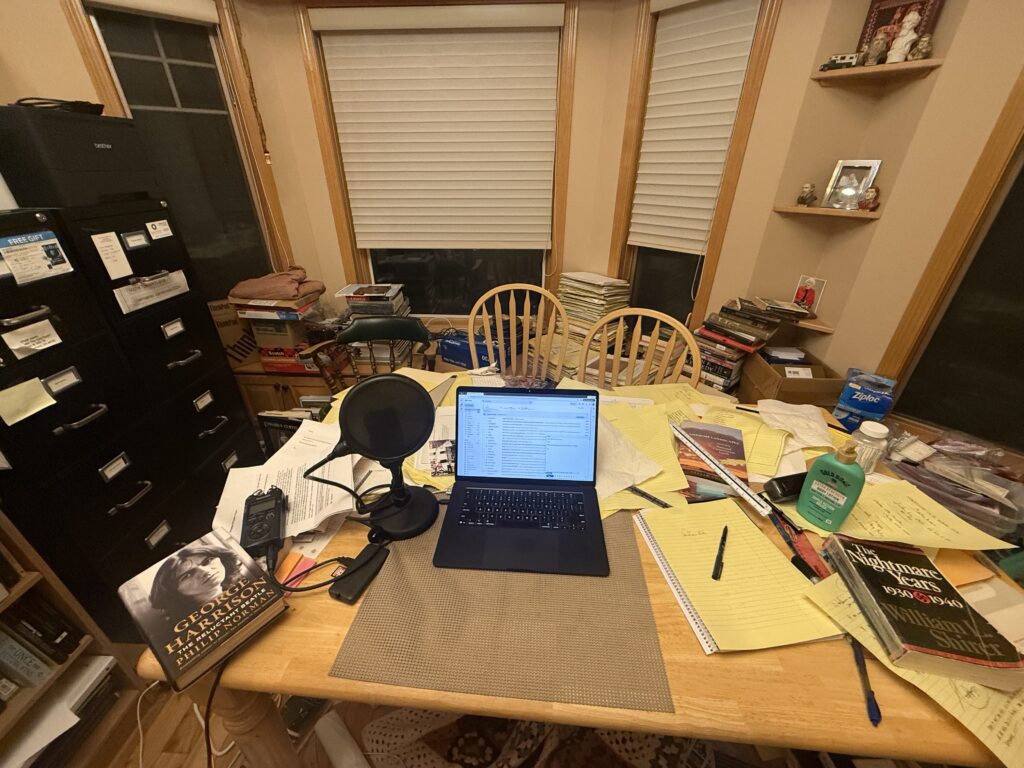
Home after a crazy year of professional and some personal travel, I have been regrouping. That means cleaning out the vehicles, rolling up the hoses, putting books and notebooks in order, and above all, reading. At the moment I’d guess I have 20-30 books that I must read, not all stacked in one place, and a great deal of writing to do. Typically, in late October or November, at the end of a hard season of professional work, almost all of which requires airplane travel, I get sick. Usually it is strep throat. My body knows what it needs; at some point, it shuts me down for a few days or a week for rest and routine maintenance. My body tends to cooperate by postponing the reckoning until most of the travel year is over, then hitting me hard. Not so this year. I’m worn out but not down and out.
As I sit at my dining room desk — my favorite work spot because a: I live alone and don’t have to answer to a more civilized human being and b: because large bay windows embrace almost half of the room and bathe it with lovely daylight, I can put my hands on about 50 books without getting out of my chair, and many more within easy sight. There are probably 20 pens (of several colors and including big black Sharpie and little black Sharpie) scattered about on my table, and at least three footlong rulers (for underlining and back scratching), a fabulous heavy vintage stapler I have had for 60 years (a white collar crime perpetrated by my father), three or four notebooks, half a dozen yellow legal pads, a large bottle of aspirin, copies of letters in and letters out, various Post-its, a small audio recorder, some errant flash drives and SD cards, a few Ziplock bags (humanity’s greatest invention, with the possible exception of Ginsu knives), two maps of the American Southwest, and a large professional microphone complete with a p-pop filter screen, and — I’m sorry to report — quite a bit more. When people see this and are trying to be nice, they say, “Well, it’s not such a big deal because you are mentally organized.” Sure I am.
More or less at the same time I am reading a new book on the Bureau of Land Management and the ongoing disputes about America’s public lands; a book on Renaissance alchemy (a spiritual precursor to modern chemistry); the third of the six Jane Austen novels I will be featuring in one of my three humanities retreats out at the venerable Lochsa Lodge west of Missoula come January; books about the Beatles, currently Tim Riley’s outstanding biography of John Lennon; and several books “for fun,” including the CBS journalist William L. Shirer’s three-volume autobiography. I take extensive, exhaustive notes on almost everything I read, even a Dickens novel (why?), but just where all those notes wind up is a problem. I’m not one of those “execs” who leave their desk clear and clean at the end of the business day. If I won the lottery, among the first things I would do would be to hire a personal assistant whose sole duty would be to bring order to all of this so that when I said, “Athena, do you remember where I put those 143 pages of notes on Thoreau’s Walden after last year’s retreat?” she would look at me with pity and contempt and say, “Yes, although they are in your file cabinet under the letter T, allow me to fetch them for you.”
As I sit here gazing at the books I know I need and want to read, I am often reduced to a kind of paralysis. Even a low-level depression. Where to start? How much can I realistically read in a week, a month, a year? (I sometimes do the math: if I could read 52 books per year, and let’s say I live another 20 years. …). Why is it that when I read a book I have previously read — in this case A.C. Grayling’s The Age of Genius: The Seventeenth Century & the Birth of the Modern Mind — I come upon passages I have previously underlined but don’t remember reading? Still, it is clear that I did read the book and that I found certain passages worthy of remembering. I wish I had an assistant who would go through my books at the end of the week and copy out all those paragraphs into what, in Thomas Jefferson’s time, was called a Commonplace Book. But no.
If Sadness #1 is that there will never be enough time to read all that I truly need to read, much less all that I want to read, and less still than what I should by now have read, with more excellent books being published in a month, every month, than I can read in a year or more, Sadness #2 is that I seem to retain so little of what I have read. For the most part, my reading brain feels like a very leaky bucket. On the many occasions when I come upon a passage that really impressed me, perhaps only two or three years ago, and I don’t remember reading it at all, I sometimes throw up my hands or get up from my chair roughly and ask myself, “What’s the point?” “What’s the point of all this lifetime of serious reading when much, even most, of it slips away into oblivion, like your room number from a hotel three weeks after you fly home?” What’s my actual retention quotient? Why not just work in a tree nursery or watch old reruns of I Dream of Jeannie?
Truly.
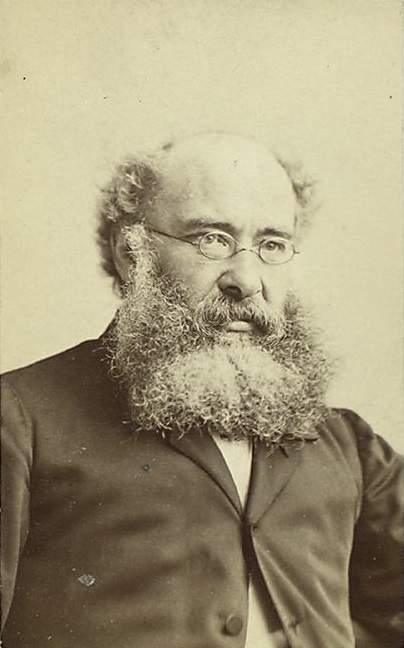
I wish I were one of those great readers, the readers who appear to have read everything. Among them were Theodore Roosevelt, Erasmus of Rotterdam, Dr. Samuel Johnson, the literary critic George Steiner, and, alive today, Bill Gates, who somehow manages to read 50 books per year, and Warren Buffett, who is said to read 500 pages a day. I don’t disbelieve that, but my immediate response is, by acronym, AYFKM, the first words of which are “Are you” and the last “kidding me!?” President William Jefferson Clinton was a great reader when he wasn’t exacting pleasure the old-fashioned way. I studied with a young scholar named Julian at Oxford University long ago who came back from the long summer vacation and asked me what I had read over the “long vac,” as it is called. I said I had read Sir Thomas Mallory’s Morte d’Arthur and Homer’s Iliad, some of it in ancient Greek. I was pretty self-impressed. When I asked him what he had read, Julian said, without a hint of triumph, “I read Anthony Trollope novels.” “Which ones?” I innocently asked. “Well, all of them.”
Well, all of them means 47 novels, at about 460 pages per novel. That’s about 5 million words. Trollope (1815-1882) worked for more than 30 years for the British Post Office, and he wrote all his novels before breakfast. Julian had read them all, and his retention was staggering. He went on to score the highest First Class Distinction in our final exams, and he is now one of the world’s leading experts on Trollope, an emeritus fellow at Regent’s Park College, Oxford University, so I guess it was time well spent. All I remember is wanting to slink away and work in a butcher shop.
In Shakespeare’s comedy Twelfth Night, the dissolute aristocrat Sir Andrew Aguecheek laments: “I would I had bestowed that time in the tongues [i.e. foreign languages] that I have in fencing, dancing, and bear-baiting. O, had I but followed the arts!” Indeed. If I had all the time back that I have spent watching late-night television (and bear-baiting, of course), I could read the complete works of Dostoevsky (11 major novels) and Tolstoy, too (four colossal novels, including the world’s greatest novel, Anna Karenina (a mere 364,000 words, a pamphlet compared to War and Peace at 587,287 words).
I have tried several times to master the art of speed-reading. I have known one or two people who can comfortably read 100 pages per hour, but my efforts have inevitably miscarried, which always makes me remember Woody Allen’s quip: “I took a speed-reading course and read War and Peace in 20 minutes. It involves Russia.”
I have always thought it would be a great achievement to have read the complete works of a single great writer. Choose carefully and don’t let it be Trollope! I think I can say I have read all of J.D. Salinger, all of Harper Lee, and Boris Pasternak (just one novel, Dr. Zhivago), but you don’t want to choose Stephen King (60 novels) or Barbara Cartland (600+). I can’t even say I have read the complete works of Henry David Thoreau, because though he published only a couple of books, he also kept his famous journal for 24 years: 2 million words, 10,000 manuscript pages, 47 handwritten manuscript volumes. He died at 44 on May 6, 1862. Just imagine if he had lived to 78, like his problematic mentor Ralph Waldo Emerson. I knew an itinerant park ranger at Rocky Mountain National Park who was one of those admirable and annoying minimalists. The only books he took with him from one National Park to the Next (always living in perfectly spartan park housing) were a complete print edition of Thoreau’s journals. You know those people you love and hate at the same time. I’ve read plenty in Thoreau’s journals, but not nearly enough. In some of it, truthfully, the great naturalist sees so much of the “world in a grain of sand” that my mind wanders from berry to stamen and then into thin air, and then all I want to do is get a bucket and go a huckleberrying.
My Pampered and Privileged Life

It is not all bad news, of course. First, somehow the universe has granted me a life of reading (and talking and writing), which is fundamentally different from my grandparents who worked endlessly on their modest dairy farm in western Minnesota. My grandfather toiled outside in the Minnesota climate, and my grandmother toiled both inside and out, with a half-acre garden, 500 quarts of canned produce per year, and when she wasn’t busy, when the evening news came on or Johnny Carson, she crocheted, knitted, and darned socks. Yes, darned socks! When I was studying at Oxford, she wrote me wonderful handwritten letters on onion skin to save postage. One time she reported that she had “put up” 45 apple pies over the weekend. I thought, great, I read Act II of King Lear this weekend. My pampered and privileged life has involved no heavy lifting. I haven’t had to go out at 3 a.m. to pull a calf in a raging blizzard or get the crop in through the night before the coming storm, and I have seldom had to punch a clock. So I have no room to whine.
Second, we now have such marvelous tools. First there was the Internet, so common now that we have dropped the capital I. Then Wikipedia. Then Google searching. Now AI. And AI (the most revolutionary tool of them all) makes what we do infinitely easier. Take Trollope, for example: please! If, back in 1980, I had wanted to know how many books he wrote and how many words, I might have found the book count in the Encyclopedia Britannica. Still, I would have had to get my hands on at least three of his novels to begin to ascertain the average number of pages per book. I might have had to drive to a library, and even then it might have taken a full day to find what I needed.
Then Versus Now
I used to ask my college students to find answers to 20 questions all typed out on my IBM Selectric III (a primo instrument!) and copied on a Spirit Master mimeograph machine (ah, that wonderful smell, and those slightly damp pages). Questions like: How many acre-feet in the Aral Sea? What is the highest peak in Finland? Where is former baseball player Rod Carew now? How many times does Shakespeare use the term “scruple”? What was the seventh of Luther’s 95 theses? Etc. I just now chose these questions at random. It took my students a full week to track such things down. Some threw up their hands and changed their major to astronomy. Now they are billionaires with yachts, and I eat generic ramen. That was then. Today this little research assignment, designed to teach them how to use the library to root out information, is pointless. Let’s see: Aral Sea, 850 million acre-feet; Finland, Mount Halti, 4,344 feet, located in Finnish Lapland; Carew, now 81 years old, living in southern California, lifetime batting average .328; Shakespeare, scruple, 28 times, 23 singular, five plural; and Luther, “God remits guilt to no one whom He does not, at the same time, humble in all things and bring into subjection to His vicar, the priest.” I just looked all this up, and the whole assignment took less than four minutes!
AYFKM? That would have taken forever in 1985. I learned, too, that Rod Carew had a heart and kidney transplant back in 2016.
I can also tell you when “scruple” entered the English language: AI told me it appeared in the 15th century, from the Latin word scrupulus, meaning a small, sharp stone or pebble, which is lovely to know. Etymology is one of my favorite hobbies. A scruple is a little nagging concern of conscience, like a pebble in your sandals! Excellent. But I was not satisfied with “15th century,” so I had to get up out of my chair (effort), walk to my upstairs library to find volume XI of the Oxford English Dictionary (OED), find a magnifying glass (old eyes, small print), to learn that it was in 1526 that the word first was used in this sense in the English language. Still, not far below that in the OED’s illustrative sentences, Shakespeare’s “some craven scruple / Of thinking too precisely on th’ event” from Hamlet (1602) appeared. Violà. That one factoid took a full 10 minutes to track down, and if I hadn’t had all 13 volumes of the OED within 20 feet of my desk, I would have given up.
Maybe AI is going to decide that the human race is a terrible invasive species (a view held only by the jaded) and snuff us out, but in the meantime I am going to find ways to tame it and use it. Thanks to the digital revolution, I could tell you in less than 10 minutes how many different (i.e., distinct) words Trollope used in those 47 novels. Well, actually, it took less than 30 seconds, and AI only told me it might be as many as 30,000+ distinct words, depending on what you mean by distinct. That was pretty disappointing, but I did learn that almost all of Trollope has now been digitized, which means it will soon be possible to get much closer than the vague and suspicious 30K+. I did learn, however, that a New York-based fellow by the name of Peter Fink has done the definitive study of chapter length in Trollope: “The Evolution of Order in the Chapter Lengths of Trollope’s Novels,” which was published in Literary and Linguistic Computing, Volume 21, Number 3 (September 2006), pages 275–282. For all I know, this Fink probably won an award for this cutting-edge scholarship or earned tenure on the basis of it.
Which leads me to my last point. If you asked these questions of Wikipedia, you’d maybe get your answer. After all, Wikipedia now contains 7,621,000 articles in English alone, compared to the pitiful 65,000 articles in the 32 volumes of the print edition of Encyclopedia Britannica. But my AI companions (free or very nearly so) not only answer my questions, usually within seconds, but also offer a menu of further fun facts and searches they would be happy to do for me. For example, AI actually suggested that I contact the aforesaid Fink and offered me his email address. Yikes. One AI provider even says that if I am a college student, it would be quite happy to write a “draft” (sure, just a draft!) of the essay that is due tomorrow. Meanwhile, my AI companion, whom I’ll call “Athena,” suggested that I compare Trollope’s vocabulary to that of Shakespeare, Dickens, and Jane Austen. Why? Because it knows that I have been working on Dickens (David Copperfield) and Austen (all six novels). This is a bit unsettling. What else does it know about me?
Notice that in all of this I have not quoted a single sentence of Trollope, not even from his masterpiece, The Way We Live Now (1875), and I have said absolutely nothing about his purposes as a novelist, or the themes he wrestled with in those gazillion words. Beware. AI is going to revolutionize everything, but it is not necessarily going to make us a jot wiser. First use of the word “jot” in English: 1562.
Yes, my friends, this is my life. To which the only sensible response is:
AYFKM?