
Can Artificial Intelligence reliably rank the 10 greatest poems of all time?
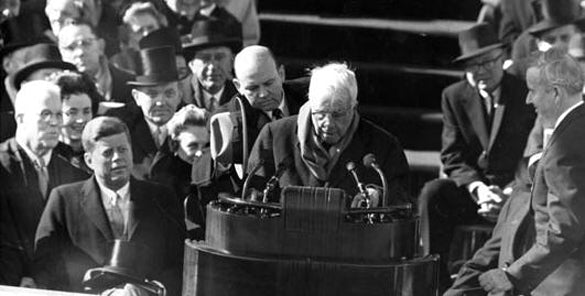
We’re all bombarded with Facebook “reels” now. I didn’t even know what they were a year ago, and now they are everywhere. I’m in some of them. Most of them are inane. (I repeat, I’m in some of them.) Many reels are annoying because they lure you in for 10 seconds and then just stop in mid-sentence unless you subscribe, “like,” or “click below.” The idea that anything of real value can be conveyed in a handful of seconds is yet another insane sign of our times.
A reel popped into my world yesterday promising to list the Ten Best Poems in English. “That should be interesting,” I thought. So, I watched it through. Here’s the list:
10. O Captain! My Captain! by Walt Whitman
9. No Man Is an Island by John Donne
8. Hope Is the Thing With Feathers by Emily Dickinson
7. The Tyger by William Blake
6. The Road Not Taken by Robert Frost
5. Stopping by Woods on a Snowy Evening by Robert Frost
4. If by Rudyard Kipling
3. The Raven by Edgar Allan Poe
2. Do Not Go Gentle Into That Good Night by Dylan Thomas
1. Daffodils by William Wordsworth
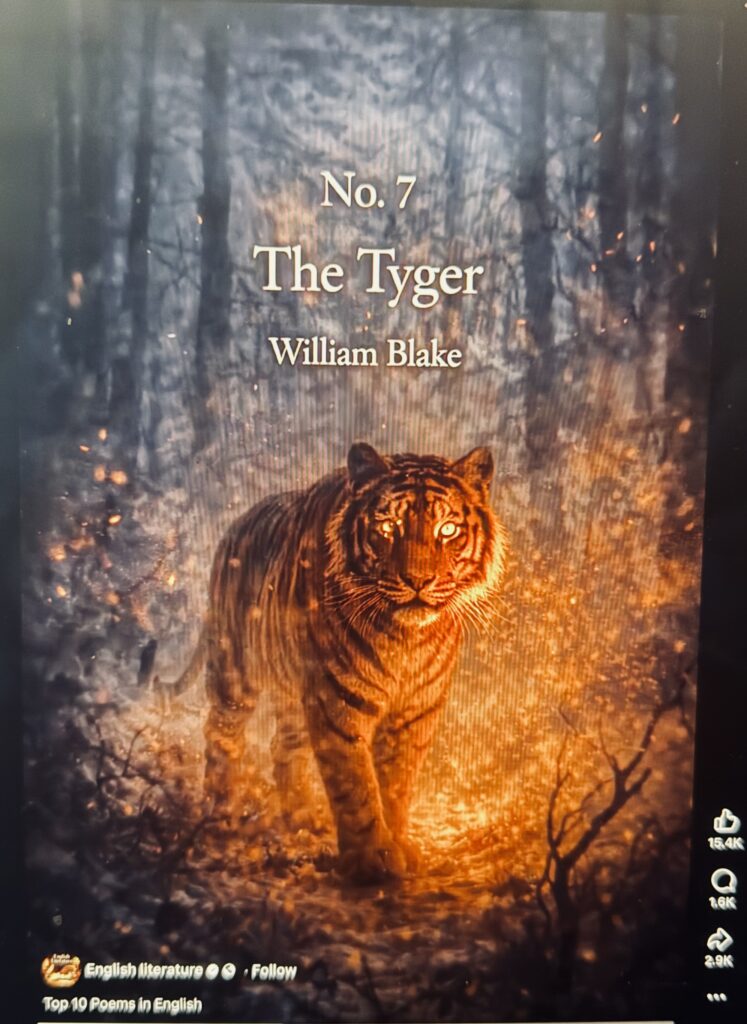
The graphics are all AI-generated and not bad. But the choices? Well, first, how do you choose 10 poems from the hundreds of thousands, even millions, in the English language, thousands of them outstanding? Short poems? Long poems? Epic poems? Sonnets? Elegies? Contemporary poems? Haiku? And if you do presume to choose 10, surely this Reel does not enumerate the list any serious student of poetry would nominate.
This list appears either to have been generated by a rudimentary AI engine (“name some popular poems”) or by someone who is straining to remember the poems they read back in high school.
O Captain! My Captain! needs a question mark, not an exclamation point. Really? We had to memorize it in middle school. Walt Whitman is a great American poet. Off the top of my head, I can think of a dozen Whitman poems better than his dirge for Abraham Lincoln. Whitman’s Leaves of Grass is indeed one of the world’s great poems. I’m not sure I would place it in the top 25 or even top 50, but I would choose it a thousand times before I would ever even think of the dreadful O Captain! My Captain! And if you want to read a much better Whitman poem on the death of Abraham Lincoln, how about When Lilacs Last in Dooryard Bloomed.
No Man Is an Island is not even a poem. It is without question a stunning evocation of the interconnectivity of everyone everywhere, and it has a definite poetic ring, but it is a prose passage from John Donne’s Devotions upon Emergent Occasions (1624), Meditation XVII. Here’s the famous passage:
No man is an Iland, intire of itself; every man is a peece of the Continent, a part of the maine; if a Clod bee washed away by the Sea, Europe is the lesse, as well as if a Promontorie were, as well as if a Manor of thy friends or of thing owne were; any mans death diminishes me, because I am involved in Mankinde; and therefore never send to know for whom the bell tolls; it tolls for thee.
I first encountered these sentences in high school, fell in love with John Donne, and gave about 15 years of my life to his poetry, especially his Renaissance English sermons. And for all of its greatness, this is not even the best of Donne’s prose, much less his cynical, witty, erotic, and metaphysical poetry. If you only get 10 poems, you’ll want to hold prose works at bay.
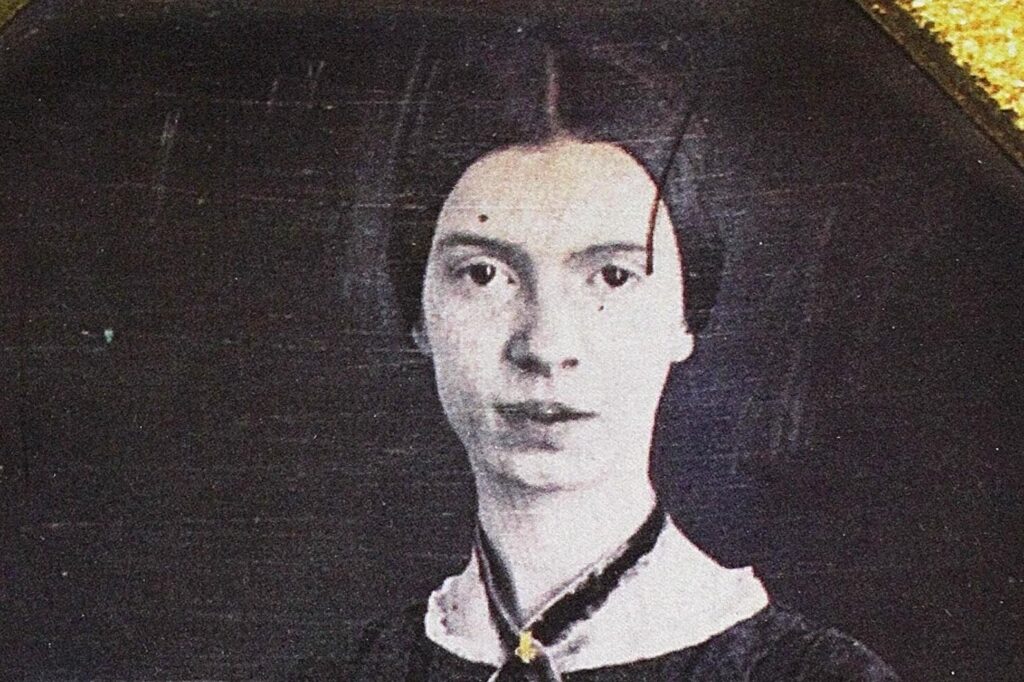
Hope Is the Thing With Feathers is an excellent poem by Emily Dickinson. Everyone’s taste is their own, of course, but I can think of a fairly large number of better poems by the elusive Dickinson. Try I Heard a Fly Buzz – When I Died, or The Heart Asks for Pleasure First. Nor would I put any of her poems in the world’s top 10.
William Blake (1757-1827) deserves careful attention. The Tyger is a great Blake poem. It has the advantage of sounding like poetry, which makes it relatively easy to memorize. There is better Blake. It’s not clear that any Blake belongs in the top 10 list, but this is the reels’s worthiest choice so far.
And then two by Robert Frost! My sense is that in a top 10 list you only get one, but both of these poems are outstanding, and The Road Not Taken is profound. Frost certainly belongs on the short list of America’s greatest poets. With the possible exception of Wordsworth’s Daffodils, these two short poems seem to me to be the worthiest to be included on this list. But for more complex, equally great Frost poems, try The Star Splitter and Mending Wall.
Rudyard Kipling’s prose and poetry have been underrated in my view, and If is a wonderful poem. Here are the two opening stanzas:
If you can keep your head when all about you
Are losing theirs and blaming it on you,
If you can trust yourself when all men doubt you,
But make allowance for their doubting too;
If you can wait and not be tired by waiting,
Or being lied about, don’t deal in lies,
Or being hated, don’t give way to hating,
And yet don’t look too good, nor talk too wise:
If you can dream — and not make dreams your master;
If you can think — and not make thoughts your aim;
If you can meet with Triumph and Disaster
And treat those two impostors just the same;
If you can bear to hear the truth you’ve spoken
Twisted by knaves to make a trap for fools,
Or watch the things you gave your life to, broken,
And stoop and build ’em up with worn-out tools.
An excellent poem that I somehow associate with Theodore Roosevelt, who knew and admired Kipling, but not among the top 100 in the English language.
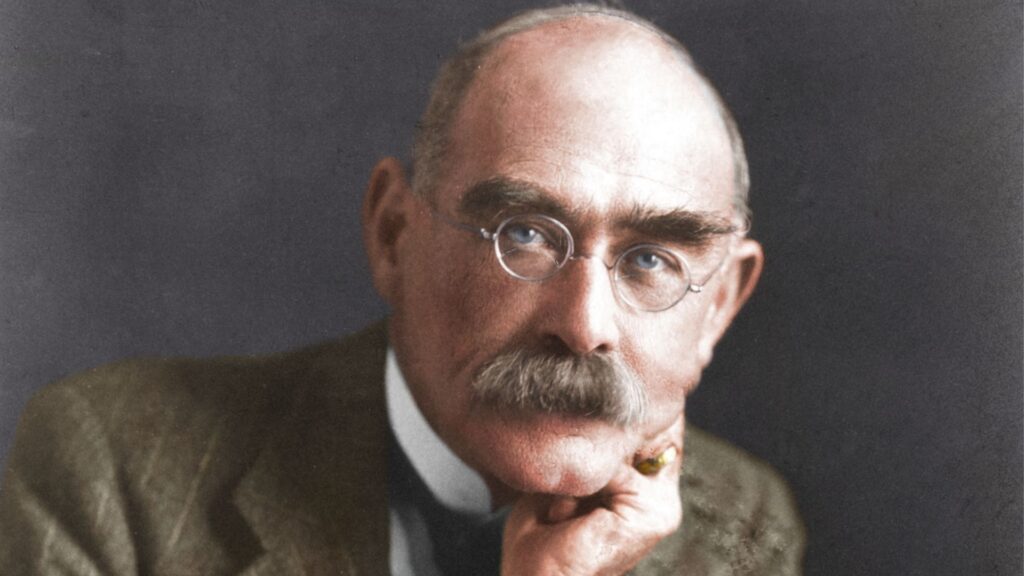
Again, it seems to me that who or whatever compiled this list was straining to remember any poems from their childhood. If is clever, satisfying, and reassuring, but it is not Chaucer.
I first read The Raven in eighth grade. We spent a week on Poe, beginning with his short stories, The Tell-Tale Heart and The Pit and the Pendulum. The Raven is a good poem, but it does not belong on this list. None of Poe’s poems belong on the top 10. I love the incantatory quality of his poem Alone:
From childhood’s hour I have not been
As others were — I have not seen
As others saw — I could not bring
My passions from a common spring —
The Raven is the longest poem in this list, and it is definitely worth reading — even better, worth hearing read by someone with a dramatic flair. My mother loved to recite it to her students.
Do Not Go Gentle Into That Good Night is a justly famous poem by the Welsh poet Dylan Thomas. Even if poetry is not your thing, you’ve surely heard someone intone “Rage, rage against the dying of the light.” Rage all you want, but death is the one appointment nobody fails to keep. Do Not Go Gentle is, to my mind, half poem, half cliché, and not top 100.
William Wordsworth (1770-1850) revolutionized English poetry. When Wordsworth and Samuel Taylor Coleridge published Lyrical Ballads in 1798 (Thomas Jefferson was vice president of the United States), they changed the course of English literature. Daffodils is justly celebrated. Here are the first two stanzas:
I wandered lonely as a cloud
That floats on high o’er vales and hills,
When all at once I saw a crowd,
A host, of golden daffodils;
Beside the lake, beneath the trees,
Fluttering and dancing in the breeze.
Continuous as the stars that shine
And twinkle on the milky way,
They stretched in never-ending line
Along the margin of a bay:
Ten thousand saw I at a glance,
Tossing their heads in sprightly dance.
There are much greater Wordsworth poems. Try Tintern Abbey, Ode: Intimations of Immortality, and the sonnet The World is Too Much With Us. But Daffodils joins the two by Robert Frost as being at least worthy of honorable mention in a top 10 list.
Simple Snobbery?
So, what’s my point here? I may sound like a snob, but at least I’m not a beer snob! Besides, in a list of the Top 10 NBA Players of All Time, if you include Scotty Pippen and not Michael Jordan or Clay Thompson and not Kareem Abdul-Jabarr, you’d call down nearly universal condemnation.
Here’s the point.
First, AI is problematic and probably always will be because it aggregates rather than discriminates, making it unreliable in important ways. It can list everyone who has ever won the Heisman Trophy or how many votes Richard Nixon received in every county of the United States in 1968, but it cannot tell you the 10 Best Hollywood Movies of All Time. It can tell you the 10 highest-grossing movies of all time, but not the best. Beware beware.
Second, to a certain extent, one’s list of favorite poems or poets is arbitrary, of course, but there are some things we should be able to agree on. Where, on this reel’s list, is Coleridge’s Kublai Khan? Where is Keats’ Ode on a Grecian Urn? Where is Shakespeare’s Sonnet 116, “Let me not to the marriage of true minds admit impediments”? Where is T.S. Eliot’s The Waste Land? Where is anything by John Milton? Where is Langston Hughes’ The Negro Speaks of Rivers? Where is Robert Burns’ To a Mouse? Where is Allen Ginsberg’s Howl? Where is Maya Angelou’s Still I Rise? Where is Mary Oliver’s Wild Geese?
Can anyone really argue that Kipling’s If is better than William Butler Yeats’ The Second Coming?
Third, the reel sent me to my Norton Anthology of English Poetry, which is never a bad way to spend a weekend afternoon. You can read all 10 of the reel’s nominees in less than an hour and decide for yourself how high each one ranks in your own poetic hierarchy. In fact, if you send me your top 10 list, I’ll be very happy to hear your choices.
Fourth, this sort of thing is definitely a slippery slope. The same AI engine has lists of the 10 Greatest Characters in Literature and the 10 Greatest Novels, among other mostly pointless exercises. To see Steinbeck’s The Pearl on the list of the 10 greatest novels and Orwell’s Animal Farm, but not Steinbeck’s Grapes of Wrath or Orwell’s 1984, is discrediting, and who would nominate Dickens’ admittedly wonderful Oliver Twist over David Copperfield, Bleak House, The Pickwick Papers, and the incomparable Great Expectations? As the Romans said, de gustibus non est disputandum (there’s no accounting for taste).
Finally, I consider the 10 Greatest Poems list to be dangerous. Earnest people may accept the list as somehow authoritative and never know the glories of Andrew Marvell’s To His Coy Mistress or John Donne’s sonnet Death Be Not Proud.
To each their own. But how about this for the entirety of a sublime William Blake poem:
O Rose thou art sick.
The invisible worm,
That flies in the night
In the howling storm:
Has found out thy bed
Of crimson joy:
And his dark secret love
Does thy life destroy.