
I rushed from Missoula, Montana, to Billings the other day to see Christopher Nolan’s Odyssey at a modified limited IMAX theater. This was the same theater where I first saw Nolan’s Oppenheimer three years ago. Quick take: I liked Oppenheimer better, but read on … (note: spoiler alerts ahead).
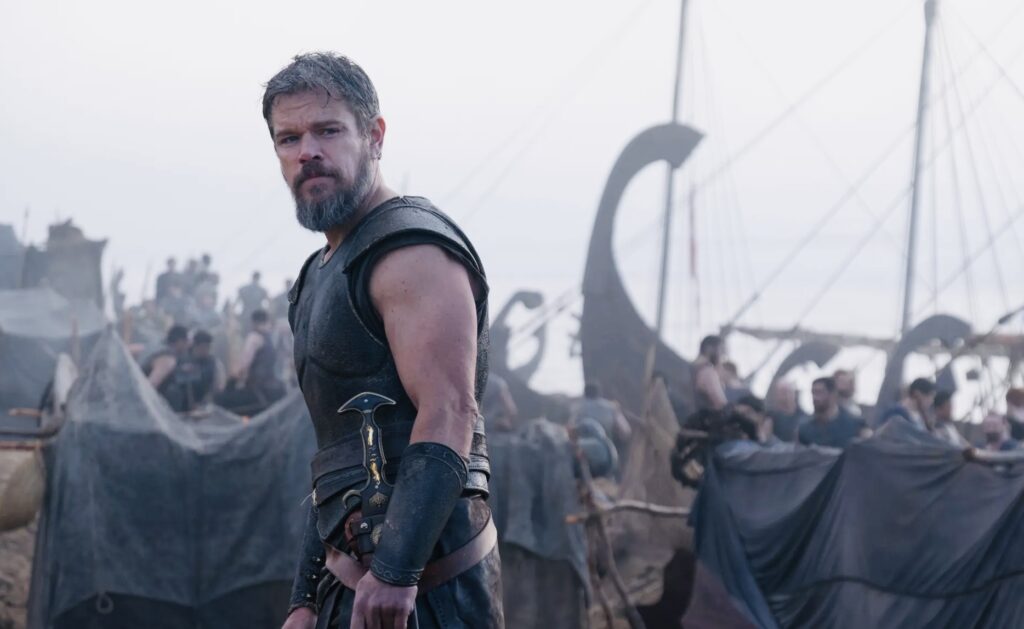
The theater was full almost to the last seat. I’m not sure what brought all the others to the viewing. I tried to imagine what the audience, mostly young people, knew about the Odyssey. Is it still taught in schools? Are the stories of the one-eyed Cyclops, Scylla and Charybdis, and the Trojan Horse still part of our general cultural inheritance? What do young people today know about the Iliad and the Odyssey? Matt Damon is always a draw. Charlize Theron is stunning as the semi-divine Calypso. Director Nolan is a hot commodity. Moreover, The Odyssey is the story of war, epic battles, monsters, and shipwrecks, so it resonates with the Marvel Comics obsession of current Hollywood. I hope that some of those who watched the film rushed afterward to the local bookstores to buy a copy of The Odyssey, like those who have encountered their first Jane Austen “novel” in a movie theater and then purchased the book.
As I looked around at several hundred others enduring previews of coming attractions, I reckoned that I was the only person in that Montana theater who had been to Troy. That seemed certain. I have visted Troy twice, separated by 30 years, and each time I have run “three times around Troy wall” in homage to swift-footed godlike Achilles, the hero of the Iliad. Troy is not one of those places you happen upon in your travels. The ancient ruin is in the far northwest corner of Turkey and getting there is not easy.
I reckoned, too, that I was the only person in that AMC theater who had read Homer in the original Greek. Not well and not recently, but several decades ago I struggled through quite a bit of the Iliad in Homeric Greek and some of the Odyssey. My limited background in ancient Greek would not be unique in a Boston or Berkeley theater. Still, I’m guessing nobody else on a Sunday evening in Billings, Montana, had wrestled with Homer’s dactylic hexameter, as I did for about six hours a day for most of a year — in another life.
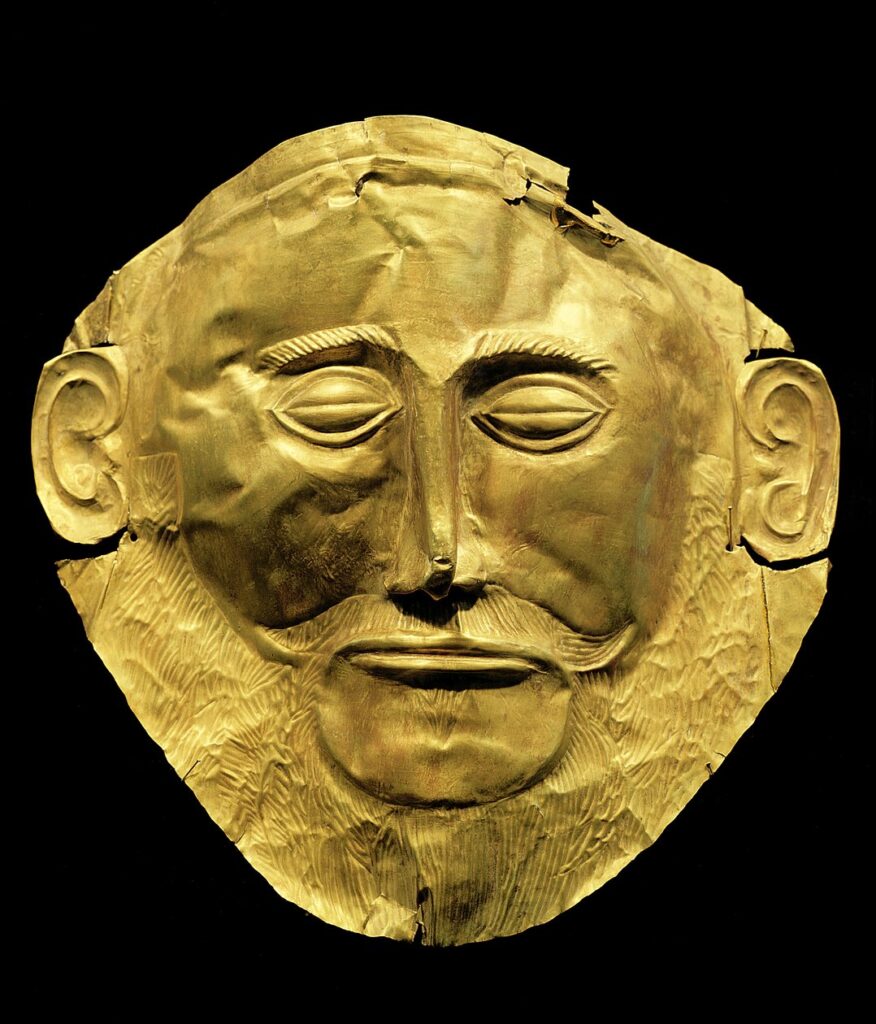
On four or five occasions I have spent time at Mycenae in the Peloponnese in southern Greece, home of Agamemnon, the leader of the Greek army at Troy; at Crete, home of the Greek leader Idomeneus; at Pylos, the home of the ancient Greek counsellor Nestor; and at the National Archaeological Museum in Athens, which conserves the famous “Mask of Agamemnon” unearthed at Mycenae by the German Homer idolater Henrich Schliemann on November 30, 1876.
I’ve read the Iliad in various translations 20 or more times and the Odyssey a dozen or more. I’ve taught both epics to university students.
I’m not sure any of that gives me any advantage.
Love-Hate
When I saw Oppenheimer in 2023, I expected to hate it. I know a lot about J. Robert Oppenheimer, the making of the atomic bomb, and the decision to use the weapon of mass destruction at Hiroshima and Nagasaki. But I loved Nolan’s Oppenheimer, especially Robert Downey Jr.’s outstanding performance as Oppenheimer’s principal antagonist, Lewis Strauss. Because of that deeply satisfying experience, I expected to love The Odyssey.
Mostly but not entirely.
In the weeks leading up to the film’s release, I read some of the conservative whining about casting a black Helen of Troy (Lupita Nyong’o) and casting Elliot Page (a transgender actor) as Sinon, an essential figure in the story of the Trojan Horse. I don’t suppose it is worth reminding these folks that Helen (the most beautiful woman in the world, “the face that launched a thousand ships”) is an entirely fictional character, not a historical figure; that we have no more idea of what she would have looked like than we do of Jesus or Moses or Eve; that she was certainly not Nordic; and that she and her sister Clytaemnestra (also portrayed by Lupita Nyong’o) were hatched from swan’s eggs! (Read Yeats’ Leda and the Swan for the back story.)
Talk about snowflakes! These cultural conservatives blow a fuse whenever they perceive (or invent) that the liberal cultural establishment is betraying them. Lupita Nyong’o is extraordinarily beautiful. Nolan’s point, certainly, is that beauty is not necessarily white and white is not necessarily beauty. In the 2004 film Troy, Helen, portrayed by Diane Kruger, was beautiful (as Helen must be), but in a conventional Hollywood sort of way. Nobody will forget Nolan’s Helen. His casting may drive certain conservatives nuts, but he is asking us all to rethink our simplistic assumptions about history, mythology, and beauty. Elliot Page is superb as Sinon, who is a liminal figure in the Trojan story.
None of this troubled me in the slightest. Frankly, I did not know anything about Elliot Page’s gender status, but the performance was compelling.
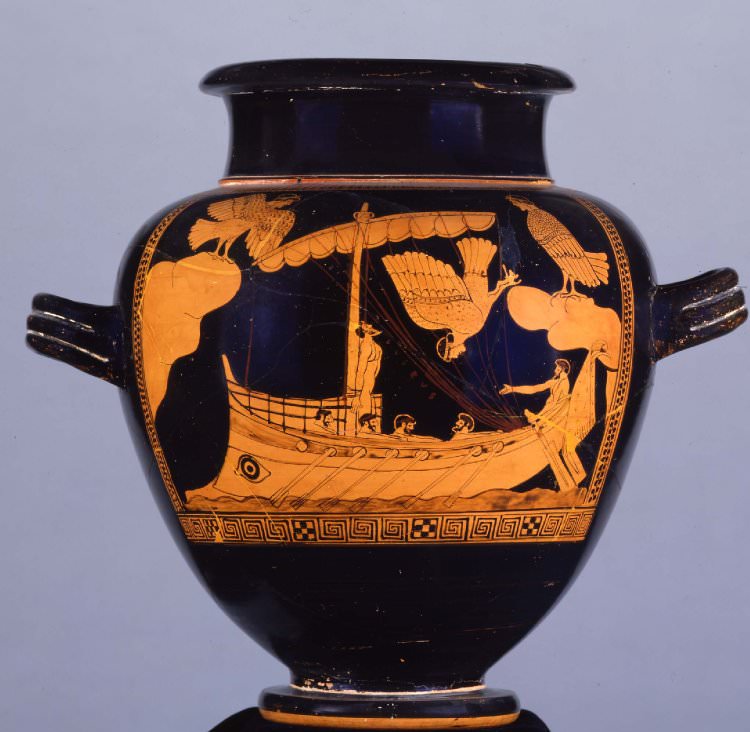
I entered the theater more worried about Matt Damon. I’ve long admired his work (especially The Martian and True Grit), but I thought he “called it in” as the irascible SOB Leslie Groves in Nolan’s Oppenheimer. In that film, I was never unaware that it was Matt Damon playing Groves; I never was able to suspend my disbelief. But I was very pleasantly surprised in Billings. Damon was excellent as Odysseus, no longer too cute or too young for the part. In the famous Sirens scene — the other men rowing with wax in their ears, Odysseus tied to the mast so that he could hear the Sirens’ fatally alluring music and still survive to tell the tale — Damon’s Odysseus was reduced to uncontrollable bawling, as if his consciousness was right on the lip of total nervous collapse. I’m guessing there was a lot of pre-filming debate about how to portray this quintessential Homeric moment, the subject of one of the greatest of all Greek vases, and the very embodiment of the playwright Terence’s maxim, “homo sum, humani nil a me alienum puto, “nothing that humans experience is alien to me.”
In Homer, it is Odysseus’ irrepressible curiosity that gets him into most of his scrapes, and his desire to maintain his status as war hero and a man so clever that he can get himself out of virtually any trap.
In Oppenheimer, Nolan violated the historical record by suggesting that Robert Oppenheimer cooperated in his 1954 fall from grace — public humiliation and the loss of his security clearance — as a way of distancing himself morally from the appalling weapon he created. There is no evidence for that interpretation in the historical record. In my opinion, that distortion damages an otherwise outstanding film. In The Odyssey, Nolan makes Odysseus a man of guilt and sorrow, who comes to believe that his Trojan Horse trick was unheroic and unethical and believes that he has failed his responsibility in not bringing his men home safely. There is no such hand wringing in the Homeric original. However, we can assume implicitly that returning to Ithaka after 20 years without even one of the men he recruited for the war against Troy would be hard to explain to his comrades’ relatives. Moreover, at the end of the film Odysseus and Penelope — finally reunited — sail west into exile to avoid the wrath of the kin of the suitors he and his son have murdered: the wastrels who have been harassing Penelope and devouring the king’s estate by way of continual orgiastic feasting.
A director adapting a book — especially a classic — into a movie has three options: 1) attempt to transfer everything in the book as literally as possible to the screen, with necessary allowances for the difference in mediums (think of BBC adaptations of Dickens or Jane Austen); 2) use the book merely as a starting point and springboard and do whatever she or he wishes with it (Spiderman); or 3) make adjustments in detail and even plot, but work earnestly to be faithful to the essential themes and “meaning” of the book. In making Odysseus a man of remorse — with a long PTSD-laced monologue near the end of the film about how his actions at Troy have brought on the collapse of the Bronze Age and the beginning of the long Greek Dark Ages — Nolan has violated the essential meaning of Homer’s Odyssey. Homer’s Odysseus returns home after 20 years disguised as a beggar, meets his son, kills the disreputable suitors, cleanses his house, restores order, and reunites with his long-suffering wife. He decidedly does not wring his hands about all the things he had to do to survive the war and return home safely to Ithaka. In my view, a director taking on one of the world’s classics has a duty to get the basic meaning right, to be faithful to the intention of the author. If Homer could meet Christopher Nolan over a glass of Pramnian wine at the Chateau Marmont in Hollywood, he’d want to know why Nolan darkened the ending of his great work of fiction. The reunion of Odysseus and Penelope is a moment of unalloyed satisfaction. What’s the point of coming home after 20 years if you and your wife have to go into exile?
A Major Omission

Nolan’s Cyclops Polyphemus was repulsively intriguing, much more than his wormlike Scylla, who seems to be dressed in costumes leftover from the 1990 Kevin Bacon film Tremors. Why Nolan brought the murderous armored Laestrogonians into the film is unclear, since they play a very minor role in the Homeric epic. Samantha Morton was magnificent as the sorceress Circe, who transformed all of Odysseus’ men into pigs to reveal their essential bestiality. Nolan’s CGI handling of the metamorphosis of Odysseus’ companions is one of the most arresting moments in the film. And yet here Circe is an older woman terrified that Odysseus’ men will rape her, whereas in Homer she is a bewitching sorceress who beds Odysseus for a full year before finally sending him on his way.
Even in a 2-hour and 52-minute film, any director is going to have to leave out a great deal in the telling. The long opening scene of the foolish Trojans dragging the giant horse statue on rollers through the city gates (“beware of Greeks bearing gifts”) is impressive, but it must have been ruinously expensive to produce. Nolan could have saved a million dollars (or more) with a simple jump cut.
Nolan left out what I regard as an essential episode of the Odyssey — the shipwrecked Odysseus washing up on the island of the Phaeacians, more dead than alive, and being discovered on the beach by the nubile princess Nausicaa. This, in book six, is one of the finest and most delicate scenes in all of literature. Nausicaa almost immediately decides that the bedraggled stranger would make a great husband, and her parents (the king Alcinous and queen Arete) agree. After all his troubles — 10 years of ruinous war, another 10 of an exceedingly difficult attempt to get home — Odysseus suddenly has the opportunity to begin a new life with a young and beautiful woman, on an island where he would be honored, wealthy, and powerful. In contrast, he has no idea whether his wife Penelope back at Ithaka is still alive or whether she has been faithful during his two-decade absence. Nausicaa amounts to the “last temptation of Odysseus.” In some respects, he’d be a fool not to accept the Phaeacians’ offer, but he declines with enormous grace, and makes his way home at last. In none of the previous film versions of The Odyssey has this great scene been given the delicate treatment it deserves, and Christopher Nolan was exactly the right director to bring it to life. This, in my view, was a serious directorial mistake, and I don’t think I speak as a Homeric purist or pedant in making this judgment. In the course of the epic, Odysseus has declined two previous chances to spend eternity with forever-young goddesses. Now he has the opportunity to start a new life with a young, beautiful, clever, and willing woman on a magical, Edenic island. He declines. He wants to go home. He wants to reunite with Penelope.
It’s a Fairy Tale
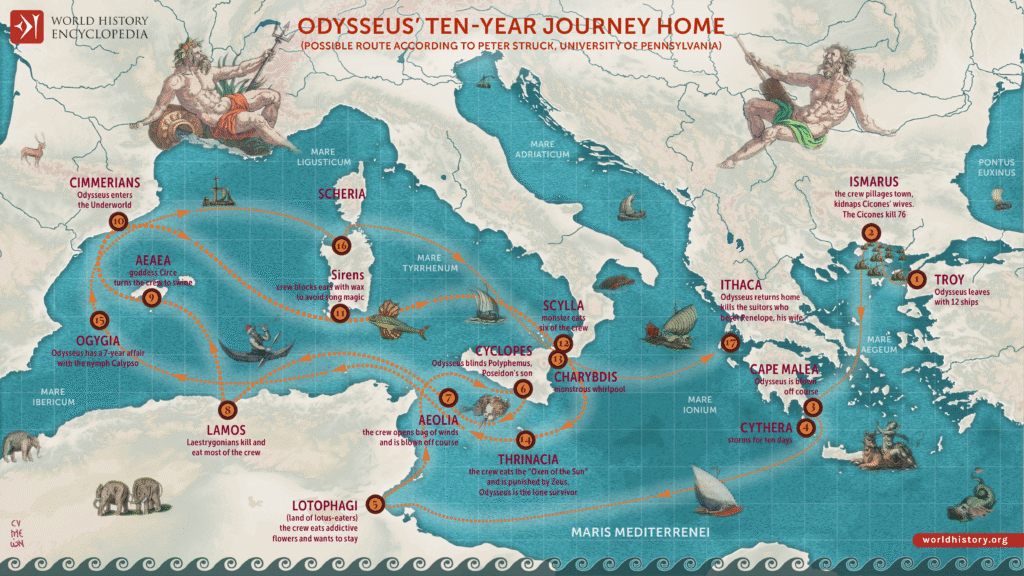
Here, in my view, is the major problem of the film. Homer’s Odyssey is a fairy tale. It is the story of a man who left for the war soon after his only child was born; spent 10 futile years besieging the impregnable walls of Troy; finally won the war with a highly improbable hollow horse trick; offended the gods in the sacking of Troy; was punished for a full 10 years by the gods, principally Poseidon (the wrong god to offend on a sea voyage); met (and survived) horrific monsters, witches, and lusty goddesses along the way; arrived home (after 20 years!) disguised as a broken down beggar; performed the impossible dozen-axes archery test; killed the 108 suitors who were trying to steal his amazingly faithful wife; then was “tested” by his wife with a bed-identification quiz to make sure he was truly Odysseus. … Fairy tales are better left to the imagination. Nobody wants to see Snow White or Cinderella performed by human actors. When you try to cast and costume fairy tale heroes on a Hollywood set, you invariably come up against very challenging and difficult-to-film episodes (the slaughter of the suitors feels like a Jackie Chan movie), and you inevitably drain some of the magic out of the story.
In some respects, Wolfgang Peterson’s 2004 Troy was a less problematic story to try to turn into a movie, because it is about single combat, battles, the existential problem of being a warrior for someone else’s cause, and a quarrel between two of the principal Greek leaders. Peterson wisely left the gods out of Troy, and there was nothing supernatural to contend with. Hollywood is good at epic battle scenes.
Still …
It may seem as if I disliked the film. Actually, I loved it despite what I regard as its weaknesses. I guess my point is that Christopher Nolan could have made a much better film if he had concentrated more on Homer’s exploration of a post-heroic Odysseus and less on spectacle.
I will see The Odyssey again, and again, and maybe again. As soon as I got home, I fetched out my copy of Allen Rogers Benner’s Selections from Homer’s Iliad, and then laughed a big Homeric laugh at the likelihood that I will get very far into the Greek text at this late juncture of my life. But I agree with Thomas Jefferson that it is worth learning some ancient Greek if only to read Homer in the original.