
During my lifetime, I have witnessed the death of the letter. Future historians will have to sift through an infinite number of mostly inane cellphone texts, with little real revelation of the individuals and the periods they are studying.
While cleaning out my mother’s house in western North Dakota, where she had lived for more than 60 years, we were about to lock the doors for the final time when I found, tucked away in the attic behind a partition, a 10x16x12 inch box. At this point, after a long, grimy day, all I wanted was a cold drink and a hot shower — perhaps a little sand blasting — and I was tempted to toss the box into the garbage tip, but I opened it to take a quick peek. Inside were all the letters I ever sent my parents, beginning with my departure for college when I was 18, until the digital revolution shattered that paradigm.
A wave of bittersweetness swept through me. At the top of the stack was a postcard, written within two weeks of my arrival at Oxford University for several years of study, announcing to my parents that I had met an extraordinary woman on a ship heading to Britain and I had fallen in love for the first time. At that point in the family attic, 40 years later, I tucked the postcard (with a photo of Oxford’s famous spires on the front) back into the box, sealed it up with strapping tape, and took it carefully out to my car.
That was 10 years ago. I have not opened it since. I am a little afraid to go through all that mail. I’m not sure I want to encounter my young self, with all that searching for identity, beginning and then later ending this first intense romantic relationship, struggling with my studies, dreams and plans for the future, travelogues, pretentious interpretations of Hamlet and Chaucer’s The Wife of Bath’s Tale, late adolescent sorties into wit and irony, questions about next year’s Christmas plans, concerns about money.
I’m not saving these letters for posterity (my daughter is my only posterity), but I am not ready to throw them away, either.
Until well into the second half of the 20th century, if you wanted to communicate with your brother in some other city or country, you sent a letter through the U.S. Postal Service. If the message was urgent, you sent a telegram. Or you placed an expensive long-distance call. Today you can text, send email and eCards, send audio or video messages or a sea of emojis, post on one of more than a dozen social media platforms, schedule FaceTime, Zoom, and other video calls, produce and share an electronic scrapbook of your vacation photos, or perhaps pick up the phone. The last century has revolutionized interpersonal communication. Facebook alone has 3.1 billion users worldwide, just a bit more than WhatsApp and Instagram, which have 3 billion users. Some people “text” hundreds of times per day. There is not much room in this brave new world for the traditional letter (paper plus envelope plus postage stamp).
There Were Manual Typewriters?
For high school graduation, my parents gave me a Hermes 3000 gray-green plastic portable manual typewriter. I picked it out at the nearby office supply store, the small-town kind that has for sale a handful of cash registers, business forms and pencil sharpeners, a few manual and electric typewriters, and a copy machine or two. Right next to the Coast to Coast hardware store, one block off the heart of downtown.
My friend Curt Pavlicek got a Corvette for graduation. But who’s counting?
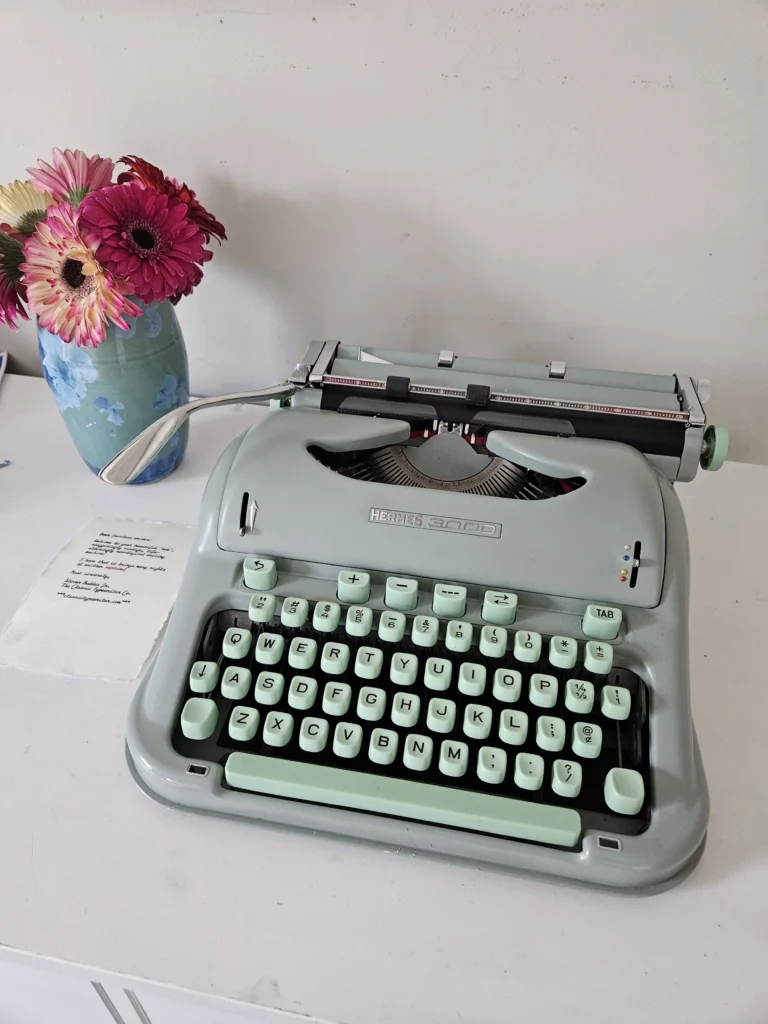
I loved my Hermes 3000. I still love it. When I want to send a letter that I regard as extremely important, I fetch out my H-3000, find some typing paper, and bang it out. I’ve only done this four or five times in the last 20 years — going back to my pre-digital roots — and the sad truth is that the recipients respond with indifference or bewilderment. Why use a clunky old technology when flawless tech support is available, with no need for White Out or xxxxing out mis-strikes? I wrote one of those Hermes 3000 letters in May. I suppose I will continue to do so on what I regard as the most important occasions, but if life is a feedback loop, I may as well desist.
I’m out of practice with a manual typewriter, so it’s a bit of a struggle to get things right. I line up two sheets of typing paper (one to protect the platen), scroll them into place, position the carriage, and begin banging away. It takes about four times as long as a letter written on a laptop keyboard, but there is something deeply satisfying about it. When I have finished, I pull the letter up out of the platen (a great sound), fold it into thirds, as I was taught in typing class in high school, and place it in a business envelope. Then I search for a stamp and a return address label (supplied in great quantities by St. Jude’s Children’s Hospital), hand-print the recipient’s address (which I usually have to search for), and then carry it out to the mailbox, where I lift the red flag to alert the mailman. And then wait. Think of all those steps — no wonder virtually everyone prefers to tap out a quick email, push send, and get up for more coffee. These days my mailman is a contract worker, not an official U.S. Postal Service employee, and I can report that there is no sense of mission among such workers that evokes the old motto: “neither snow nor rain nor heat nor gloom of night stays these couriers from the swift completion of their appointed rounds.”
I was once a prolific letter writer. Before the coming of word processing (ca. 1990), I wrote hundreds of letters on my travels and from the universities I attended — to my parents, my sister, my mentors, my close friends, colleagues, and women I was dating. I generally kept carbon copies of my correspondence, using a special brand of carbon paper that produced a better facsimile than the usual ash carbons. Most of those carbon copies are long gone or marooned in manila files in banker’s boxes in the garage; so they are effectively lost to me.
My university studies were in English literature. The great figures in literature were great letter writers: John Keats, John Donne, Francis Bacon, Dr. Samuel Johnson, Thomas Jefferson, Ernest Hemingway, John Steinbeck, Virginia Woolf, Mark Twain, Sylvia Plath, Bertrand Russell, Willa Cather. … What we know about the early modern period in Britain (the Elizabethan and Jacobean period) comes largely through the long letters they all wrote to each other. Here in America, when John and Abigail Adams were apart and when Jefferson and his closest friend James Madison were apart, they wrote remarkable letters to each other. These letters illuminate their characters and their views of the trajectory of the American republic, but also provide invaluable newsy information about the world around them. Our understanding of history would be deeply impoverished without those letters. Not to have saved them and neatly filed them away in the British Library or the National Archives (and now increasingly digitized for home viewing) would have been a cultural catastrophe. Try to imagine John Adams responding to one of Jefferson’s elegant epistles with just this: ROTFLMAO (rolling on the floor laughing my ass off).
Incalculable Loss
During my lifetime, I have witnessed the Death of the Letter. Future historians and biographers will have to sift through an infinite number of mostly inane cellphone texts, with very little real revelation of the individuals and the periods they are studying. Sample:
LOL Great flick
It was fire. It was sick.
Did you apologize to S?
Naa. CU nxt wk at thng
Who is going to annotate this? What flick? Does “sick” mean good? Who is S? What is the thng? Good luck, future historians? And don’t even bring up emojis.
By way of contrast, here is a letter I love from the archives of the Times of London.
Sir,
Today, entirely without human intervention, I successfully opened a packet of biscuits.
I feel it only right to share this momentous triumph with your readers, given that modern packaging is seemingly designed to withstand a small nuclear blast. After bypassing several useless pull-tabs, avoiding the immediate shredding of the plastic wrapper, and escaping with the top biscuit entirely intact, I believe I have reached the absolute peak of human domestic achievement.
I am now resting quietly, awaiting contact from the Cabinet Office regarding my well-deserved knighthood.
Yours faithfully,
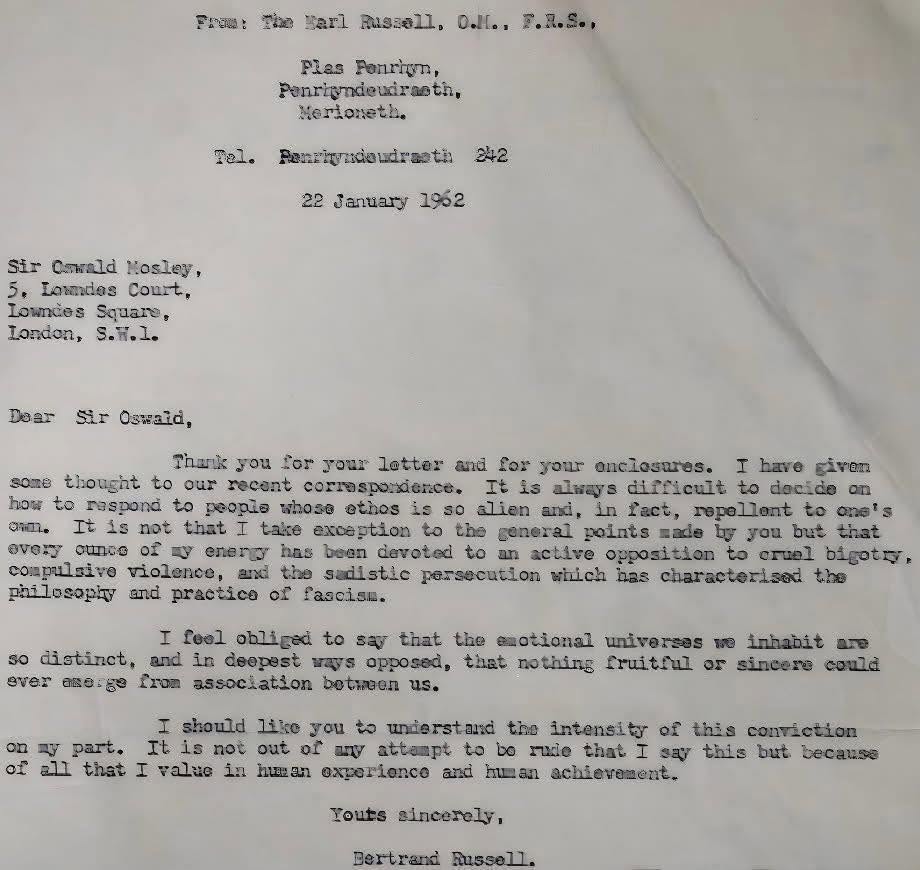
In a single lifetime, we have cheerfully and mostly unthinkingly cut off one of civilization’s primary and richest traditions, dating back to Cicero (a Senator during the last years of the Roman Republic), who wrote thousands of letters in Latin, 850 of which have somehow survived. Theodore Roosevelt wrote at least 155,000 letters in his strenuous lifetime. Without them, we’d be denied access to one of the most interesting individuals in American history. Needless to say, Roosevelt, the letter writer, was a different being from TR, the often bombastic public figure. His illustrated letters to his children are priceless for assessing “the whole Roosevelt.” When I am feeling melancholy on a Saturday night, I sometimes just read 50 or 100 of the sprightly, puckish, and fascinating letters of the English philosopher Bertrand Russell. They invariably cheer me up.
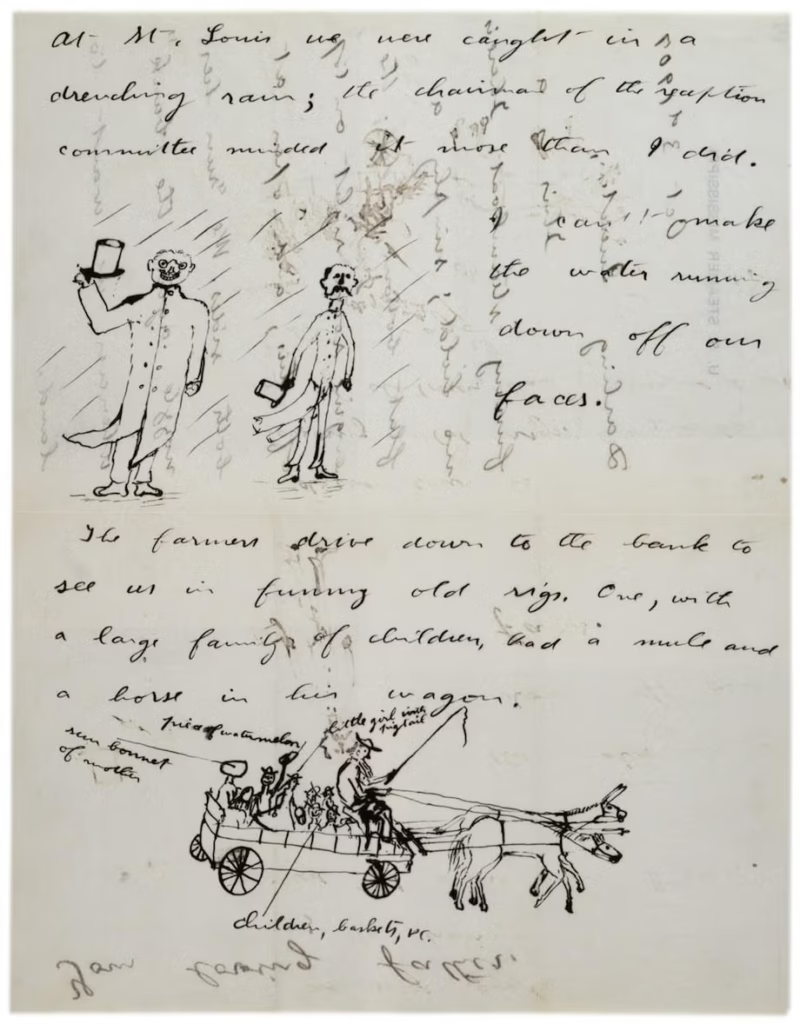
Imagine if we had no letters whatsoever in any archive, but instead just a complete file of all the telegrams ever sent. That would be a very rich archive, indeed, but a telegram is necessarily short, tight, void of nuance. The telegraph has been called “The Victorian Internet” for good reason. When you paid by the word, you pared your message down to bare bones. When Martin Luther King, Jr. was jailed for nonviolent protest, Muhammad Ali sent a seven-word telegram of support: “HOPE THAT YOU ARE COMFORTABLE NOT SUFFERING.” When the first hydrogen bomb was successfully tested on the island of Elugelap in the Pacific on November 1, 1952, the commander merely telegraphed, “IT’S A BOY.”
The Joy of Letter Writing
Ah, but when you sit down to write a genuine letter, a letter that matters to someone who matters, you have the opportunity to think about what you want to say and how you want to say it instead of just thumbing some quick telegraphic message into the cosmos between subway stops. In a genuine letter you can play with words (or punctuation), and with your prose style. You can step back, reread what you have written so far, and adjust the tone, the level of directness, the approach, and the structure. Or start over. People like Thomas Jefferson wrote drafts of their letters, walked away for a short time, and then wrote out the fair copy in a cleaner penmanship, often with significant adjustments. You have permission in a letter to someone who matters to reveal things you would never put into a text and may not be willing to speak out loud to that person on the phone or in a chair next to you. You can dream or daydream in a letter, confess, reveal, probe, disclaim, explain, or apologize.
All that is being lost — apparently forever, because (under the iron rule of technological innovation) steam engines replace the horse, the telegraph kills off the Pony Express instantly, the internal combustion engine replaces the buggy, DVD replaces VHS, the SD card replaces 35mm film; and few if any would really want to return to a world of what is derisively called “snail mail.” I hate that term. But it is a loss of incalculable significance.
The Postal Service reported that in 2000 Americans sent approximately 2 billion personal letters to friends or relatives. By 2011 it was down to 715 million. In 2012, it was down to 650 million. And you can imagine the decline in the last 15 years. Most of these “personal letters” are greeting cards or postcards from the Eiffel Tower or St. Peter’s to one’s mother.
Now in the third decade of the 21st century, I send 400 or 500 letters (usually notes) per year, 99% of them through email. But I very seldom labor over an email letter the way I would if I were typing it out to print and put into the mailbox. We all know that an email is not held to the same standards for punctuation, spelling, grammar, or logical consistency as a letter. I receive many hundreds of emails. In a limited sense, I am more prolific than I ever was with traditional mail, and there is no frustrating post-composition search for stamps, envelopes, etc. No agonizing wait for a response — one week, three weeks. But it is not the same. Some very important part of the pleasure of correspondence has been lost. A letter produced on a word processor with autocorrect and grammar functions, flawlessly printed, with no crossings out, no words careted in above the line, no handwritten note at the bottom, no squiggles or doodles, no genuine signature, is in some essential way sterile, no matter what the subject or the passion of the writer.
The death of the physical postal service letter is one of the saddest developments of my lifetime. But as with so many other American rituals, procedures, and habits of the heart, it’s clearly irreversible, and nostalgia won’t move the needle or return “the golden age.” May as well make the case for cuneiform or hieroglyphics. There is no use in my trying to buck the trend, because when I do send an actual letter, even one composed on a laptop, the recipient’s response is usually something along the lines of WFT, not gratitude.
Still, even now, when I go out to check the mail and begin tossing 95% of the junk (including political postcards, COSTCO catalogs, shopper’s guides, solicitation letters from banks and credit card companies, etc.) and then come upon a hand-addressed letter in an actual envelope, I am thrilled. Someone somewhere has taken the time to write me an actual old school letter. I sit down in a good chair and read it through, usually more than once.
One of these days, I am going to open the box that contains my early-to-mid-life letters, painstakingly saved by my parents. I expect it to be both a joyful and at times a painful experience. I’ll be interested to learn how much of that correspondence is illuminating and how much is gibberish. I’m prepared to blush, wince, grimace, cry, laugh out loud, and smile wanly across the decades at that pre-digital hyper-purposeful young man.
My purpose in writing about this topic, as in all of these essays reviewing the staggering changes of the last 75 years, is not autobiography and it is not lament. I do deeply, profoundly lament the death of the letter, but my purpose here is to contextualize the world we live in now within the larger trajectory of history. I find this exercise fruitful, and I hope you do, too. Let me know. And please suggest topics for me to explore.