
I write this as a personal letter to all of you who read my work. My work is exceedingly important to me — these weekly essays — and writing them is one of the principal joys of my life.

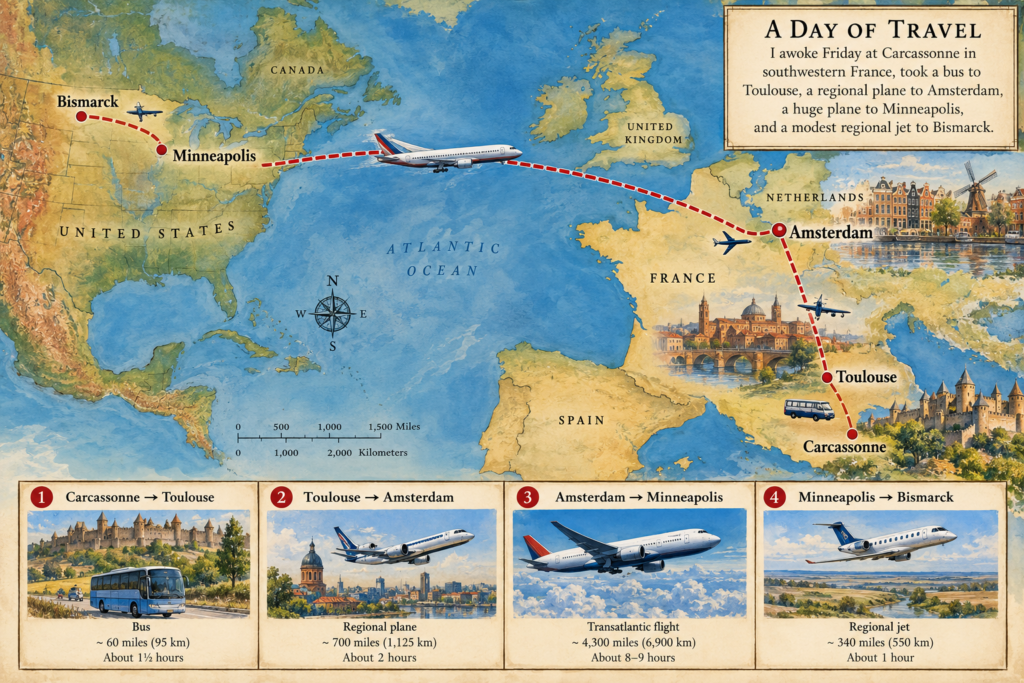
My endless summer finally ended Friday evening when I arrived back in Bismarck, North Dakota, after just under two weeks in Thomas Jefferson’s France. I awoke Friday at Carcassonne in southwestern France, took a bus to Toulouse, a regional plane to Amsterdam, a huge plane to Minneapolis, and a modest regional jet to Bismarck. I began the day in France and (after three hops at 38,000 feet) ended it in my own bed in the U.S. No matter how often I do this — begin the day in a European city and end it in my own bed in a faraway place in America — I marvel at what the modern industrial world has made possible.
I’m totally and appallingly exhausted. Just spent. I’ve been on the road since mid-April. I’ve flown to Europe four times this summer. I’ve had so little time at home that when I do return, I barely open the parcels and do the laundry before I depart for the next thing, the next cultural tour, the next lecture, the wedding, a whimsical pilgrimage to Homer’s Troy in Turkey. I’ve co-hosted one cultural tour this summer (archaeological) and led two others. I have done my usual performing of historical characters here and there, including in Milan, Italy, over the Fourth of July, and I have done two of my four annual humanities residencies at Vail, Colorado, including on-stage conversations with Judy Woodruff and the incomparable Doris Kearns Goodwin. I spent weeks in my Airstream in Montana and Wyoming. I’ve recorded weekly podcasts.
Dog tired. Bone tired. Hopelessly over-stimulated. Numb.
Home
On one of the last days in France, we did a four-hour barge excursion on the Canal du Midi, the 17th-century canal that links Marseilles (the Mediterranean Sea) and Bordeaux (the Atlantic Ocean). When lunch was announced downstairs in the air-conditioned dining room, all one hundred people on board basically stampeded for the food. I stayed — all alone, it turns out — up on deck as the boat slowly glided down the canal towards Toulouse. I remembered what Thoreau said at the end of Walden:
“I did not wish to take a cabin passage, but rather to go before the mast and on the deck of the world, for there I could best see the moonlight amid the mountains. I do not wish to go below now.”
That’s just how I felt. It was serene up there. I had an hour to myself in this magical place. The Canal du Midi was Europe’s first great canal, completed in 1681. Thomas Jefferson spent nine happy days on it in the late spring of 1787, taking extensive notes so that he could better advise the construction of canals in the United States. My long summer was ending. There is a kind of exhaustion that is actually quite agreeable — there is certainly no restlessness in being that tired. I sat, gazed, and occasionally closed my eyes to daydream. The fall colors had brought all their autumnal beauty to Provence, my favorite part of France. As I sat there sipping a glass of white wine, I could see the end of the 2026 madness.
The question was: how to manage my re-entry? How could I come off six months of pell-mell travel and more plate-spinning than I’m accustomed to, and re-enter life on the northern Great Plains without just holing up and watching sitcoms for a few days?
Dialogue With Self on the Canal Boat
Q: So how do you see the next couple of months?
A: Not sure, but I know I’ve got to get back to reading. It has been a poor summer for reading.
Q: Got anything in mind?
A: Well, there are a dozen or more books I need to read, so they don’t count. Honestly, I think I want to read something of no immediate professional value, a literary classic, something from which I can derive pure pleasure.
Q: Name your poison.
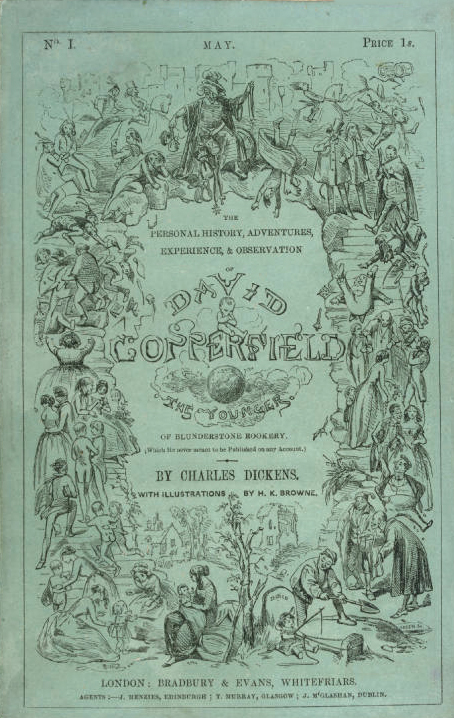
A: I don’t know why, but I am thinking Dickens’ David Copperfield. I haven’t read it in six or seven years?
Q: You’re kidding, right? It’s an 865-page book, even in small print. If you start to read David Copperfield, and get sidetracked, and not finish it, you’ll be disappointed in yourself. Pick something small like To Kill a Mockingbird.
A: You are right, but I have a serious hankering for some Dickens humor, irony, insight, satire, and his incomparable power with the English language. No, I’m going to make a run at David Copperfield.
As I said these words, I was pretty sure I would fail. But I am determined to reset my life, rebalance it, and reestablish it.
So, once we were wheels up from Amsterdam, I opened David Copperfield on my eReader and started in. Because I had nowhere to go, I wound up reading for eight straight hours, even while eating my adequate tortellini and stale bread roll.
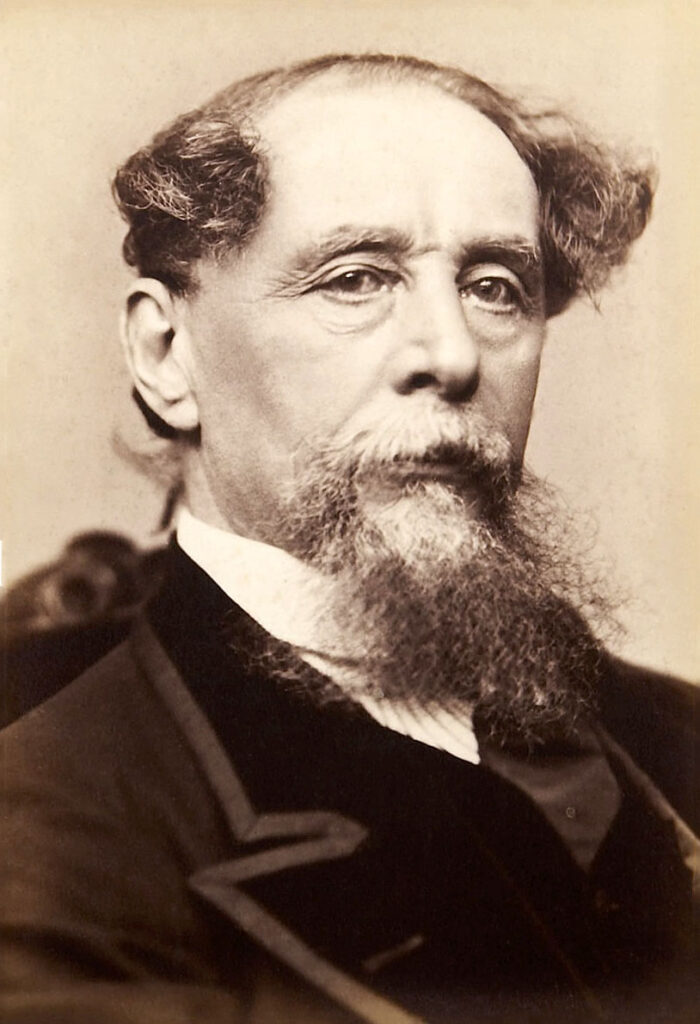
I know Charles Dickens (1812-1870) is not everyone’s cup of tea. Most of my closest friends do no more than pay lip service to Dickens. They trot out the usual litany: contrived plots, passages of almost nauseating sentimentality, endless descriptive passages of the slums of London, and really eccentric characters. I think they are full of beans, but so it goes.
At some point in the flight, about when young David meets Mr. Micawber on the streets of London, I somehow slipped into The Zone — reading’s highest summit, when you are no longer conscious of the words on the page, or even of turning pages, and the genius of the author has drawn you into another cosmos, another world. You do not tire, get distracted, fidget, cut your nails, check your email, or watch a bit of cable news. You realize you could read forever. You want to read forever. You have entered a mystical zone of one corridor of Heaven. This almost never happens. I read my way into The Zone once a year at most, even when my enjoyment of the book is high. There are things you can do to get there, but that doesn’t guarantee you will.
If I could find the pill that brings on The Zone, I would swallow it once a month at the very least. For someone who identifies himself with the humanities, it’s a kind of ecstasy. It’s one of many Zones, of course — in music, dance, mountaineering, running, etc. — but it’s the one I most cherish.
So there I was with hours of uninterrupted time to wallow in one of my top-10 works of literature. Flying in seat 40-C on a full airplane, right at the choke point of the path to the toilets, could make for a very frustrating day. But thanks to Dickens and The Zone, the day floated by, and I never thought, “for goodness sake, how much longer does this take?”
It’s such a magnificent book. There are several plot lines, but they all orbit around young David Copperfield, who grows up an orphan in a world of wicked stepfathers, brutal school masters, cheating innkeepers, urban homelessness, alcoholism, mental illness, and casual violence. David makes many mistakes along the way, but he becomes a professional success, gets married right on the second try, and lives to see his various tormentors destroyed by karma.
As we flew across the Atlantic, I laughed, I cried, I snorted, I took some notes, I wept, and at least a dozen times. I put down the book and said, out loud, probably to the consternation of my aisle-mate (a perfect stranger), “The genius of Charles Dickens, the unbelievable genius of Charles Dickens!” (In my defense, she was watching Below Deck: Mediterranean, so she probably didn’t hear me raving.)
David Copperfield is a very long book. I’m a slow reader. When we landed in Minneapolis, I was only 42% of the way through it. But for some reason — I think for a very important reason — I didn’t put it down and start in on the large to-do list that awaited my return. I knew I had to see it through or it would be yet another instance of fragment reading. Accordingly, and with great pleasure, I spent most of Saturday reading it in several of my favorite chairs. By the time I fell asleep on Saturday night, I was down to about 250 pages, and on Sunday morning, jet-lagged at oh dark thirty, I sat down and finished the novel.
It gives me such deep satisfaction to have read one of the world’s classics by way of jumping off the 2026 treadmill or bandwagon. The novel has so many amazing things: Dickens’ capacity to see the world through a child’s eyes; the villainy of Mr. Murdstone; lone, lorn Mrs. Gummidge; Dora’s lapdog Jip; and, above all, Wilkins Micawber.
Micawber is my favorite Dickens character — among at least a dozen near-rivals. He’s a grandiloquent, melodramatic, comic masterpiece in tights and a walking stick with a perfectly bald head shaped like an egg. Perpetually in debt, unwilling to work for a living and therefore always fighting off debtors’ prison, a master mixer of English punch, an inveterate writer of letters, crushed by despondency and almost simultaneously the exemplar of mirth, Micawber pawns his furniture to host an elaborate dinner party.
Great books are greatly new each time you encounter them. At some points in this my eighth or ninth time through David Copperfield, I noticed things I have never noticed before or (worse), forgotten. I saw connections and foreshadowing I had never noticed before. I interpreted some key scenes in a new way. I liked some characters more and some less. Above all, I found it possible to groove on Dickens’ comic writing and his incredible wit without losing sight of the deeper tragedy of London life for the masses in Dickens’ era.
Now it’s over. I finished several days ahead of what I expected. I’m going to read some Dickens criticism and write more extensively about the novel. I’m so tempted to start right in on Great Expectations or Bleak House, two of my other favorite Dickens novels, but I reckon I’d better not push my luck. I did have a sudden fantasy of reading all of Dickens’ novels in succession, straight through, doing nothing else, absolutely nothing else, between now and Christmas. That would be a good retirement project, but I know I will never retire.
I’m with Jefferson: “I cannot live without books.” What would life be without the humanities? A dreary thing (at least for me).
So, tomorrow: the to-do list. I knew that when I gave myself this luxury, I would have to pay the piper.
But it was so worth it.