
Iconic to the American West, I was surprised to learn of a British preservation program for European bison.
Jet-lagged, alone, I was scrolling through the hundreds of television channels in my very modest hotel in Vevey, Switzerland, the other evening, looking for anything in English. I happened on one of the three BBC channels. After a commercial for Weetabix cereal, there was a special report from Cumbria, up near the Lake District of England, about the release of a handful of bison (five) into a small “wild” landscape.
My ignorance was 100% —
1) There are bison in Britain? Answer: yes, exactly nine: four in Kent (south) and now five in Cumbria (north). They are considered “wild,” in that they are not kept in cages, but their free range is, by American standards, minuscule.
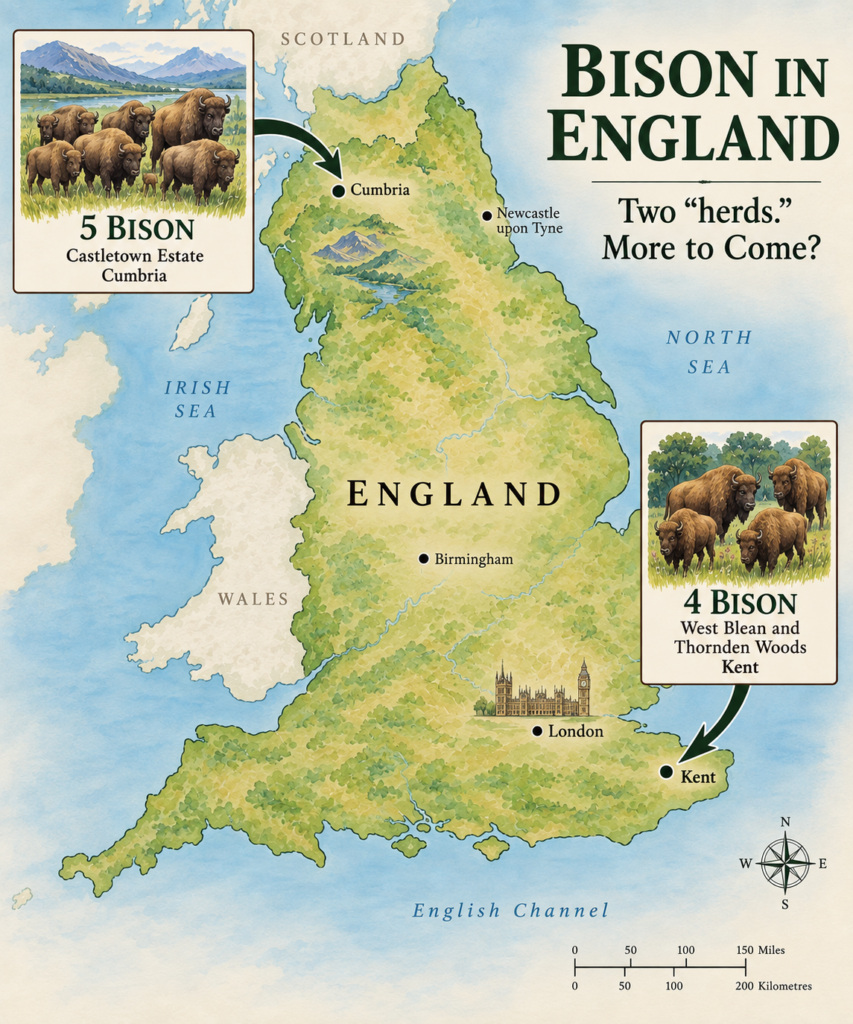
The British are very and rightly proud of this achievement — the bison comeback story.
2) Are the British bison the same species (bison bison) as the American buffalo? Answer: No. They belong to a separate species, bison bonasus. We Americans often call our creature a buffalo. The British sometimes use the term Wisent, after an old Germanic word.
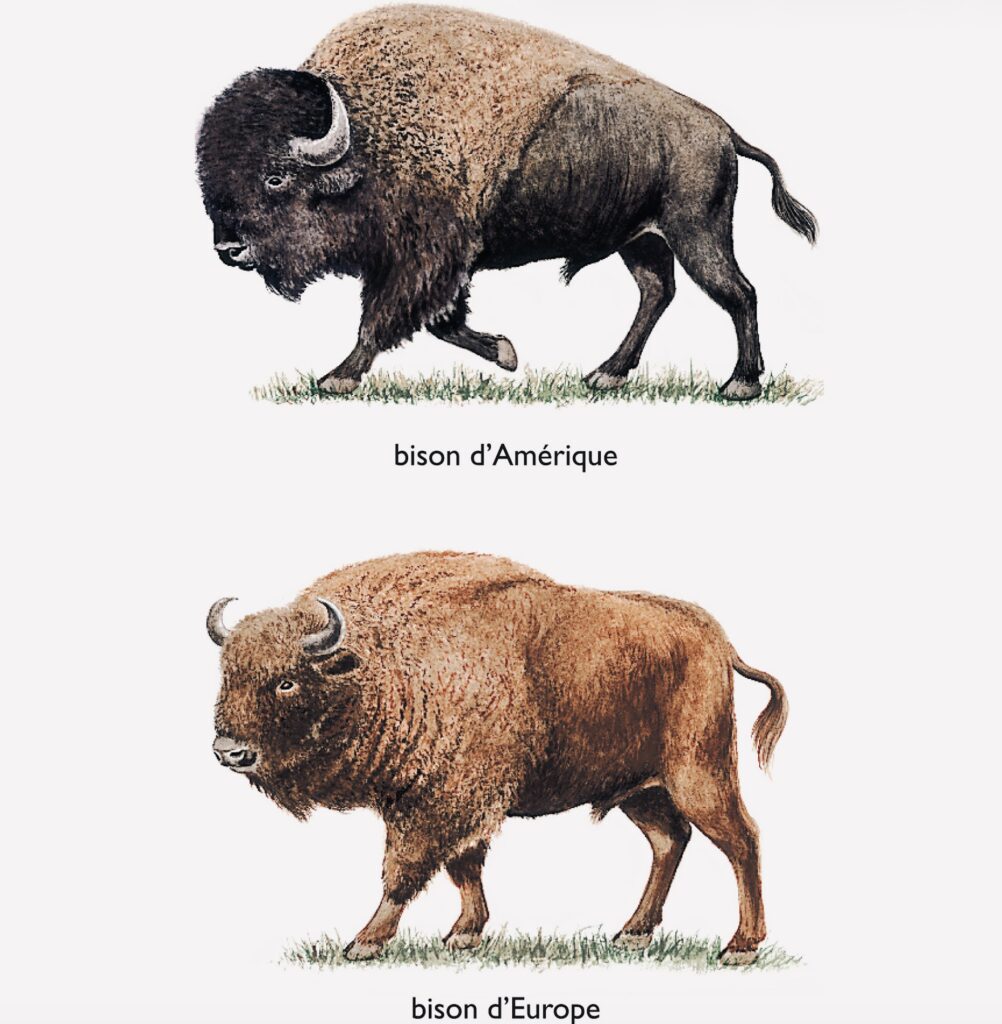
3) What’s the difference? Answer: The Euro-bison is longer, more spindly, with a smaller head and a less pronounced hump. The American bison is shorter, bulkier, and sports a fuller beard.
Today there are merely 12,209 bison in all of Europe, descended from a DNA pool of just 12 “founders.” Russia has 3,073; Poland 3,060; Belarus 2,927; Germany 643; Ukraine 480; Lithuania 339; and about another hundred-plus scattered about.
At one time, long, long ago, there were as many as half a million (“modern,” not paleo) Euro-bison. By 1927 they had effectively been extirpated, with a puny remnant maintained in zoos. It was the low population density of the American heartland that permitted such greater numbers to survive (mostly on the Great Plains), and the fact that Native American cultures were and are more committed to sustainability and sacrament than the Anglo-American extraction mania — and, at a certain point, a near-official “Indian Policy” of species genocide. In 1873, Secretary of the Interior Columbus Delano wrote, “I would not seriously regret the total disappearance of the buffalo from our western plains, in its effect upon the Indians.” In 1867, Colonel Richard Irving Dodge is reported to have said, “Kill every buffalo you can! Every buffalo dead is an Indian gone.”
John Locke: “In the Beginning All the World Was America”
We all know the basic story of the American bison. When Columbus accidentally bumped into the New World, there were between 40 and 60 million buffalo in North America, and their range stretched from the Appalachians in the east (and a little beyond) to the Rocky Mountains in the west (and quite a little beyond).
The whimsical Thomas Jefferson was actually hoping to establish a nature park on his private mountain in Virginia, along the lines of the European “deer parks” maintained by wealthy squires. According to a 1771 memo Jefferson intended to thin the forest at Monticello and then “keep in it deer, rabbits, Peacocks, Guinea poultry, pigeons, etc. let it be an asylum for hares, squirrels, pheasants, partridges, and every other wild animal (except those of prey) … procure a buck-elk, to be, as it were, monarch of the wood; but keep him shy, that his appearance may not lose its effect by too much familiarity. A buffalo might be confined also.”
There is no evidence that he ever obtained a buck elk, shy or otherwise, or a bison. Lewis and Clark did send back (from Fort Mandan in North Dakota) a small menagerie of live critters: four magpies, a sage grouse, and a prairie dog. By the time this precious cargo traveled from North Dakota to St. Louis, from St. Louis to New Orleans, by merchant ship from New Orleans around the tip of Florida to the Chesapeake and on to Baltimore, and then in the back of a wagon overland to the White House (4,500 miles, 129 days), the grouse was dead as well as three of the magpies. But Jefferson was thrilled by the live prairie dog (the “barking squirrel”), which he showed off to White House dinner guests before eventually sending it to Philadelphia, where his friend Charles Willson Peale displayed it for the remainder of its short life.
Lewis and Clark sent buffalo robes to Jefferson (some painted by the Mandan people), but no live buffalo! Not so long after that, the explorer Zebulon Pike brought two live grizzly bear cubs to President Jefferson, who kept them for a time in cages near the entrance to the White House. Not wishing them for his nature park at Monticello (!), Jefferson soon enough shipped them, too, to Peale (America’s first museum director), where he displayed them until one escaped and terrorized Peale’s home (kitchen). It soon became clear that they would both have to be euthanized. Peale knew taxidermy and displayed all these creatures at his extraordinary museum.
When Lewis and Clark reached central Montana in May-June 1805, they discovered essentially an infinite number of buffalo. On July 11, 1805, Lewis wrote “when I arrived in sight of the whitebear [grizzly bear] Islands the missouri bottoms on both sides of the river were crouded with buffaloe I sincerely belief that there were not less than 10 thousand buffaloe within a circle of 2 miles arround that place … the bulls keep a tremendious roaring we could hear them for many miles and there are such numbers of them that there is one continual roar.”
A week later, Lewis wrote, “we passed immence herds of buffaloe on our way in short for about 12 miles it appeared as one herd only the whole plains and vally of this creek being covered with them.”
On the return journey in 1806, on the Yellowstone River, Clark wrote about the seemingly-infinite herds day after day and then finally gave up: “For me to mention or give an estimate of the differant Species of wild animals on this river particularly Buffalow, Elk Antelopes & Wolves would be incredidable. I shall therefore be silent on the Subject further.”
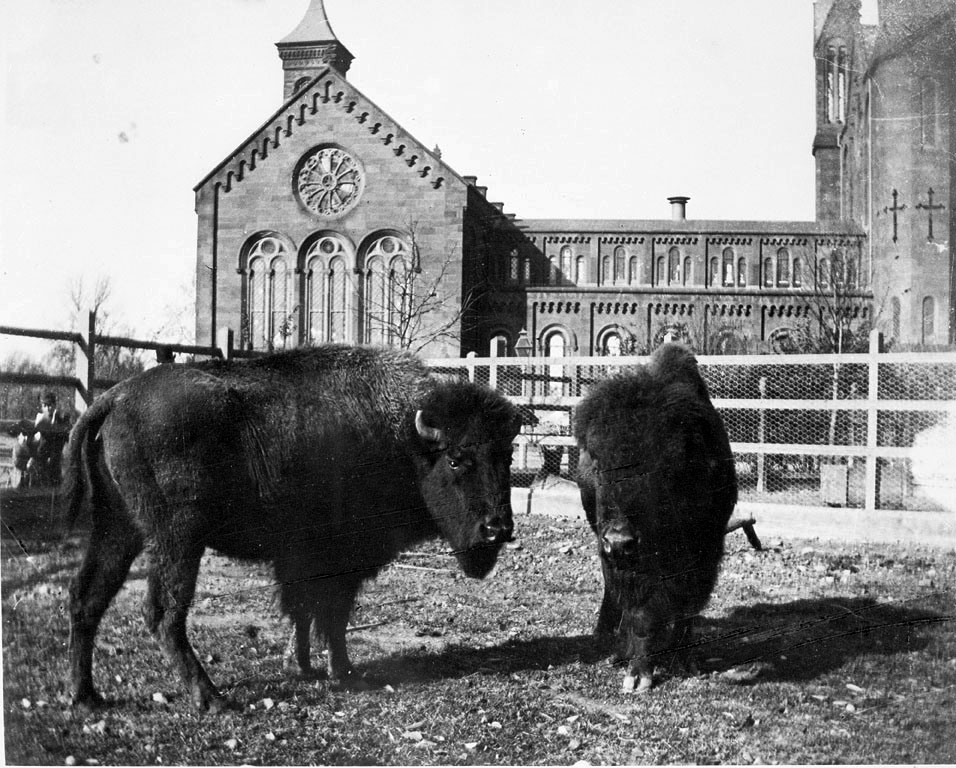
During the 19th century, white Americans (and Euro-tourists) brought the tens of millions of buffalo to the brink of extinction. The great conservationist William Hornaday (1854-1937) conducted a scientific survey in the last years of the century and estimated that no more than 500 (possibly 1,000) bison remained. Hornady made it his life quest to “save the buffalo,” which he accomplished with the help of President Theodore Roosevelt, George Bird Grinnell, Charles and Molly Goodnight, Scotty Philip, the Pend d’Oreille native Samuel Walking Coyote, and a few others, including — ironically — Buffalo Bill Cody.
Today the American buffalo is out of danger — a success story if you regard a collapse from 50-60 million to a few hundred thousand in a century and a half as a success story. The largest free-range herd in the United States now is in the Lamar Valley of Yellowstone National Park: ca. 5,900 critters minding their own business and sport-tossing a foolish tourist from time to time. If the audacious American Prairie project succeeds in northern Montana — no thanks to the current U.S. Department of Interior — it will provide fence-free space for up to 35,000 undomesticated buffalo. American Serengeti. No pun intended, but Europeans and Asians will flock to that. If the American Prairie Project succeeds against the forces of shameless mythology, the deliberate misreading of Bureau of Land Management regulations, and greed, it will immediately become one of the Wonders of the World. That’s the America I want to live in!
If I survive this crazy, zany, hyperventilating summer and early fall of 2026, I will light out in early October for the territories. I have two Thoreauvian cabins 2 miles from the NE portal of Yellowstone National Park. Within an hour’s drive from my front porch there, I can be among the largest existing buffalo herd in North America.
There is so much that is wrong with the United States of America right now — believe me, I have been doing a great deal of explainin’ over the last week in Switzerland — but we mustn’t forget that there is also so very much that is fabulous, wonderful, inspiring, and admirable about America, too. Let two examples suffice for the moment. First, our public lands: the National Parks (envy of the world), the National Monuments (under political fire, alas), National Wildlife Refuges, National Forests, National Recreation Areas, National Game Preserves; state parks; vast open spaces extending hundreds of miles in every direction. … And somehow, we have managed to save some of the magnificent wild species (including the bison) that Europe extinguished or nearly so over the last 5,000 years, especially since the Industrial Revolution.
Second, thanks to the influx of global visitors during the recent World Cup, the rest of the world has forgiven America and fallen in love with us again (a bit), thanks to our greatest invention: Ranch Dressing. I carried several giant bottles of the stuff in my luggage as contraband.
What do you call five Euro-bison in the English Lake District? A start.