
I tuned in, along with over 300 million others from around the globe, on that landmark day when popular music connected with the space age and changed the world forever.
Note: Over the next year or so, I will occasionally write about events of the last 75 years that helped define a remarkable era in modern American history. I will only write about myself as a conduit to one of the most turbulent and exciting times to have been alive. My goal is to attempt to understand, for myself, the monumental changes that have taken place in my lifetime (no wonder the Constitution is straining). I hope you will follow along and send me thoughts.
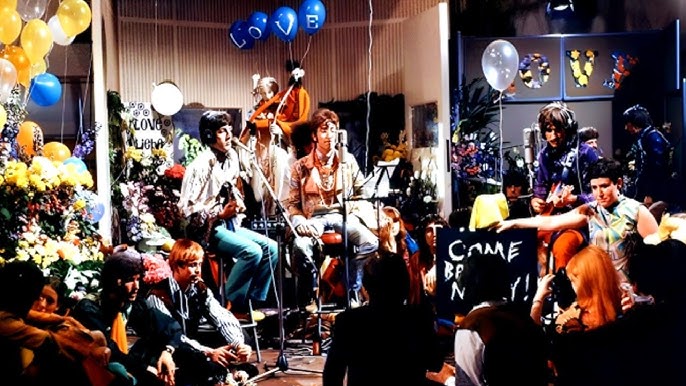
June 25, 1967, was a landmark in the history of technology. It marked the confluence of the space age and popular music. On that day, for the first time in human history, music and other audio were beamed from around the world up to a few communications satellites and then simultaneously beamed back down into television sets in more than a dozen countries on five continents. The purpose of the experimental broadcast, a joint effort by the BBC and the European Broadcasting Union, was to showcase the emerging satellite technology that would soon knit the world together as never before — and forever. It was called Our World. It might just as well have been called Our Brave New World: Like It or Not, Here It Comes.
Featuring … The Beatles
At the time, the Beatles were not in entirely good standing with the venerable BBC. In 1965, Time magazine called the BBC the “sonorous, serious, slightly stuffy voice of England’s Oxbridge-accented Establishment.” The staid British network had recently refused to play A Day in the Life from the just-released Sgt. Pepper album and had grave concerns about Lucy in the Sky with Diamonds, which many at Broadcasting House thought was a code for LSD. Still, the directors at the BBC had the good sense to realize that if they were going to beam representative British entertainment to every corner of the globe in the summer of 1967, it had to be the Beatles and not Basil Rathbone reciting soliloquies from Hamlet and Richard II or Dylan Thomas’ Do Not Go Gentle into That Good Night. The only stipulation was that the performance (at least most of it) had to be live.
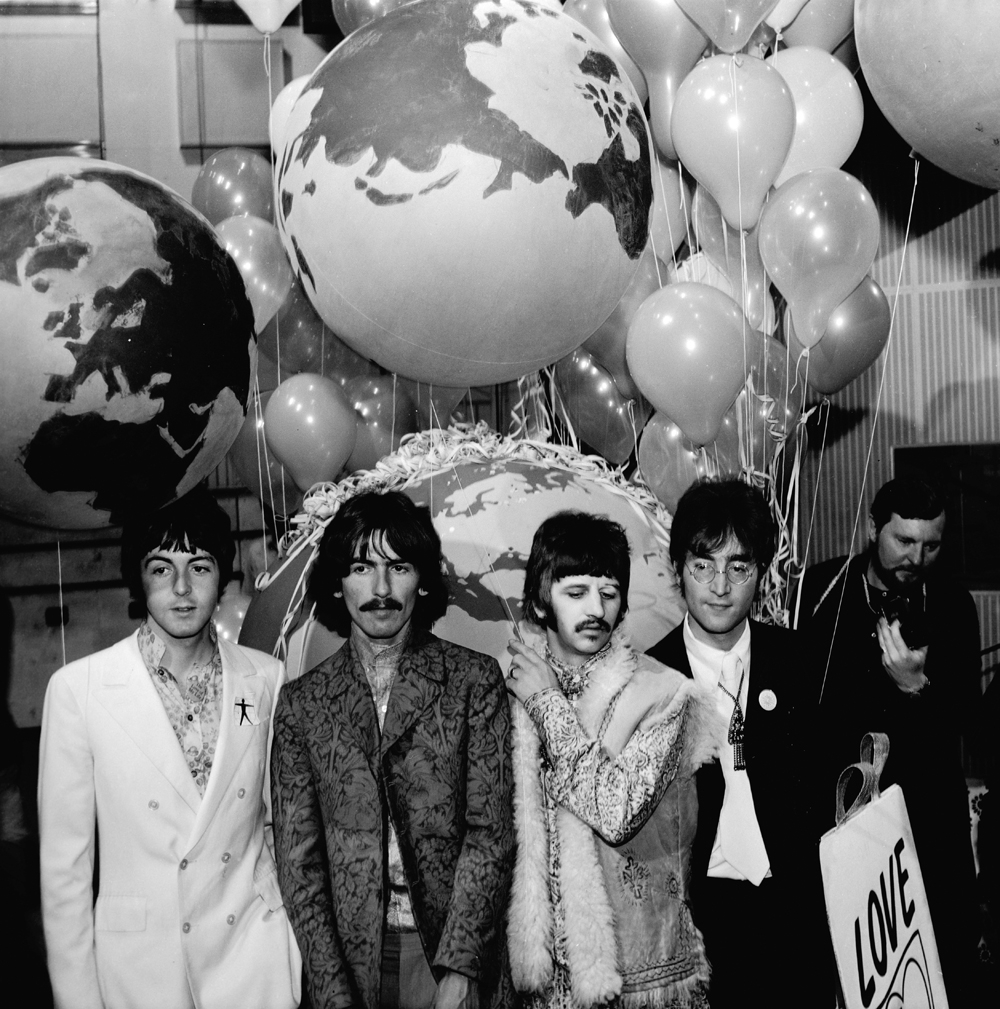
On February 28, 1967, the BBC wrote to Beatles’ manager Brian Epstein that the scheduled broadcast would “show man’s greatest current achievements in the field of art and entertainment.” And, to accomplish that, the BBC “would like to offer Britain the subject of The Beatles at work … in a recording studio making a disc.”
George Harrison later said the other countries participating in the broadcast were showing things like “knitting in Canada, or Irish clog dancing in Venezuela. So, we thought we’d sing All You Need Is Love because it’s a subtle bit of PR for God.”
The June 1967 broadcast of All You Need Is Love from Studio II at Abbey Road wasn’t the Beatles’ best performance or their best song, but that doesn’t really matter, because the song — written for the occasion — was beamed instantaneously all across planet Earth. It was plenty good, and though John wrote it (in his usual procrastinating and dilatory fashion), it reflected not only his core sensibility but that of all four of the Beatles (perhaps especially Paul). Somewhere between 350-450 million people worldwide watched the broadcast. I was one of them — a 12-year-old kid in a backwater town in a backwater state somewhere on the northern tier of the United States. Most of those approximately 400 million people were hearing the Beatles for the very first time. And the message was simple: All You Need Is Love.
Sputnik and Beyond
We forget how big a deal it was. We take satellite technology and instantaneous communication for granted, as if it had always been there. Young people under 50 have known no other reality, and they assume — perhaps without ever once thinking about it — that this is just how the world works. Flip a switch: the light comes on. Turn on a faucet: hot water. Turn on a car’s ignition: drive to Nashville. Turn on your television: watch the Berlin Wall come down or witness mass protests at Tiananmen Square. Use the app on your smartphone: start your car from five miles away. The protestors at the Chicago Democratic Convention in 1968 meant it when they chanted, “The whole world is watching.” Of all the revolutions we have been living through in the last 75 years, the revolutions in communication — the way almost everything in our civilization is disseminated — have been the most breathtaking.
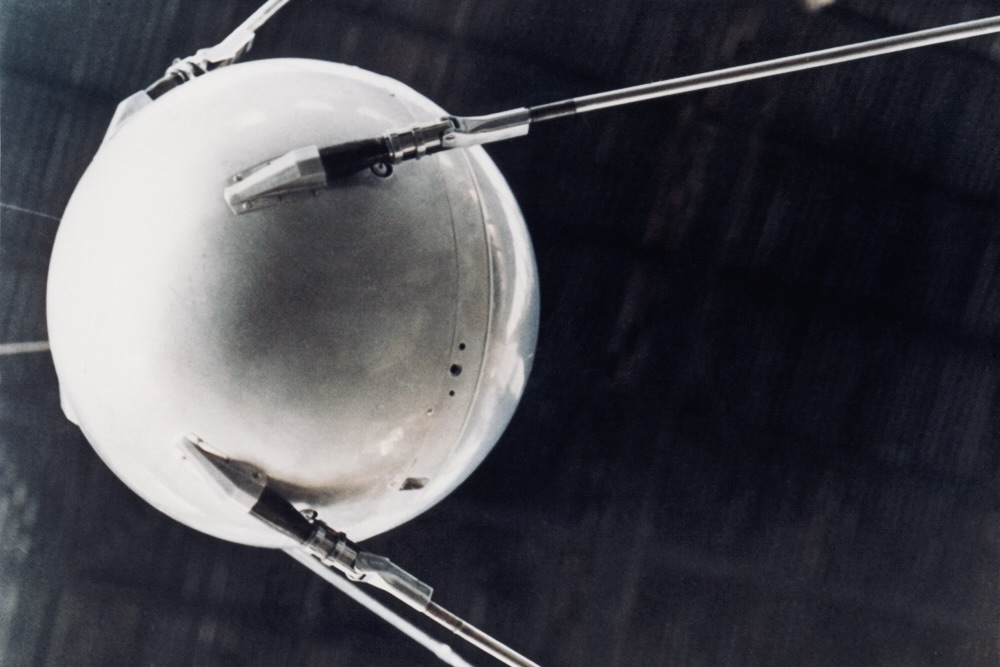
The world’s first artificial satellite, Sputnik, was launched by the Soviet Union in October 1957, shocking the world with Russian technological superiority and seeming to threaten nuclear annihilation. All Sputnik did was beep a short-lived radio signal, but on that day the Space Race began. America’s Telstar I, launched in 1962, received microwaves from Earth and transmitted them back. In 1964, thanks to Syncom 3, a limited number of television images of the Tokyo Olympics were transmitted across the Pacific Ocean for viewing in America’s living rooms. In April 1965, Intelsat I (popularly known as “Early Bird”) routinized the transmission of low-resolution television images across the Atlantic. With that, the age of commercial satellite connectivity had begun. In January 1967, Intelsat II (F-2) linked the United States with the Pacific, and by June 1967 the multi-satellite infrastructure was in place in space to enable the global Our World broadcast.
The Beatles’ manager Brian Epstein had immediately accepted the BBC’s offer to feature the band on the broadcast, but the Beatles themselves were not sure they wanted to do it. They had just spent five grueling but exhilarating months producing the most revolutionary album in rock history: Sgt. Pepper’s Lonely Hearts Club Band. They needed a break. They had quit doing live performances after a harrowing tour year that ended with a concert at Candlestick Park on August 29, 1966. Hard though it is to believe, they were nervous about performing live again. To break the tension and make the broadcast a “happening,” they convinced their friends, rivals, and lovers to attend: Mick Jagger, Keith Richards, Eric Clapton, Marianne Faithfull, Keith Moon, Graham Nash, Gary Leeds; wives Cynthia Lennon, Pattie Harrison, Maureen Star, and Paul’s girlfriend Jane Asher. The studio was festooned with balloons (including globes), placards, posters, and colorful Carnaby Street attire. Lead vocalist Lennon, who had poor eyesight but refused to wear glasses, chewed gum throughout the performance and nearly fumbled the simple lyrics. As usual, McCartney bailed him out.
Producer George Martin performed his usual magic (as the Fifth Beatle) in proposing pre-recorded backing tracks for the “live” performance. This included a 13-piece orchestra, harpsichord, banjo, horns, a string bass, and violin. The Beatles made 58 takes over five days to perfect the backing tracks, without which the live song would probably have sounded thin or even trite. To ensure the song would truly evoke globalism, Martin opened the performance with a few bars from the French national anthem La Marseillaise.
All We Need Is Love
Some critics have detected weariness in John’s performance of the vocals; some have seen it as parody of the band’s early She Loves You phase. Maybe, but the BBC and manager Brian Epstein told the Beatles the song must be simple so people all over the world could understand it. When he listened to John’s song for the first time several weeks earlier, George was heard to mumble, “Well, it’s certainly repetitive.”
In my view, it was much more than that, for all of its simplicity. The Beatles recorded 213 songs before the breakup in 1970. If you had to distill their essential message from all that wild and sometimes experimental variety over a seven-year period, the message is — however trite this may seem — love. An estimated 42% of their songs are about love (not always happy love), and love is mentioned in their songs 613 times, an average of three times per song. From I Saw Her Standing There, Please Please Me, Love Me Do, P.S. I Love You, and Baby It’s You, of their first album (March 22, 1963) to The End at the end of Abbey Road (September 26, 1969), “the word is love.” In fact, the most constant, consistent, and profound word of their body of music is love. It appears 76 times in All You Need Is Love.
And there is that moment of pure genius at the end of the broadcast, as “all you need is love” is repeated 10 times in a row, with some of the studio audience joining in. As the song fades out, either John or Paul twice sings over the refrain the first line of She Loves You:
“She loves you yeah yeah yeah
She loves you yeah yeah yeah”
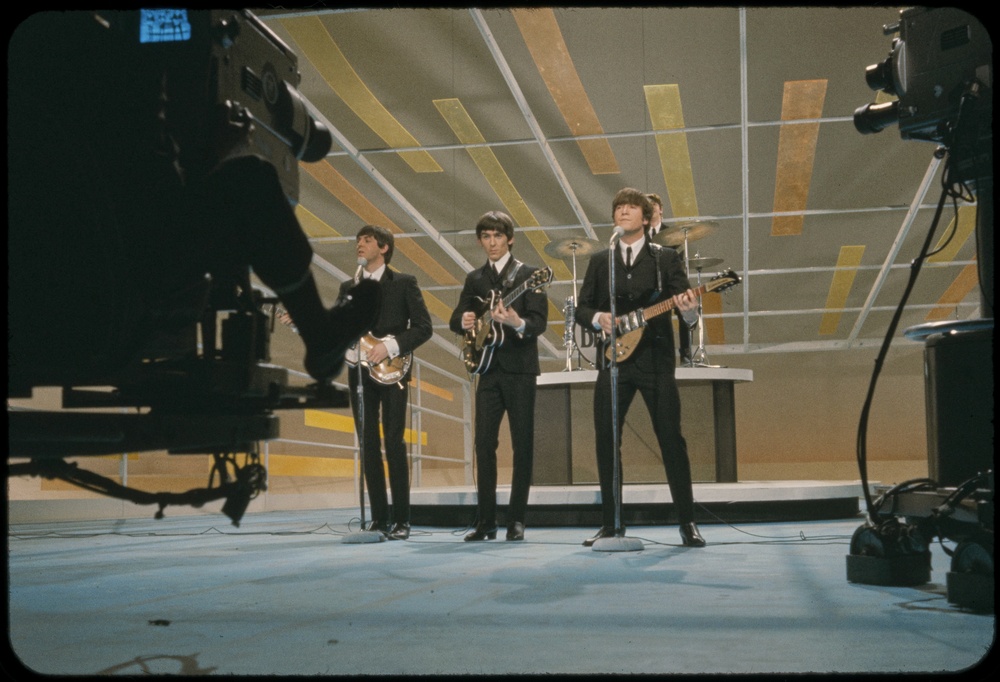
It’s a perfect mix of sweet nostalgia, parody, and a sense of how much has changed since those early days in the identical suits. And some loss.
When you hear it, you either burst into tears or laughter or both, because it carries you back to July 1, 1963, when the Beatles were just beginning to conquer the world, when they were still “troubadours of the innocent,” before they grew out their hair, when the ’60s had not yet turned sour, when the American cities weren’t burning, when John F. Kennedy was still alive, and Vietnam was still a minor police action.
It was exactly the song the world needed to hear.
One of the Beatles’ best chroniclers, Mark Lewisohn, has written, “In what has since been described, with some justification, as the greatest single moment in the history of popular music, the Beatles, now at their absolute zenith, performed All You Need Is Love … From playing skiffle music in an abattoir workers’ social club back in 1957 to instructing 350 million people, live across the globe 10 years later that ‘love is all you need’ is a leap in scale so colossal that it’s still hard to comprehend.”
When NPR’s Terry Gross interviewed Michael Pollan after the release of his book How to Change Your Mind, about his experimentation with psychotropic drugs, she asked him to sum up what he had learned. Two things, he said. First, you cannot achieve peace and enlightenment until you wrestle your ego to the ground once and for all.
“And second?” she asked.
“It sounds trite, but the Beatles had it right: “The love you take is equal to the love you make.”