
Clay and his daughter make a long-planned pilgrimage to Troy, the site of the ancient epic the Iliad.
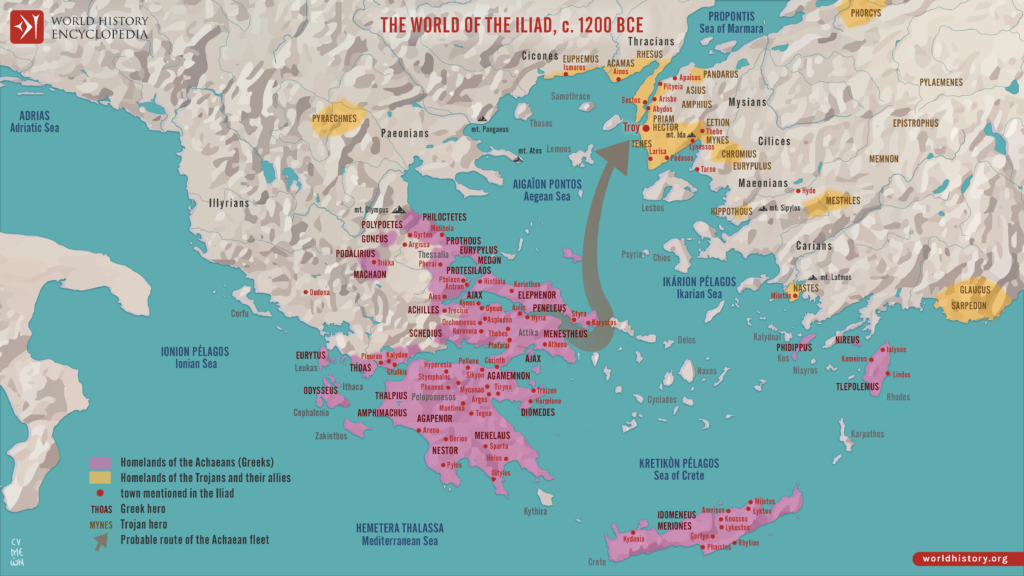
Saturday, May 7, 2026 – 9:37 a.m. somewhere north of Ephesus, Turkey: Today we will sail between Lesbos and the coast of Turkey, and we will pass close enough to the island of Chios to see it, perhaps. Chios is the traditional home of the poet Homer, the most likely of several birth locations that have claimed him through the millennia. We have ventured so far from the American heartland because of our love for two books that reach back to the beginnings of Western civilization: the Iliad and the Odyssey. It is often said that “all literature is a footnote to Homer.” Not quite, but close.
Our initial destination is Istanbul (early tomorrow), the ancient capital of the Ottoman Empire, situated right up against the entrance to the Black Sea. And then on to Troy, where the action of the Iliad takes place over a 51-day period in the 10th year of a siege that won’t finally end until Odysseus comes up with the lame Trojan Horse trick. But hey, it worked. After Troy was sacked, its warriors slaughtered, women and children carried into slavery, and the famous beauty Helen was taken back to Sparta in Greece, where she and her long-suffering husband Menelaus patched their marriage back together with a little help from a mind-numbing drug called pharmakon.
A bit of geography. The Mediterranean is a long, horizontal sea that opens out into the Atlantic at Gibraltar. It is about 2,500 miles long and on average 500 miles wide. The east end butts up against Turkey, Syria, Lebanon, Israel, and Egypt. Western Civilization’s origin stories began in the greater Mediterranean world — the Old and New Testaments of the Israelites and the early Christians; the Greece of Socrates, the Parthenon, the Peloponnesian War, city-states, Plato and Aristotle; and the Roman Republic and later Empire. To all of these people, the Western Hemisphere simply didn’t exist. It took Columbus to bump up against the Americas in 1492 and the Mormon visionary Joseph Smith to connect those dots (March 26, 1830).
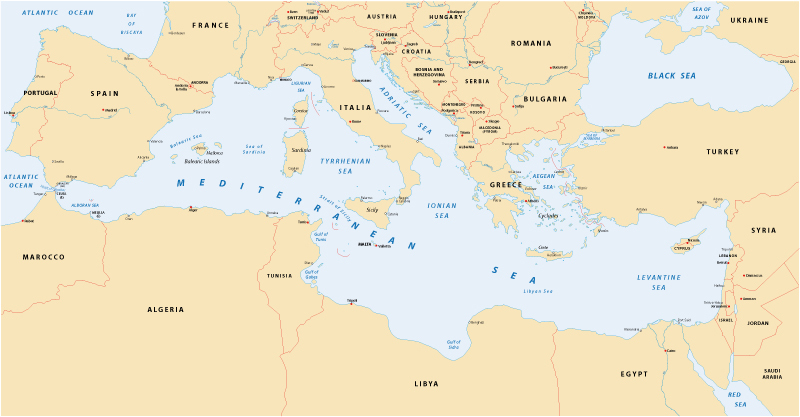
Ancient Troy was strategically located at the point where the Mediterranean meets a series of waterways that eventually link up to the Black Sea in the heart of Eurasia. From west to east: the Hellespont (also called the Dardanelles), the Sea of Marmara, the narrow channel of the Bosporus, and then the Black Sea, once a freshwater lake, now not. The Black Sea touches Turkey, Bulgaria, Romania, Ukraine, Russia, and Georgia.
These days, we’re all aware of the importance of choke points in the world’s shipping lanes: the Strait of Hormuz, for example! The Panama and Suez canals, Gibraltar, and the Dardanelles, among others. Ancient Troy was situated to manage and dominate trade at the point where the Black Sea meets the Mediterranean.
Historicity Versus Myth
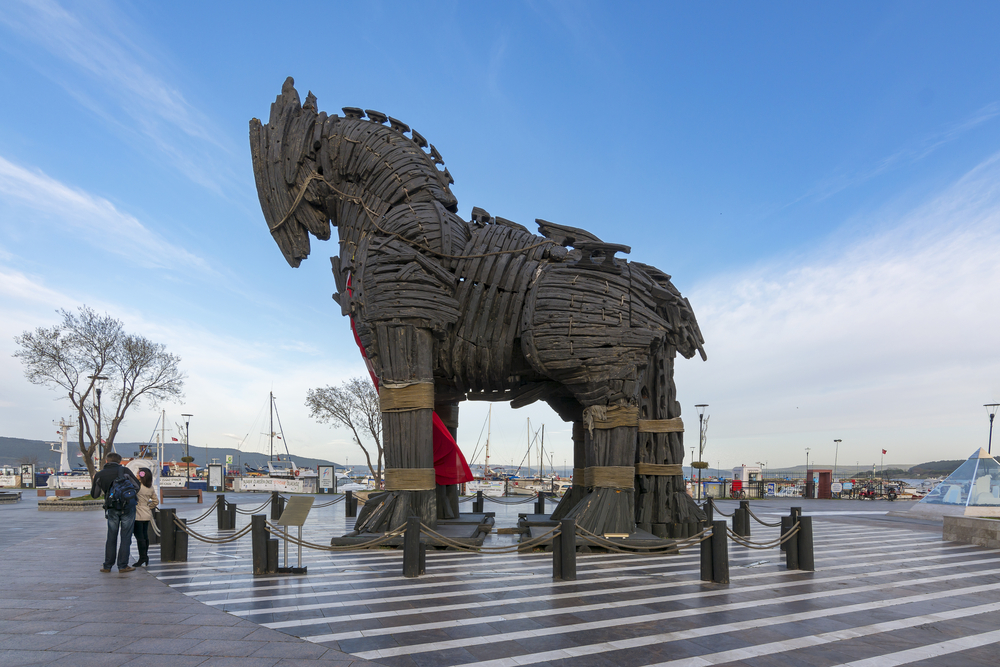
The ancients believed that the Trojan War was an actual armed conflict between Greek and Asian armies. The two greatest Greek historians, Herodotus (ca. 484-425 BCE) and Thucydides (ca. 460-400 BCE), both believed the Trojan War had actually occurred and attempted to determine when it had happened. Herodotus, basing his estimate on the passage of generations and obscure divine matters, said the war occurred 800 years before his time, or about 1,250 BCE. Thucydides threw up his hands and opted for “the distant past.” But neither disbelieved. The traditional date of the Fall of Troy, 1,184 BCE, was given by the Greek polymath Eratosthenes in the third century BCE. Among other things, Eratosthenes was the first person to determine the size of the Earth.
Beginning with the Renaissance, for a very long time it was thought that the Trojan War was merely a mythological tale about the abduction of the world’s most beautiful woman — Helen of Sparta — and its aftermath, as famously invoked in Christopher Marlowe’s Dr. Faustus: “Was this the face that launched a thousand ships and burnt the topless towers of Ilion [Troy]?”
Scholars and literature lovers in Thomas Jefferson’s time assumed the Trojan War was a fairy tale, though Jefferson insisted that the Iliad was the greatest work of literature. People like Jefferson didn’t really care whether the Trojan War ever occurred or not. Jefferson could read Homer in the original Greek (of course!), but he also read it in English in the rhymed couplets of
Alexander Pope’s 1715-1720 translation:
The wrath of Peleus’ son, the direful spring
Of all the Grecian woes, O Goddess, sing!
That wrath which hurled to Pluto’s gloomy reign
The souls of mighty chiefs untimely slain,
Whose limbs, unburied on the naked shore,
Devouring dogs and hungry vultures tore:
Since great Achilles and Atrides strove,
Such was the sovereign doom, and such the will of Jove!
The 18th-century English classicist Richard Bentley reportedly told Pope, “It is a pretty poem, Mr. Pope, but you must not call it Homer.” Every translation has its limitations; every translation evokes its own time and sensibility.
I first encountered the Iliad at the University of Minnesota in Richmond Lattimore’s magnificent 1951 translation. Then, for the next four or five years, I struggled to read parts of it in Homeric Greek — one of the hardest and most satisfying challenges of my life. In the summer of 1978, beginning at dawn, I spent six hours a day in a 17th-century farmhouse in Wiltshire (England) memorizing Homeric vocabulary and hacking my way through the Greek dactylic hexameter verse.
I’ve taught Homer in translation a dozen or more times over the years. To get ready for this trip, I have read it again in three separate translations and devoured an outstanding book by my Oxford University contemporary, Caroline Alexander: The War That Killed Achilles. So you can see that I am heavily invested in this Greek and Turkish adventure.
Archaeological Vindication
Until after the American Civil War, the events at Troy were seen as mere fiction or — at best — a heavily fictionalized and embellished account of something that may or may not have happened at the Hellespont a zillion years ago and certainly not a war over a woman.
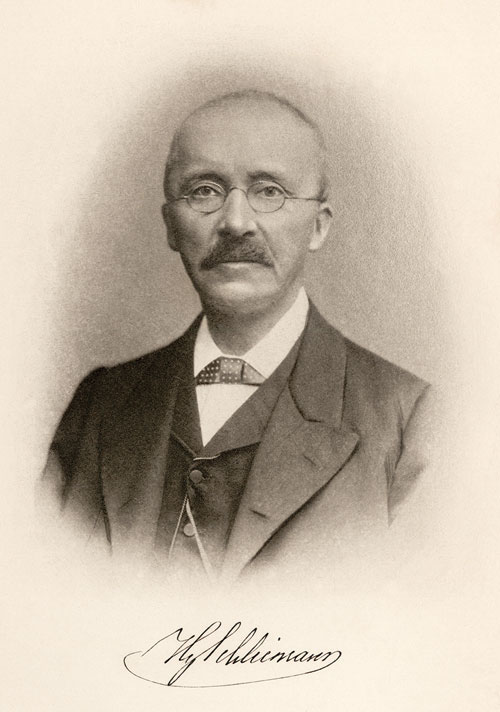
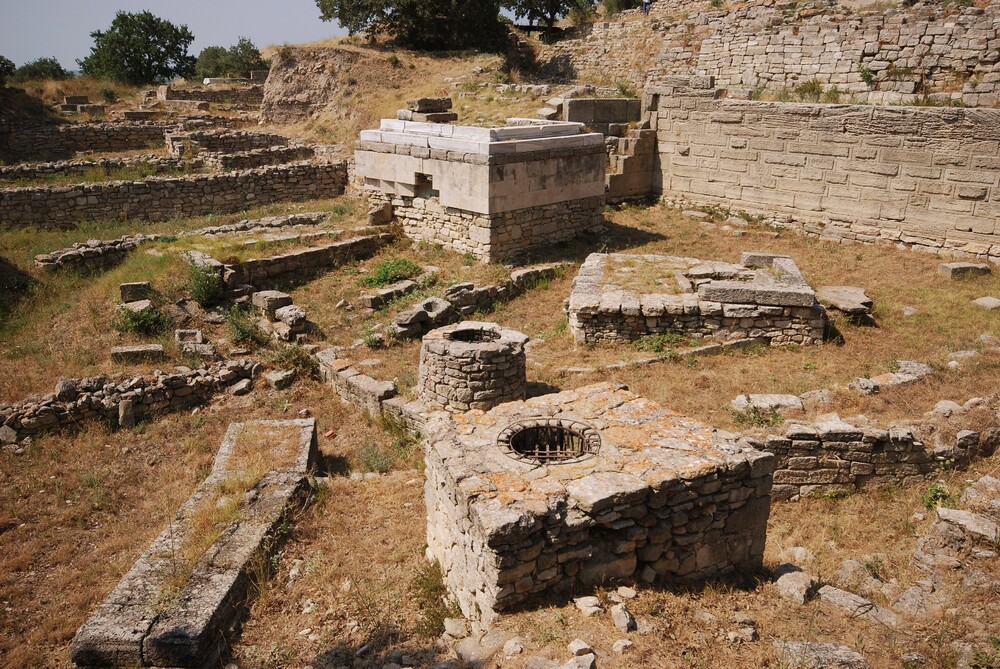
Then came Heinrich Schliemann (1822-1890), a German banker, amateur philologist, and intense lover of the Homeric epics. Schliemann’s great heart convinced him that the Homeric epics were real. The experts scoffed and raised their supercilious eyebrows, as they always do. After amassing several fortunes, Schliemann ventured to the putative location of Troy (as described in Homer) and began to dig, not with much scientific precision or decorum, but with iron determination and plenty of money for bribing local officials. Turns out he was right (mostly). In May 1873, he dug up what he called the Treasury of Priam (the king of Troy), smuggled the golden artifacts out of the Ottoman Empire, and draped them on his Russian wife Sophie to take photographs. Schliemann was vindicated. He, and later more careful archaeologists, discovered that one of many “Troys” at the site was indeed destroyed at about the right time. It is today known as Troy VIIa. That’s where I’m headed Monday.
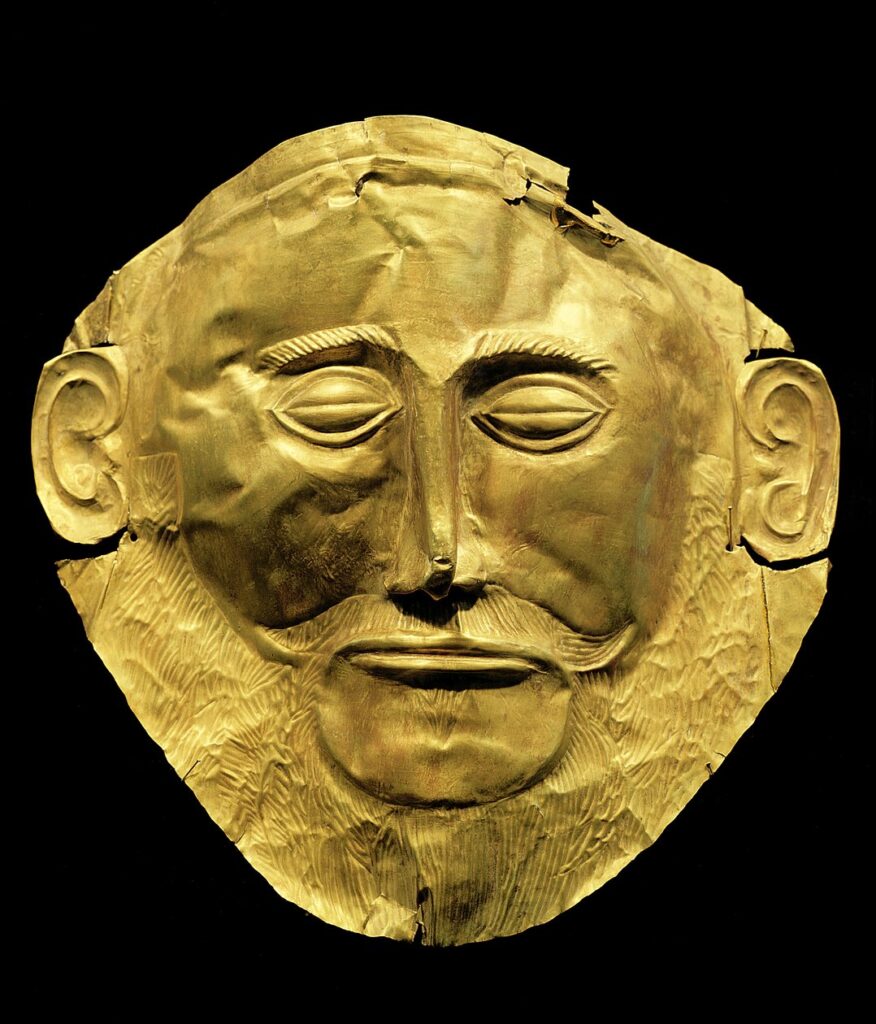
Later, Schliemann dug up an equally impressive treasury at Mycenae in the Peloponnese in southern Greece. One of the most fabulous pieces he unearthed was a beaten gold mask of an elderly man, one of the greatest archaeological discoveries ever made. Schliemann erroneously thought the mask preserved the visage of Greece’s Trojan War commander Agamemnon. He is said to have sent one of the most famous telegrams of history to King George I of Greece: “Today I have gazed upon the face of Agamemnon.” Schliemann later named his first son Agamemnon. Today, the Mask of Agamemnon is one of the treasures of the National Archaeological Museum in Athens.
I’ve been to Mycenae five or six times in the last few decades, and the thrill never diminishes.
Today in Real Time
It’s 4:33 p.m. At this exact moment, we have sailed past the site of Troy, on the Asian side of the Hellespont, and the nearby village of Çanakkale, where we will stay a couple of nights from now when we drive back west to the Ancient Troy Interpretive Center from Istanbul. In other words, we’re visiting Troy both by sea (now) and by land (soon). Our plan is to venture to Troy by rental car (in Turkey, what could go wrong?!) and walk the grounds with maps and guidebooks (and Homer’s epic).
It would be difficult for me to express how excited I am to be visiting Troy and the Hellespont with a copy of the Iliad in hand. The equivalent joy for a lover of the NFL would be to have prime seats at the Super Bowl between the Dallas Cowboys and the Buffalo Bills. For a lover of tennis, Wimbledon. For a lover of opera, Wagner’s 18-hour Ring Cycle at the Bayreuth Festspielhaus. For a lover of Shakespeare, a backstage pass to meet Sir Laurence Olivier playing Hamlet at the Old Vic. For a space junkie, the launch of Apollo 11 on July 16, 1969, was a memorable event. For a golf lover, the 1997 Masters, when Tiger Woods won there for the first time. He was 21 years old. Talk about anticipation.
Troy is one of those places that is not easy to get to. You really have to want to make the pilgrimage, which makes it all the more valuable. It’s a bit like driving the Dalton Highway (Alaska Rt. 11) from Fairbanks to the Arctic Circle or walking the sacred Little Missouri River from Devils Tower to Medora. Or canoeing from Three Forks to New Orleans, an insane adventure recently completed by my British friends Nat and Mikey.
I’m planning to run (by which I mean lurch) three times around the ruined walls of Troy in the footsteps of Homer’s Achilles to honor the humanities, to honor hopeless romantics like Heinrich Schliemann, to honor a vow taken long ago, to come full circle, and to pass the torch to my favorite person in the world.
Stay tuned.