
America’s Founding Fathers drew heavily on the last years of the Roman Republic in crafting our nation’s founding documents, foreseeing both the promise and the frailties of a Republic.
I had the great good fortune to share a stage recently with the historian Ed Watts of the classics department of the University of California, San Diego. Professor Watts is the author of several books, most notably Mortal Republic: How Rome Fell into Tyranny. His newest book, The Romans: A 2,000-Year History, is approximately a gazillion pages long, but worth it.
I invited Dr. Watts to share the stage with me at the Vail Symposium in Colorado, where I serve as a moderator four times per year. Our subject is perhaps inevitable, given where things stand on the 250th anniversary of the United States of America: Are We Rome?

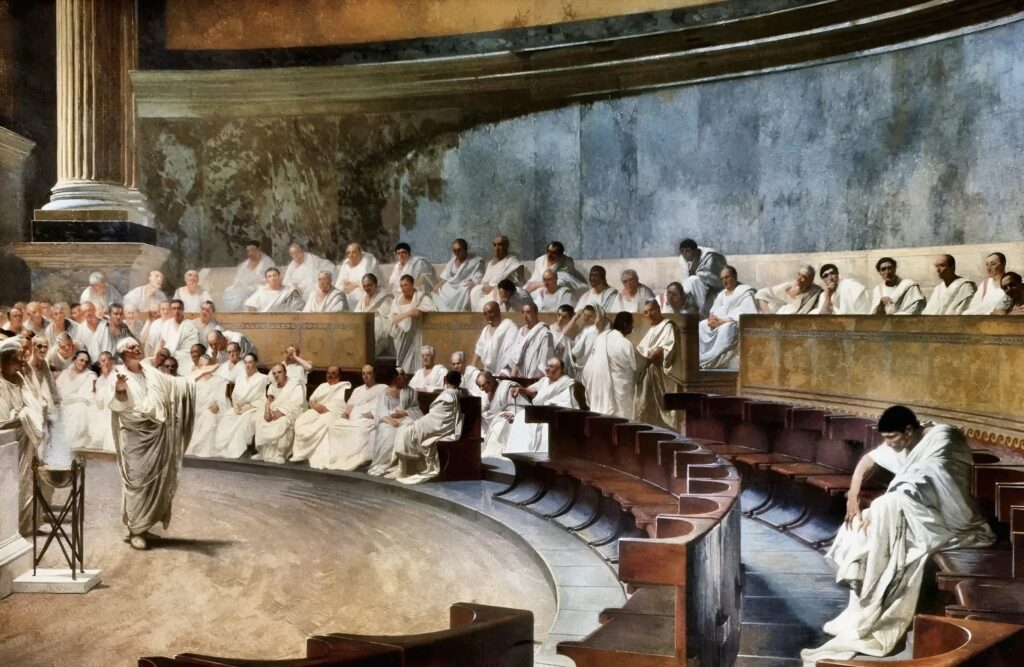
This question, “Are We Rome?” has been something of a national obsession in the United States from the very beginning. The Founding Fathers (and such Founding Mothers as Abigail Adams, Mercy Otis Warren, and Theodosia Burr) were all deeply schooled in the last two centuries of the Roman Republic (509–27 BCE). When the Founders wrote op-ed pieces, they signed them as Publius, Fabius, Cato, Horatius, and Helvidius, straight out of the Roman historians Livy and Cassius Dio.
The American Founders knew the life and achievements of Caesar, Pompey, Crassus, Cato the Younger, Cataline, Augustus Caesar, Cicero, Cincinnatus, and the Gracchi brothers the way we know the Kardashians, Taylor Swift, Bill Maher, Brad Pitt, and Whoopi Goldberg. We are, in short, doomed. The Founders were desperate to create an American republic, not a monarchy, aristocracy, or democracy, and certainly not a tyranny. Their model was Rome. They were aware from their obsessive reading of Roman history and literature that a republic is inherently fragile.
The Founders borrowed heavily from the last years of the Roman Republic when they crafted our great founding documents — the Declaration of Independence, the Constitution, the Bill of Rights, and the Federalist Papers — to provide the new republic all the guardrails they could think of. Such terms as capital, Senate, legislation, veto, and republic itself (the Latin res publica, “the public stuff”) come straight out of Rome, not fourth-century BCE Athens, nor the parliamentary vocabulary of 18th century Great Britain. The snooty British ambassador Anthony Merry found it hilarious as well as appalling when the Founders renamed the District of Columbia’s Goose Creek the Tiber!
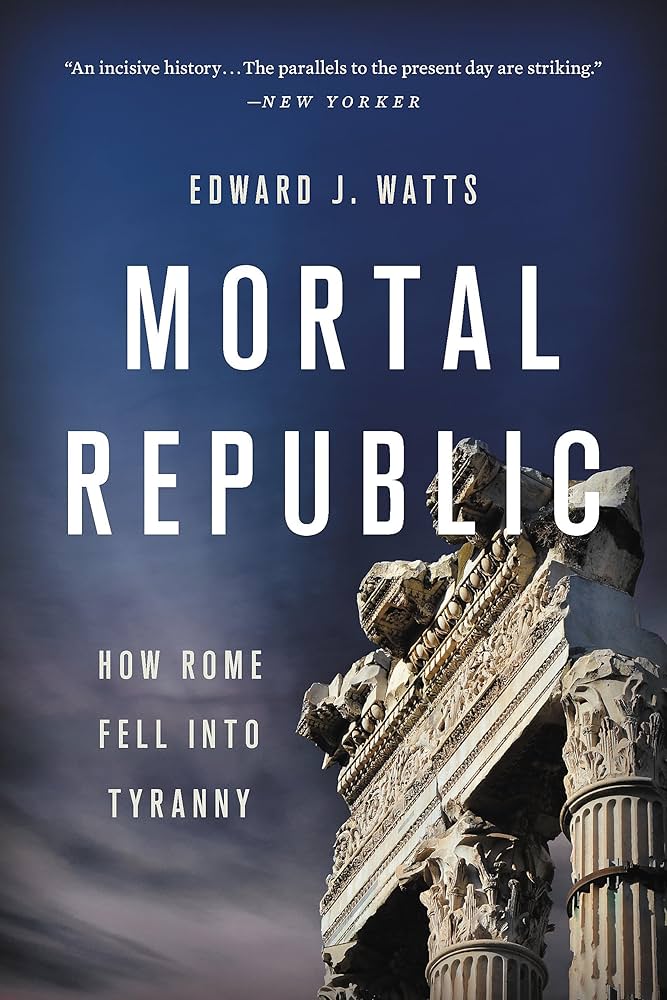
Ed Watts is a careful and exceptionally rigorous historian, so we should not expect him to jump on the We Are Rome bandwagon. But he knows that republics fail when those who lose elections fail to accept the results. The heart of a republic is the peaceful transfer of power. He knows republics fail when political disagreement devolves into political violence. He knows republics fail when rich and powerful men surround themselves with private armies. He knows republics fail when the divide between the few rich and the masses of the poor becomes so great that the poor have nothing to lose by taking their grievances to the streets. Republics die when public officers (magistrates) use the apparatus of the state to punish their real and perceived political enemies. Republics fail when what the late John McCain called “regular order” collapses into national political paralysis and mutual demonizing.
Consider this passage from the conclusion of Professor Watt’s book:
“Each of these men’s [Caesar, Pompey, etc.] selfish, individualized pursuits of glory ensured that Romans quickly returned to a form of elite political competition in which no limits were placed on the tools one would use to vanquish his opponents. And the fact that ordinary Romans did not immediately oppose all of these selfish acts and punish all these actors by withholding their votes simply encouraged more and more extreme misbehavior.”
Sound familiar? This should keep us up at night.
Thomas Jefferson made much the same point in his great First Inaugural Address on March 4, 1801. You have to read the following passage very carefully to discern both the fragility of our republic (any republic) and Jefferson’s formulation for a republic’s success and survival:
“All, too, will bear in mind this sacred principle, that though the will of the majority is in all cases to prevail, that will to be rightful must be reasonable; that the minority possess their equal rights, which equal law must protect, and to violate would be oppression. Let us, then, fellow-citizens, unite with one heart and one mind. Let us restore to social intercourse that harmony and affection without which liberty and even life itself are but dreary things.”
The deist Jefferson does not use the word “sacred” lightly. He is saying that our system, of course, depends on majority rule, but the majority needs to show special respect to the minority, “must be reasonable,” in other words, must be accommodating, and not lord it over the minority (by which he means those who did not win the vote this time). When he declares that the minority “possess their equal rights,” Jefferson means that the “minority” is made up of our fellow citizens, our friends and neighbors, and they should be treated with the utmost respect, as you hope they will treat you when they are in the majority. You don’t punish the opposition; you accord them equal respect and dignity, “to violate which would be oppression.” What Jefferson has in mind is a conciliatory majority and what we used to call the “loyal opposition.”
Is this code of republican conduct enforceable? No, of course not. It requires character and virtue, both national and individual. If this regimen of voluntary disciplines and self-restraints, this voluntary generosity of spirit, does not prevail in the citizenry, “liberty and even life itself become dreary things.” Life itself! says Jefferson. The Roman people had these qualities at their best. And when this unenforceable “spiritual” essence of a republic yielded to unfettered ambition and unfettered aggression, the Roman republic died.
As a loyal Jefferson scholar, I am compelled to acknowledge that we have never been the people of Jefferson’s semi-utopian vision. The election of 1800, when Jefferson narrowly defeated John Adams for the presidency, was one of the most vituperative in American history. But it is clear that, for most of American history, we have been closer to Jefferson’s republican ideal than we are now, and the breakdown of commonwealth values is one reason we seem to be circling the drain at 250. When is the last time that a major political figure in America behaved in this republic-over-self manner? Perhaps it was Al Gore’s concession speech on December 13, 2000. Or Richard Nixon in not contesting the very contestable election of 1960, when it was quite clear that the Democrats had cheated in Texas and Chicago.
If the American republic collapses, it won’t be primarily the responsibility of our sorry roster of national political figures. It will be on us.

When, in the year 2020, I first read Mortal Republic, a book focused on the last decades of the Roman Republic, every 10 pages or so, I looked up from my reading and asked myself, out loud, “Is he talking about Rome or is he talking about us?” Watts revealed on stage in Vail that in the course of writing his book (after the 2016 election), he found himself wondering about our current predicaments more than he had intended when he undertook the project. And things have only begun to echo more worryingly in the last half dozen years.
But …
Professor Watts’ greatest concern is not January 6, 2021, or the Proud Boys, or even the antics of our current president, a self-described disruptor who says he is contemptuous of the U.S. Constitution. His concern is with the American people.
“Rome’s republic, then, died because it was allowed to. Its death was not inevitable. … When citizens take the health and durability of their republic for granted, that republic is at risk.” Think of all that we have taken for granted as mostly disengaged and escapist citizens of the American republic. The Epstein files are of great importance, but they are not nearly as important as the dizzy decline of our republican system of government. We cannot expect America to be saved by a Kennedy, a Reagan, or a Roosevelt. Elvis has left the building. Nor can Ed Watts set us right, but if we read his work with full attention and gaze into the mirror he carefully holds up to us, we, the people, might be able to pull back from the abyss. Here’s the last sentence of Mortal Republic:
“In ancient Rome and in the modern world, a republic is a thing to be cherished, protected, and respected. If it falls, an uncertain, dangerous, and destructive future lies on the other side.”
He has my attention. I urge you to borrow or buy the book and read it.