
My friend, the Italian journalist Marzio Mian, has just published a remarkable book on his monthlong underground journey along Russia’s sacred Volga River. Part travelogue, part Russian history, and part exploration of the dense, tragic Russian soul in a time of brutal war, the book is a powerful read when America’s place in world affairs is significantly unsettled.
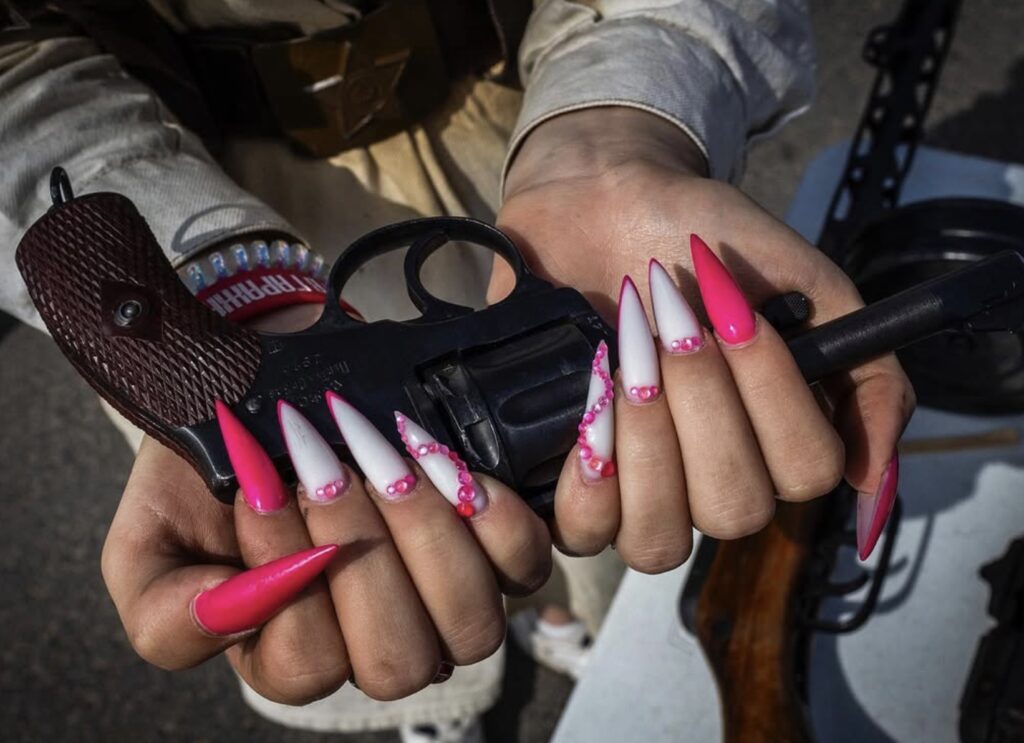
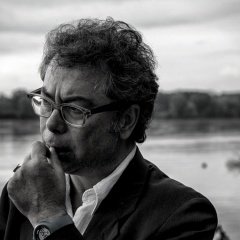
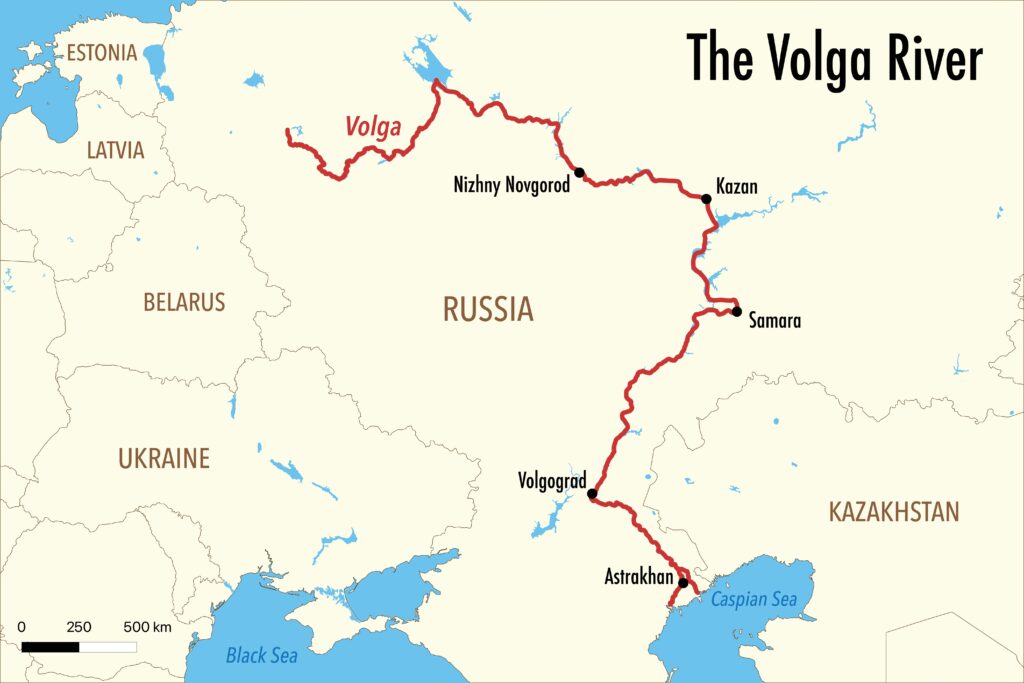
My friend Marzio Mian of Milan, Italy, has published a new book on Russia. Marzio is an award-winning journalist who has traveled to 56 countries around the world, sometimes at great risk, including war zones in Bosnia and Africa. The English language edition of Volga Blues: A Journey Into the Heart of Russia is just out in the United States. Volga Blues was recently very favorably reviewed in the New Yorker, and I now see it prominently displayed in major bookstores everywhere I travel. In 2023, Marzio and his friend and photographer Alessandro Cosmelli spent just under five weeks following the Volga River corridor from the river’s source in the Valdai Hills, 220 miles northwest of Moscow, all the way to its mouth at the north end of the Caspian Sea. They hired two young, spirited Russians, Marzio calls “Vlad” and “Katya,” to interpret for them and drive them along the river. Their goal was to see what they could learn about the mood of average Russians as the catastrophic war against Ukraine grinds on.
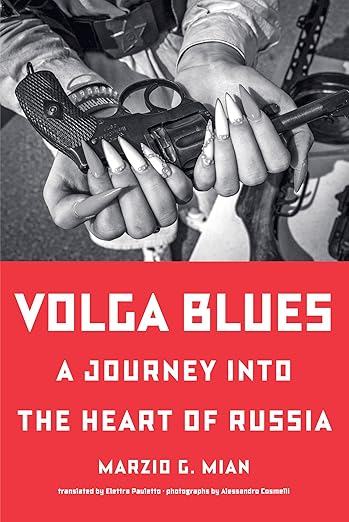
Volga Blues is an amazing journey story and a great book, part travelogue, part sketch of elements of Russian history, and part exploration of the dense, tragic Russian soul in a time of brutal war. I’ve read a number of books about the Russian Revolution of 1917, the USSR., the Cold War, Vladimir Putin, and post-communist Russia, but this is, without question, the best book on Russia I have ever read. In the midst of heavy competition. This includes the English philosopher Bertrand Russell’s Practice and Theory of Bolshevism, which he published after his disillusioning visit to the Soviet Union in 1920; and John Steinbeck’s excellent Russian Journal, published after his visit to Moscow, Kyiv, Stalingrad, and Georgia (with photographer Robert Capa) in 1947.
Marzio Mian has a deep fascination with rivers. I first met him 10 years ago, when he and Alessandro were traveling along the Missouri-Mississippi River corridor in the United States, from Lake Itasca in northern Minnesota to the Mississippi’s delta below New Orleans. More recently, in 2019, Marzio published a biography of Italy’s Tiber River. Though it is only 252 miles long, the Tiber (like the 215-mile Thames in England) has historic significance far greater than its length or volume.
Marzio and Alessandro ventured deep into the heart of wartime Russia at great risk. They were traveling undercover, without having sought foreign journalist credentials from the Russian ministry. To have done so, even in the unlikely event they had received official permission from the government, would have fatally distorted the project, which was to mingle with average Russians in unexpected venues and see the country for themselves rather than through the lens of “state-managed encounters.” Had they been arrested by government authorities at any point along the way, they would certainly have been detained, perhaps indefinitely. As they made their way down the Volga, often visiting places along the river where journalists (foreign and domestic) were not welcome, they lived in fear that Russian security agents would bang on the door of their lodgings in the middle of the night and whisk them off to interrogation and detention. By the end of the journey they could no longer even be sure that Vlad and particularly Katya were reliable guides; Katya, on the eve of their departure from Astrakhan at the mouth of the Volga to Baku in Azerbaijan, threatened to report them to the Russian authorities: “Katya’s threat, now that we are facing our last mile of Russia alone, is ringing in our ears, amplifying the ticking of the bomb. Will we be ambushed in the closing credits?”
The 2,193-mile Volga River is not quite the longest river in Russia, but it is by far the most important. The Volga is the mother river (matushka) of the world’s largest country. Before Marzio’s journey began, the director of the Hermitage (museum) in St. Petersburg told him, “Russia would not exist without the Volga. It was everything, and it remains everything. It’s the life force of a nation. Symbol and destiny. It’s the autobiography of a people.” What an amazing statement. The only analogy we Americans have is the mighty Mississippi, the “Father of Waters,” but we don’t regard the Mississippi with anything like the passion, sacramental reverence, or centrality to the identity of the American people that the Volga embodies in Russian history and mythology.
Volga Blues reminds us that many of Russia’s most important events in its long history have occurred along the river. Russia was born on the Volga around 830 CE (AD) when Scandinavian Vikings (the Rus’) mingled with East Slavic tribes. Some of the greatest Russian writers have a Volga connection, including Maxim Gorky, Ivan Goncharov (the author of the novel Oblomov), and Leo Tolstoy. Lenin (1870-1924) lived in Ulyanovsk until 1887, when he moved to Kazan (also on the Volga) to pursue his studies. One of the greatest battles in human history occurred at Stalingrad (now Volgograd) between August 1942 and February 1943, resulting in almost 2 million casualties, slightly more than half of them Russian. The Battle of Stalingrad “turned the tide of the 20th century,” Marzio writes — 41,000 buildings demolished, and, at the moment of victory in February 1943, when Hitler lost the war and doomed the Third Reich, only 7,000 Russian residents remained in Stalingrad of a previous population of 400,000.
The Russians have a long, dark memory that haunts even the war in Ukraine. America’s “greatest generation” lost approximately 405,000 soldiers in World War II, what the Russians call the Great Patriotic War. Russian losses? Approximately 30 million, including 19 million civilians. This is a fact that the American people cannot possibly understand or even fathom.
The Volga is an endorheic river — it flows in a closed basin, its waters never reach the ocean. The Volga’s outlet is into the Caspian Sea, the largest lake in the world. In this, it resembles other closed basins, including America’s Great Basin in Nevada, Utah, and bits of Idaho, California, Wyoming, and Oregon. The entire flow of the Volga is contained within Russia’s borders. Somehow, this seems symbolically important as we try to make sense of Russia’s psychological insularity.
Volga Blues is worth reading merely as a well-written and spirited travelogue by an award-winning journalist with a great eye for the telling detail. But it is Marzio’s findings — his tentative conclusions — that I find most interesting and a little haunting, given America’s simplistic view of the war in Ukraine.
First, the Russian people (on the whole) look upon the war in Ukraine as a defensive war. They believe the West (NATO, Europe, and the U.S.) is the aggressor and that Russia is fighting not only for its territorial integrity and regional security, but also to preserve the unique Russian Slavic identity from the cultural decadence of the West. Here in America, we see Putin as the sole aggressor, gobbling up Crimea in 2014 and now another chunk of Ukraine (2022-), more if he succeeds. The first instance of an armed invasion of another sovereign European nation since World War II. The average Russian sees the war as yet another in a long series of Western invasions of the homeland: Poland (1605-1618), Sweden (1708-1709), Napoleon (1812), and Hitler (1941-1944). And now Europe and NATO are relying on the United States’ checkbook. It helps, of course, that there is no real free press in Russia. Putin has said, “We’re once again being threatened by German panzers … and once again, we’ve been called to push back Western aggression.” The state-controlled media conforms to Putin’s narrative, that this war somehow represents an existential threat to the core Russian identity and would have been unnecessary if the West had kept its word after the collapse of the Soviet Union and not extended NATO right up to its borders (Poland 1999, Estonia, Latvia, and Lithuania 2004, and Finland 2023).
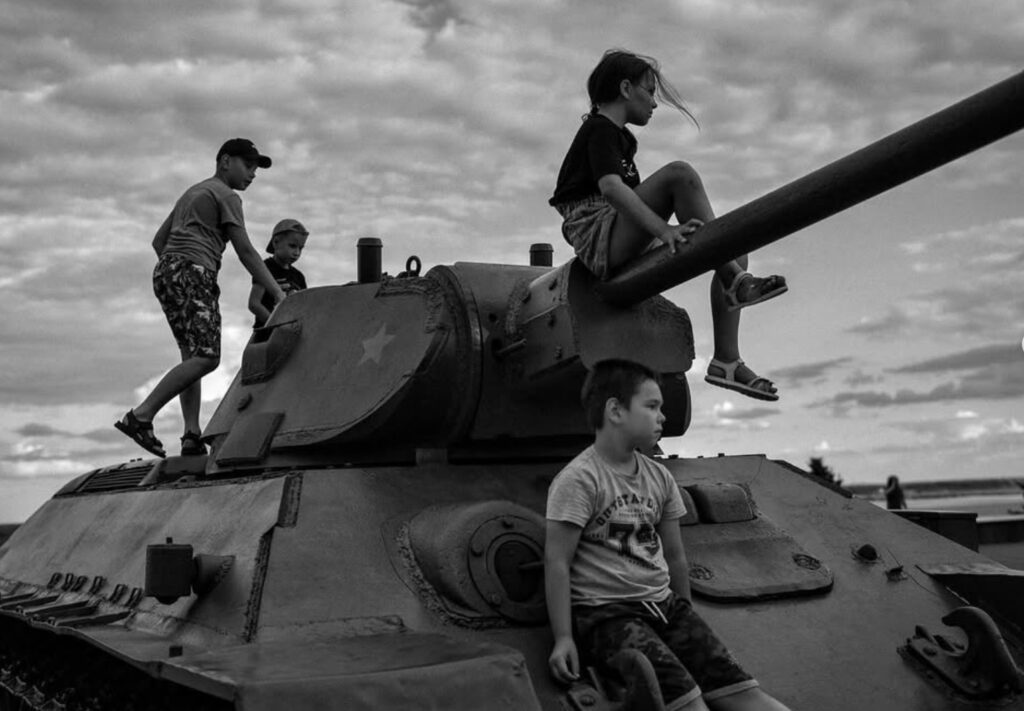
Second, in spite of the heavy losses (350-450,000 dead so far, more than a million casualties), the Russian people support the war. In the course of his travels, Marzio sensed a deep and growing war weariness among the Russian people, but so far, they still mostly support Putin’s military initiative. Marzio says it’s when the Russian women take to the streets in mass numbers (as they did toward the end of the debacle in Afghanistan, 1979-1989) that the Russian government and military have to pull back and broker whatever peace they can negotiate, but he saw no evidence of that in his 2023 travels.
Third, up until now, the Russian economy has not collapsed, despite gigantic war expenditures (guns, not butter) and heavy sanctions. The sanctions have, in many respects, backfired. To fill the gap left by international corporations that have pulled out of Russia (Apple, Starbucks, etc.) a new wave of Russian entrepreneurship has emerged. Ironically, the sanctions have diversified the Russian economy and enabled Russia to graduate from its status as a petro-state. Basic commodity prices have not risen much, if at all, during the war years, and in some cases have diminished. Inevitably, a number of “friendly” nations (including China, India, and North Korea) have found ways to circumvent the sanctions, much of it along the historically central Volga shipping corridor.
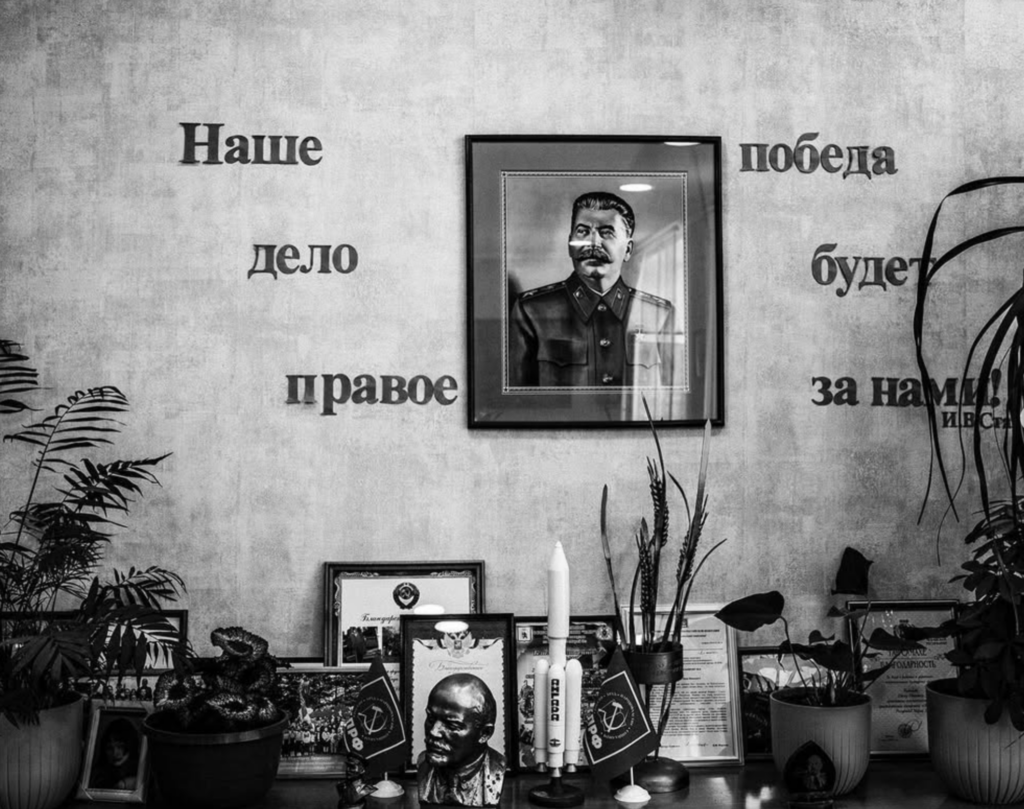
Fourth, while Putin is not exactly beloved, the Russian people on the whole continue to support him. His nostalgic grievance for the lost Russian Empire resonates with much of the population, 194 million and dropping, mostly because of the low birth rate, poor health, and the ubiquity of vodka. Russia has never shown much interest in Western-style democracy and open markets. Putin’s dictatorship does not particularly offend the Russian soul, which has embraced Western Enlightenment ideals and political structures only rarely and briefly. The Russians see America and Western Europe in palpable decline (and awash in decadence). Many Russians believe they will be “the last man standing,” the true home of high culture and civilization, when the West collapses. They believe the answer to Western weakness is a highly centralized Russian government led by an autocratic or semi-autocratic strongman. Russia is not Iran, with tens of millions of good people desperate to throw off the yoke of tyranny and sharia fundamentalism.
Finally, Marzio is certain that the West (and particularly the United States) neither understands Russia nor seeks to, and partly because of this, has made serious mistakes in its response to the Russian invasion of Ukraine. The European press, even more than the American, says Marzio, has cast the war in simplistic black and white terms, what he calls Manichaean terms, unnecessarily heroizing Volodymyr Zelensky, and pitting plucky and “democratic” Ukraine against the unconscionable and brutal Russian bear. Marzio regards this as caricature. He accuses the Western press of preferring lazy anti-Russian propaganda to the search for truth. At the very least, the geopolitical situation is more complicated than the West pretends, and even a moderate understanding of Russian history offers a more accurate, more nuanced, and somewhat more sympathetic view of Russia’s perspective in the struggle. Like the rest of us, Marzio decries Putin’s brutal aggressions, and particularly the growing inventory of war crimes (mostly) perpetrated by Russian and allied troops. But you cannot travel the Volga for a month without awakening to a less tidy and less self-serving narrative.
How Does This War End?
In an interview I recently conducted with Marzio, I asked him the obvious closing question. How does this war end? “Unclear,” he said, but it appears that the United States (and not merely the Trump administration) is going to pull away, provide fewer and fewer grants of cash and weaponry to Ukraine, and probably force a peace treaty that yields a good deal of territory to Russia, with little or no regard for the appalling outrage this represents to the 39 million people of Ukraine. It seems likely, too, that the U.S. will broker (impose) a settlement that gives Russia a greater presence in the government of Ukraine, and no iron guarantee that no subsequent invasion(s) will occur.
I want to make two important points in conclusion. After reading this, you may think that Marzio Mian is an apologist for Vladimir Putin and his Russia. Not so. Marzio is a thoroughly Western and cosmopolitan geopolitical liberal who is subject to no illusions about the war or the character of the current Russian autocrat. In addition, in 2023, he witnessed firsthand the dark apprehensions of the Russian people as the war drains more and more human and financial resources from a nation desperately in need of peaceful economic reform and development. If that was how things looked in the summer of 2023, imagine how much worse things are in Russia in the spring of 2026, in the fourth year of a ruinous war for which the Russian military was not adequately prepared. Volga Blues is not an op-ed piece but a careful study of one of the world’s most consequential nations in the midst of an international crisis that may set back Russia for decades, perhaps longer.
My second point is that Volga Blues would be an outstanding book even if there were no war in Ukraine. Marzio has gotten closer to the heart of Russia and the Russian people than any writer I know. I’ve learned most of what I know about the Russian heartland from this book, and essentially all I know about the Volga, one of the world’s great rivers. If it were safe to retrace parts of his journey, I’d be there, right after I spent a week in St. Petersburg with Dostoevsky and the Hermitage! I’d give anything to bestride the source of the Volga with Marzio, who brings as much humor as insight to the quest, and who has a genius for finding the right people and the right location from which to tell the story of Russia in our time.