
One of the great things about reading a lot is that it gives you the insights of triangulation. One book illuminates, interprets, and perhaps even disagrees with another, though the authors never met and were unaware of each other’s existence.

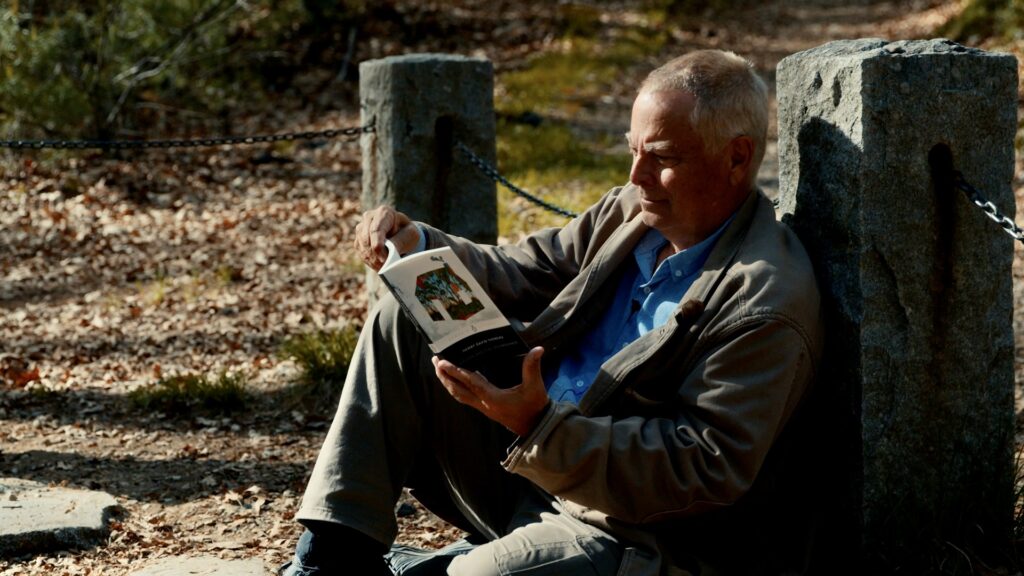
Today, for example, I’m reading Thoreau’s Walden with special intensity, trying to see deeper into it than in my dozen or more previous encounters.
I came upon this passage just now, which immediately carried my mind to John Steinbeck on his 1960 Travels with Charley tour. Here’s Thoreau:
“I have never felt lonesome, or in the least oppressed by a sense of solitude, but once, and that was a few weeks after I came to the woods, when, for an hour, I doubted if the near neighborhood of man was not essential to a serene and healthy life. … But I was at the same time conscious of a slight insanity in my mood, and seemed to foresee my recovery.”
Thoreau said he was never lonely out there again, or anywhere except in a room full of establishment types talking about the things establishment types talk about.
That passage on loneliness is excellent. I know the feeling. When I camp out alone in my one-person tent in the middle of nowhere, I sometimes feel a little wave of apprehension when it gets dark, though my rational mind tells me I won’t be interrupted by anything or anyone. But there is a sudden awareness that I am as alone as it gets and, in some respects, helpless. Certainly, nobody will rush in if I cry for help in the night in the middle of the badlands. It takes a few minutes to relax. It helps to remember that if any other person were there to fight off the aloneness, you’d as likely be talking about old episodes of the Andy Griffith Show as pondering the age and the extent of the universe. You can’t hear the coyotes when your camping mate is talking about spa treatments.
Two years ago, I retraced the entire journey of John Steinbeck from September to December 1960, 11,500 miles at a minimum, around the entire perimeter of the United States. It didn’t take me very long on that journey to begin to realize that the great novelist, who was 58 years old and not in very good health, didn’t really enjoy being alone out there. He took his wife’s French poodle along as a companion — I think to cut the loneliness — and then wrote Charley deep into his book when he got back home to a world of amenities. Travels with Charley was Steinbeck’s most personal and confessional book — finally!, said his readers — and he admits to feeling “desolate” when he leaves his wife Elaine behind in New York or puts her on an airplane after one of their frequent rendezvous: Long Island, Chicago, Seattle, Salinas/San Francisco, Austin.
I think Steinbeck was lonely. He was discovering that, at this point in his life, he wanted his spouse, his third wife, by his side. He also realized, without admitting it much, that he didn’t really like making up his bed in the camper on the back of his pickup. It was about as comfortable as the cabin on a boat, but in that case, there were no alluring alternatives. Steinbeck didn’t relish his time in his camper on the back roads of America in the romantic way we imagine when we read the book. The book carefully creates the illusion that on any given night, he was parked somewhere off road, in the hills, in the pines, opening a can of chile con carne for dinner, letting Charley out one last time to do his business, pouring himself a glass of whiskey, reading for a time with his kerosene lantern, and going to sleep.
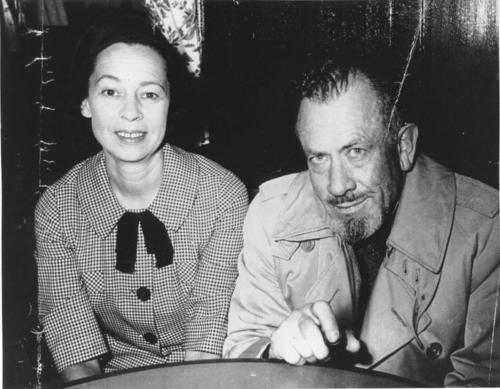
How often Steinbeck really slept in the rig is unclear. The answer, I think, is 1) not as often as he would have you believe, through no great deception, but thanks to the perfect description he provided early of a typical night in the heartland; 2) more often than his severest critic alleges, mostly out of spite; and 3) not as often as we would like. I’d say he slept alone in the rig about 2/5 of the time he was on the journey. I don’t think Elaine ever, when she met him on the road, spent a full night in the camper, or if she did, only one. Elaine wasn’t even pretending to want to rough it out there.
The point of my little essay here is that reading Walden enabled me to reach what I hope is an insight about John Steinbeck. As I pondered Thoreau’s confession about one night of loneliness and then no more, my mind flashed to Steinbeck, and I wondered if he experienced anything like one bout of temporary loneliness and then got over it. I do definitely think Steinbeck experienced loneliness. But not only temporarily. When you call it desolation, you wish you were somewhere else.
I’ll take this one step further. I believe that if Steinbeck were not a stubborn man wanting to prove to the people around him and to himself that he still had the right stuff, that he was still the man he had once clearly been — out there in his “pie wagon” in the Central Valley in the 1930s helping Okies survive, at or near the front in North Africa and Italy during the war, he would have packed it in. I believe if he could have snapped his fingers somewhere around Tehachapi Pass after his “you can’t go home again” visit to Monterey and instantly been snug in his Long Island cottage with Elaine, and the whole camper pickup was somehow magically evaporated into thin air, I think Steinbeck would have done just that, and given up the quest for the grail of his former creativity and vitality. There was no way he was going to quit once he’d gone to all the trouble of convincing Elaine, his agent Elizabeth Otis, his publisher Pat Covici, and his close friends that he was going to undertake this adventure no matter what they said, but in my view, his heart wasn’t really in it.
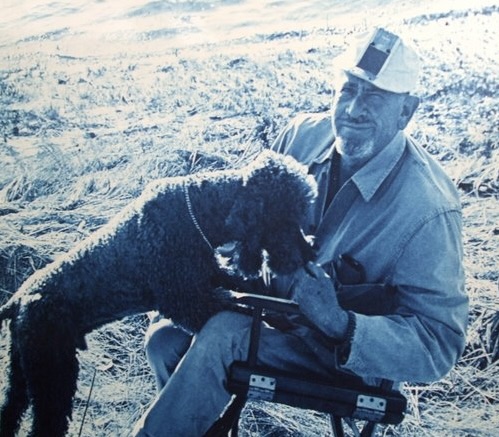
The book Travels with Charley is better than the journey with Charley. Steinbeck was a great writer, still in touch with his mature talent, and he had relaxed enough by now to write a modest gem of a book rather than try to sort out the problem of evil, the fate of the displaced, or how average citizens were responding to the atomic age. I don’t think his heart was in this late journey. I know for sure from my retracings that he rushed around quite a bit from one Elaine encounter to the next. By the time he reached the West Coast, he had gotten the adventure out of his system, but like Lewis and Clark, who were equally eager to get back to civilization, he had no choice but to turn the rig around at Monterey Bay and drive home. There was no way he was going to hire someone to drive the truck back to New York. But you can tell from what he writes that he wanted to:
“It would be pleasant to be able to say of my travels with Charley, ‘I went out to find the truth about my country and I found it.’ … But what I carried in my head and deeper in my perceptions was a barrel of worms … my impressionable gelatin plate was getting muddled. I determined to inspect two more sections [of the country] and then call it a day — Texas, and a sampling of the Deep South.”
There is nothing wrong with Steinbeck’s response to all of this. He was wealthy, celebrated, pampered by his admiring (and nurturing) wife, used to the finest hotel rooms, accustomed to the steaks at Delmonico’s, and a panoply of fine liquors.
And he was tired. And he was, frankly, old at least according to the imperfect medical protocols of his time. He had a bum knee and serious heart trouble. Those closest to him were worried about him. Elizabeth Otis tried to talk him out of the journey, at least to convince him to undertake a much tamer set of brief adventures. It is said that Elaine wanted him to take the poodle, Charley, not just for companionship, but so the dog could look after him. Steinbeck exploded at that: He’s not Lassie, he barked.
None of this makes me lose any respect for John Steinbeck. He provides several confirming hints about all of this throughout the book. In fact, he admits, early on the return drive, that the journey had been a failure. If his goal was to rediscover America and the American people and to prove, like an aging character in Kerouac, that he still had “IT,” he freely admits that he didn’t find what he was looking for, in America or in himself. We love the charm of the book so much, and the romantic idea of an eminent writer wandering incognito over the fruited plain, that we hardly notice his admissions of failure.
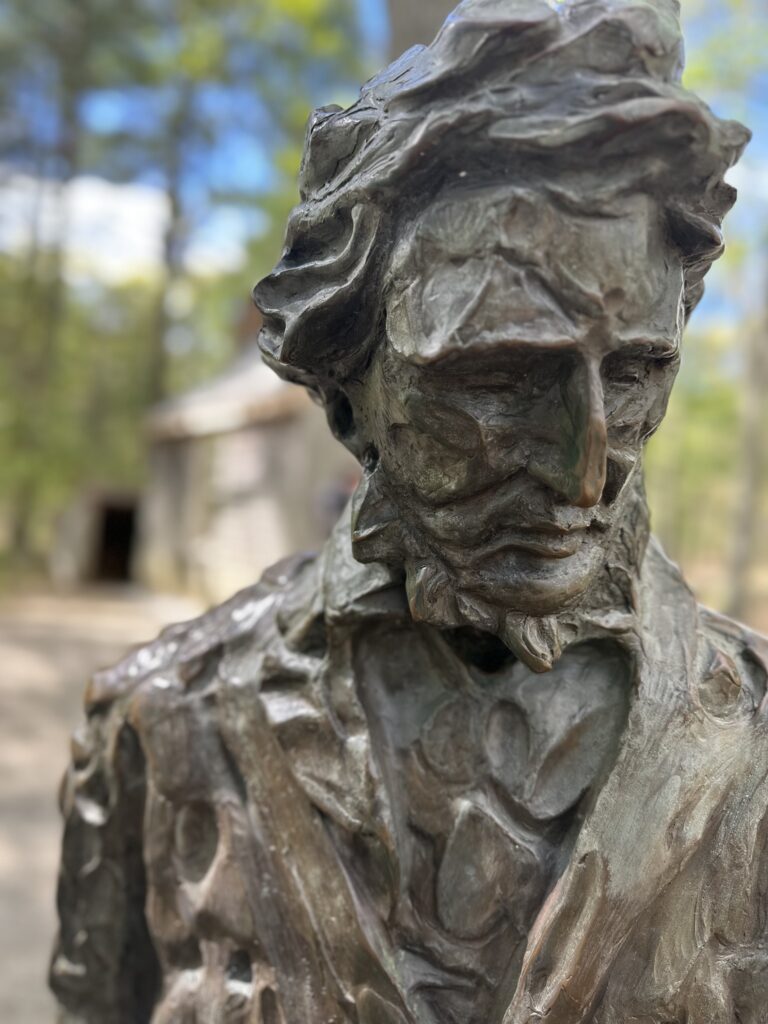
Henry David Thoreau was a different breed of man. Unlike Steinbeck, a loner, for one thing, something of a misanthrope, and certainly not a man who needed to be coddled by a loving woman. (Apparently, no woman applied for the job.) Thoreau, in 1845, was what Meriwether Lewis called himself after the expedition in a moment of bemused self-pity: a “rusty, musty, fusty old bachelor.” Thoreau was not nearly as restless as Steinbeck, who was never quite content even when he was content.
I don’t think Steinbeck could have written these words:
“I find it wholesome to be alone the greater part of the time. To be in company, even with the best, is soon wearisome and dissipating. I love to be alone. I never found the companion that was so companionable as solitude.”
That is quintessential Thoreau, and we all know there is no posturing in it. Almost always when I read a couple of books at the same time, I find that they want to get into a conversation with each other.