
“The cost of a thing is the amount of what I will call life which is required to be exchanged for it, immediately or in the long run.” — Thoreau
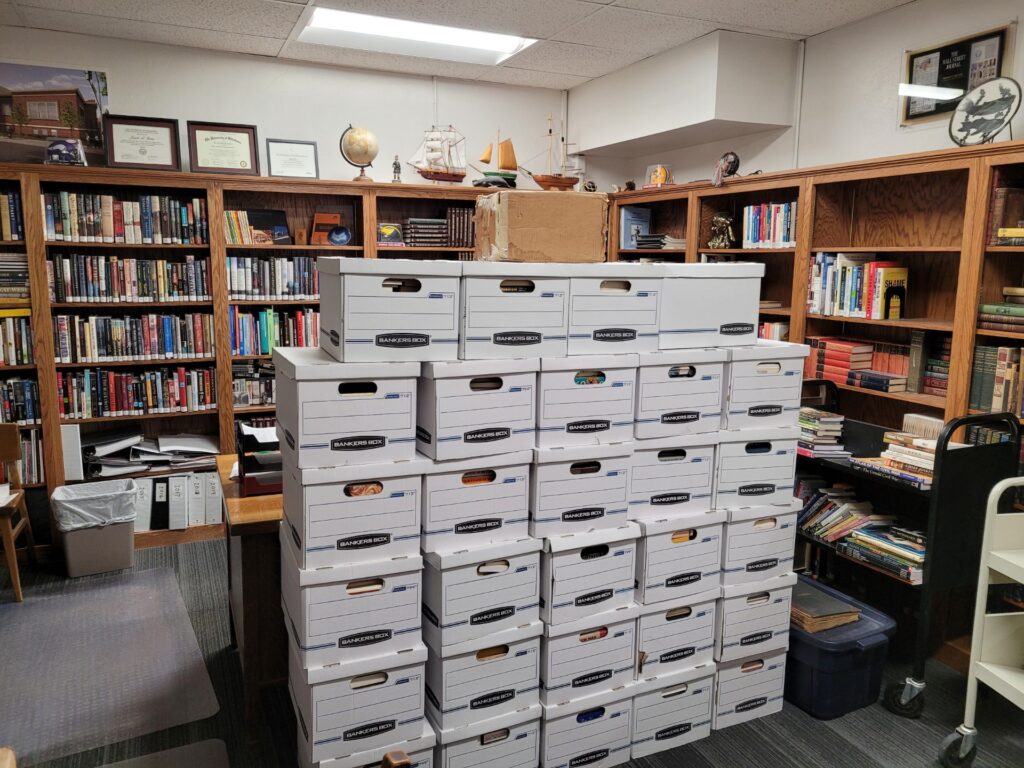
Yesterday, in early afternoon, a library director from eastern North Dakota, Joe R., backed into my driveway. He had come with his red sedan to take delivery of the first load of the books I am donating to his library system and to a small religious college in southern North Dakota. We loaded 30 heavy bank boxes into his vehicle, then sat down to share beverages and fruitcake in my living room library.
There was black ice on my front steps, sidewalk, and driveway, and the streets and roads of North Dakota were treacherous. But Joe had no trouble getting here. I had taken a pretty bad fall on my steps when I first ventured out hours earlier, one of those falls where the legs go out from under you in an instant, and all you can do is brace yourself for impact. It was slip-on-a-banana-peel stuff, hilarious except for the force of impact. I lay on the sidewalk for a while, wondering if I was hurt.
Joe took about a third of the books I am de-accessioning, my “weeding out,” as he put it. He’ll return for more, and I may drive a load of 40 boxes or so to Jamestown, North Dakota, to make his work less onerous. I’d like to see the library he manages.
So far, the downsizing has been mostly cheerful. I’ve selected books I’m unlikely ever to read again or ever to want to read. After spending part of a day packing them up, on a few occasions I have gotten up in the middle of the night, or the next morning, to fish out a book that — on second thought — I’d like to keep for now. Several times, I have dismally calculated approximately how many reading hours I have left in my life, at about the rate of 104 books per year. This fills me with despair. Even to catch up on all the approved classics of English, European, and American literature I have so far failed to read, I would need another 50 years of hard reading. Then there are collections on my 10 or so favorite subjects, from the U.S. space program to the golden age of CBS news (Sevareid, Cronkite, Murrow), from the making of the atomic bomb to the life and achievement of John Steinbeck, from the Lewis and Clark expedition to a collection of books on the U.S. Constitution. And what about the complete works of Dostoevsky?
As Mark Twain might put it, accounts of the Death of the Book have been greatly exaggerated. In many respects, this is the great age of publishing for readers. If I hung out at the local Barnes & Noble bookstore, I could easily pick out four or five books per week that I would quite like to read. Should read.
We talked for about an hour in my living room. Joe has an expansive philosophy of libraries, which dovetails perfectly with my own view. When I quoted Thomas Jefferson, on the occasion of his donating/selling his library of about 7,000 volumes to the Library of Congress in 1814-15, that “There is, in fact, no subject to which a Member of Congress may not have occasion to refer,” Joe sighed his approval. He wants to give the people who venture into his libraries the opportunity to explore the human condition in ways that open doors rather than confirm their existing views of things.
I took no money for my books, of course. Joe is doing me the favor. When he asked me if I had any requests or requirements, I said two things. First, he can do with my books whatever he thinks best, but if he gets rid of some (for whatever reason), I don’t want to know about it; and second, I’d like to come to the college sometime in the next year to give a talk to the student body about the importance of serious reading to a complete life. No charge. He reckoned that could be arranged.
When Henry David Thoreau finally convinced me to “simplify, simplify, simplify,” and to remove some of the burden of having more books in my house — in which every room is a library — than shelves to put them on, my biggest concern was that the books not wind up in a landfill or sold “by the pound” as is the habit of many public library sales. A lifetime of carefully building a library should not end in someone lugging away 15 books on World War II in a shopping bag for $2.75. I wanted to repurpose my books, put them into the hands of someone somewhere who would take them seriously. Thanks to a distant friend who understood my intentions, I was put in contact with Joe. My books are not furniture, and I don’t want them to be dumped unceremoniously into a landfill.
In a week or two, all 3,000 of the Year One Initiative books will be gone. I now have some open space on my shelves, which means that I can sort books more effectively, and bring all of Shakespeare into the same space, all of Lewis and Clark, and Theodore Roosevelt, and reference works.
My plan is to donate 2,000 books a year for the next five years. That will still leave about 10,000 books to browse, read, and love in my dotage. My daughter, a serious scholar, will probably want about 100. The rest have to go somewhere. I don’t want to wait until I croak, which would probably mean one of those giant metal garbage container units in the driveway and a skid-steer.
To those of you who know you need to start downsizing (whether you are 40 or 80), I can report several things. First, there is a wonderful sense of liberation. In many respects, my life was being choked by the sheer abundance of books, notebooks, files, gadgets, kitchen appliances, etc. If your life is anything like mine, two categories of things seem to breed in one’s house: coffee mugs and t-shirts.
I don’t exactly yet feel “the incredible lightness of being,” but my world does not now seem so congested, and I am now in some danger of actually being able to find things I am looking for (and not just ordering another). Second, giving is gratifying. If I were taking my books to the town dump, I’d feel horrible. By putting them in the hands of those who profess they will benefit from them, I feel satisfied, almost virtuous. It’s recycling in its finest form. Third, I’m already more organized, and I expect to become much more so now as I shuffle two books here and four there to place them where they belong and where I can get at them easily. Fourth, I know I am making things much easier for those who will have to clean out my house when I am gone.
The next phases of library downsizing are likely to be harder, because I will want to cling to books that still matter to me. Soon, the fat and gristle will be gone, and I’ll have to start cutting muscle and bone. What if I get rid of all of my Captain James Cook books and then one day, five years from now, wake up with the desire to study his voyages or write about his voyages? So far, there has been no blood on the floor, and my aching back is the only indication of “the price of downsizing.” But there will definitely be blood on the floor soon.
In the course of my weeding, I have come upon several dozen books that I now very much wish to read, and they are stacked up near my desk in front of the 160 degrees of window that bathe my work desk with light — at the moment, wan winter Great Plains light. If I read 10 hours a day (as I did in my Oxford years), I could up my game to 156 books per year, and I might still vindicate a life radially misspent.
Thoreau again: “The cost of a thing is the amount of what I will call life which is required to be exchanged for it, immediately or in the long run.” I reckon I have spent half a million dollars on books in the course of my life. That would have bought weeklong journeys to all the world’s cultural capitals, some of them annually, like London, Athens, Rome, and New York. Or a lot of jet skis. One unintended benefit: in a subarctic climate like Dakota, those books have been excellent insulation.
And Thoreau again, in the sentence from his greatest single paragraph that haunts me now that there is less life ahead of me than behind: “I went to the woods to live deliberately, to front only the essential facts of life, to see if I could not learn what it had to teach, and not, when I came to die, discover that I had not lived.”
I have lived for the badlands of the Little Missouri River valley. I have lived for my daughter. I have lived for and in the humanities. I have lived for friendship. I have lived to do my little part in keeping the flame of enlightenment alive in the Age of Disillusionment.
And, thank goodness, my house is still awash in good books to read.