
Last week, I reviewed the year 2025 by way of Time magazine’s Year in Review issue. Today I want to review my year as the traveling editor of Listening to America.
I’ve been brooding over the semiquincentennial of the United States for a couple of years now. Big anniversaries like this are a time to step back and assess how we got here, what our current state says about us, and where we might be headed. If we duck this opportunity to step back and do some hard thinking about the quarter of a millennium American experiment, we will prove that we are not fit for the republican form of self-government the Founders envisioned for us. They thought we were going to be the culmination of the human aspiration — to live in a government of our own fashioning, dedicated to equality under the law, equality of opportunity, and an unprecedented commitment to human rights.
In 2024, I followed John Steinbeck’s 1960 Travels with Charley tour of the U.S. I drove more than 20,000 miles around the perimeter of the United States and spent time in 41 states along the way. I met thousands of people, had conversations with more than a hundred, and tried to listen, listen, listen to America. It was an election year. What I learned then was that our shambolic national politics had everyone on edge. Most of the people I met in RV Land were self-consciously escaping from the dispiriting national slugfest. “That’s why we’re out here. We are exhausted, and we just want to turn away.” They wanted to see America, to grill steaks and sip a few cocktails in an RV campground, to visit places they had never been before, and watch a movie before turning in. They were worried about the course of human events, but mostly they wanted to turn away and pursue private satisfactions.
Donald Trump was returned to power. Almost everyone calmed down. Something had been decided.
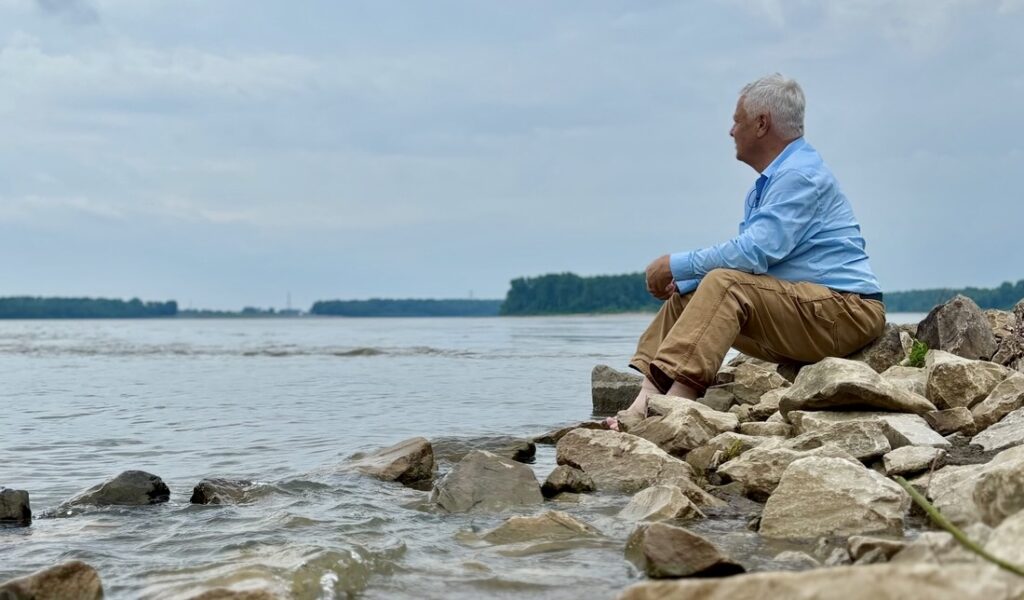
This year, 2025, I drove America in the wake of the Lewis and Clark expedition (1804-06), one of the subjects I have been studying for 40 years. I wanted to explore our river systems (the Ohio, Mississippi, Missouri, Yellowstone, Lochsa, Clearwater, Snake, and Columbia). I floated sections of the Missouri three times (twice by canoe, once with two spirited young rascals in a pontoon boat), floated the upper Yellowstone on a raft, sat for a couple of hours at the precise confluence of the Missouri and Mississippi, tried to get my brain around the colossal meeting of waters of the Ohio and Mississippi at Cairo, Illinois, and walked the beach just south of the mouth of the Columbia in Oregon. I bestrode the source (one source) of the “mighty and heretofore deemed endless Missouri River” at Lemhi Pass on the Montana-Idaho border, and then ventured with my friends Russ and Liz (of North Carolina) to the true head of the Missouri (if there is one) at Hell Roaring Creek near Upper Red Rocks Lake in extreme southwestern Montana, just over the ridge from Yellowstone National Park.
The Larger Dynamic
I am intensely interested in the problematic concept of “Manifest Destiny,” a phrase coined in 1845 to suggest that God and Fate had designated the Anglo-Americans as the rightful inheritors of North America and the natives would have to get on board or get out of the way or perish to enable European-derived white people to open this vast land to our various forms of occupation and extraction. I try never to forget that in 1492, when Columbus bumped into the New World, it was 100% indigenous, and by 1942, when FDR was promoting a New Deal, including an “Indian New Deal,” only about 3% of the land was under the semi-sovereign control of the descendants of those Native Americans. We’d like to argue that “we took it fair and square” or that “these great migrations happen, have happened, and will happen, and there is not much point in wringing our hands over it.” But there is a hollowness and self-soothing in such arguments. I honestly don’t think we can be whole and healed until we come to terms with “the cost of empire.” It would be easier to accept this ethnic cleansing if we had erected a truly admirable civilization on what people like Jefferson preferred to think of as a tabula rasa (blank slate), but windswept marginal communities like Sidney, Nebraska, or Williston, North Dakota, and the strip mines around Gillette, Wyoming, don’t really vindicate that vast dispossession. (Note: I’d rather live in Sidney or Bismarck than New York or New Orleans, for some perverse reason.)
I drove about 18,000 miles in 2025. I fell in love with the American outback over and over again. We have an astonishingly beautiful continent — the Tetons, Glacier National Park, the Snake River valley, Tillamook Head on the Oregon Coast, even such Interstate Highways as I-70 through Glenwood Canyon in Colorado, I-94 along the Yellowstone in Montana, the last hundred miles before Seattle on I-90. America is, as a West Virginian once pointed out to me, “a lot of country all spread out,” or as Gertrude Stein said, “In the United States there is more space where nobody is than where anybody is. That is what makes America what it is.” Even at 340 million, the thinness of our population is astonishing.
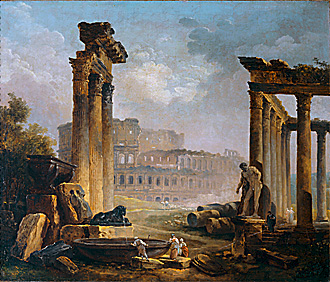
While I was in Rome at the beginning of December, as we sat looking at a building more than 2,000 years old, one of my closest friends reminded me that the United States is a very young country — only 250 years old — and if we are still not able to make good bread and good cheese, and the portions at our restaurants are large enough to give a hog diabetes, we are still in an early adolescent phase of American civilization. Velveeta and Spam. But this is hardly a consolation. A small plate of cacio e pepe pasta in a café from which you can gaze at the Pantheon is exquisite enough to make you rethink the all-you-can-eat, endless breadsticks culture of the USA. And always, said Jefferson, when traveling, order vin ordinaire (the house red).
As 2026 begins, my mind is a roller coaster of anxiety, apprehension, and cautious optimism. On a given Tuesday, I almost conclude that our republic is circling the drain, but on a Thursday of the same week, I reckon we will blunder through the present crisis as we always seem to do. I have never in my long life been so worried about the American experiment — and I wonder how exactly we should celebrate, commemorate, observe, or endure (choose your verb) our 250th birthday. I would like to conclude that we are a robust democracy that sometimes loses its way and then self-corrects, but then I think of masked federal agents snatching immigrants (and some bonafide American citizens) off a Home Depot parking lot or from within a strip mall church, and a Secretary of Homeland Security who publicly defines Habeas Corpus as the president’s right to kidnap (behind masks) fellow human beings and deny them due process or even legal representation. This is America?
My Own Year in Review
In January, I hosted my two annual humanities retreats at a retro lodge west of Missoula. One was on two plays by Shakespeare (King Lear and As You Like It), and the other on Thoreau and Edward Abbey. I spent four weeklong residencies in the mountains of Colorado for the Vail Symposium on a range of controversial topics. I celebrated a milestone birthday with my daughter in Oxford, London, and Paris. Three of the best days of my life. I led a group of approximately 20 to Cuba for more than a week in February, where we saw farmers plowing the fields with oxen, thousands of people walking the main road between Santiago and Havana, and others somehow patching 1950s American cars together with wire and makeshift carburetors. The people of Cuba deserve better from the colossus 90 miles to the north. We have had our boot on the neck of the innocent Cuban population for six decades now, and caused widespread, even universal suffering among a friendly, earnest, and desperate people who only want to live their lives in something like economic security. They do not hate America, but they are bewildered by our government. While we were there, the power grid went down for part of every day. We chose our restaurants according to whether they had private generators. And at year’s end, America’s blockade of Venezuelan oil is making things worse in Cuba to the point of national collapse.
In April, I performed in Moab, Utah, as my Chautauqua characters J. Robert Oppenheimer (it was uranium mining country) and John Wesley Powell (the one-armed Civil War veteran who ran the Green and Colorado Rivers in 1869 and tried to forge a sane protocol for water use in the American West). Edward Abbey (of Desert Solitaire and The Monkey Wrench Gang fame) has become one of my favorite subjects.

At the end of April, I began my summer-long Lewis and Clark trek in Salisbury, North Carolina, home of the locally celebrated Cheerwine soda (“since 1917”) and the local Cheerwine Festival. I had some mechanical issues with my Airstream along the way, but on the whole it performed beautifully, allowing me to sleep all over America on my own clean sheets and to make modest “scratch together” meals at almost every stop.
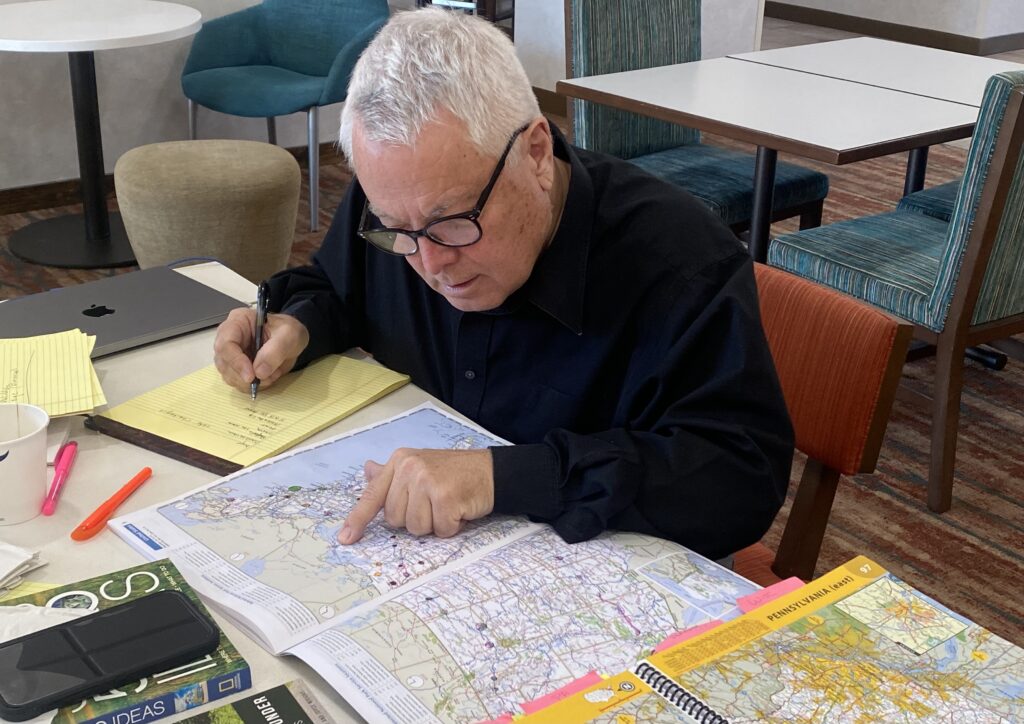
Throughout the year, I created 52 brand-new podcasts, often recorded at my desk in the Airstream. Everyone loves Lindsay Chervinsky and Joseph Ellis, of course, but in every podcast this year, I asked questions of writers, thinkers, historians, and activists that I hoped would illuminate America at 250. How did we get here? How well are we doing? What’s unfinished and unresolved in American life? How will we work ourselves out of this national political paralysis? Are we in any measurable way the rightful heirs of the Founding Fathers? Who are we now? Where do we seem to be headed?
Invariably, like the first great essayist Montaigne (1533-1592), I wind up saying, Que sais-je?, What do I know?
In November, I went to England to see my child take her PhD from Oxford University. That was two trips to Britain in 2025. Long ago, I studied there for four years, and after all this time, that experience remains one of the two or three best times of my life. Now I am that geezer in the old favorite pub, sipping his sherry and port and daydreaming when life was all before me, and I was going to read my way to mastery and wisdom. In December, Rome, Florence, and Naples (Herculaneum), to luxuriate in the ruins of the Roman Republic and Empire, and wonder how nations rise and fall. Why did the Roman Republic collapse? Why did the Roman Empire decline and fall? What about us? Where do we fit in the big picture?
Meanwhile, all year, I wrote a great deal, read much but not enough, recorded podcasts and video modules all over the place, took 7,000 photographs, attended two Major League baseball games (Pittsburgh and St. Louis) and one superb magic show (in Pittsburgh), drank from the sources of great rivers, hiked in National Parks, National Forests, and National Monuments, watched the sky at night, left a dubious carbon footprint, and sat on the banks of rivers daydreaming Huckleberry Finn and Meriwether Lewis and the poet John Neihardt (The River and I).
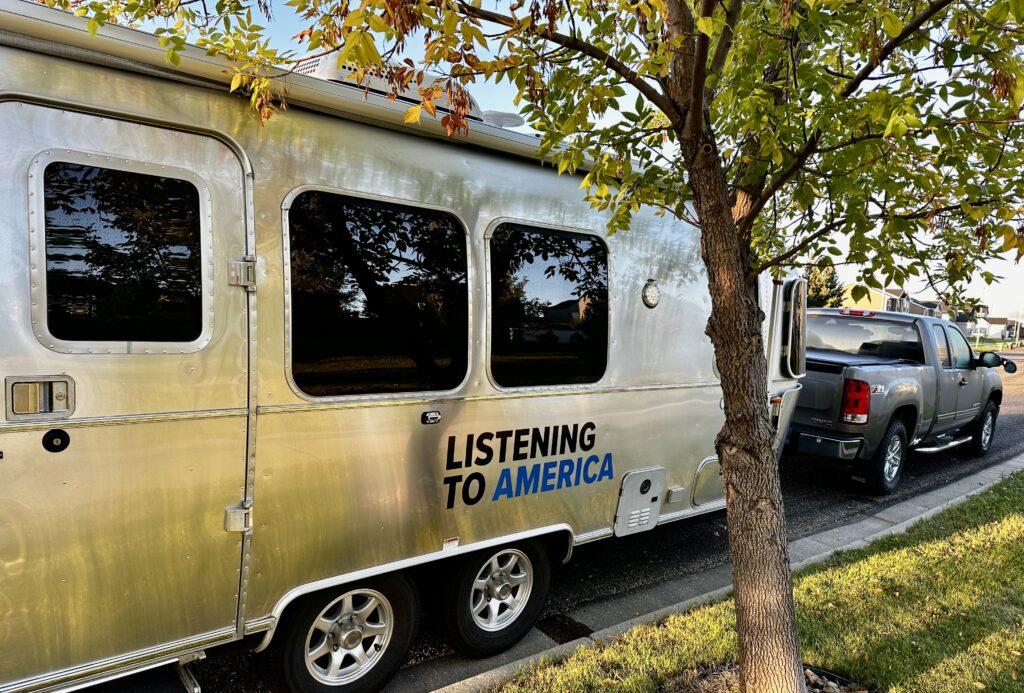
The Airstream (Rocinante) is sitting out the winter in storage on the fierce Northern Plains, all pipes drained. When I fire it back up in late April, I plan to take only 25% of what I hauled in it last year. My downsizing campaign is changing the course of my life. I’m not entirely settled on my travels in 2026, but I’ll be exploring the world of the great photographer of Native Americans, Edward S. Curtis, and the conservation properties of Theodore Roosevelt, across the West.
I am not yet quite sure where I will be on the 4th of July 2026, but I know the question I will be pondering. When the Founders left the Constitutional Convention at last on September 17, 1787, a Philadelphia woman asked the elderly sage Benjamin Franklin what they had wrought behind closed doors. His reply: “A republic, if you can keep it.”
That’s the big question that hovers over America.