Seeing flags at half-mast last week brought to mind the immortal passage from the great poet and scholar John Donne.
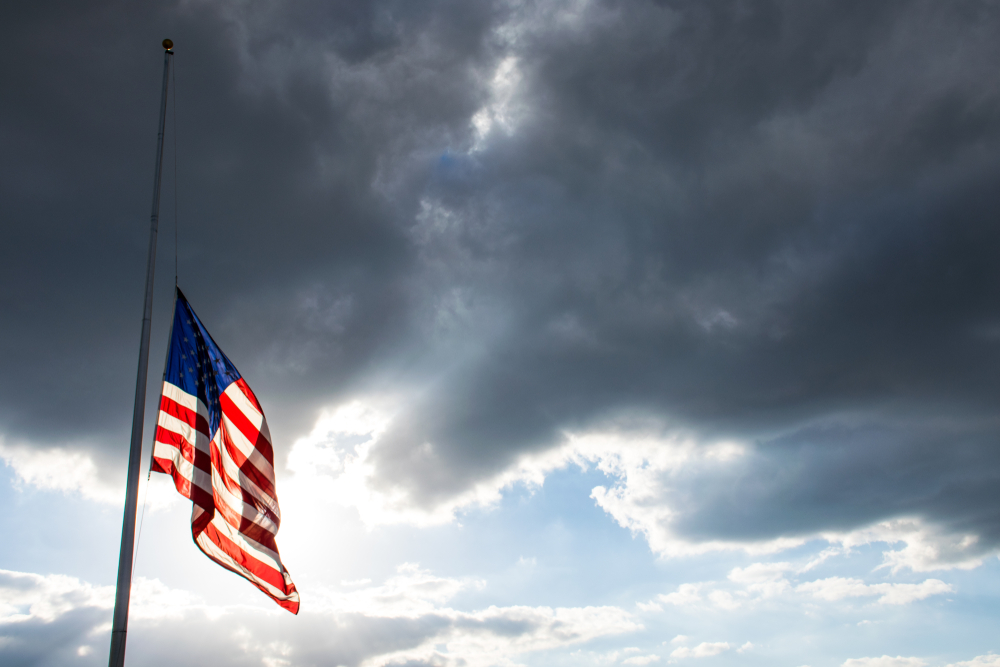
American flag at half-mast. (Shutterstock)
I was driving to the airport at 0-dark-30 the other day, and when I arrived, I noticed that all three flags were flying at half-mast: the U.S., North Dakota, and Canadian flags. I was unsure of why they were at half-mast. I reckoned it might be for former Vice President Dick Cheney, who died on November 3 at the age of 84. But I was not sure. Maybe someone died overnight. When I was safely through security, I looked up. Sure enough, Richard Bruce Cheney was born on Jan. 30, 1941, in Lincoln, Nebraska. An Aquarian, for what that’s worth. Like virtually all Americans on both sides of the political spectrum, I have complicated feelings about Dick Cheney, but I respect his long public service.
I learned that the flags will be flown at half-mast until sunset on November 20.
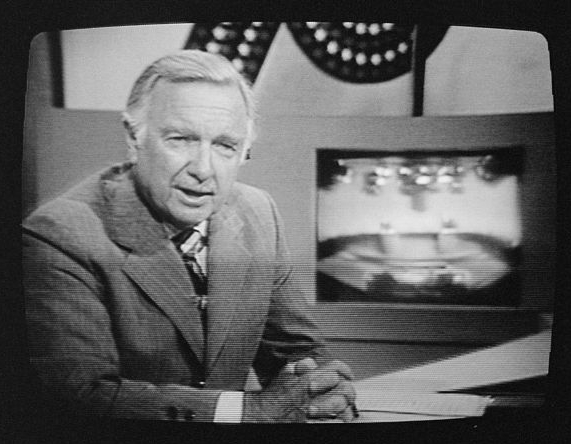
Legendary television newscaster, Walter Cronkite. (Library of Congress)
As I settled in with a muffin and a cup of airport coffee, I thought about how the public is alerted to big events in the world. The flags at the airport triggered me (though I was aware of Vice President Cheney’s death) that something of national importance had occurred. Big news tends to travel fast. Within 40 minutes of the death of John F. Kennedy on November 22, 1963, fully 70 percent of the American people had been made aware of the assassination. By the end of the day, nearly all Americans (and most of the people of the developed world) knew of the death of the president. That was back in the era when most people still got their regular news from daily newspapers and their breaking news from radio.
On Sept. 11, 2001, almost all Americans knew that the United States was under terrorist attack within an hour. I was in Phoenix. When I woke up that morning, I saw an image of the burning towers of the World Trade Center on my AOL.com feed, and at first, I reckoned it must be an ad for a new blockbuster film. Within two hours, I was in a rental car hurtling toward Reno and my 7-year-old daughter.
Those in New York are alerted to breaking news by the electronic marquees in Times Square. Today, there is a television screen in virtually all waiting rooms (including airports) and, of course, especially in bars, overwhelmingly in sports bars. We all get news alerts on our smartphones and our smartwatches.
The cable news networks have dramatically devalued important news events. On any given day, you see lavish BREAKING NEWS graphics for such things as “BREAKING NEWS: Inflation up 1 percent” or “BREAKING NEWS: President’s annual checkup.” We are now so bombarded and overstimulated that it is not clear what television could graphically conjure up for a really important national or international event. If you saw the world through Fox or MSNBC, you’d think the world is in continuous crisis.
As I parked my car at the airport, I thought of one of the greatest passages in English literature, John Donne’s Meditation XII in his 1623 book, Devotions upon Emergent Occasions.
“The bell doth toll for him that thinks it doth; and though it intermit again, yet from that minute that that occasion wrought upon him, he is united to God. . . Who bends not his ear to any bell which upon any occasion rings? but who can remove it from that bell which is passing a piece of himself out of this world?
No man is an island, entire of itself; every man is a piece of the continent, a part of the main. If a clod be washed away by the sea, Europe is the less, as well as if a promontory were, as well as if a manor of thy friend’s or of thine own were. Any man’s death diminishes me, because I am involved in mankind; and therefore never send to know for whom the bell tolls; it tolls for thee.” — John Donne
Renaissance prose! Translation. When a church bell tolls, in that era, we hearken to it and wonder just what it is announcing. A church bell can ring for many reasons (with different repetitions) — a call to morning or evening service, a new king has been crowned, a birth in the parish, or the death of someone in the parish. We may think we are sovereign individuals, somehow separate from the common fate of humanity, but that’s not so. If the sea erodes a cliff, Europe loses a bit of its land. It may as well have been tearing away someone’s estate (as on Highway 1 on California’s coast), or your own estate, for that matter. Why? Because we are all linked in a common fate, and any other person’s death has implications for you and me, because we are fellow humans, we are in this together, and the same fate awaits each of us. Therefore, when you hear the church bell tolling someone’s death, don’t send your servant over to the church to find out who it’s about. In some real sense, it is about you!
Church bells were how news circulated in that pre-technological age. Donne is saying you have to know how to “read” the bell’s message. But if you really understand the human condition, every time the bell tolls someone’s death, you will think about your own, which is (in eternal terms) just around the corner.
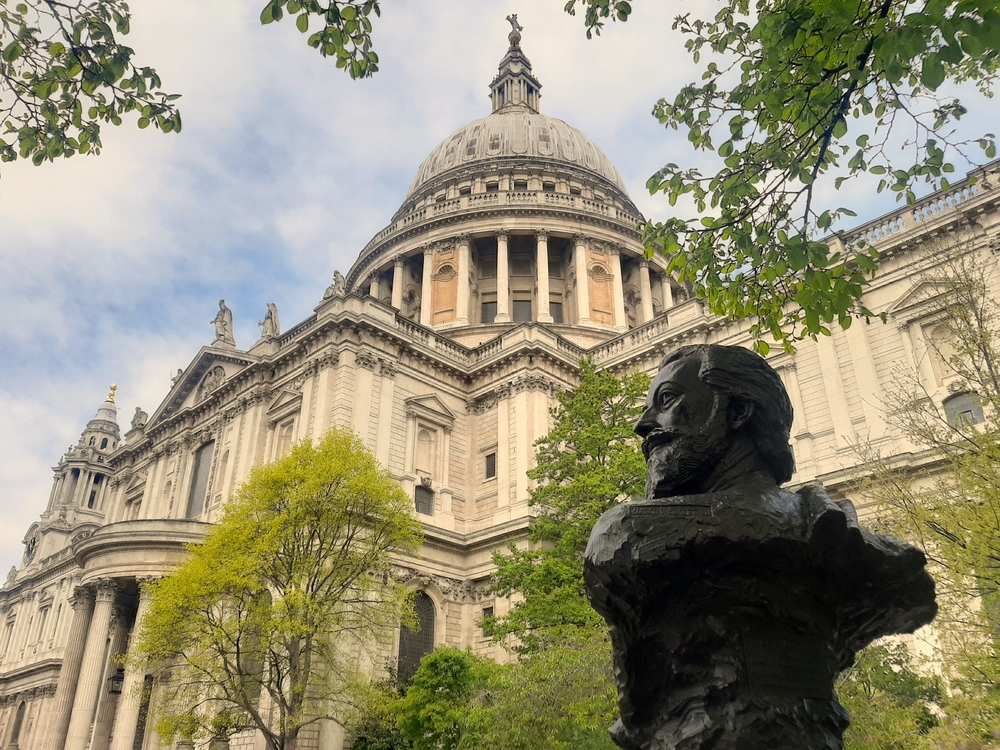
Bust of poet John Donne outside St Paul’s Cathedral in central London. (Shutterstock)
This passage is justly famous. Ernest Hemingway used a bit of it for the title of his book about the Spanish Civil War, For Whom the Bell Tolls. John Donne wrote millions of words, but this is the passage that would find its way into a time capsule.
The flags outside the airport tolled the death of someone important. It could have been any number of people: a pope, a U.S. senator, a former president, the current president, or, in this case, a former congressman and vice president.
As I parked my car, I did not think the flag message was in any way about me, and I did not spend any time contemplating my own appointment with death, the one appointment nobody ever fails to show up for. I get plenty of that when I hike down a mountain trail or stand up rickety after 10 hours on a transatlantic flight. When I was in London last week, I stopped at the statue bust of John Donne (my favorite poet, whose work I spent eight or nine years of my life studying) outside St. Paul’s Cathedral, where he was the dean (chief administrator and principal preacher) between 1621 and his death 10 years later. In fact, Donne is said to have “preached his own funeral sermon,” which is a weird and macabre incident best left for another dispatch.
The gloomier people of John Donne’s time (1572–1631) were much more fixated on their mortality than we are in the age of Botox, face lifts, and near-starvation macrobiotic diets, at a time when the gazillionaires of Silicon Valley are spending their fortunes trying to cheat death and become immortal. Good luck with that. The duke in Shakespeare’s Measure for Measure advises, “Be absolute for death. Either death or life shall thereby be the sweeter.”
Most Americans do not really believe “I am involved in mankind,” and we seem bent on finding a workaround for our mortality.
Discover more on these topics at Listening to America