
After spending five or six decades buying books, an enormous number of books, I have begun to downsize.

“I had three pieces of limestone on my desk, but I was terrified to find that they required to be dusted daily…”
Henry David Thoreau
I’m downsizing for four reasons. First, I’m in the seventh or eighth inning of my life. I have only one child, a young scholar and intellectual. She has made it clear that she will only be able to take a few dozen of my books, perhaps 100, but the vast majority of them will have to be disposed of in some other way. She does not want me to die one of these days (years, decades?) and leave her to handle all of that mass. I agree.
Second, I’m trying — admittedly very late in the game — to get organized. My house is so full of books, gadgets, clothes, file boxes, camera and audio-visual equipment, desks, shelves, framed posters, photographs, and art, and my three-car garage essentially a storage facility, that I cannot usually find what I am looking for this side of half an hour, sometimes half a day, and when I have given moderately due diligence to the search, I order a new copy of Robinson Crusoe, the poetry of Alexander Pope, Christopher Hitchens on the Elgin Marbles, etc.
From time to time I have attempted to bring order to my library, but when you begin such a quixotic quest you discover that every shelf in the house is full to the straining point with books, and there is no good way to transfer a book on Queen Elizabeth I’s spies to the right section (Renaissance), because the right section is full to bursting. My goal for the rest of 2025 is simple. Every book goes on a shelf, and the books are at the very least clustered together by subject. Today, for example, culling books from a neglected shelf, I found 14 books by Mark Twain. They were not shelved in the American literature section of my library, which means that in the last couple of years, I have ordered new copies of Twain’s books because I could not find the old. Help! So far, I’ve pulled about 2,500 books from my shelves, about 10%, and my house can breathe again. Me too.
Third, I’m a devotee of Henry David Thoreau. Perhaps that is enough said; Thoreau, after all, was our first great minimalist. Remember this anecdote? “I had three pieces of limestone on my desk, but I was terrified to find that they required to be dusted daily, when the furniture of my mind was all undusted still, and threw them out the window in disgust.” If Thoreau could spend an hour in my house looking around, he would leave in disgust, but not before telling me my soul is constricted, choked, even buried by the sheer quantity of stuff all around me. He’d say A: no wonder you are not really happy; and B: it’s amazing that you ever get anything done. Tone it down a little, please, Henry. I’m working at it.
Every year or two, I lead a retreat at a lodge west of Missoula, Montana, on Thoreau. There, I explore Thoreau’s concept of minimalism, extol his wisdom, make resolutions to downsize, and then, the minute I get back into internet space, order several of the books I have heard about during the retreat. This time I intend to get it right. I want to feel the clearing of my soul as I clear the clutter of my physical spaces. I can feel it already. And it is liberating.
Fourth, one of the saddest things about growing old is that the number of books still ahead of you is shrinking. You are not going to be able to read all the books you dreamed of reading when you were young — all the novels of the 19th century, a ten-volume history of the First World War, the complete works of Milton. Given that, it’s probably too late for Gravity’s Rainbow and a number of those “books of the moment” that have not held up particularly well. I don’t generally find much pleasure in having to puzzle and strain through a novel (think Cormac McCarthy, William Faulkner, e.g.). If I’m going to sweat, it’s for Joyce’s Ulysses every time. So I am making a mental pile of books I still want to read. It’s a long and somewhat embarrassing list.
“What? You have never read Stendhal’s The Red and the Black?!?” “What, you have never read …?” How odd is it that there are about 50 or maybe even 100 books that you need to have read before you flame out, and yet we continue to put them off? Shameful confession: I have begun but never finished War and Peace. And yet I have loved every page that I have read. In some moments, as I sit in my reading chair with a lamp my mother bought for me (almost my favorite gift ever from her) and a glass of wine, I can read thirty pages of War and Peace and feel what I actually regard as heaven. There is nothing like reading when we get into the Zone. If there is a heaven and I get to go, I do hope there is a stupendously satisfying library with the kind of mahogany reading rooms you only dream about now. And no late fees.
My point is that I hear the clock ticking, and my total remaining reading space is shrinking like the trash compactor that seems likely to crush Princess Leia, Luke, and Chewbacca in Star Wars. I’m serious. It fills me with deep melancholy when I let myself think about it.
All this makes my downsizing easier. If I can only read 30 books per year and I have … er, probably quite a few years left, then I’m going to keep Crime and Punishment, one of my favorite novels, Middlemarch, which my closest literary friend says is better than Dostoevsky’s best. Heresy. I’m going to keep Henry Fielding’s Tom Jones (which I have read a couple of times), but also Madame Bovary, which I have never read. But I am not going to keep a couple of John Grisham novels, the Complete Works of Danielle Steele (newly edited with an update), or a New Age book on how to interpret your dreams, or a five-volume history of the Mongol Empire.
So far, no blood on the floor. I have gotten up in the night a couple of times to rescue a book I too hastily put in a pile. This usually involves some comedy — tripping on books, treating a five-foot stack of books like a Jenga game, etc.
The Clock is Ticking
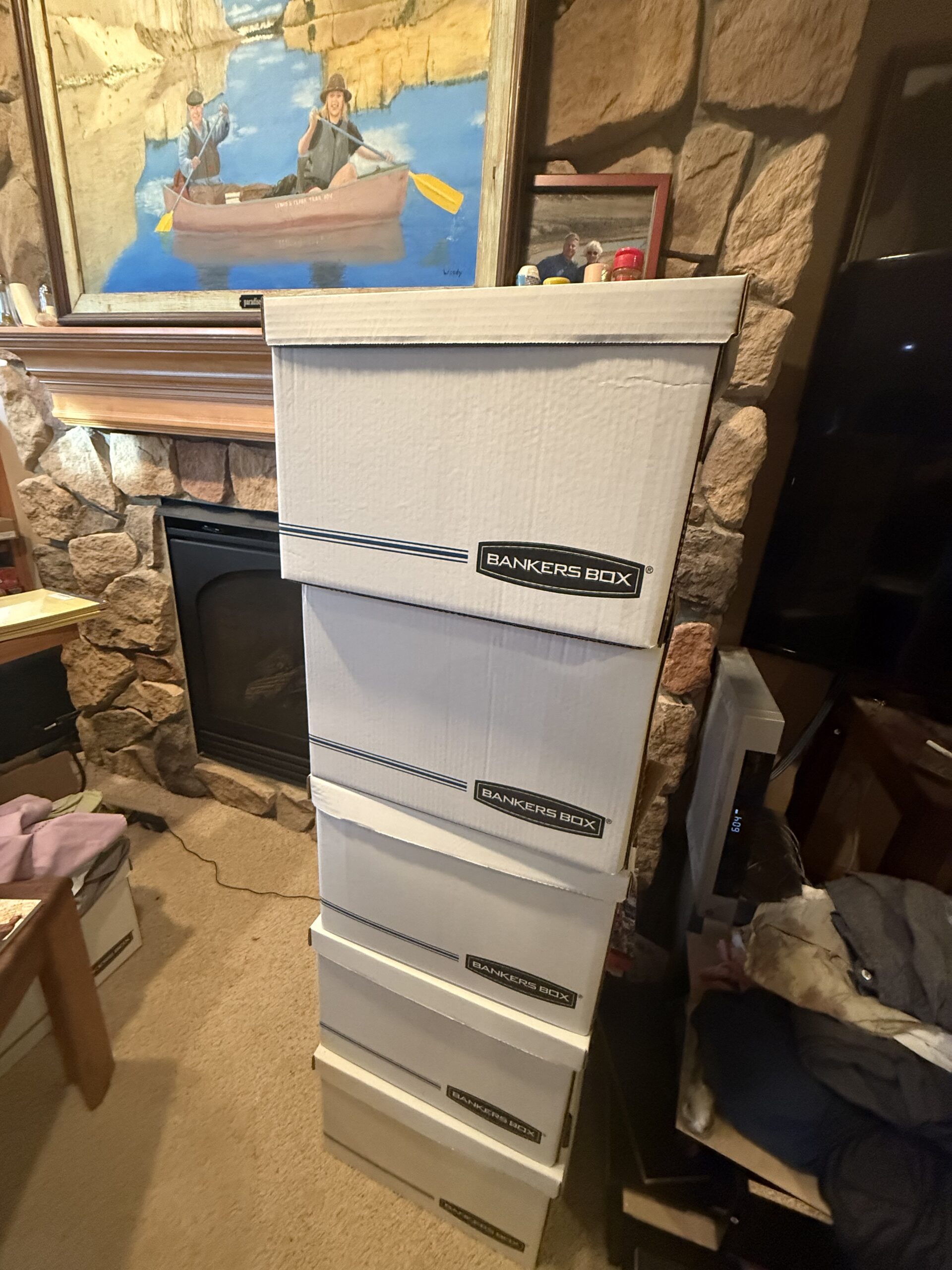
So far, I have pulled about 2,000 books off my shelves. So far, it has been comparatively easy. I’m keeping all of English literature (except triplicates on up), most of my Jefferson library, most of my exploration and Lewis and Clark library, much of my space program library, much of my classics collection, my atomic bomb and Oppenheimer section, my special Charles Dickens shrine, etc. In these, there will be modest drawing down, but nothing severe — yet. But that day is coming. “Time’s winged chariot,” said Andrew Marvell, the 17-century poet.
Over the years, I’ve made a few very half-hearted attempts before to downsize and reorganize, but this time is different. I’ve already done (in a couple of weeks) more than I have ever done before by magnitudes. This is so serious that it sometimes scares me. I intend to see this through. It is already changing my life. Whatever was the red line, the taboo shield, the character armor, the life-in-denial in previous attempts to regroup, I have sashayed across that line without a moment of remorse or hesitation. In a very, very small way, it’s a rebirth.
Walmarting Ourselves to Death
Let me raise one more point about this moment in my life, not because my life is interesting, but because I am inviting you to think about these questions in your own lives. Generally speaking (I am exempting you because you read for enlightenment), we Americans are suffocating our souls, our creativity, our principles, and our republic with a kind of runaway materialism that would stagger the mind of someone from Jupiter observing America in the twenty-first century. And I am the chief of sinners. I know we would be a better and less enraged people if we chose better and less rather than more and more and more. Thoreau’s experiment was in a cabin in the woods. Mine is to see what kind of liberation comes from careful but thorough downsizing. “And not, when I came to die, discover that I had not lived.”
I frequently recite Thoreau’s great passage in Where I Lived, and What I Lived For, “I went to the woods because I wished to live deliberately, to confront only the essential facts of life ….” If I were the person I most envision, I would be equal to that great paragraph, which says, “and not, when I came to die, discover I had not lived.” Probably we all feel that. It’s been haunting me. My reincarnationist friends have not convinced me that we get a second chance, so I want to make things right this time around, if I can.
It is also true that we are living in a deeply disturbing time. I don’t know what’s happening to America, but something unsettling is happening. Maybe it is yawning growing pains, but it feels more like a measurable decline. I don’t intend to turn away from all of that — we must not abdicate our desire to continue living in a republic — but I find in this serious downsizing and re-evaluating a sense that I can control some of the things happening in my life. I can’t contribute much to the healing of America, but I can craft my own life in the most enlightened way I can, given my limitations. I don’t intend to escape into what’s left of my library, though that does sound delicious. What if you could just read and take walks every day for the rest of your life? Or how about 300 days per year?
Where Will They Go?
One of the reasons I can do this is that I have, through a good friend, found an institution that is willing to take delivery of my discarded books. There is a small college in south central North Dakota that is eager to have them. This means that they will not be tossed into the landfill or a few hundred sold by the pound at public library auctions. This means they will stay together. My books are not particularly valuable. I have no more than 100 books that have real value, and even those are at the low end of valuable books. Most of my books are paperbacks, trade books. I have the most ecumenical and best-selected library in North Dakota, and until now, the largest private library, but a serious book buyer going through my shelves would probably designate no more than 350 books as worth trying to sell individually. My biggest fear has been that I will die, and a month later, a giant container bin will be in my driveway and hired thugs will toss thousands of books unceremoniously into the bin. Knowing now that my beloved books will have a home gives me satisfaction and somehow “releases” my inhibition. This may be the most important consideration in my current campaign of book downsizing.
Conclusion
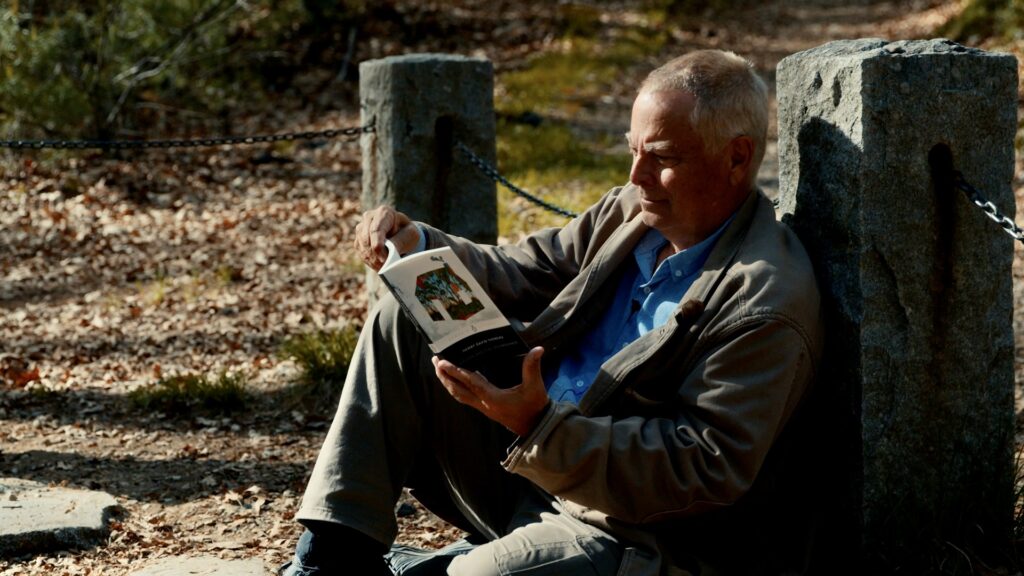
At the end of Walden, Thoreau assures me that if I will advance confidently in the direction of my dreams and endeavor to live the life I have imagined, I will meet with success. In fact, he says that deliberate and disciplined effort will enable me to cross what he calls “an invisible line.” I think I have crossed that line with respect to downsizing. If I can find worthy ways to redistribute what I no longer need, I will have achieved something deeply satisfying.
Who knows if I will see this through or backslide? I am pretty confident that I will win the battle against stuff-glut, including book glut. Of course, that’s just the easy part. The rest is a spiritual journey, and all I can say is, we’ll see.