
Wounded Knee, really?
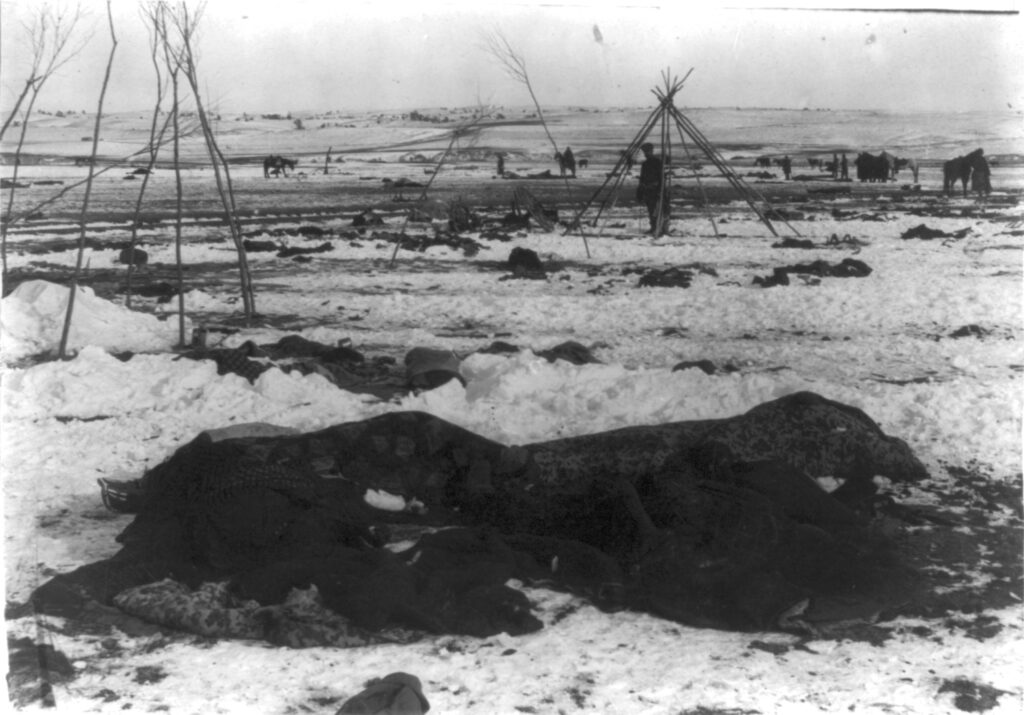
On December 29, 1890, at the tail end of the “Indian Wars,” the United States Army massacred about 250 Lakota men, women, elders, and children at Wounded Knee Creek on the Pine Ridge Indian Reservation in South Dakota. This wasn’t no battle, folks. Several hundred Lakota Ghost Dancers (Miniconjou, Oglala, Hunkpapa) had been rounded up and moved to a site near the Pine Ridge Agency for processing. Just what happened on that frigid December day remains a little murky, but we know this: the Army had all the firepower — including early machine guns — and the Natives had next to none, and when the shooting started, it turned into a one-sided bloodbath. The Lakota seer Black Elk, who witnessed the carnage, said decades later, “When I look back now from this high hill of my old age, I can still see the butchered women and children lying heaped and scattered all along the crooked gulch as plain as when I saw them with eyes still young.”
In the aftermath of the incident, 19 of the 120 U.S. soldiers at Wounded Knee were awarded the Medal of Honor for their actions. That tells you where we were in 1891.
There are a handful of the worst moments in U.S. history, great stains on the national honor. By any measure and from any perspective, Wounded Knee 1890 is one of the worst, along with the Sand Creek Massacre in eastern Colorado on November 29, 1864; My Lai (March 16, 1968); the killing of Emmett Till (August 28, 1955); Abu Ghraib (April 2004); and the internment of 150,000 Japanese Americans (1942). Is there any well-informed person who will defend what the white government of the United States let happen at Wounded Knee?
In 1990, on the hundredth anniversary of the incident, the U.S. Senate passed a resolution acknowledging that Wounded Knee was a “massacre” and expressed “deep regret on behalf of the United States to the descendants of the victims and survivors and their respective tribal communities.”
In 2001, the National Congress of American Indians formally requested that the 19 medals be rescinded. In February 2021, the South Dakota state Senate unanimously requested that Congress investigate the awarding of the medals. This was red state South Dakota wondering how anyone who participated in a massacre could deserve the coveted Medal of Honor. In July 2024, former Secretary of Defense Lloyd J. Austin III ordered a review of the medal awards to ensure they were bestowed for conduct consistent with the nation’s highest military honor.
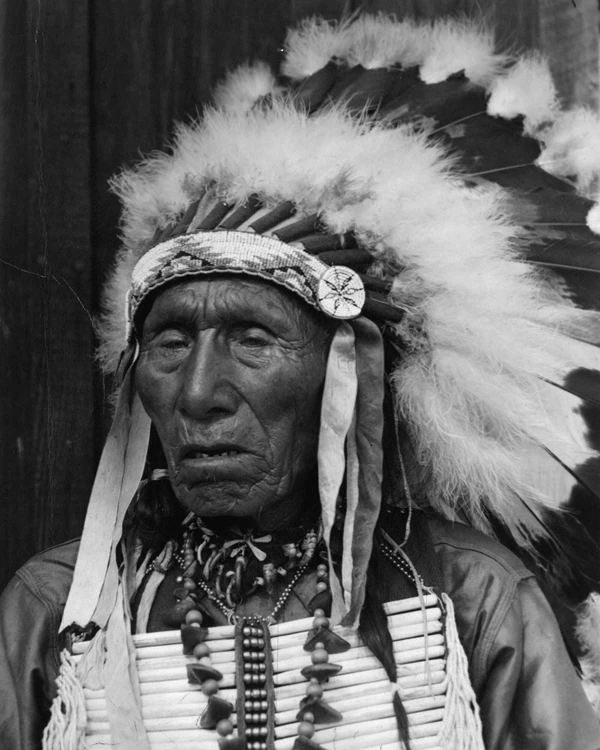
But now Pete Hegseth’s War Department (formerly the Department of Defense) has decided that none of the medals will be rescinded, period, end of story. Hegseth may or may not be aware of what a gigantic slap in the face this represents to all Native Americans. Wounded Knee is not just a terrible blot in white America’s conquest of the continent. It signifies far more than a bloody incident in a remote and isolated terrain at the tail end of the “Indian Wars.” It has long become the single most potent symbol of white perfidy, greed, racism, broken promises, and a strain of genocidal rage toward Indigenous peoples. For Native Americans, any mention of “Wounded Knee” touches off an oceanic sorrow. In his old age, Black Elk said, “I did not know then how much was ended. … And I can see that something else died there in the bloody mud, and was buried in the blizzard. A people’s dream died there.”
The historian Dee Brown understood the potency of the incident when he titled his groundbreaking 1970 study of white misconduct in the Indian Wars Bury My Heart at Wounded Knee.
Given the current administration’s desire to use the Culture Wars to political advantage and to eradicate any trace of “wokism” from American life, I predict that this is only the beginning of a campaign (I choose my words carefully) of official hostility toward Native American sovereignty, land and water claims, spiritual activity, federal funding of the basic Native infrastructure (health, nutrition, schools, colleges), and quite possibly the continued existence of Indian reservations and federal recognition.
It’s hard to imagine a legitimate reason to protect, promote, or lionize the men who participated in the Wounded Knee massacre. If this is yet another provocation in the Culture Wars, there must be better ways to drive the left crazy. These machinations will be particularly hurtful to descendants of those who were killed at Wounded Knee, and to the entire Lakota (Sioux) nation, and they are also a profound symbolic assault on Indigenous people everywhere. Just at a time when white-Native relations have gotten to a pretty good place, and Martin Luther King Jr.’s trajectory trope (the arc of the moral universe is long, but it bends toward justice) seemed to be more than empty rhetoric, the “no apologies” element in American political life attempts to turn back the clock yet again.
In the past few years, the Pope has formally apologized for the boarding school tragedy and officially repudiated the 15th-century Doctrine of Discovery that allowed European nations to summarily claim Indigenous lands for their own purposes. Former Secretary of the Interior Deb Haaland quietly began to establish an American equivalent to the Truth and Reconciliation Commissions that played an important role in healing South Africa after the fall of apartheid and later in Canada with respect to boarding schools.
The Ghost Dance
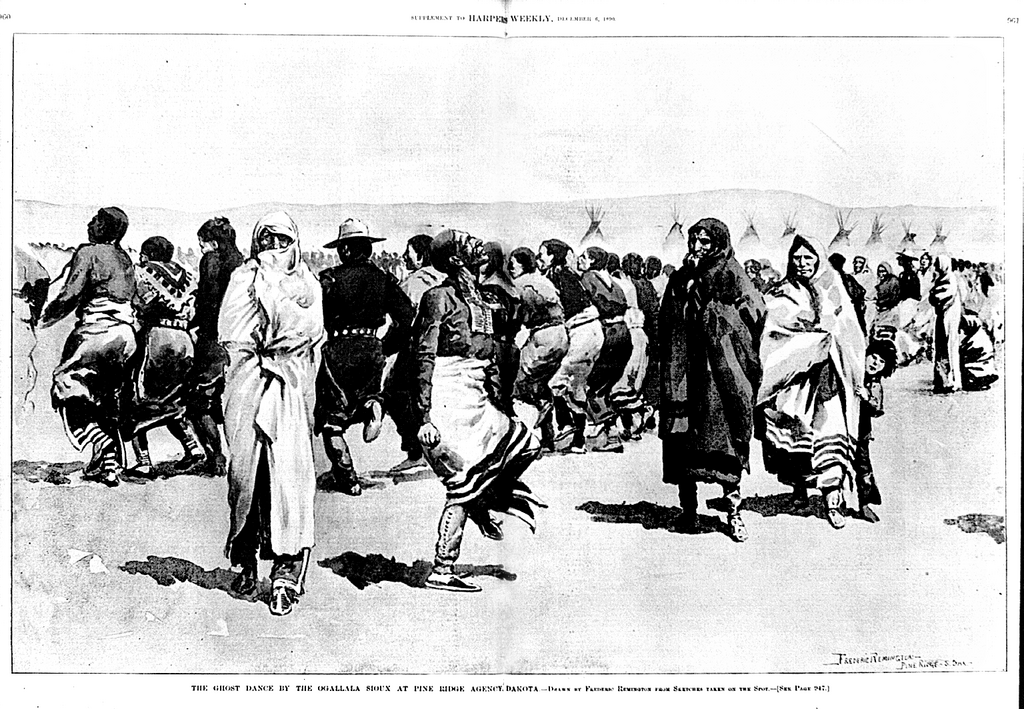
The Ghost Dance movement is one of the most fascinating and tragic chapters of American history.
By the late 1880s, the “Indian Wars” had effectively come to an end. The military resistance of the Sioux (Lakota), Cheyenne, Apache, Nez Perce, and other Native Americans had been crushed. It was a decade of severe suffering in the Dakotas — a prolonged drought, the Dawes Act’s assault on Native concepts of sovereignty and property, disease outbreaks, and treaty-guaranteed rations late, arbitrarily cut, rancid, or skimmed by corrupt Indian agents. The Lakota were hungry, angry, dispirited, and desperate. Just at that time, along came the Ghost Dance. From out in Nevada, a Paiute prophet named Wovoka declared that it might be possible to restore the Golden Age — i.e., the time before white people (Wasichu) stormed in to take whatever they wanted in the West.
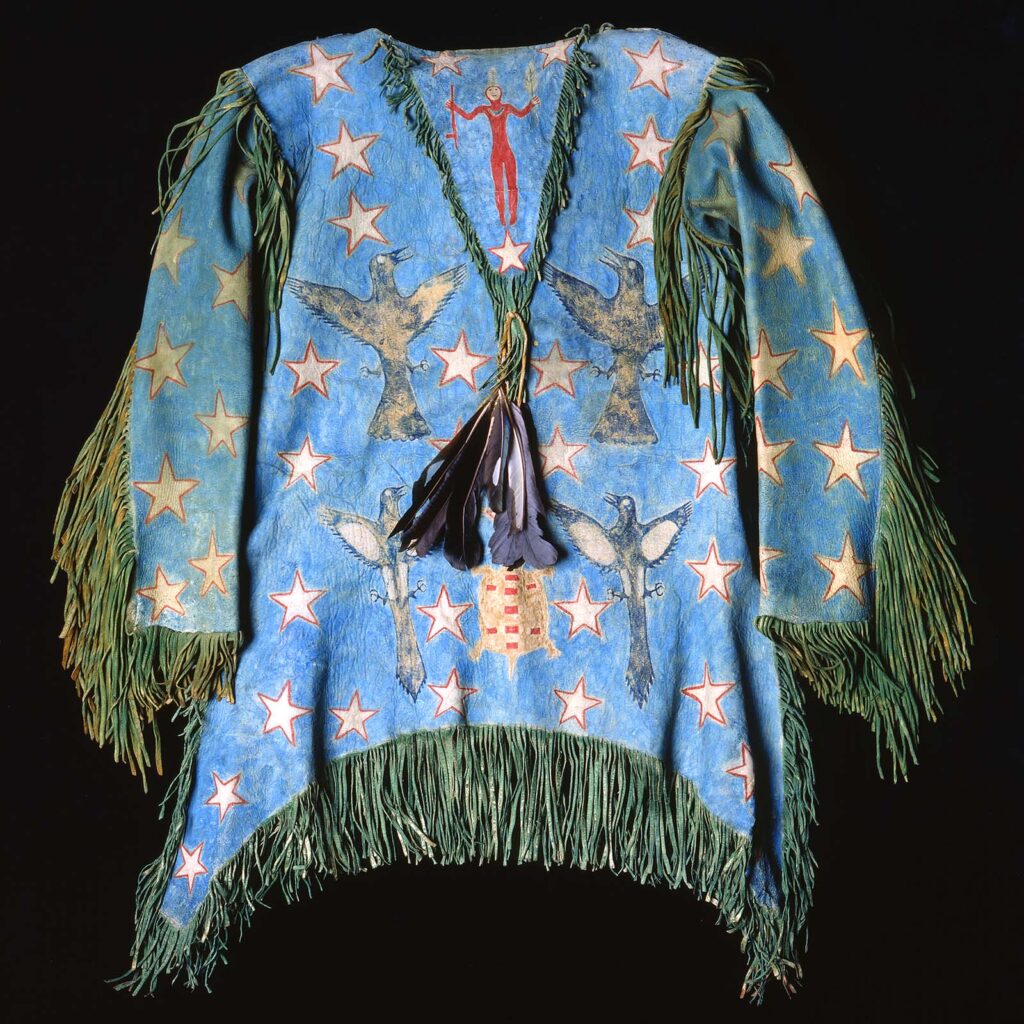
As Wovoka’s millenarian movement spread throughout the American West, handed down from tribe to tribe, the rituals of the Ghost Dance evolved. The core idea was that if Natives would dance incessantly in a sacred way, they could hasten the apocalypse in which white people would simply be swallowed up into oblivion and a prelapsarian world would be restored, “where all the dead are splendidly alive, and summer lingered and the bison thrived forever,” as Nebraska historian and poet John G. Neihardt put it in his epic Song of the Indian Wars. In scores of locations across the western half of the continent, Native Americans danced until some collapsed or fell into an altered state, in which they encountered their dead ancestors or the Great Mystery. In some versions of the Ghost Dance, participants were encouraged to sew special Ghost Shirts, decorated with celestial iconography, which were said to have the power to protect the wearer from bullets fired by white men. Some of those Ghost Dance shirts have been preserved by museums around the world and, under the terms of the Native American Graves Protection and Repatriation Act, have been returned to tribes and individuals when their provenance can be determined.
The great Hunkpapa Lakota leader Sitting Bull regarded the Ghost Dance as a retrograde exercise in futility. Still, he permitted it to be practiced near his cabin on the Standing Rock Indian Reservation in North Dakota because he understood that it gave a desperate people a sense of purpose. He understood that when the apocalypse didn’t come, the dancers would begin to slip away from the dance circle. For the same reasons, former Pine Ridge agent Valentine T. McGillycuddy urged the U.S. Army not to intervene and let the craze dance itself out.
Despite this wise counsel, the Army sent hundreds of troops to Pine Ridge.
The Massacre
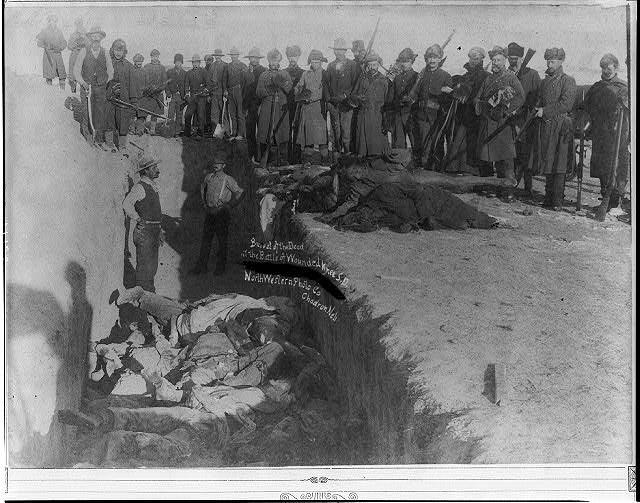
What brought on the massacre? 1. The new and inexperienced agent on the Pine Ridge (D.F. Royer) overreacted to the Ghost Dance. He failed to realize that the Ghost Dance had no military application. He panicked. He requested federal troops. Royer was described in his own time as “destitute of any of those qualities by which he could justly lay claim to the position — experience, force of character, courage, and sound judgment.” The Lakota called him “Young Man Afraid of the Sioux.” 2. Both whites and Natives were weary of the 30 years of Indian Wars. Some in the Army, no doubt, just wanted “to get it over with.” Some of the troops sent to the Pine Ridge were members of Custer’s Seventh Cavalry, eager for payback. 3. As troops moved through the camp to search for any hidden firearms, one of the recalcitrants struggled with a U.S. soldier. Inevitably, a shot rang out, after which the Army essentially descended into a riot of blood-seeking, killing everyone in sight and then pursuing unarmed women and children as they attempted to crab-walk their way up the ravines to safety — bashing the heads of infants against trees and rocks, cutting Native fetuses out of women’s wombs, shooting and bayoneting helpless and terrified people in the back. So great was the mayhem that many of the two dozen U.S. Army casualties were caused by friendly fire. 4. The frustrations of Army life on the western frontier were severe. Many of the soldiers were recent immigrants (mostly from Ireland), raw recruits, with poor (in some cases no) military training. They were not a disciplined fighting force with the capacity to handle a delicate situation in which hundreds of desperate individuals were surrounded by heavily armed troops.
The Lakota who were gunned down had surrendered in two ways. First, they had permitted themselves to be arrested en masse by the Army. They knew they could no longer resist the force of the U.S. government. They were hungry, cold, exhausted, terrified, and desperate for any stability that would warm their bodies and put food in their mouths. They were rounded up and hemmed in a temporary refugee camp. Second, they had complied with the Army’s order to turn in their guns. There might have been a handful of weapons still with the dispirited refugees, but they had no capacity to mount an attack on U.S. soldiers.
It was an entirely needless massacre. We Americans live in a time, 135 years later, when we are mature enough to recognize our flaws, express genuine remorse, and do what we can to improve the lives of those we have harmed. This is not a time for a national surge of toxic masculinity as we look honestly at the past on the eve of our 250th birthday as a nation.
Worst Possible Time
The last 10 to 25 years have been a time of healing and regeneration in Native American communities. Being an “Indian” is still — on average — much more difficult than being a white American. Despite measurable material gains, there is still a good deal of poverty, unemployment, poor access to healthy food, drug and alcohol epidemics, fetal alcohol syndrome, broken families, and crime. But things have been slowly getting better in Indian Country ever since the New Deal (1930s) and particularly in the last 20 years. Most off-reservation institutions now begin public proceedings by reading a land acknowledgment statement. Indian language programs are working hard to introduce young people to their Native language. Increasingly, Native Americans are earning college degrees and pursuing graduate studies in fields such as law, medicine, and business. There is widespread evidence of cultural recovery as traditional rites, clan structures, religious ceremonies, and craft guilds struggle toward a Native renaissance. The Land Back Movement is getting some modest traction. Native lawsuits are increasingly successful in the federal court system.
Now Pete Hegseth’s War Department has jumped recklessly into the fray and reopened one of the deepest wounds in American history.
In the Newtonian world of the Culture Wars, every cultural action seems to precipitate an equal or more violent opposite cultural reaction. If the Biden administration had just left Wounded Knee alone and waited for Congress to stumble through to some reparative legislation, Secretary Hegseth would have had no reason to intrude himself into one of the saddest episodes in American history. Probably a solid majority of white Americans would oppose stripping the soldiers who participated in the Wounded Knee massacre of their rank, commendation, and medals. I’m not sure we gain much from these long-after-the-fact social justice initiatives, which some will regard as contemporary virtue signaling. We all get it that that was then and this is now, that the soldiers (the grunts on the ground) were on the whole only doing what they were expected (even encouraged) to do, and that the primary responsibility for the tragedy lies with the U.S. government, commanding officers in the Army, and a tacit national policy of cultural genocide, forced assimilation, and zero tolerance for Native resistance.
What happened at Wounded Knee was the logical end product of what historian Helen Hunt Jackson called A Century of Dishonor. If you merely prosecute individuals on the ground for the atrocities at Abu Ghraib, have you really addressed the issue of responsibility?
The case can be made to let sleeping dogs lie, but the very last thing you’d want to do at this juncture is to try to turn back the clock and reassert a white triumphalist paradigm of American history. And that, of course, is precisely what Secretary Hegseth has done.
The Pilgrimage
I have visited Wounded Knee a dozen times or more. I go out of my way when driving the Great Plains to make the pilgrimage. I take my daughter there every time we are within 200 miles of the Pine Ridge, and it has changed her life. It’s not Gettysburg or Appomattox or even the Little Bighorn. It’s a stark, lonely, haunting, and haunted place. There is no cultural infrastructure nearby — only a large red sign inscribed on both sides with explanatory text. And a half-neglected cemetery up on the hill from which Hotchkiss guns rained down death on the helpless Natives.
On some visits, I have wished there were an interpretive center at Wounded Knee — telling the truth about what happened, but with an emphasis on cultural recovery and the astonishing resilience of Native Americans. But maybe it is better that there is nothing there. It’s important for white Americans to stand there in the middle of nowhere and reflect on what I call “the cost of empire, the cost of becoming transcontinental America.”
America has a lot to answer for at 250. Still, it can be done with thoughtfulness, respect for a range of points of view, generosity of spirit, a commitment to cherish the rights and dignity of all Americans, and with everyone represented at the table. How many Native Americans do you suppose are at Pete Hegseth’s table?
I will go to Wounded Knee again in the next few weeks. By then, the landscape will be wind-blown, and all the grasses and trees will be barren in hibernation. This is a pilgrimage I urge every American to make if you can, for if you were trying to make a list of the worst atrocities in American history, you’d place Wounded Knee right at or near the top. If we are to heal as a people, we must confront some disturbing aspects of our history and national character. We’re nine months from July 4, 2026. No time like the present.