
As a longtime student of President Theodore Roosevelt, historian Clay Jenkinson considers how TR might have approached current events in Iran.
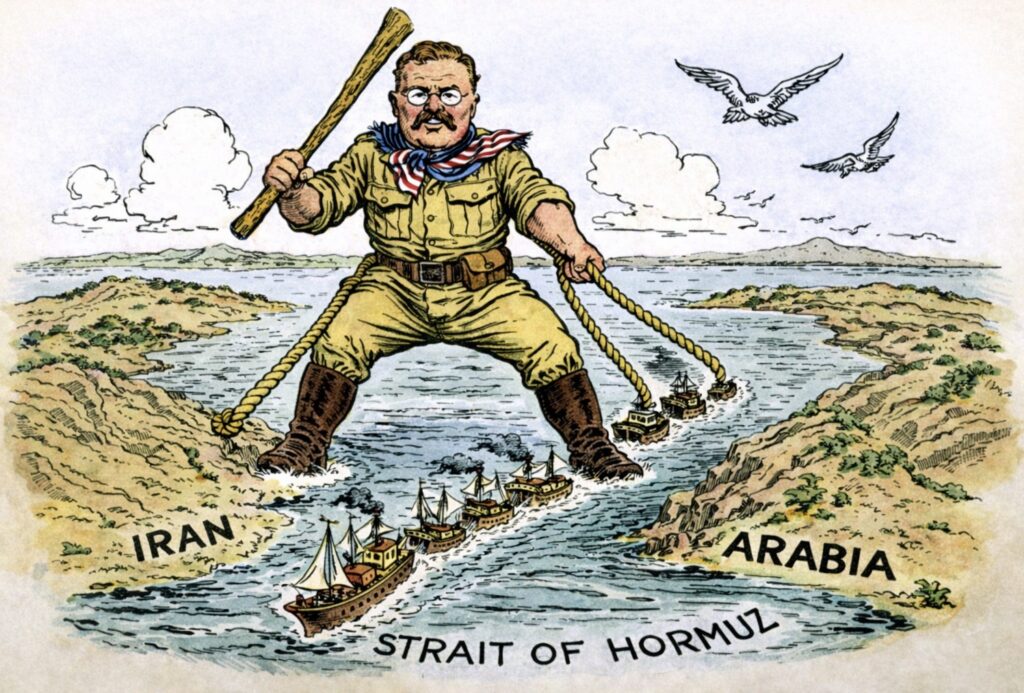
Somebody asked me the other day how Theodore Roosevelt would have handled the war against Iran. I should point out first that although Roosevelt has a well-deserved reputation as someone friendly to war — “All great nations have been warring nations,” “I should welcome almost any war, for I think this country needs one” — the 26th president of the United States presided over seven years and 171 days of peace (mostly — there was the continuing Philippines occupation). And in 1906, he became the first American president to win the Nobel Peace Prize — for helping to bring about a settlement in the Russo-Japanese War.
Roosevelt was what by today’s standards would be regarded as a committed constitutionalist. He did not violate the Constitution, though he stretched his executive authority as far as he dared without crossing the line of the rule of law. He would not have been afraid to attack an enemy without the formal congressional approval required by the Constitution, if the circumstances had necessitated it, if the threat were truly imminent. But he would first have talked things over at length with his closest friends in Washington, including such key senators as Henry Cabot Lodge and Nelson Aldrich. Roosevelt made a habit of listening to his trusted advisers. He would have sought full congressional authorization in any protracted war, even though he did not have much respect for most members of Congress. He spoke of the Senate as “a shrill concatenation of impotent shrieks.” He said privately, “I could run this country very much better if I did not have to bother with Congress.” And when William McKinley hesitated to declare war on Spain in 1898, TR reportedly said McKinley had “the backbone of a chocolate éclair.” That’s certainly what he meant, and the remark is quintessentially Rooseveltian.
If Roosevelt decided to take America to war — the gravest thing a president must ever do — he would have used the bully pulpit to full effect. Nobody was better at this than Roosevelt, who invented the term “bully pulpit.” He would have given speeches around the country (traveling by train) explaining Iran’s criminal behavior, its open threats to the existence of another sovereign nation, and its sponsorship of terrorism all over the region. He would have given four or five 90-minute speeches in different cities, each outlining a different perspective on the threat from Iran. He would have urged young American men to enlist in the military or form volunteer “Rough Rider” groups to do some of the work of the war, including at the front. He would have urged Congress to ensure the War Department (as it still was) had all the munitions and funds it needed to prosecute the war successfully.
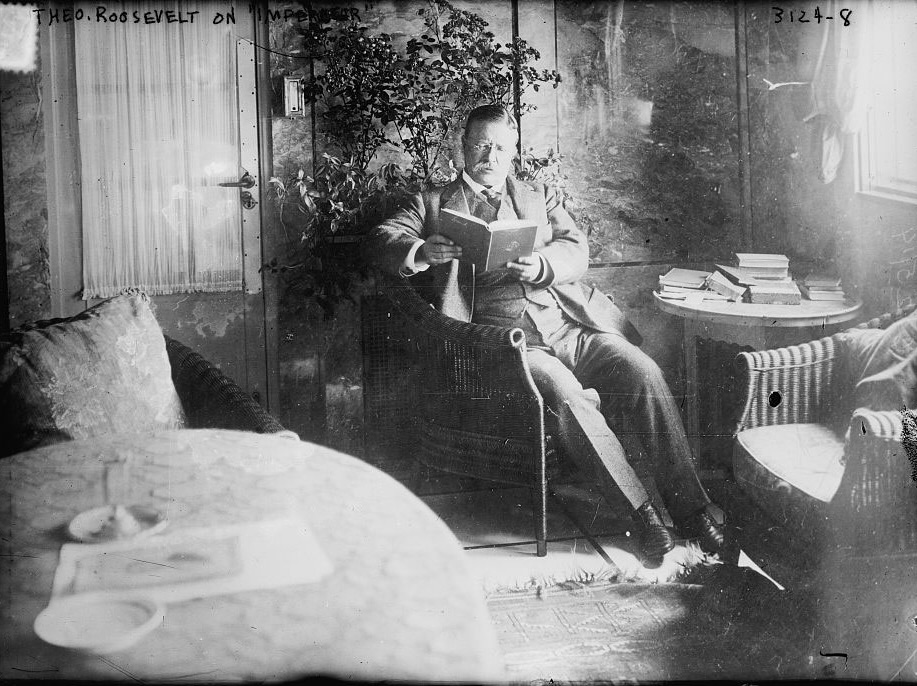
Roosevelt had one truly great advantage over almost any subsequent president, including Dwight David Eisenhower. He had read deeply in the history of warfare: Caesar, Alexander, Napoleon, Horatio Nelson, Xerxes, John Paul Jones. As a child, he used to stage famous battles in the family’s house on 28 East 20th Street in New York, deploying battalions of miniature metal soldiers and maps. Probably no president has had a deeper knowledge of the history of warfare — including what can (and often will) go wrong. And remember, his first serious book was The Naval War of 1812, a book he wrote entirely himself (are you listening, Theodore Sorensen?), one that was still used at the U.S. Naval Academy deep into the 20th century.
A Voracious Student of History
Roosevelt read a book a day his entire life. He had a near-photographic memory. He wrote approximately 40 books, depending on how you count, and all without ghostwriters.
After spending many hard-listening hours with his closest advisers, including his remarkable sister Bamie, and after consulting with key members of key committees in Congress, Roosevelt would next have made an address to the people of the United States. Unfortunately, that was not fully possible in his time, because television was decades away and radio was just in its infancy, not quite ready for anything like a national broadcast. He would therefore have delivered speeches that were printed in full in the nation’s newspapers, with photographs, and he would have traveled the country as much as pressing war-related business allowed.
Roosevelt probably would have lamented that, as president, he could not gather up another harum-scarum group of Rough Riders to lead heroically against the enemy. Iran is not Cuba, and 2026 is not 1898.
What Might TR Have Said?
Here is approximately what his address to the people of the United States would have been if he could have spoken to the entire nation from his White House office:
My fellow citizens. I interrupt your lives because we are in the unhappy position of needing to go to war against the Islamic Republic of Iran. I want to begin by acknowledging that Iran has a glorious history dating back at least to 550 BCE. The Persians created one of the great civilizations in history. We have no quarrel with the 93 million people of Iran. We commiserate with them for the tyranny under which they are forced to live by Islamic fundamentalists who do not represent the will of most Iranians and are not committed to the rule of law as we are. If we had the power to do so we would come in and set things right for the beleaguered Iranian people, but my study of history, particularly of the many 19th-century Middle East debacles of the British Empire, indicates that nothing short of a wholesale invasion of Iran and an occupation of five to 25 years would secure for the Iranian people the kinds of rights and security we enjoy in the United States. That is not in our national interest. I heartily agree with Secretary of State John Quincy Adams’ Fourth of July speech in 1821. America, he said, “goes not abroad, in search of monsters to destroy.” The Iranian people are responsible for their own destiny, as we are for ours.
If there were any alternative to this war, believe me, I would be pursuing it. I now again extend my hand to the government of Iran to say we would prefer to be at the negotiating table. We believe our demands are reasonable and that it would be in Iran’s best interest to meet them. We will only wage war if we absolutely have to. But it is decidedly in our national interest, and it is my responsibility to protect American lives and American interests all over the globe. If Iran behaved like the other responsible nations of the world, we would never think of waging war against it. Unfortunately, Iran’s record of killing American soldiers, bombing our ships, incarcerating journalists and other Americans, torturing many of them, and attacking America’s friends in the region using tactics that violate all of the nobility and honor of a just war, forces me to take decisive action.
I want to assure you that I have consulted the books in my library about the long, sad history of the Middle East and particularly of Persia; books about the differences between Shia and Sunni Muslims, books about the sea-borne traffic lanes of the region; and, particularly, the history of British and French incursions into the region.
In addition, I have consulted every member of Congress who could help me make this difficult decision, including some who disagree strenuously with me. I would never attempt to carry the United States into war unilaterally.
There will be casualties. That is the fundamental fact of war. Some of our soldiers will be injured or killed. Good planning and adequate equipment will keep these casualties to a minimum, but I do not want to pretend that we can wage war against another well-armed nation without loss of life and battlefield setbacks. I ask for your support. It is the American nation that will be waging war with Iran, not just the soldiers and sailors who go into battle on our behalf. They need your support. I need your support. I hope you will let your elected representatives know your views on this conflict, even if you disagree with my decisions. A robust national conversation about something of this magnitude can only be healthy and helpful.
In closing, let me pledge that I will be fully transparent with you about the prosecution of the war. I will provide frequent, candid updates on our military operations, including those that do not succeed. I will provide the appropriate congressional committees with every document they may need, so long as their release does not pose an imminent threat to our national security.
I will try to end this war as quickly as possible, but not before the job is done, and return to the real business of America — making sure everyone of our citizens gets a square deal irrespective of their social status, religion, nation of origin, or ethnicity; and finding ways to conserve our rich but increasingly depleted natural resources for future generations.
Thank you for your attention.
Theodore Roosevelt was arguably the best-read and best intellectually prepared president in American history, and that includes our three polymaths, Thomas Jefferson, John Adams, and John Quincy Adams. He would have known that the Middle East has been the grave of empires. He would have been better informed about the full sweep of Iranian history, including recent Iranian history, than any of his advisers. He would have engaged in long pre-war conversations with his most trusted British friends — Cecil Spring-Rice and Edward Grey — and with the French ambassador, Jules Jusserand.
Roosevelt would never have accepted any two-minute morning updates about the status of the war. In fact, he would have worn out his top military advisers by asking a blistering range of questions every day. As a big-navy advocate and a student of Alfred Thayer Mahan’s 1890 The Influence of Sea Power upon History, his first concern would have been how to secure the Strait of Hormuz. He would have been able to give his advisers a full lecture on the Strait — its strategic location, the most vulnerable choke points, the nature of Iranian military installations along the Strait, the global GDP it represents, and Iran’s previous attempts to close it to shipping.
In private, Roosevelt would have urged his military to “hit the line hard,” but his knowledge of Persian history would have made it impossible for him to threaten to bomb Iran back to the Stone Age. His public statements would have been stern and bellicose, but characterized by presidential decorum and a deep understanding of the facts on the ground.
We have dramatically better tools of war today than in TR’s time, but our leadership is dramatically more impoverished in geopolitical understanding and foresight.