
I’ve flown from Bismarck, North Dakota, to Eastern Tennessee to find out.
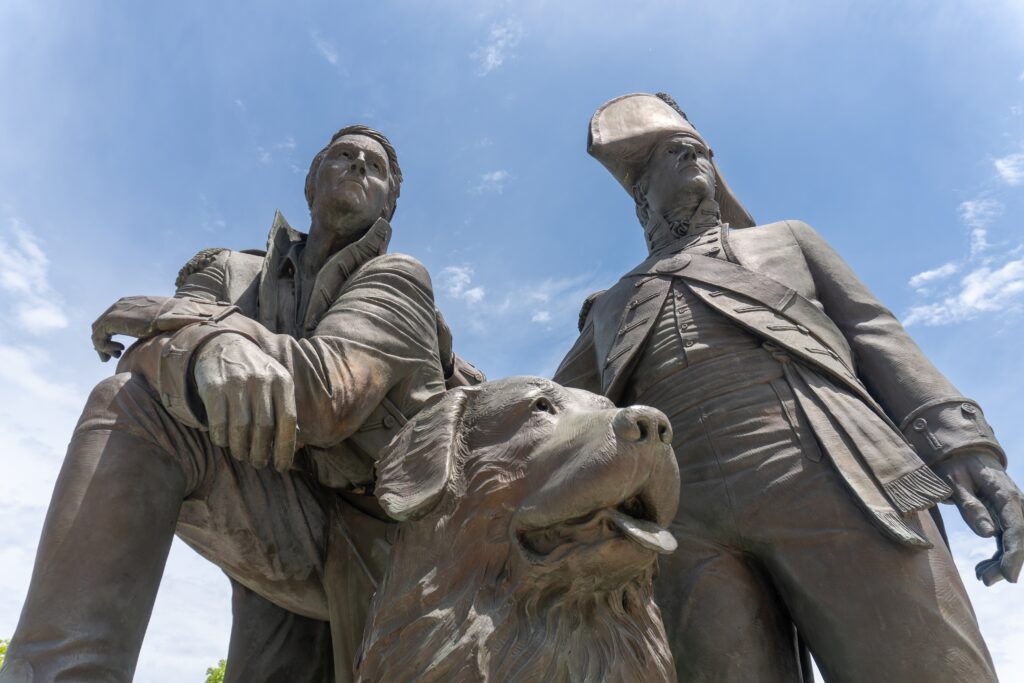
By the time you read this, I will have given a lecture at a prestigious private school in eastern Tennessee about Lewis and Clark. My adventure began Saturday with a long and extremely frustrating day of air travel — delays, aggressive silences by gate agents, a mile-long last-second gate change at the Dallas airport, 40 minutes sitting on the tarmac while luggage from a previously canceled flight was jammed into the hold, with pilots warning us that they were in danger of being “timed out” by FAA rest regs, and — when we at last arrived — one of the longest baggage claim waits I can remember. By that time, I half-hoped that my luggage was lost to make it a perfect hat trick. All I wanted now was to burn my clothes, take an endless shower, and tumble into bed.
Here I am in my “woe is me” mode, when I am about to lecture about the 7,689-mile Lewis and Clark expedition (1804-06) in which, day after day, the 30 young volunteers used their backs and thighs to force 60,000 pounds of gear against the capricious currents of the Missouri River. The men of the expedition had the right stuff. They had the stamina of Navy Seals. On a good day, they might push their flotilla of three boats 12-15 miles up the river — assuming nobody got hurt, they didn’t take a false channel or strike a submerged cottonwood trunk, and nobody mouthed off to the “gate agent. On my first flight Saturday, the man next to me wheezed like a Bessemer blast furnace for 2.4 hours, and on the second leg, the man next to me, playing solitaire on his tablet, kept jamming his left elbow into me as if he were driving the Indianapolis 500. When the flight attendant finally put a plastic glass of Bloody Mary mix on my tray table, there was no ice. I can’t work under these conditions!!
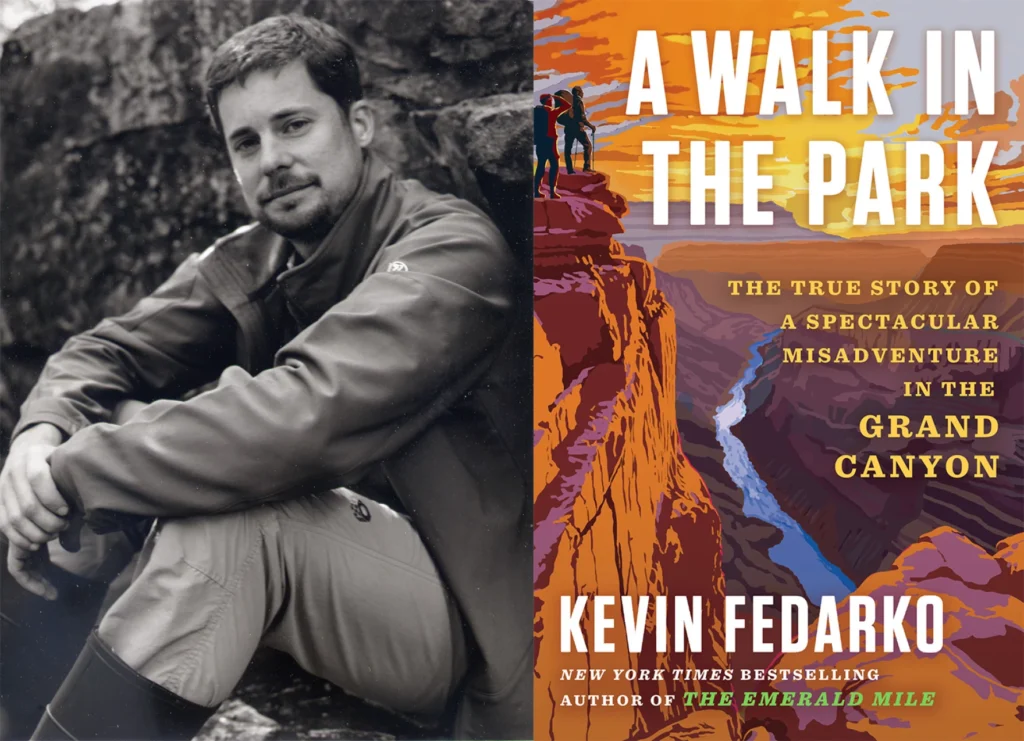
My Tennessee host had been waiting for 2.75 hours at the Kiss & Fly lot for me to land. It was now well past midnight. And, of course, the clocks were going to “leap forward” by an hour while I slept. On the ride to the hotel, he told me that last year’s endowed lecture had been delivered by Kevin Fedarko, the Flagstaff, Arizona-based author of two extraordinary books, The Emerald Mile: The Epic Story of the Fastest Ride in History Through the Heart of the Grand Canyon and A Walk in the Park: The True Story of a Spectacular Misadventure in the Grand Canyon. I groaned. Had I known that, I might have refused to come. Fedarko is a writer I greatly admire. I’ve read The Emerald Mile three times. I’ve been trying to get him to sit for a podcast interview for many months. When my host told me whose shadow I was about to lecture in, I wanted to say, “Just circle around and leave me here at the airport, and I’ll get the next flight home, assuming there is ever a return flight to Dallas.” Then he informed me that my lecture must not exceed 30 minutes. I did not say (but felt), “Boy, that’s a lot of wear and tear on my body and soul for 30 minutes of discourse, not to mention a whopping carbon footprint,” but I did say, “Oh my, it would be infinitely easier for me to give a three-hour lecture than one of just half an hour.” “You’ll be fine,” he said. Will I?
What Can One Say About the Lewis and Clark Expedition in 30 Minutes?
It was Jefferson’s brainchild. Jefferson chose Lewis, Lewis chose Clark (the best decision he ever made). They recruited some tough but talented frontiersmen. After wintering near St. Louis, they followed the Missouri to its source in far western Montana, suffered greatly in lugging their gear over the Bitterroot Mountains, eventually found navigable waters of the Clearwater-Snake-Columbia River system, and made it to the sea late in their second year of travel. They wintered on the Pacific Coast, where it rains more than 100 inches per year. That made them miss their bitterly cold but dry winter in North Dakota. (Always get in some North Dakota mentions!) Then they turned back. And, oh yeah, also in North Dakota(!), they hired Sacagawea and her troublesome husband Toussaint Charbonneau to help them acquire horses among her birth people, the Shoshone. Lewis killed himself just three years after their return.
Any questions?
These talented private school students can get all that in short order on their smartphones. So what can I tell them that will perhaps stay with them more than “that old guy who said some stuff about Lewis and Clark”? What can I say that will inspire them to think about the dynamics of American history, about the interplay of myth and history in our national narrative, about the extraordinary complexities of the mission commander, and about the great dispossession of the Indigenous people of America in the aftermath of the Jefferson era?
You can’t tell the story of Lewis and Clark without falling into a rhapsody about what it must have been like to see Montana in 1805, when there were 40-50 million buffalo in the American West — a Serengeti of bison, mule deer, bighorn sheep, wolves, coyotes, grizzly bears, elk, eagles, prairie dogs, mountain lions, and Native American cultures still intact in a steady-state and sustainable lifeway they had forged over hundreds and even thousands of years. To have seen “Montana” (the American West), and the great rivers Missouri, Yellowstone, Snake, and Columbia, before a single cubic yard of concrete had been dumped into their natural flows. It’s magical to float the upper Missouri even now, when most of what was there in 1805 has been refashioned, replaced, or eradicated. Imagine what it must have been before “industrial man” arrived with a slide rule and an improvement plan.
The Cultural Revolution
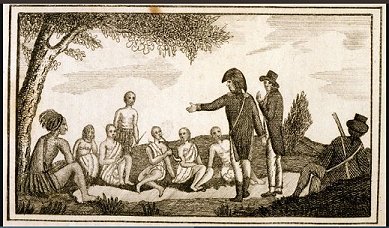
But you can’t tell the story of Lewis and Clark today without acknowledging our ambivalence about what used to be called “the westward movement.” A generation or two ago the expedition was a hero story: these intrepid explorers who became the first white Americans to cross the continent “from sea to shining sea” as the late Stephen Ambrose liked to put it, against nearly impossible odds. Back then, Lewis and Clark were best friends (Ambrose again), and they embarked on an entirely noble mission of “peace and friendship,” as the peace medals they handed out indicated, with an image of the Great Father (Jefferson) on one side and the clasped hands of peace on the other. Back then, Lewis discovered the confluence of the Missouri and the Yellowstone, the Great Falls, the source of the Missouri River, and “the most direct and practicable water communication across this continent for the purposes of commerce,” as Jefferson put it in his famous instructions. Back then, Sacagawea was imagined as Miss Indian America and their guide to the Pacific. Clark’s slave, York, was a kind of minstrel figure and sexual athlete.
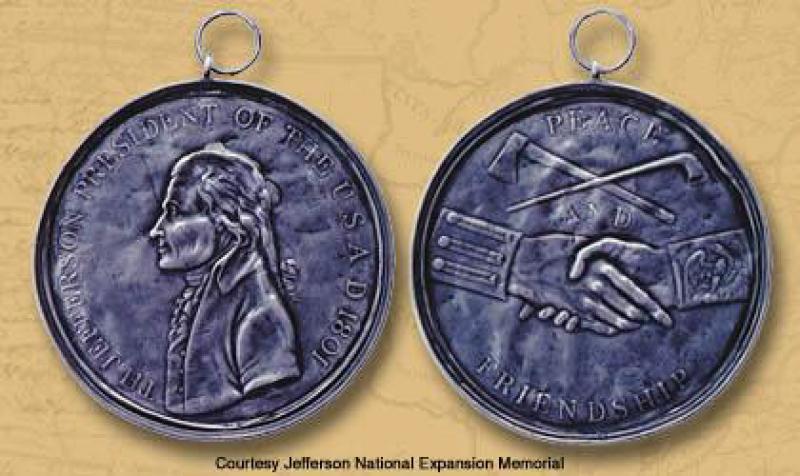
Between then and now, we’ve experienced a cultural revolution in America that has fractured (and in the minds of some, shattered) the old American narrative. Today it’s essential to put the word “discovered” in air quotes, because we are now quick to acknowledge that Native people had known of all those geographic and biological wonders for millennia and frequently informed Lewis and Clark well in advance what they could expect to see (discover). Today, we see the Indigenous peoples they met (more than 50 tribes in all) as much more than the bit players they were portrayed as in standard histories for much of the 20th century. Today, we acknowledge that the Teton Lakota of South Dakota had every right to challenge and resist Lewis and Clark, who were astonished that “a bunch of Indians” presumed to get in their way. Clark later called the “Sioux” “the vilest miscreants of the savage race.” Ouch. One important book on Lewis and Clark, published in 1979, was entitled Only One Man Died — Sergeant Charles Floyd, near Sioux City, Iowa, of natural causes. Today, we are quick to acknowledge that on the return journey at the end of July 1806, Lewis and three of his men wound up killing (admittedly in self-defense) at least one and perhaps two Piegan Blackfeet on the upper Marias River in Montana. Didn’t they count? Back then, we could write blithely about a group called “The Nine Young Men from Kentucky,” recruited by Clark as the expedition was getting organized. But there was a 10th Young Man from Kentucky, Clark’s slave, York. Didn’t he count?
None of these recent historiographical adjustments ruins the story or discredits the achievements of Lewis and Clark. But they make the story less tidy, upbeat, and triumphalist.
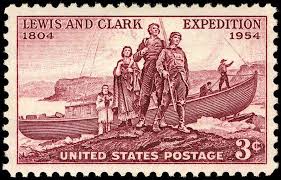
What sort of mission were Lewis and Clark on? Were they largely innocent Anglo explorers working their way earnestly across the continent on behalf of the Enlightenment, or were they the “spear of American imperialism” and Manifest Destiny? I once asked the then Chairman of the Standing Rock Lakota, Ron His Horse Is Thunder, to write a wry commentary on the expedition for a public radio documentary I directed. He entitled his essay, “We Should Have Just Wiped Them Out When We Had the Chance.” He delivered this commentary in good humor, but he also wanted to make an important point. From the perspective of the Lakota (and all the Indigenous people they met over 28 months), there wasn’t much to celebrate during the Lewis and Clark Bicentennial. Lewis and Clark may have been on the whole respectful and high-minded, and they really were making a scientific inventory of the continent for the philosophical president of the United States, but they were also the harbingers of a long, tragic 19th (and even 20th) century for the Native Americans of the West.
As we approach the 250th birthday of the United States, we must wrestle with these questions. The Old Narrative, which argued that it was God’s actual (manifest) purpose (destiny) that white people from Europe would take the continent from its Indigenous sovereigns, doesn’t hold up well anymore in most circles. And yet we must also avoid falling into a grim parade of guilt and self-condemnation as we consider one of the most complicated migration stories in the history of the modern world. As Facebook used to put it with respect to relationship status, “It’s Complicated.”
As a people, we have not yet engaged in a useful national conversation about who we are, how we got here, where we are now, what is still unresolved in the American story, and what sorts of repairs and healings we need to undertake with good hearts and rigorous minds as we proceed on, as Clark liked to put it. If we don’t step back to have that national conversation at 250, when are we likely to do it? At 283? Or 310? If I were writing a book about the semiquincentennial, I would entitle it “The Glory and the Cost of America.” The cost has been high. Much better historians will write that book. They must. At the moment, we do not have an agreed-upon national narrative — and boy does it show. A nation that cannot agree upon a consensus narrative about its origins and its history — a nation at loggerheads in what is called the Culture Wars — is a nation that is incapable of doing the great things that great nations do: comprehensive immigration reform; a sane national health care system; crafting a responsible American role in the world arena; a rethinking of the cost of higher education and the product it delivers; some resolution of the monstrous gap between the few and the many in American life; and more.
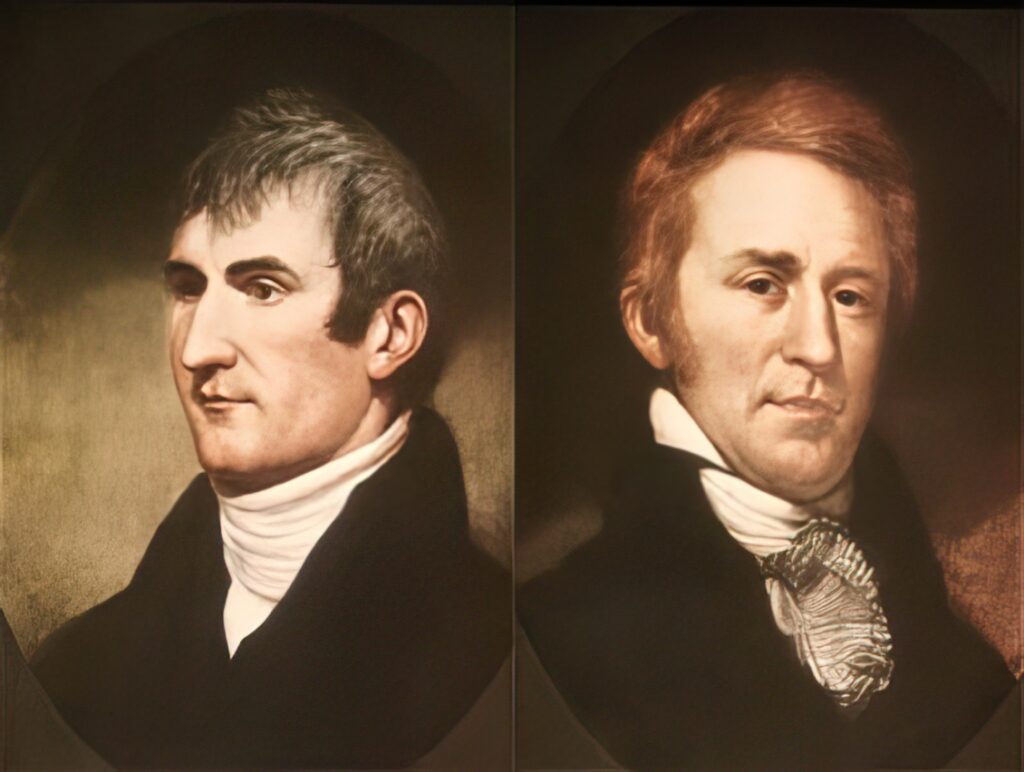
Should poor Meriwether Lewis and William Clark be burdened with all of this? Of course not. But they are an important part of the story, in part, because they made their journey so early in our history. I’ve been reading and writing about the expedition for more than 30 years, and I still don’t know what happened to Lewis’ Newfoundland dog, Seaman, in July 1806. What exactly was the role of Sacagawea, or how should her name be spelled and pronounced, for that matter? Why did Meriwether Lewis commit suicide on October 11, 1809, or why did he never write the three-volume account of the expedition he promised the American public? Mysteries abound. That’s what keeps me at it when there are so many other utterly compelling stories to explore.
By the time you read this, I will have found something to say to the 800 students I’ll face here in East Tennessee tomorrow. Dang that Fedarko with his high-octane recent ventures on the Colorado. Thirty minutes. My host said I might possibly be forgiven for taking 34. And then, after a short night of sleep on Daylight Saving Time, I have to get back on those planes. America at 250. I was on an airplane in Munich, Germany, in December, just after the forward door had been closed, when the pilot came on and said the following. “Ladies and Gentlemen, I want to apologize. We will be leaving the gate eight minutes late this morning.” I wanted to stand up (I was too weary to stand up) and shout, “That sentence has never been uttered in America.”