
It felt like old times on Friday night as we all watched the splashdown of the Artemis II moon mission.
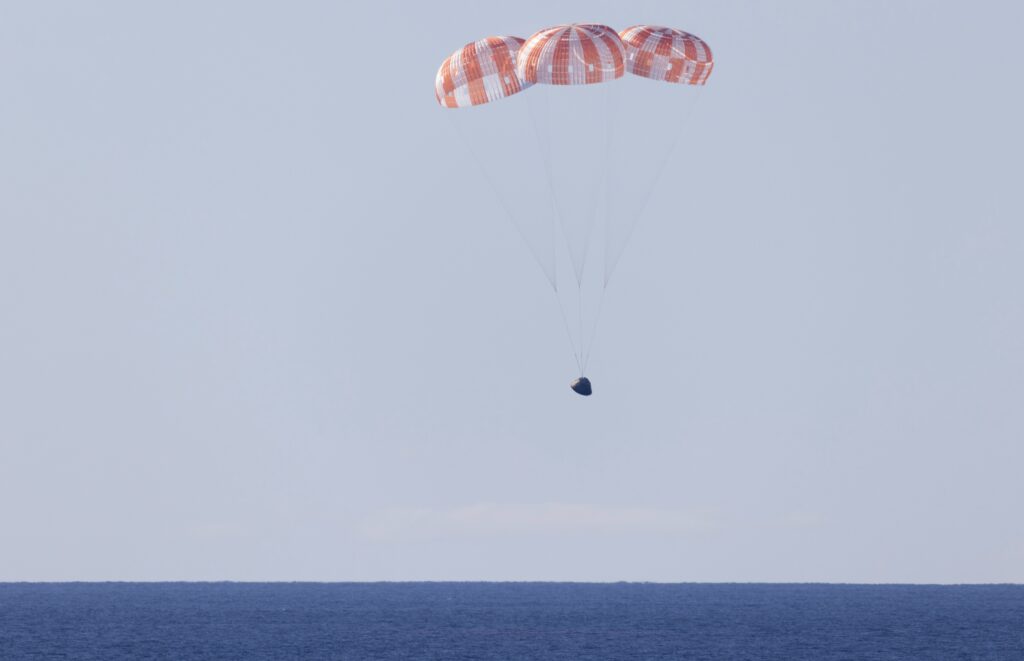
The four-member Artemis II crew plunked into the Pacific Ocean near San Diego at 8:07 p.m. EDT after a flight of nine days, one hour, 32 minutes, and 15 seconds. They traveled a total of 695,081 miles and ventured farther from the surface of the Earth (by a few tens of thousands of miles) than any previous humans. They got to spend some time gazing at the elusive backside of the moon, something you and I will never see through our own eyes.
I don’t bite my fingernails, but I was essentially doing just that during the last hour of the flight. I was as fidgety as Huck Finn on the raft when he and Jim are looking for the mouth of the Ohio River. On CNN Friday evening, engineers sounded slightly anxious about the heat shield that had to endure temperatures of up to 5,000 degrees Fahrenheit, half the temperature at the surface of the Sun. The shield on the unmanned Artemis I mission (November–December 2022) had cracked, and a large number of pieces had fallen off, a potentially fatal problem in a manned mission.
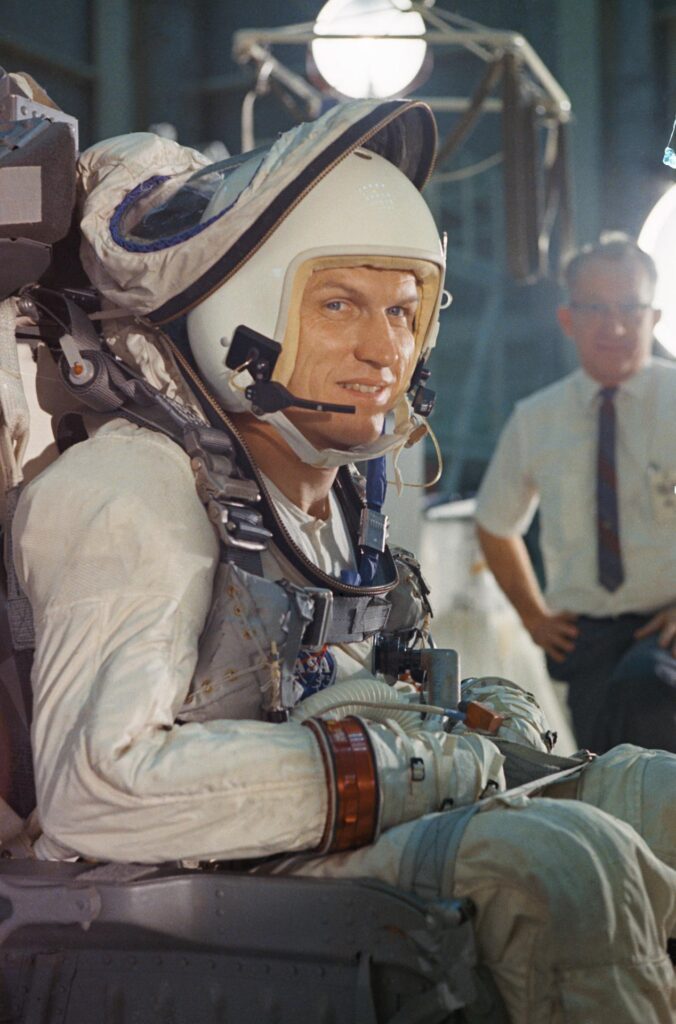
So many things can go wrong on a space mission, especially at launch and at re-entry. When NASA decided in 1968 to leap ahead of several planned Earth-orbit flights and send Apollo 8 all the way to the moon, mission commander Frank Borman’s wife, Susan, drove over to mission control to demand that Director of Flight Operations Christopher Kraft level with her. What was the likelihood that she would ever see her husband again? “Was Frank coming back this time?” she asked. Don’t hold back. Kraft’s response: his survival chances were no more than 50-50. That actually calmed Susan Borman a little because finally someone was willing to tell her the truth. Still, she was so worried that she actually wrote Frank’s eulogy at the kitchen table during the mission.
Note: Frank Borman (Gemini 7, 1965, and Apollo 8, 1968) died quietly in Billings, Montana, on November 7, 2023, at the age of 95. Susan and Frank Borman were married for 71 years.
I also remember hearing, back in Saturn V days, that the rocket alone had 5.6 million parts and the Apollo command module another 2 million. If only 1% of those parts failed (5,600 parts for the rocket alone), the mission could end in disaster. When Alan Shepard was sitting atop his Redstone rocket in Mercury 7 before becoming America’s first man in space (sub-orbital) on May 5, 1961, he said, “I looked at the instrument panel and realized that every one of these parts was supplied by the lowest bidder on a government contract.”
Gallows humor is one of humanity’s best coping mechanisms. Benjamin Franklin, August 2, 1776: “We must, indeed, all hang together, or most assuredly we shall all hang separately.” Dr. Johnson, hearing that a preacher on death row was writing the best sermons of his career, said, “Depend upon it, sir, when a man knows he is to be hanged in a fortnight, it concentrates his mind wonderfully.” The Gravedigger in Hamlet: “Who builds stronger than a mason, a shipwright, or a carpenter?” Answer, “a grave-maker. The houses he makes last till doomsday.”
A Space Geek All My Life
As a space geek all of my life, I fretted in several directions Friday night as I sat on the edge of my chair in my home in Bismarck. My concerns:
– Would they get the exceedingly unforgiving re-entry angle wrong and skip off into space like a frisbee, forever? Experts say it’s like threading a needle from miles away while hurtling at 25,000 mph.
– Would the heat shield crack and disintegrate? NASA has had trouble with heat shields from the beginning. John Glenn’s orbital flight in 1962 was shortened when a warning light indicated that the heat shield on his Mercury capsule may have come loose. False alarm. It was damaged heat shield panels that caused the Space Shuttle Columbia to break up over Texas on February 1, 2003, killing all seven astronauts. NASA engineers feared the Apollo 13 heat shield might have been damaged. It was fine. The problem is that it is impossible to see (and assess) the heat shield at re-entry from either the crew capsule or Earth.
– Would the parachutes fail to open, and the astronauts hit the water at 300-plus miles per hour? It is quite possible that the seven Space Shuttle Challenger astronauts survived the rocket explosion 73 seconds after liftoff on January 28, 1986, but died a short time later when their crew cabin slammed into the Atlantic at 200-plus miles per hour. Cosmonaut Vladimir Komarov died instantly when his Soyuz 1 spacecraft crashed near today’s Kazakhstan border on April 24, 1967, after his parachutes failed to deploy properly.
– Would the capsule sink like Gus Grissom’s Liberty Bell 7, July 21, 1961, after his splashdown in the Atlantic? To this day, nobody is quite sure whether the hatch of his Mercury capsule blew off prematurely all by itself or whether Gus Grissom, in the words of Tom Wolfe, “screwed the pooch,” i.e., panicked and blew the hatch prematurely. The capsule flooded and sank. Grissom was lucky not to have drowned when ocean water spilled into his heavy flight suit, and the recovery team seemed more interested in saving the capsule than securing the astronaut. The capsule sank to the bottom of the Atlantic, 16,000 feet down. Thirty-eight years later, in 1999, a team funded by the Discovery Channel located the sunken capsule and winched it up. It’s now on permanent display at the Kansas Cosmosphere and Space Center in Hutchinson, Kansas.
– Would the hull have cracked from the re-entry pressures, and the astronauts have died from asphyxiation? This happened to three Russian Soyuz 11 cosmonauts on June 30, 1971, when a pressurization equalization valve opened prematurely. During the splashdown of the Apollo-Soyuz international goodwill flight on July 24, 1975, toxic fumes (nitrogen tetroxide and hydrazine) were accidentally sucked into the Apollo cabin. The crew was overcome. They had to be hospitalized in Hawaii for two weeks with chemically induced pneumonia before they recovered enough to go home.
What can go wrong, indeed?
At least 21 men and women have died on U.S. and Russian space missions since 1960. Most of them were Americans. It would not have been particularly surprising if three or four times that number had been killed on the approximately 320 crewed U.S. and Russian space missions so far. During the 10 days of the Artemis II mission, I pondered again and again what the effect would be if the crew members died on the journey. That it would be another blow to American prestige is certain. Whether it would have shut down our space exploration agenda is unclear. One of the most persistent space mantras — that robots can do anything humans can do in space at a fraction of the cost, and do it better and without risk of death — would have been revived.
The Artemis II astronauts did not land on the moon. That will be the work of Artemis III, a couple of years from now, if all goes well. The Artemis II crew did not even make one complete orbit of the moon. They emulated the Apollo 8 and Apollo 13 missions in using the moon’s mass and gravity to “slingshot” the capsule back to Earth. I remember the first time I learned about the “slingshot effect.” I was a freshman in high school, reading Arthur C. Clarke’s 2001: A Space Odyssey, where the crew uses the massive gravity of Jupiter to slingshot and accelerate the spacecraft (Discovery One) toward the end of the solar system and beyond. The more you think about gravity, the more interesting and stupefying it gets.
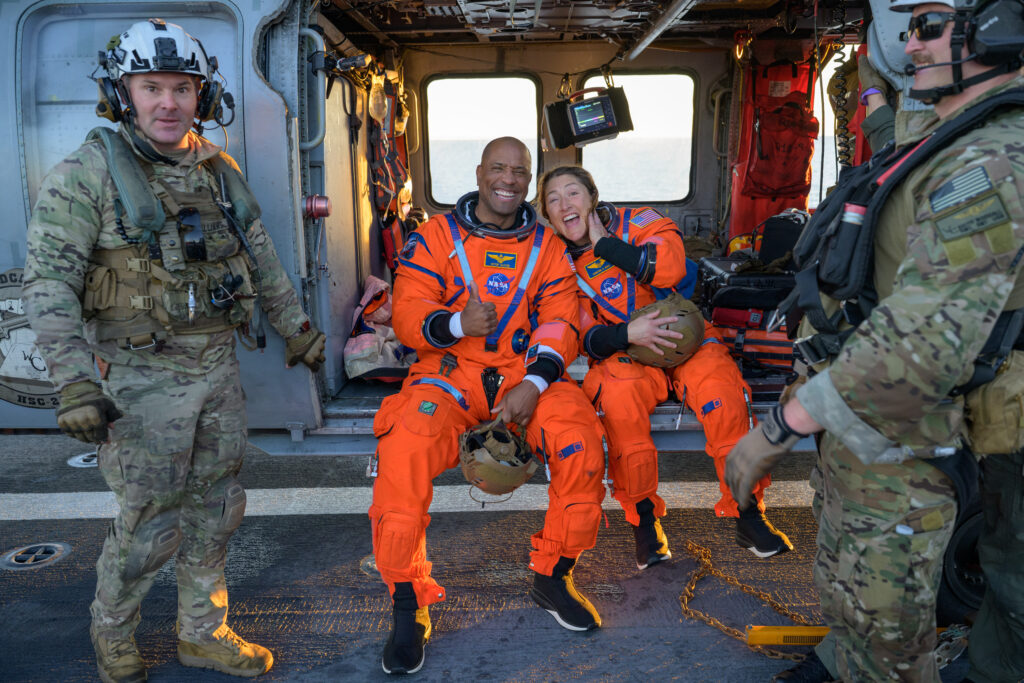
Except for the Space Shuttle missions, in which the aircraft landed on an elongated runway either in California or Florida like a boxcar with stub wings, all American astronauts in NASA capsules have splashed down into the ocean. Scores of U.S. astronauts returning in Soyuz capsules from the International Space Station have landed on land in Kazakhstan in the last three decades. During the Mercury-Gemini-Apollo era, the emphasis was on the spacecraft and their crews, not on the U.S. Navy recovery efforts. But on Friday night, I was amazed at how dangerous and complicated the recovery was: four helicopters dangerously winching the crew up to safety one by one, capsule collars, Navy frogmen battling the wake turbulence from helicopter rotors, floating porch rafts, chemical detection monitors, health care professionals, camera crews, and the USS John P. Murtha only 2,000 yards away.
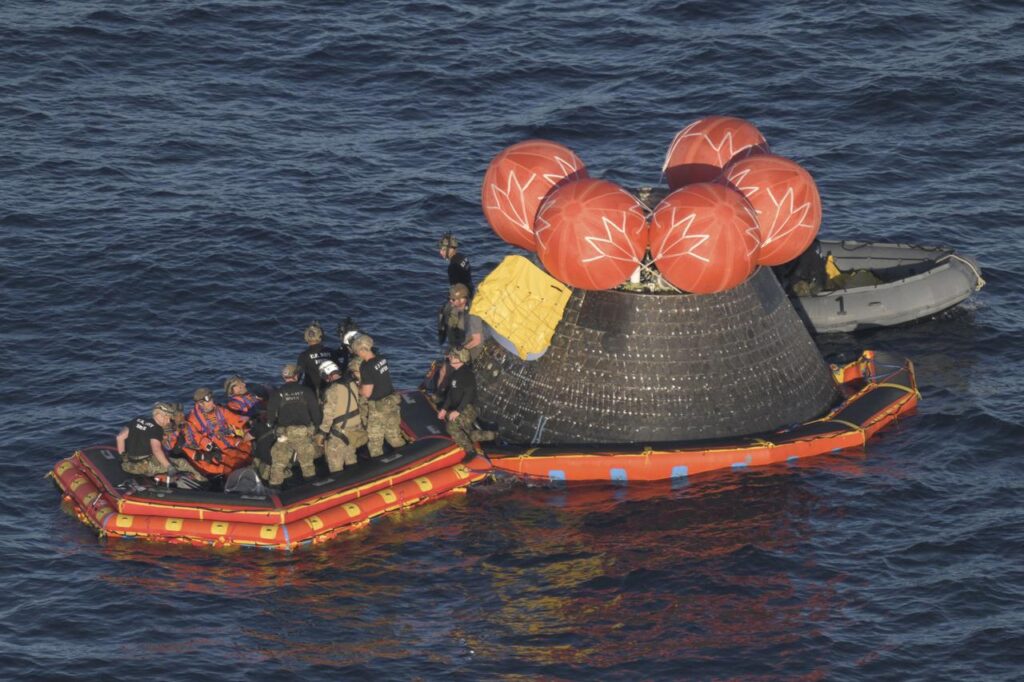
Once the capsule splashed down, the Navy recovery crew had to perform some difficult tasks in choppy water. First, approach the capsule with sniffing equipment to ensure there are no toxic gases that might endanger both the rescue team and the astronauts. Second, conduct a very rudimentary health check on the three men and one woman inside. Third, open the hatch so that the crew could get some fresh air and feel less trapped inside the capsule. Recovery teams from Apollo 10 and Apollo 11 were overwhelmed by the stench they encountered after opening the hatch. They called the aroma “recoil-inducing.” Think of four individuals locked in a panel van for 10 days with exceedingly rudimentary toilet facilities and nowhere to put the human waste. Fourth, attach the flotation collars and egress porch. Fifth, carefully extricate the astronauts. Sixth, more preliminary health checks. Seventh, winch them one by one to helicopters overhead. Eighth, deposit the astronauts safely on the undulating deck of the USS Murtha.
The U.S. Navy deserves enormous praise for its flawless labors off the coast of San Diego.
The four astronauts crawled out of the bobbing capsule with a little help from their friends. They were wobbly from the muscle atrophy of weightlessness, from 10 days of wild assaults on their inner ears (sudden up, zero gravity, and then suddenly 4 gs or more during the descent), and probably from some degree of seasickness.
I was so enthralled by all of this that I watched the Houston news conference that began shortly after the astronauts were safely ensconced in medical bays on the USS Murtha. NASA Associate Administrator Amit Kshatriya spoke first. He made the American people aware of how many tens of thousands of dedicated individuals (and hundreds of corporations, teams, and nonprofit organizations) it takes to send men and women to the moon. Kshatriya made it clear that it would be a terrible mistake to land humans on the moon again, to prove we can do it and do it first, and then walk away the way we did after the Apollo program. This time we are going to the moon and staying, he said.
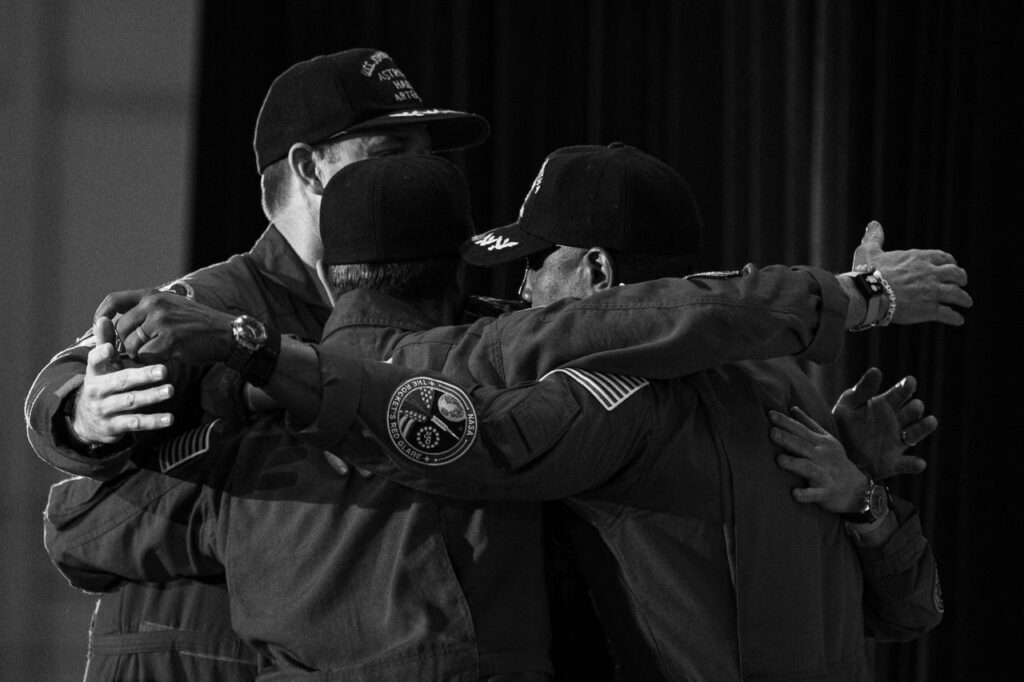
Then Lori Glaze spoke. She is the acting associate administrator for the Exploration Systems Development Mission Directorate (ESDMD) at NASA. Her speech was shorter and less “heroic” than Administrator Kshatriya’s, but it was still fabulous. She paid proper respect to the “standing on the shoulders of giants” trope (Shepard, Glenn, Armstrong, Aldrin, etc.), but then she explained that that was then and this is now, more than 50 years later, and that we should not see the Artemis missions (and what follows) as a continuation of the First Space Age. This is a brand new, breathtaking era of exploration. She said, “This is OUR Moonshot!” That couldn’t have been more perfect. Translation: you Boomers have reason to feel pride in what you did back then (JFK, “not because it’s easy but because it’s hard,” Walter Cronkite at the Cape, Armstrong’s “one small step …”), and we all honor your pioneering work. But people born after 1972 didn’t experience those great moments of American history in person. Until now, we have had to live that experience vicariously. But now we get our own space age. You had yours; it’s OUR Moonshot now.
Time for the gerontocracy to shuffle off to Buffalo, “exit stage left.” That’s what John Kennedy said to a different gerontocracy in his famous Inaugural Address on January 20, 1961:
Let the word go forth from this time and place, to friend and foe alike, that the torch has been passed to a new generation of Americans — born in this century, tempered by war, disciplined by a hard and bitter peace, proud of our ancient heritage.
Onward and upward: to infinity and beyond.