
On a trip to Rome Clay contemplates art’s many forms and why the Mona Lisa is considered the most famous painting in the world. There are so many instantly recognizable paintings yet none of them is as widely recognized or parodied as the Mona Lisa.
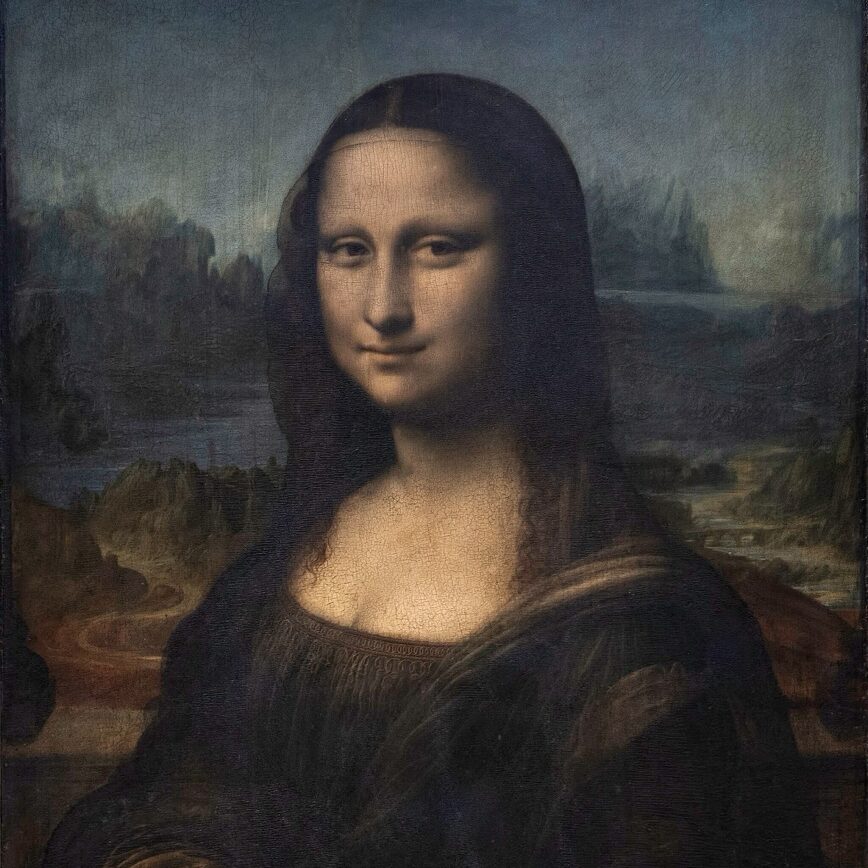
The most famous painting in the world is the Mona Lisa, probably a portrait of Lisa Gherardini, the wife of a Florentine silk merchant by the name of Francesco del Giocondo. Leonardo da Vinci’s Mona Lisa is one of 12,000 paintings in the Louvre in Paris, approximately 3,500 of which are on display at any given time. It’s displayed in a special room with the tightest possible security, with stern-looking guards on either side of the red museum rope that keeps tourists well away from the painting.
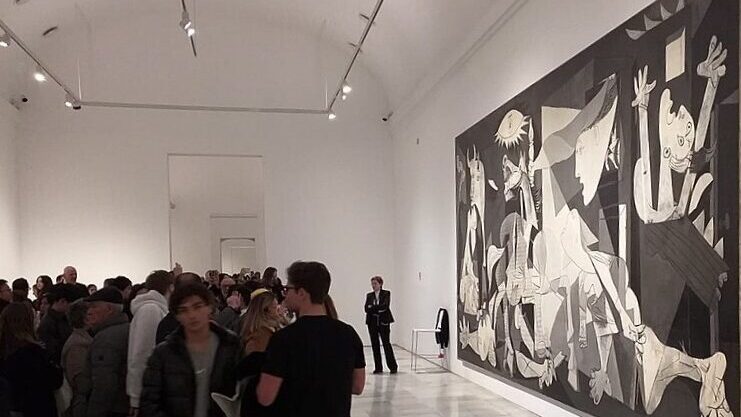
From earliest childhood we are informed that the Mona Lisa is THE MONA LISA. Everyone who cares about art, and many who don’t, make the pilgrimage to see the famous portrait if they visit Paris. That’s 7–10 million viewings of that painting alone per year, 80% of everyone who visits the Louvre. Mona Lisa is the most visited painting in the world, by far, followed by (in no particular order) The Last Supper (Leonardo da Vinci), Starry Night (Van Gogh), Guernica (Picasso), Girl With a Pearl Earring (Vermeer), and Edvard Munch’s The Scream.
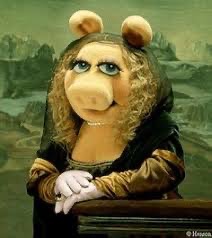
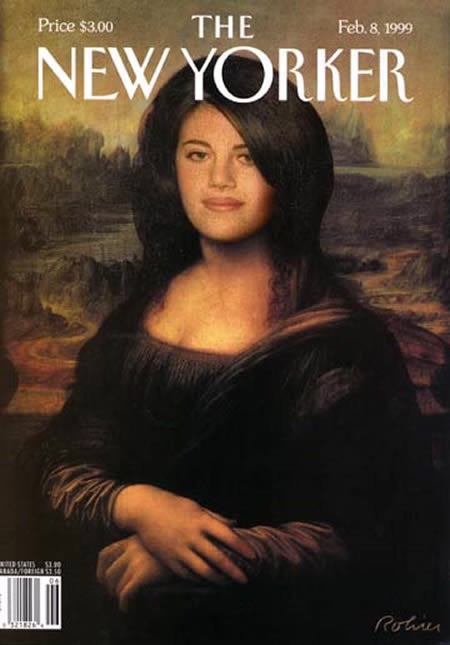
The Mona Lisa is also the most parodied artwork in the world. She has been metamorphosed into Miss Piggy, Lisa Simpson, Superwoman, Groucho Marx, Shrek, Snow White, and Princess Leia, among many others, and she has made her appearance in a COVID mask, an Islamic burqa, and blowing a Bazooka bubble. The painting is instantly recognizable in magazine ads, on kiosks at bus stops, in murals, and at the top of Times Square.
So the question is, why have we “privileged” the Mona Lisa above all other paintings? Is it because it is the finest painting in the world? Or the finest painting of a woman? Is it the famous enigmatic smile, which causes everyone who sees it to wonder what da Vinci is trying to express through her? Or is it world famous because it is … well, world famous? In other words, is there an objective reason for prizing it at the very top of the art hierarchy, or has it become a universal cultural icon in which excellence becomes fame and fame, celebrity and celebrity, cultural phenomenon?
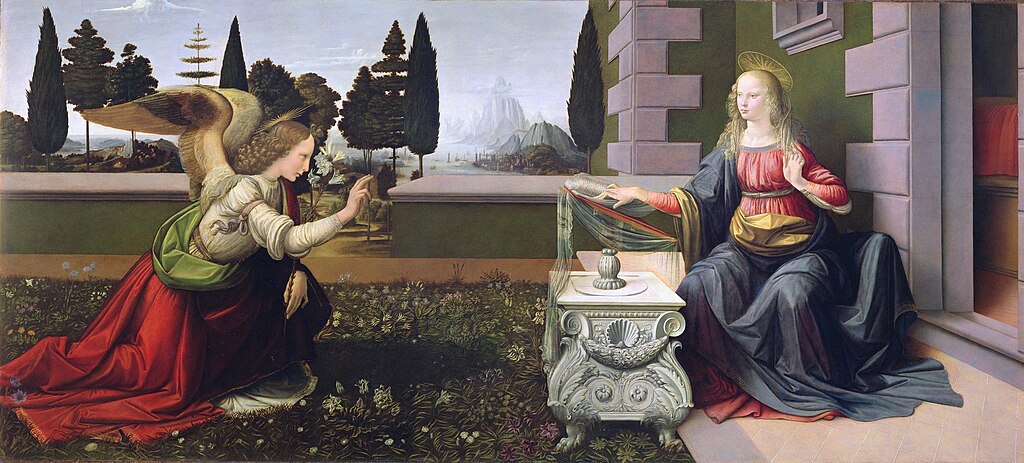
Here’s my confession. I admire the painting, of course, but it is not my favorite work of art by the incomparable da Vinci. That prize (for me) goes to his Annunciation at the Uffizi Gallery in Florence. I just viewed it again a day or two ago and felt weak-kneed in the presence of its staggering beauty and delicacy. If I did not know that the Mona Lisa is THE MONA LISA, and I were wandering through the Louvre gazing at paintings that caught my eye, I would probably walk by Mona Lisa without stopping for more than a few seconds. “Lovely painting, next?” I doubt that I would do a double-take and exclaim, “There is the most beautiful painting in the world.”
I have been very fortunate — I must never take it for granted — in that I have seen all of the top six listed above, including The Last Supper in the original refectory in Milan, which is a difficult ticket to obtain. Of those six, if I had to craft a personal hierarchy, I would put Guernica at the top merely for its awesome power (partly because of its enormous size: 11 by 25 feet).
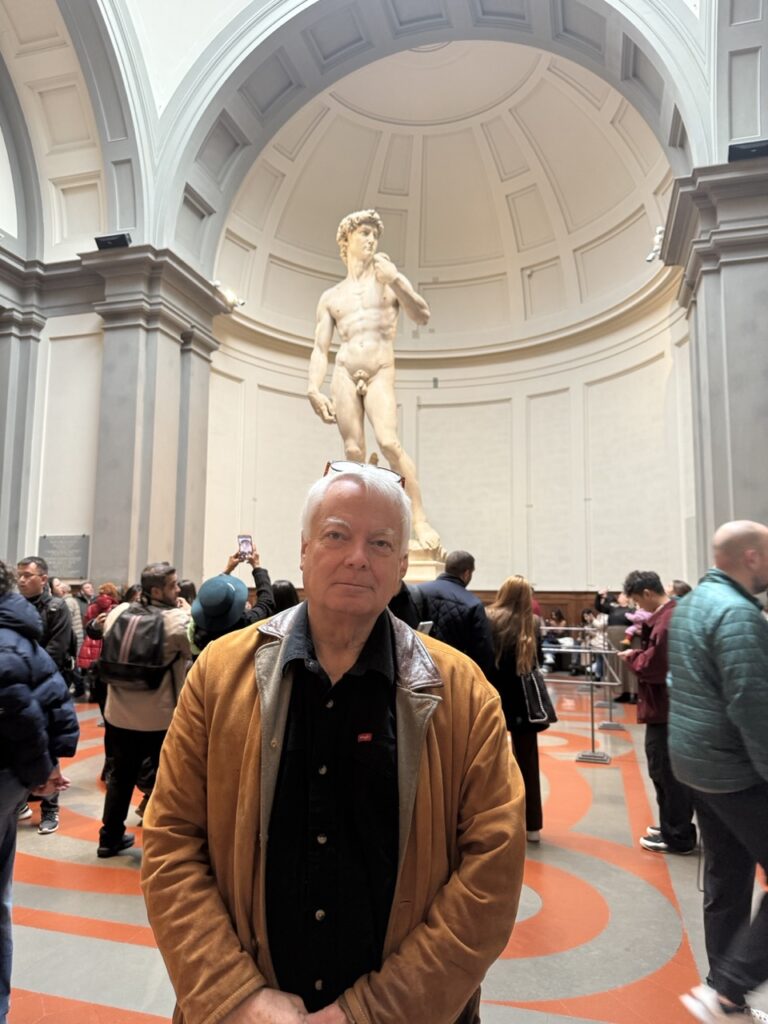
Yesterday I spent a couple of hours with Michelangelo’s David in the Galleria dell’Accademia in Florence. It is, I think, my favorite work of art in the world. I have seen it six or seven times now. It never ceases to stun me into a kind of numbness. This time the crowd size (early December) was not oppressive, as it can be with such works of art. Just try the Sistine Chapel in July if you want to know what jostling militant tourism can be. I was able to give it a full hour. The niche it is in is in itself beautiful, with a domed skylight that bathes the David in a perfect soft light. There are marble benches all around the back and sides of the 14-foot-tall statue (17 feet if you include the pedestal), and I found a chair 15 feet away directly in front of it. The sheer size is monumental, invigorating, and daunting.
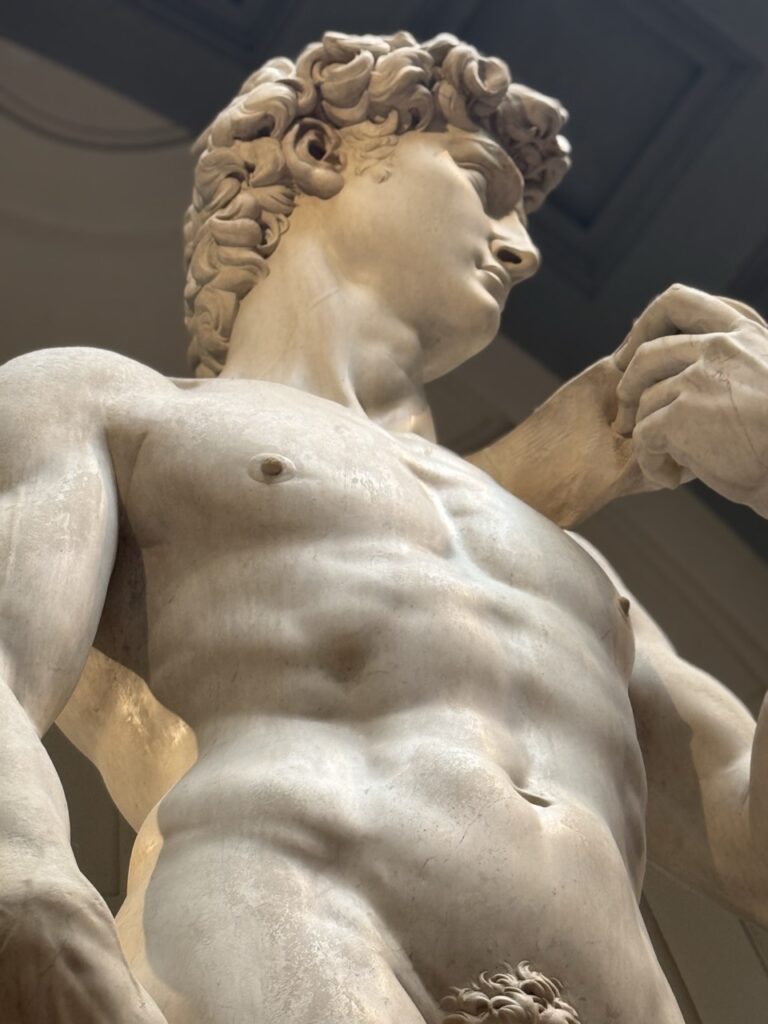
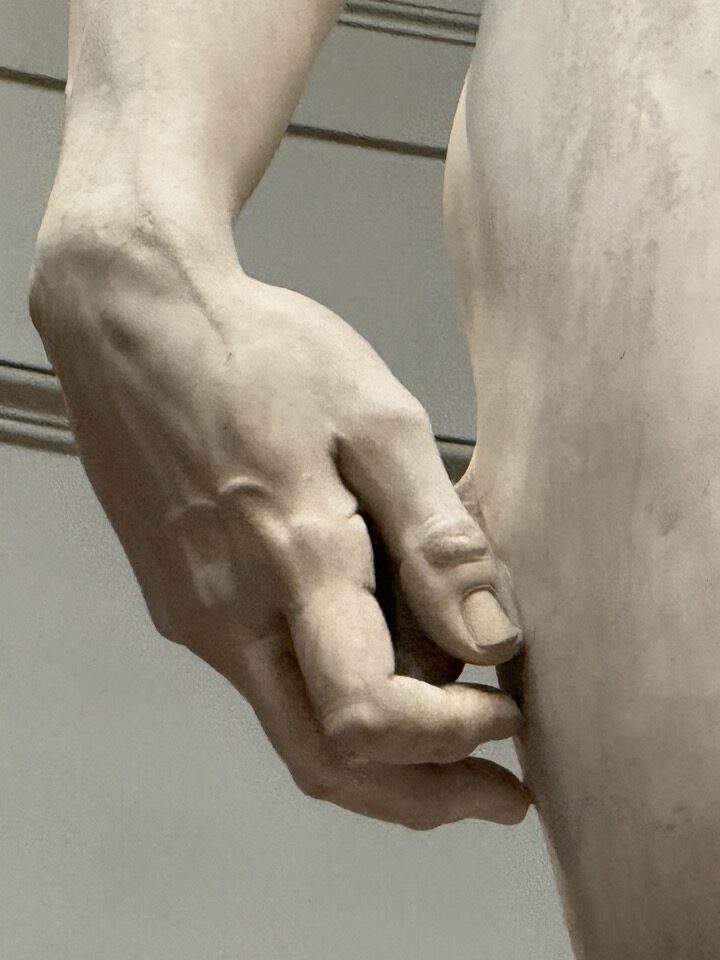
Perhaps I speak only for myself, but I know that if I had never heard of it (a cultural impossibility for almost anyone), and didn’t know the name of the sculptor, I would never walk by it without exclaiming, probably out loud, “This is one of the most beautiful things I have ever seen.” Anatomists who have studied it millimeter by millimeter have said that it is essentially perfect in all of its magnificent detail, the head may be a smidgeon too large, and several veins and tendons in his right hand are perhaps not quite flawless. But hey … who’s quibbling?
As I sat there, 4,930 miles from home, I tried to be fully present (there! gazing at this work of art! drinking in all of its detail from his curly head of hair down to his exquisite ankles and toes). I took a hundred or more photographs of it from every angle, zooming in on every detail that interested me. I could have spent the whole day there. In my view, you don’t need to “privilege” the David to know that it belongs at the top of the list, a list that includes the Sphinx at Cairo, Bernini’s Apollo and Daphne, Michelangelo’s Pieta at St. Peter’s in Rome, Rodin’s The Thinker, the Moai statues at Easter Island, the Venus de Milo at the Louvre, among others.
It is true that Michelangelo was depicting a famous scene from the Bible, David and Goliath — 1 Samuel 17. He was creating a statue of Florence’s signature hero to serve as a public icon. One of the most amazing facts about the sculpture is that Michelangelo, who was just 26 years old when he undertook the project, is that he had to work with a block of marble that had been damaged by a previous sculptor, and (in the eyes of others) impossible to sculpt. As I sat there enraptured by this creation by a mere human being (using a hammer and chisel beating on a rock), I realized that the Bible story was probably not Michelangelo’s primary interest in the work. It seems to me that he was attempting to show the body of a generic human male at the height of his strength and virility, not unlike da Vinci’s Vitruvian Man, with a pro forma glance at the biblical account. In other words, I believe Michelangelo was attempting to depict Universal Man by way of the artistic commission to sculpt David for the city.
As I attempted to drink it all in, essentially trying to inscribe into my brain and memory its wholeness and its dozens of important details (my favorite part is his right hand in repose on his right thigh), I was thinking, with sorrow, “What if this is the last time I will ever see the David? I had better view it as if it were for the last time. In fact, I think it would be a good idea to use that modus operandi for every great work of art or literature, or for that matter when we gaze at the Grand Canyon or Chaco Canyon or the northern California redwoods.
I will almost certainly be in Florence again. In two short days in Florence I was only able to see half a dozen cultural museums or churches, and I left more on the table than I was able to see. At some point, also, you get to tilt and one Adoration of the Magi looks pretty much like most of the others.
I know it is a cliché, but it is really true. As you sit there gazing at it in wonder, you almost expect David to walk off the pedestal and out into the courtyard of the Palazzo Vecchio.