
While he avoided the public spotlight, John Steinbeck spent a life “in the arena” exhibiting great moral courage both in his writing and deeds.

John Steinbeck warned us again and again that we should not be interested in his life — a purely private matter — but only in his books. He avoided publicity, generally refused to be photographed for professional purposes, and was reluctant to hold a press meeting even after he won the Nobel Prize for Literature in 1962. Steinbeck said the writer is a guy alone in a room with pencils and paper, wrestling with some impossible question or problem that he was trying to sort out. When he was not writing, Steinbeck said the writer is exhausted and not very eager for social interaction. He said most writers are SOBs. In this, he rightly included himself.
It is true that a man who wrote thirty books, some of them long and ambitious, spent much of his life in social isolation. Steinbeck always insisted upon having a designated writing room where he could shut the door and do his work away from the traffic lanes of his family home. At Sag Harbor, he had built an octagonal writing studio, an enclosed gazebo away from the house. It was so primitive that he had to run a very long extension cord when he wanted light out there.
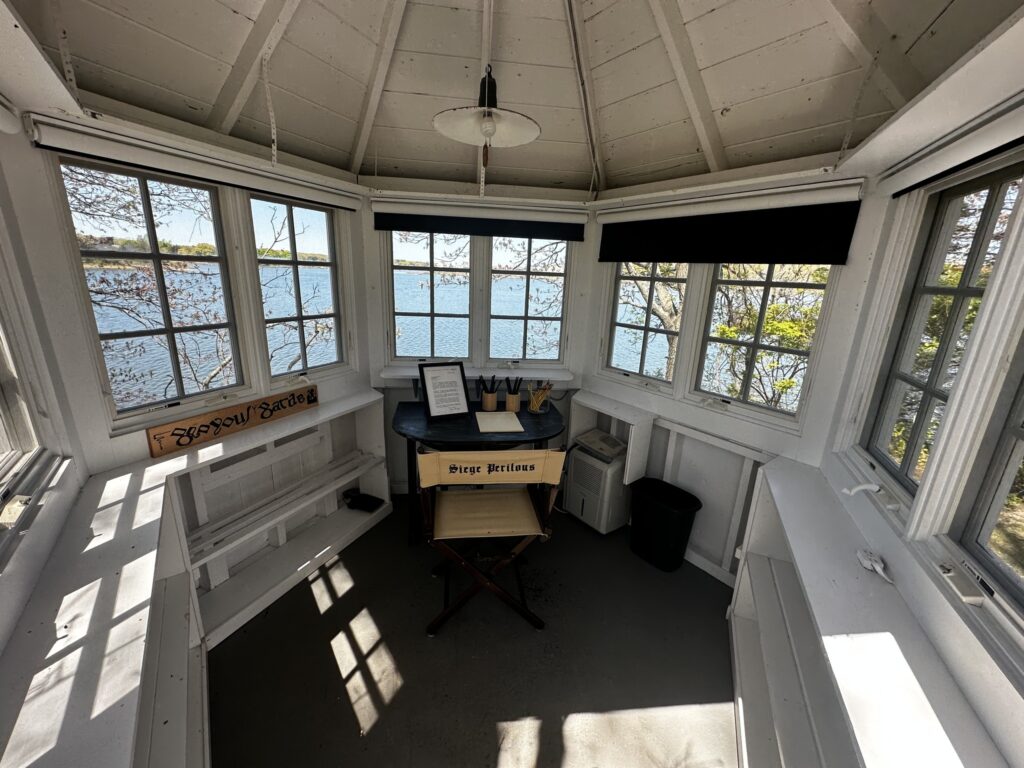
Steinbeck’s life was more interesting than he wanted us to believe. In reviewing his biography before the weeklong cultural retreat I hosted in Salinas and Monterey, California, I noticed how many times in his life Steinbeck showed remarkable moral courage outside of his books. Let me provide just a few examples.
1. He got himself into World War II, not as a combatant as he had hoped, but as a foreign correspondent for the New York Herald Tribune. He reported the war from England, North Africa, and Italy. He saw men die. A bomb exploded so close to him that his eardrums were ruptured. When he came home late in 1943, he was almost certainly suffering from PTSD. My friend Russ Eagle, who is writing a study of Steinbeck’s novella Cannery Row, believes that Steinbeck never fully recovered from what he observed and experienced in the war. Steinbeck could have avoided the war altogether. Or he could have, like so many other journalists, observed the war from positions safely behind the front. Instead, he thrust himself directly into the action.
2. When he was an on-again, off-again student at Stanford University, he was visiting his friend Robert Bennett in the Bay Area at Christmastime 1920. They attended services with Bennett’s mother at a San Francisco Methodist Church. Bennett tells the story: “The preacher, a garrulous man, went on and on about the ‘spiritual hunger’ that was felt throughout the land. Steinbeck muttered under his breath that this was a ‘lot of crap.’ Unable to contain himself at last, he rose to his feet and shouted: ‘Yes, you all look satisfied here, while outside the world begs for a crust of bread or a chance to earn it! Feed the body and the soul will take care of itself.’” I’m certain Bennett’s mother was mortified. Still, Steinbeck, even at this early age, was sufficiently derisive of hypocrisy and committed to social justice that he was willing to disrupt a solemn holiday social gathering to make his point. He was eighteen years old at the time.
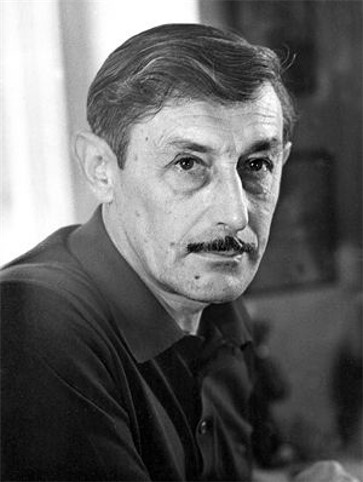
3. During his three visits to the Soviet Union — 1937, 1947, and 1963 — Steinbeck was not afraid to speak truth to power. Steinbeck always requested to meet with dissident writers. He was generally informed that they were ill, on assignment, or otherwise unavailable. When Steinbeck and his third wife, Elaine, were in Ukraine (then part of the U.S.S.R.) in 1963, he requested several times to meet anti-Stalinist writer Viktor Nekrasov. He was always rebuffed with the usual excuses. At the end of their visit, the Steinbecks were guests at a meeting of the Writers’ Union, attended by more than 250 people. The evening was well along when the massive door suddenly opened. This is Elaine’s account of what happened: “Everybody stopped talking and looked. He was absolutely one of the most beautiful looking men I ever saw, very dark with a big scar across his face. … The man strode across the room, stopped in front of John. He slapped his hand down on the table and said, ‘Nekrasov!’ And John smacked his hand on top of his and said, ‘Steinbeck!’ And the man said, ‘I have heard you were asking for me. I’ve come out of hiding to see you.’ There was a deathly hush in the room, and John said, ‘Pull up a chair, my friend.’ John carried on the press conference as if nothing had happened, and when it was over, Nekrasov went with us back to the hotel, and he and John talked all night.”
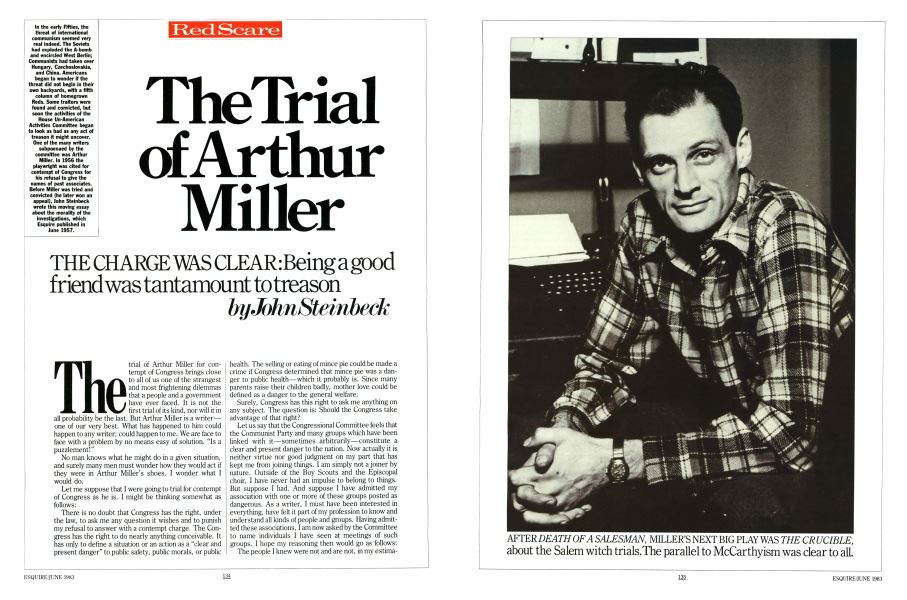
4. During the McCarthy years, when a wide range of writers, actors, directors, and government functionaries were accused of treason, and many lives were ruined, Steinbeck spoke out for his friend, the playwright Arthur Miller, who was held in contempt of Congress for refusing to name names when called before the House Un-American Activities Committee. Steinbeck wrote a public letter published in Esquire magazine. This was a gutsy and even risky thing to do under the circumstances. He determined to craft the letter as if he himself were accused of treason. “If I were in Arthur Miller’s shoes,” he wrote, “I do not know what I would do, but I could wish, for myself and for my children, that I would be brave enough to fortify and defend my private morality as he has. I feel profoundly that our country is better served by individual courage and moral.” In a letter to his friend and publisher Pat Covici, dated May 16, 1957, Steinbeck wrote, “When Artie [Miller] told me that not one writer had come to his defense, it gave me a lonely sorrow and a shame that I waited so long and it seemed to me also that if we had fought back from the beginning instead of running away, perhaps these things would not be happening now.”
5. In 1943, he wrote the screenplay for Alfred Hitchcock’s film Lifeboat. But when Hitchcock altered the script to portray the African American man in a racist stereotype, Steinbeck abruptly withdrew from the project. “While it is certainly true that I wrote a script for Lifeboat, it is not true that in that script as in the film there were any slurs against organized labor nor was there a stock comedy Negro. Instead there was a Negro of dignity, purpose, and personality.” Steinbeck insisted that his name be taken off the finished film. It wasn’t, but he had made it clear that he would not willingly lend his name to a project that violated his innate sense of justice and fairness.
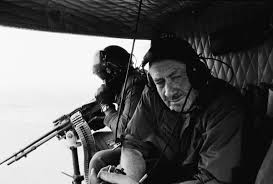
6. In 1966 and early 1967, Steinbeck visited Vietnam to see for himself how the war was going. Both of Steinbeck’s sons had been drafted and served their tours in Vietnam. Steinbeck was naturally concerned about their well-being. His friend LBJ wanted him to make the journey as an informal adviser to the president, but Steinbeck insisted that he must go independently to have any credibility and to be able to make an honest assessment of the war. He was sponsored as before by the New York Herald Tribune. Even though he was 64 years old and in poor health, he didn’t hold back. He flew sorties in helicopters, went on combat patrol, handled a military weapon despite military protocols, and made sure that he saw real war action. When he returned to the United States in the spring of 1967, he reported not to LBJ but to LBJ aide Jack Valenti, to whom he made it clear that the war was unwinnable. “There is no way to make the Vietnamese war decent,” he wrote. “There is no way of justifying sending troops to another man’s country. . . The government we are supporting with our men and treasure is about as smelly as you can get.” Some people (then and now) argued that Steinbeck should have gone public (like Walter Cronkite in 1968) with his convictions, and that in not doing so, he was putting his friendship with Lyndon Johnson above his public duty to the American people. I don’t see it that way. I credit a man, no longer in good health and living on borrowed time, for getting himself to Vietnam to witness the most important national event of the 1960s with his own discerning eyes. Had he broken publicly with the president, it is not clear that his public pronouncements would have made any difference.
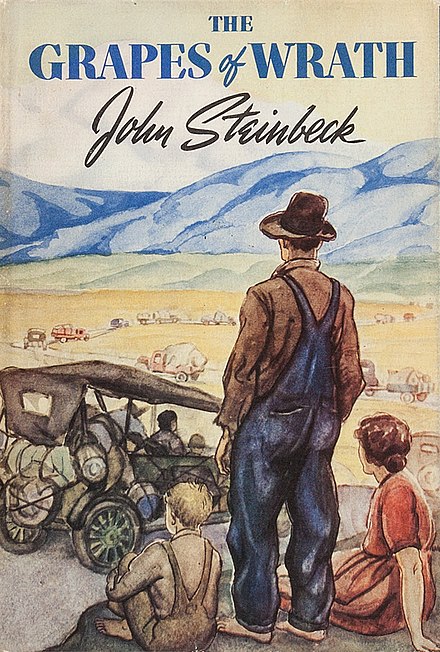
These are examples of the moral courage Steinbeck exhibited steadily through life, but of course, we find it everywhere in his books, particularly his masterpiece, The Grapes of Wrath. To publish a defense of the “Okies” in the face of widespread opposition among the California agriproducers, Chambers of Commerce, vigilance committees, bankers, and besieged citizens was a heroic act in 1939. There is a reason his friends advised Steinbeck against traveling alone, making public appearances, and staying below the radar until the furor died down. There is a reason that The Grapes of Wrath was publicly burned in Salinas and banned from the public schools in Kern County (home of Weedpatch) until 1978. Steinbeck wrote, “It takes great courage to back truth unacceptable to our times. There’s a punishment for it, and it’s usually crucifixion.”
Most writers work hard to stay out of the fray. Most exhibit their “courage” in the safety of the printed page, but not in the arena. Steinbeck wrote millions of words, but he was not content to blend in on the margins of the world around him: two world wars, the Cold War, the coming of the Atomic Age, the plight of the “Okies,” Korea, the Civil Rights Movement, and Vietnam. He always wanted to see and judge things for himself. I have the deepest respect for this quality of Steinbeck’s character. He had character. I probably would have cowered under my pew had I been in that church congregation in 1920, but I would have given anything to see the doors burst open when Nekrasov strode in behind the Iron Curtain.
We live in a time when truth has yielded to “truthiness,” “alternative facts,” “whataboutism,” “fake news,” and “my truth.” Those who wish to see what happens when people cower in the face of corruption and the systematic violation of human rights might want to study the ordeal of individuals of Steinbeck’s time, like Arthur Miller in the 1950s or the crushing of J. Robert Oppenheimer by out-of-control Cold Warriors in 1954.