
I’ve loved Devils Tower since I first close encountered it four decades ago. President Theodore Roosevelt established Devils Tower as the nation’s first National Monument in September 1906. Roosevelt would establish 18 National Monuments during his two terms. Today we have 138.
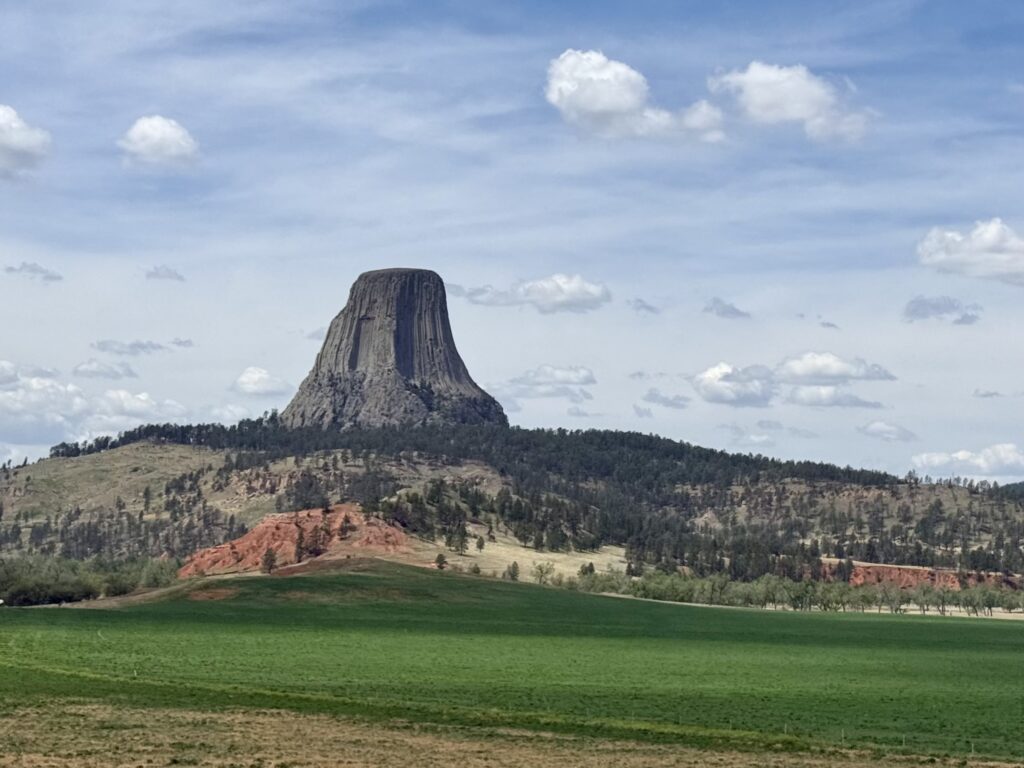
The Kiowa writer N. Scott Momaday got it exactly right. “A dark mist lay over the Black Hills, and the land was like iron. At the top of the ridge I caught sight of Devils Tower upthrust against the gray sky as if in the birth of time the core of the earth had broken through its crust and the motion of the world was begun. There are things in nature that engender an awful quiet in the heart of man; Devils Tower is one of them.”
President Theodore Roosevelt made Devils Tower his first National Monument on September 24, 1906. There would be 18 altogether during his two terms. Today we have 138. Think about that. Roosevelt named almost one in seven of our National Monuments. Not only was Devils Tower Roosevelt’s first National Monument, it was also America’s first. And what a fabulous (and uncontroversial) first selection it was. Spectacular and unique, Devils Tower had no economic value beyond tourism. The amount of land that would be needed to envelop and protect it (1,153 acres) was well within the spirit of the National Monuments and Antiquities Act, passed by Congress in June 1906. For these reasons, it would be unlikely to provoke blowback from those who wanted the government to get out of the way so that the immense public domain of America could be subjected to every possible form of unrestrained resource extraction.
The spirit of the Antiquities Act may have been to protect parcels of modest size (like a cluster of cliff dwellings), but the legislative language, from Roosevelt’s point of view, was deliciously ambiguous. The law directed that monument designations should be “confined to the smallest area compatible with proper care and management of the objects to be protected.” The word “confined” certainly suggests a minimalist approach, but the phrase “compatible with proper care and management” gives the president who signs the order enormous discretion. Theodore Roosevelt was a maximalist in his philosophy and practice of power. If Congress had decreed that a prospective National Monument must not exceed 5,000 acres of public land, the history of the 20th-century West would have been dramatically different. We can thank one of conservation’s unsung heroes, Congressman John Lacey of Iowa, for quietly building enormous elasticity into the language of the Antiquities bill.
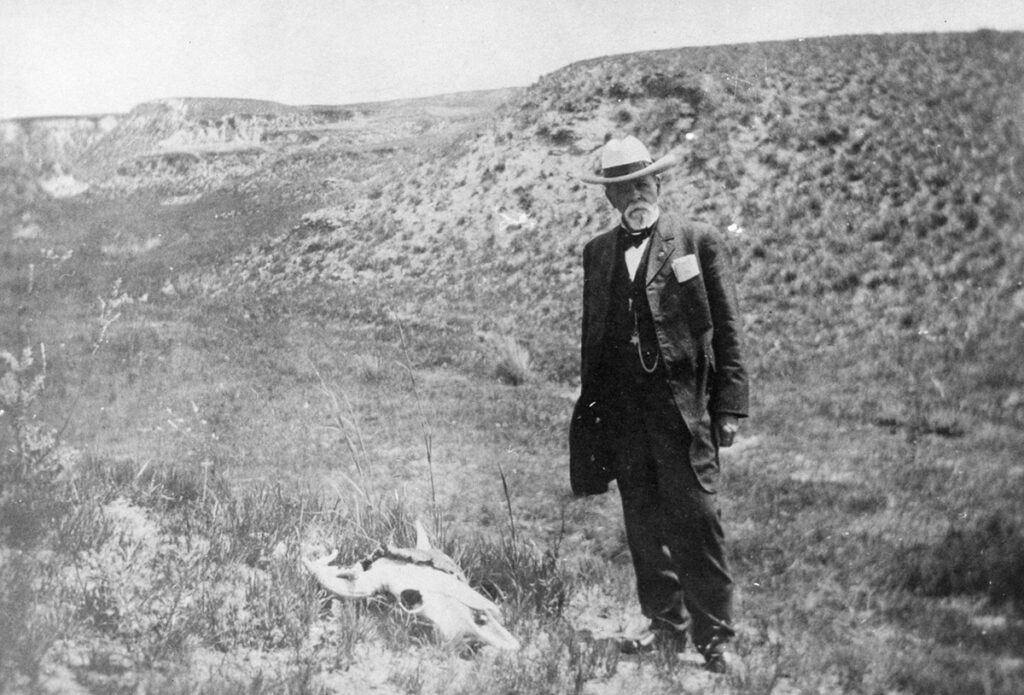
Roosevelt’s conservation confidence grew with success. On January 11, 1908, he established — with a single stroke of his pen — Grand Canyon National Monument, with a modest footprint of only 818,560 acres! Clearly, TR saw this acreage as “the smallest area compatible with proper care and management.”
Today, half a million people visit Devils Tower per year, and 4.5 million visit Grand Canyon National Park, which attained national park status in February 1919.
American Sublime
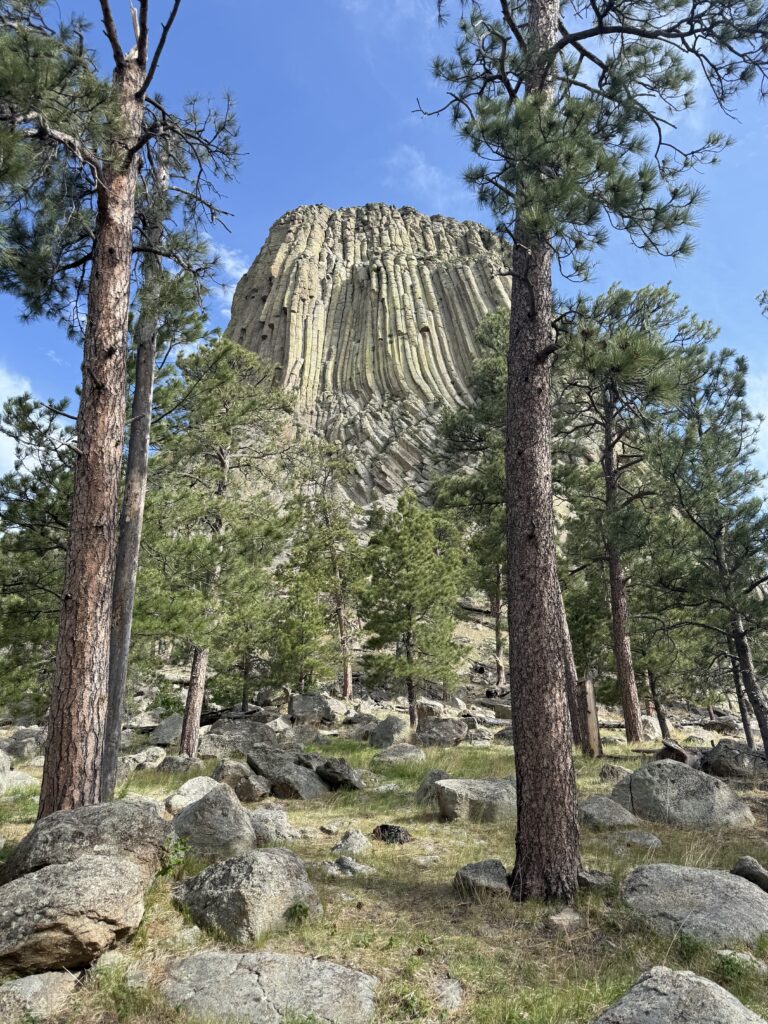
I’ve loved Devils Tower since I first close encountered it four decades ago. I’ve been back a dozen or more times. Every year now, I intend to begin my summer Airstream travels by way of a pilgrimage to Devils Tower. I spent three nights there last week, fanning out to visit other places part of the time, but always sitting out under the tower in a camp chair in the evening to let the awe have its way with me.
You have to imagine geologic time to fully experience the inrush of wonder. Approximately 50 million years ago, a gigantic volume of molten rock (like the kind that spills out of Hawaiian volcanoes) pushed up through a fracture in the earth into something like the shape we see today, then cooled in place. Back then, the formation was well beneath the surface sediment, but over time the softer surface materials have eroded away, exposing the formation as a blunt 867-foot tower that dominates the landscape in every direction. Technically, Devils Tower is a laccolith, like its neighbors, the Missouri Buttes or Bear Butte at the other end of the Black Hills.
As I gaze at the tower, I try to imagine the dynamism of deep-time Earth history. Think of the heat, the pressures, the energy, the force, the destructiveness, and the geomorphological drama that erected Devils Tower. This was not routine earth dynamics. What happened here was catastrophic in the best sense of the word!
What’s unique about Devils Tower is that it is just naked rock. It’s a treeless igneous colossal tower (or plug) of bare rock standing out in stark relief on Wyoming’s endless plains. It is cylindrical, not conical like a volcano. And it’s grooved all around, as if some gigantic creature — the Lakota say a bear — was trying to climb its face, and its ferocious claws had incised the entire surface. Nothing like it in America. Nothing like it in the world. A great first National Monument.
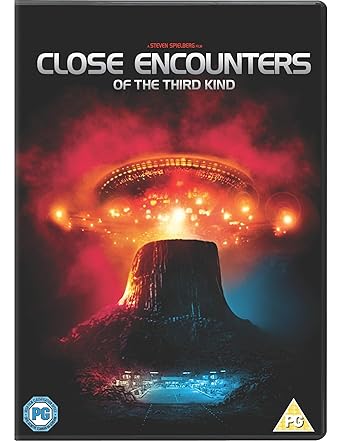
No wonder the aliens found it in Close Encounters of the Third Kind. It’s a mind-blowing geological phenomenon. There are higher formations nearby. One peak of the Missouri Buttes, just a handful of miles west of Devils Tower, is 262 feet higher. Still, nobody notices because the Missouri Buttes are more conical and more forested than the bald columnar stump of Devils Tower.
I strolled around the 1.3-mile circle trail at the base of the tower, stopping every hundred yards to gaze at it from a different angle. When I got there at 7:45 a.m., there were only a handful of cars in the huge parking lot. Devils Tower is so beloved that there are now timed entries at the height of the tourist season. Alas. When humanity gathers at such outdoor precincts, perhaps especially vacationing families, there is going to be chatter. Last year, I jotted down a few of the topics of conversation I heard during my 40-minute walk. Best episodes of Friends? How cousin Bert ruined the wedding. Young Gorgeous Elvis or Old Fat Elvis? I hope we are not going to eat at that retro café again tonight; the food sucked. Remember the time we had the flat tire at Yellowstone? Tiger Woods is finished. I’m hot; how long is this stupid hike?
On an average summer day, scant evidence of Momaday’s “quiet in the heart of man.” But this time I was virtually alone on the trail. The experience is so much deeper in silence. The breeze in the Ponderosa pines was heavenly.
The Unfinished Work of the American Outback
Only three things bothered me at Devils Tower. I’m relatively ok with people climbing it, though I’d rather they didn’t, since it is sacred to a number of Native tribes. I certainly see its appeal to the climbing community. But one result of the climbing is that average people strolling along the perimeter trail end up standing in clusters, trying to spot climbers with the naked eye and sometimes binoculars. And they invite anyone who comes along to join them in the scrum. I heard one man say, “It’s a woman climber!” and then three or four others crowded around to see for themselves. It is indisputable that such folks spend much of their time at Devils Tower watching recreationists interface with the Tower hundreds of feet up its seemingly vertical surface. These tourists give little or no time to the spectacular pines that envelop the Tower below the reach of the rockfalls. Nor to the crystalline nature of the Tower’s composition. Nor to the beauty of the Belle Fourche River (red banks, perfect sinuosity), threading its way through the plains below. Or the subtle but amazing freshness of the breeze in the pines. I like to lie on my back under a cluster of trees and let the gentle sway of the pine tops lift me into a meditative state.
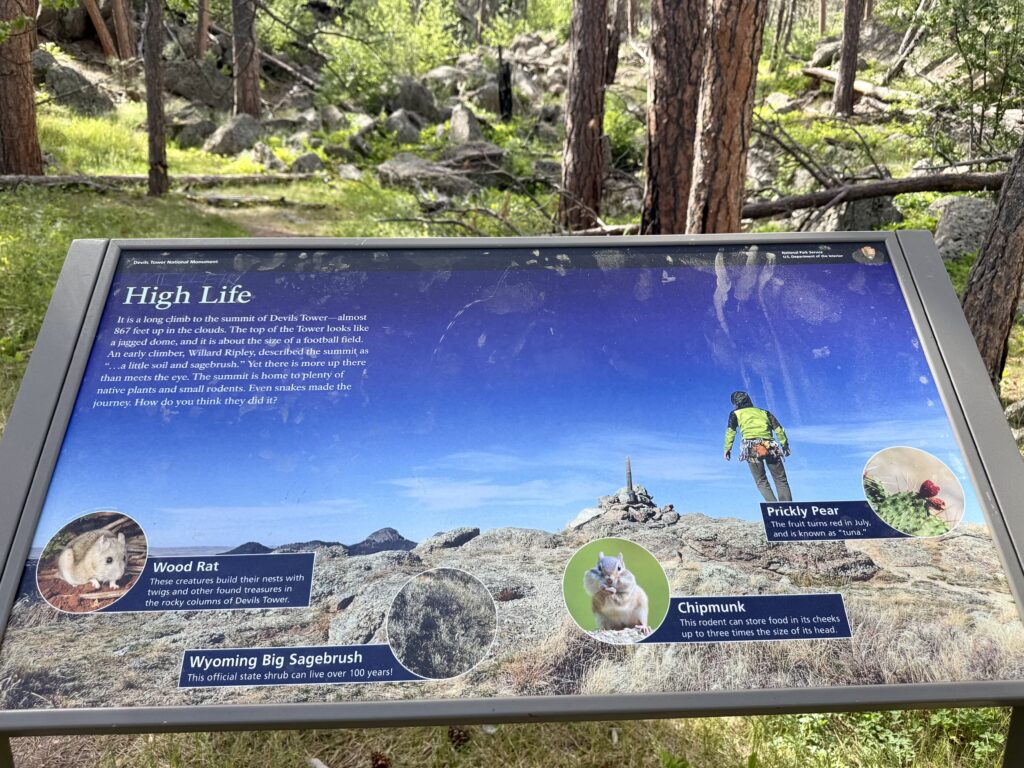
When I got back to my Airstream and the internet, I looked up some climber sites. Photographs of the summit show men and women smiling in well-deserved triumph next to a four-foot post or summit marker, which is, of course, taller than Devils Tower. This is what humans do. We replay the Tower of Babel story again and again. Our hubris is remarkable: Anything you (Nature) can do, we can do a little higher. We can never leave nature alone in its primordial dignity. Climb Everest, leave a flag.
The second thing that bothered me on that otherwise serene morning was a member of the park staff blowing pine needles off the sidewalk and parking lot with a leaf blower. We all know that the leaf blower is one of humanity’s most annoying inventions. To make matters worse, another staff member was cutting grass and weeds down to size with an industrial-strength weed whacker, the second most annoying invention of the industrial era. On an average Saturday in my subdivision in north Bismarck, North Dakota, the whole day is lost to the whine of lawn mowers, leaf blowers, and weed whackers. I wish the otherwise listless neighborhood association would require all lawns to be mowed simultaneously in a two-hour window on the same day every week. Ah, but we Americans chafe at that which cramps our freedom. Surely a broom and hand clippers would be more appropriate at Devils Tower.
The third thing that bothers me is the name. Different tribes had different names for the formation, as well as different oral traditions about its origin and its grooved surface. None of them used their words for devil, demon, or malignant spirit. The term Devils Tower was coined by Colonel Richard Irving Dodge in 1875 during his exploration of the Black Hills region. Somehow, he got it into his Anglo head that Natives called it “bad god’s tower,” which was soon shortened to Devils Tower. In fact, Native names almost all invoke the bear: Bear Lodge, Bear Rock, Home of the Bear. The Lakota term is Mato Tipila (Bear Lodge). No doubt Colonel Dodge made an honest mistake, but white men have had a habit of translating indigenous terms for “spirit,” “medicine,” “mystery,” or “touched by the divine” as Devils this or Devils that. Devils Lake, North Dakota. Devils Gate, Wyoming. Devils Postpile, California. Devils Kitchen, Calif. An Arapahoe sacred site is “Hell’s Half Acre” to those who displaced them.
Such 19th-century terms sometimes carry a whiff of racism. Back in the horrendous days of the “Indian Wars,” white newspapermen, politicians, and army officers spoke of Native Americans as “Red Devils” and frequently urged their extirpation. Victorian puritans considered Indigenous people heathens, who must be converted to Christianity before they could be accepted into the American family. This was a primary function of the notorious boarding schools.
The list of American placenames that are now regarded as insensitive, racist, sexist, or cringeworthy is long. Some of them tenaciously resist renaming, but I would be very pleased if the name of this extraordinary sacred place at the edge of the Black Hills were changed to something proposed by the tribes who have had the closest relationship with it. The current non-Native view is that Devils Tower is a freak of nature, a must-visit Scenic Wonder of America, a unique geologic phenomenon, one of the great selfie backdrops in the West. If it were renamed Bear Lodge Tower or (for that matter) Mato Tipila, I believe almost everyone who came to visit the site would approach it in a new, better, quieter, more enlightened, and more satisfying way. I believe, too, that this National Monument and many others in the system should be co-managed by the National Park Service and the tribes who have known it far longer than Euro-Americans. The newish interpretive signs along the loop trail are outstanding for their focus on Native American oral traditions, lifeways, resource engagement, and concerns.
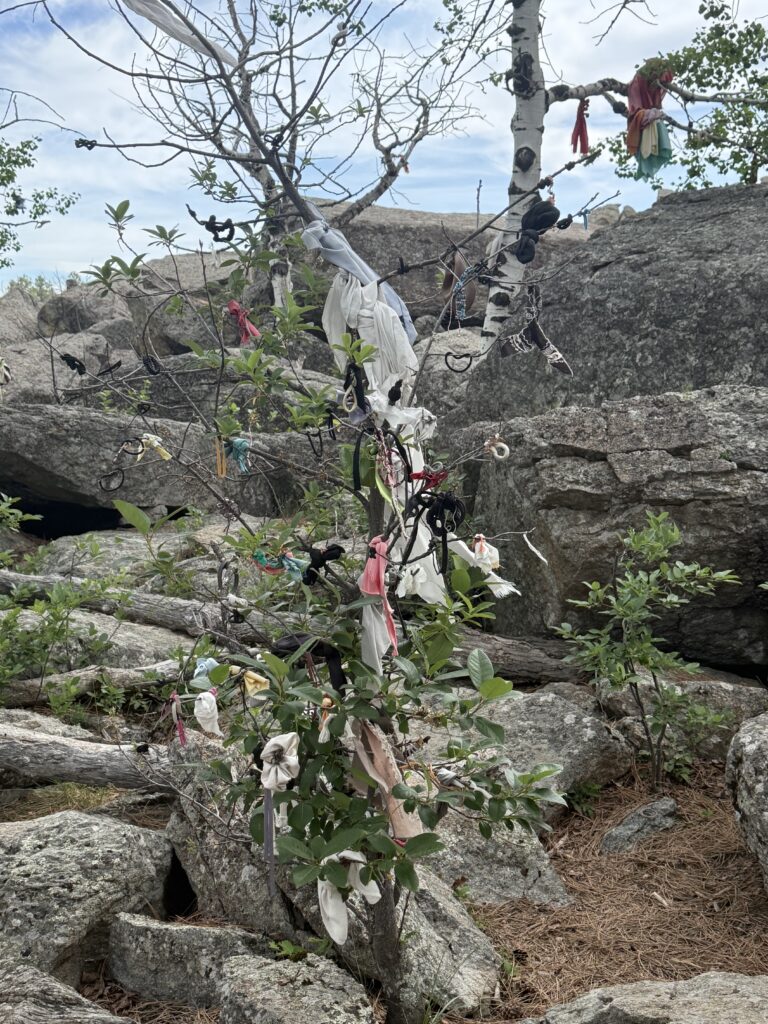
Along the loop trail, there are thousands, perhaps tens of thousands, of colorful prayer bundles left by Native people. Typically, these round bundles are made of squares of cotton cloth (sometimes handkerchiefs) in which a small quantity of tobacco has been tied. In other words, Devils Tower is an active Indigenous prayer site. So, too, are Black Elk Peak (formerly Harney Peak), the highest point in the Black Hills, and Bear Butte, where the young Oglala Lakota man Crazy Horse vowed never to yield to the white invaders of the Black Hills and the Powder River country. Because these are prayer sites, we non-Natives should treat them with heightened respect.
The Shadow of One Great Man
Thank God for Theodore Roosevelt, or thank goodness, or thank the stars. What would America’s public lands be without him? During his presidency, TR set aside 230 million acres of the public domain for permanent federal protection. He had some serious faults (like the rest of us), but his achievements as a conservationist are truly astounding. He was not only a very serious amateur naturalist and conservationist, but one who got his hands on the levers of power at exactly the right moment in American history, and of all the many ways he could have used his power and charisma, he chose to make a long series of presidential actions on behalf of conservation almost his signature achievement. And that includes the Panama Canal, the Great White Fleet, and the antitrust suits. Take Roosevelt out of the picture between 1898 and 1919, but particularly between September 1901 and March 1909, and what would the public landscape of the United States look like? The best you can say is that we would have saved some fraction, probably a modest fraction, of what he achieved. Ralph Waldo Emerson said, “An institution is the lengthened shadow of one man.” I think it can be said that the panoply of National Parks, Monuments, Wildlife Refuges, Forests, and Game Preserves of the American West we so cherish — the envy of the world — is largely the work of Theodore Roosevelt. And what he did not achieve himself in his seven years, 171 days as president, he inspired in those who followed, including his fifth cousin, Franklin Roosevelt, who also achieved an impressive record in conservation, though somewhat differently defined.
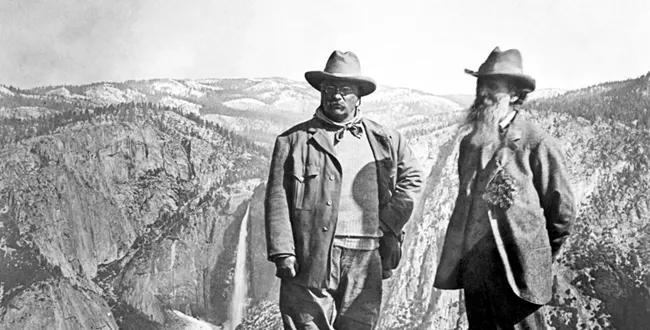
I plan to visit all 18 of Roosevelt’s National Monuments this year. What a start! The more you examine Roosevelt’s conservation achievements, the more impressive they become. If he had done nothing else but this, we would have ample reason to cherish his spirit and his foresight.
Discover more on these topics at Listening to America