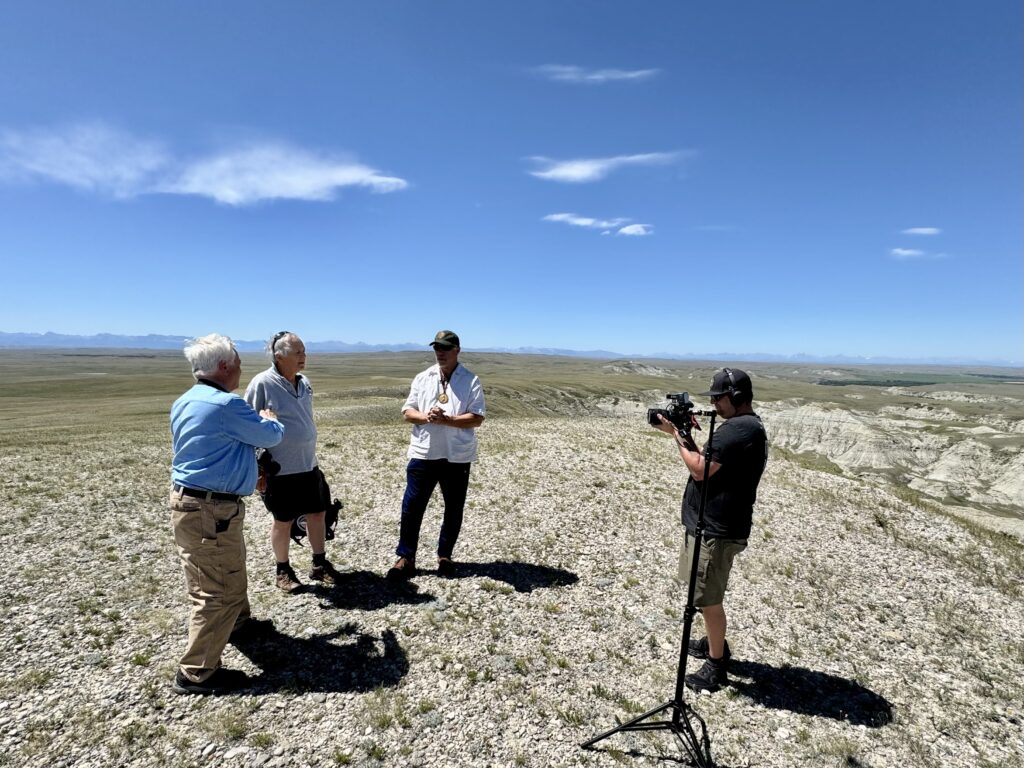
Clay reports on his visit to the remote Montana site where Lewis and Clark had their only fatal encounter with Native Americans on their historic 1804-1806 expedition.

Two Medicine Creek, Montana, July 8, 2025 — Author’s note: I had the great pleasure of touring what is known as the Two Medicine Creek fight site with two extraordinary experts in the Lewis and Clark world. Larry Epstein has been an important figure in the Lewis and Clark Trail Alliance for decades. At the age of 12, as a Boy Scout, Larry helped to locate the actual site of the skirmish between Lewis (traveling with three of his best men) and eight young Blackfeet men, not far from Cut Bank, Montana. Larry has led hundreds of people to the site. He’s regarded as the great field expert on the Marias incident, which occurred on the Expedition’s return journey from the Pacific. The skirmish led to the death of at least one of the Blackfeet men, maybe two.
Jack Gladstone is a Blackfoot singer-songwriter, guide, and cultural commentator who has long argued that viewing the famous incident through Blackfeet eyes provides a more insightful and comprehensive understanding of what happened on July 26, 1806, in the shadow of what would become Glacier National Park.
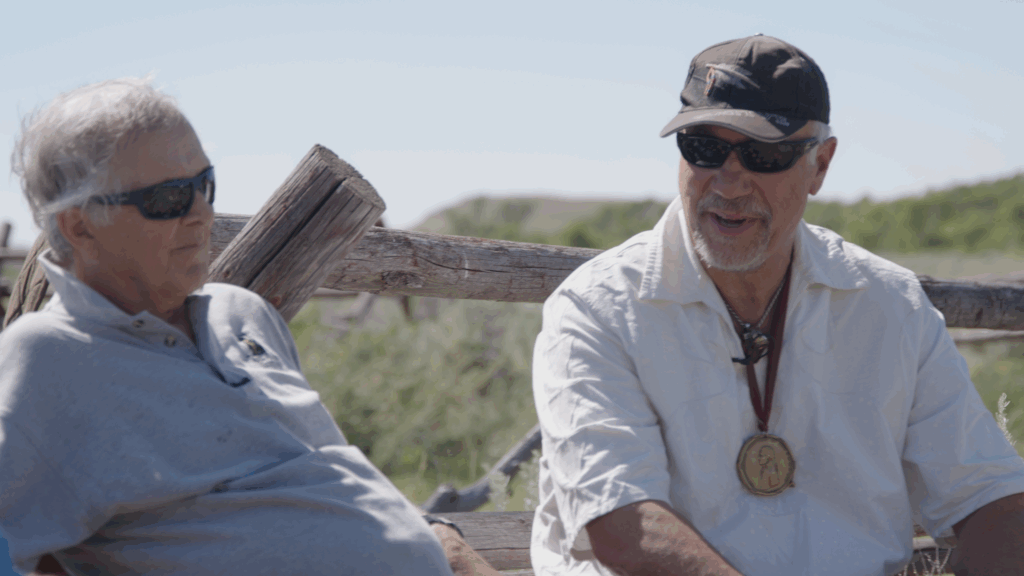
It was pure joy — on a perfect July day, hot, brilliantly lit, with a slight breeze — to listen to these extraordinary men discuss and debate the skirmish, the only bloodshed of the 28-month Lewis and Clark Expedition. Larry can match every descriptive phrase in Lewis’s famous journal entry to the lay of the land — the ridge from which Lewis discovered the Blackfeet men observing George Drouillard down by the Marias River; the site of the uneasy bivouac between the two groups; and the niche in the broken hillside where several of the surviving Blackfeet were trying to escape with the Expedition’s horses.
It doesn’t get any better than this: exploring a pivotal incident in the Lewis and Clark story with individuals who have devoted years to studying the landscape and unraveling the complex flow patterns of all those involved in the incident. I’d been dreaming of this moment for more than a decade. We finally all got our schedules to mesh. We had a hearty breakfast in Cut Bank, and then eased our four-wheel-drive pickups through the torturous landscape where the fatal skirmish occurred.
Watch for several video reports from the field in the weeks ahead. Meanwhile, here’s my report.
What Happened at Two Medicine Creek?

The bare facts: In the last days of July 1806, Meriwether Lewis and three of his ablest men, on six horses, followed the course of the Marias River northwest of the great falls of the Missouri River. Lewis was hoping that the Marias had a Canadian source — that its feeder streams were above the 49th parallel. He brought scientific instruments to ascertain the longitude and, especially, the latitude of the northernmost reach of the Marias. Lewis regarded this as an essential geopolitical data point of his 28-month journey.
The Marias disappointed Lewis’s hopes. The Marias, named by Lewis for a lady friend back east, did not drive back the Canadian border. Lewis named their last camp in the heart of Blackfeet territory Camp Disappointment. Lewis’s great hope that he would discover a northern tributary of the Missouri that would extend the northwest reach of the Louisiana Purchase and give the United States a better portal into the Canadian fur trade fizzled in the shadow of what would instead become one of America’s greatest national parks.
Just as Lewis and his three companions were starting back toward the Missouri River, they ran into eight young Blackfeet men with a cluster of about 30 horses. In that endless and treeless sea of rolling grassland, there was no place to hide. So Captain Lewis decided to bivouac with the eight young Natives and, through his sign language expert George Drouillard, explain America’s purposes in the Upper Missouri country.
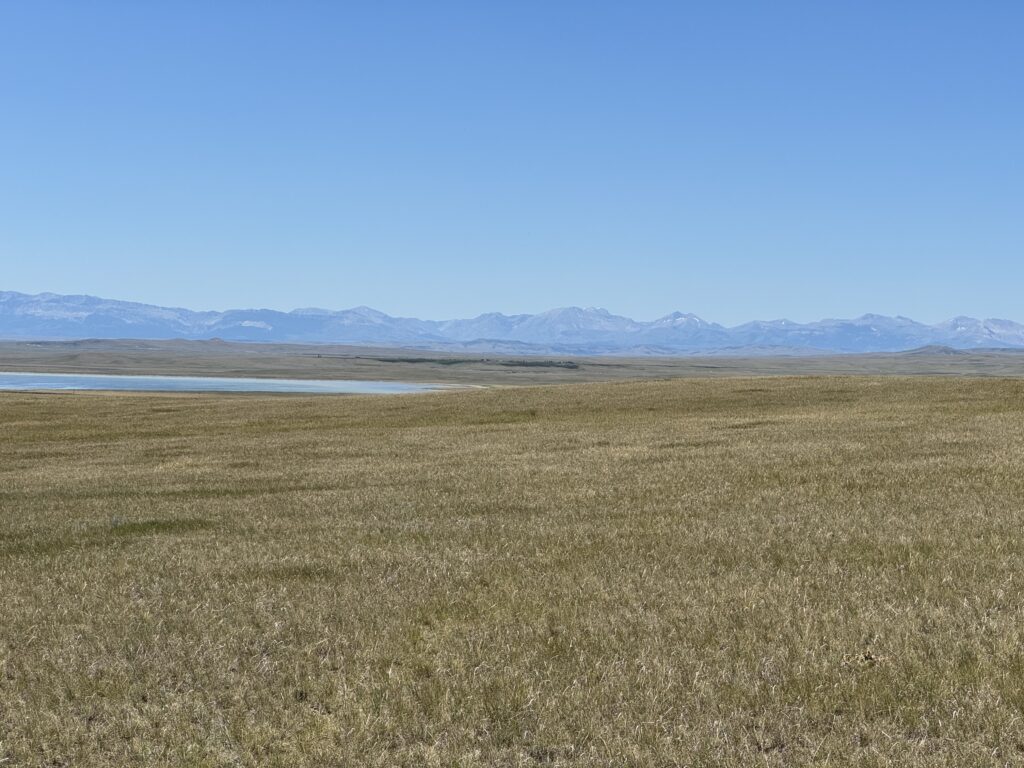
Lewis had ventured into Blackfeet country with an already hardened, grim view of the Blackfeet: “they are a vicious, lawless and reather abandoned set of wretches I wish to avoid an interview with them if possible. I have no doubt they would steel our horses if they have it in their power and finding us weak should they happen to be numerous wil most probably attempt to rob us of our arms and baggage; at all events I am determined to take every possible precaution to avoid them if possible.”
Much later in American history, Secretary of War Henry Stimson (1867–1950) said, “The chief lesson I have learned in a long life is that the only way you can make a man trustworthy is to trust him; and the surest way to make him untrustworthy is to distrust him.” Indeed. I believe Lewis’s distrust and his dark forebodings may have contributed to the crisis that followed.
It was a combination of fidelity to the principles of the Enlightenment and hubris that nearly got Meriwether Lewis and his men killed on Two Medicine Creek. The Marias reconnaissance began on July 17, 1806.
Lewis had originally intended to take six men as well as himself up the Marias, but some of the Expedition’s horses had either drifted off or been stolen by Natives, and Lewis wound up reducing his contingent to four, including himself, Joseph Field, Reuben Field, and George Drouillard. For the mission he had in mind into the heart of Blackfeet territory, Lewis was seriously undermanned. That was his first mistake.
On July 22, Lewis realized that the Marias was not going to cooperate. He might have turned back then. Had he done so, he would probably have avoided his “interview,” as he called it, with the Blackfeet. He lingered in that dangerous arena because he wanted to get latitude and longitude, but cloudy, cold, and rainy weather was frustrating his purposes.
They were out of food. They were out of science. They were well beyond that last outpost of the Enlightenment. And from a Blackfeet point of view, they were trespassing.
Lewis finally gave up the quest for celestial observation on Saturday, July 26, four days after he had realized that the Marias would not drive the Louisiana Purchase territory into Canada. It was just then that he encountered the eight Blackfeet.
After an evening of sign language conversation, when everyone finally bedded down for the night, Lewis took the first watch. Then he awakened Joseph Field to take over guard duty. Apparently, Field dozed off. At first light, the young Blackfeet men attempted a great coup: they would snatch up the Lewis party’s superior firearms (all they had was a smoothbore musket) and “liberate” the Expedition’s horses, including Captain Lewis’s, and then gallop away to tell the story of their triumph. When Lewis was startled out of a sound sleep by shouting and frenzied motion (“Damn you let go my gun,” Drouillard said), he discovered that his rifle was gone, so he grabbed his pistol and threw himself into the melee.
Reuben Field stabbed one of the young men in the heart, killing him within seconds. Lewis was chasing two of the young men toward a draw beyond which he would never be able to recover the Expedition’s horses, when he shot one of them in the gut with his pistol. The Native man returned fire. Lewis felt the whiz of the bullet above his head. “Being bearheaded, I felt the wind of his bullet very distinctly,” Lewis later wrote.
After the dust settled, Lewis gathered up the shields, bows and arrows, horse tackle, and other gear of the eight young men, and burned the pile. He left a Jefferson peace medal on the chest of the man Reuben Field killed — “that they might be informed who we were.” (This would seem to be a dumb thing to do, like leaving a calling card on a man you just killed in his sovereign territory. Hubris.)
And then he and his three comrades rode more than 100 miles in 24 hours to get away from the scene of the skirmish, believing, probably correctly, that a reprisal party would almost certainly be coming after them.
This incident is sometimes called the first “high noon gunfight in the American West.” Lewis and his three men survived to tell the tale. Whether this was the primary reason for the Blackfeet’s hostility to American fur trappers in western Montana over the next few decades is a point of considerable debate in historical circles.
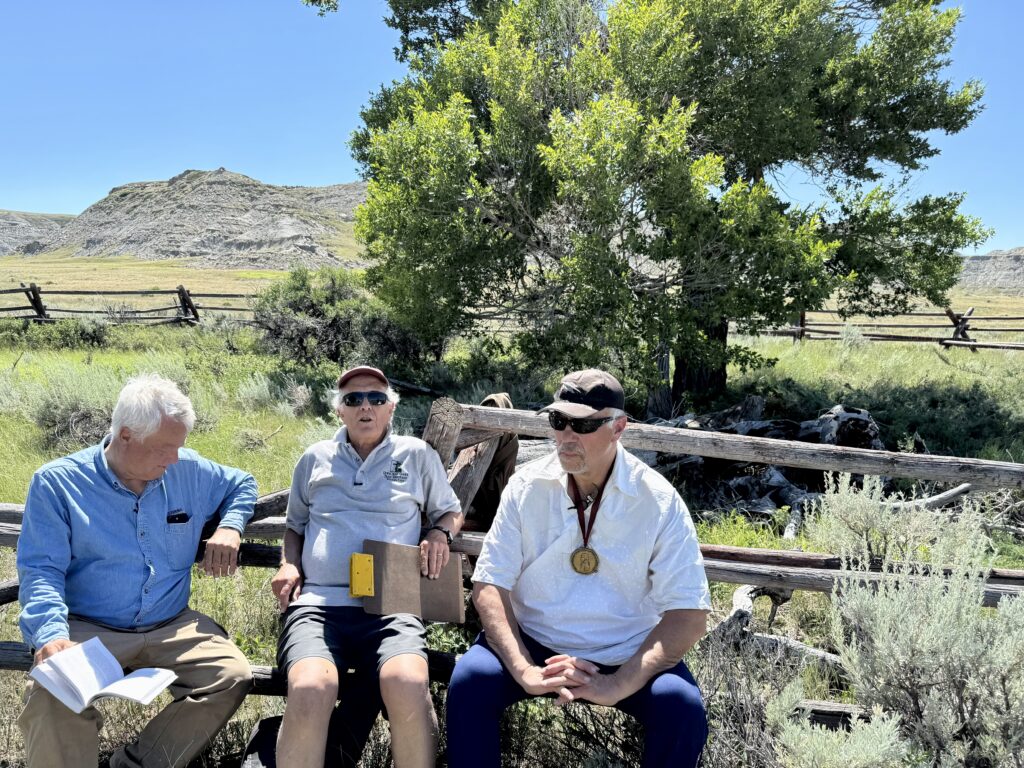
I persuaded Larry Epstein and Jack Gladstone to accompany me to the fight site and offer their own perspectives on this famous moment from the Lewis and Clark story. As we sat in the shade near the little stockade that protects the lone remaining cottonwood tree where the two cultures bivouacked, I asked these great experts a series of questions.
Jack Gladstone insists on the following points:
- These Blackfeet were not full adults, and it is a mistake to call them warriors. They may have been aspiring warriors, but they were young, and this was likely their first raid. It went badly, and they lost at least one man, but they did get away with Lewis’s horse.
The term “teenagers” seems too modern for these young men. Adolescents, perhaps, or young men just reaching full adulthood.
- The Blackfeet men probably had no intention of hurting Lewis and his three companions. They probably just wanted to snatch up a couple of rifles and perhaps a few horses. If they had returned to their villages with even one of the Expedition’s rifles, it would have been a great coup in both senses of the term. Those rifles would almost surely have been the best firearms the Blackfeet had ever seen.
- I have heard Jack use the analogy of young men of our time stealing a car for the fun of it — adolescent grand theft auto — as did Dean Moriarty in Kerouac’s On the Road.
Larry Epstein and I took turns defending Lewis and his men’s actions, though — truth told — both of us incline to Jack’s reading of the incident.
Supposing we grant all that Jack argues — I have no quibble with his view — the fact remains that Lewis and his three men woke up to a raid on their firearms and (soon) horses. They had no choice but to do whatever it took to reclaim their guns. To be without a firearm of any sort in the middle of the vast and empty plain through which they were traveling would put a very severe strain on their strength and stamina. It is unlikely that they would have starved to death out there without firearms, but it would have been an exceedingly tough return (on foot) to the mouth of the Marias. Remember that George Shannon was lost for sixteen days on the Central Plains in 1804, and when Clark finally found him, he had been subsisting on grapes and berries.
To have lost their horses would have meant a much graver crisis for Lewis and his men. Lewis seemed to regard it as a death sentence. Thus, their urgency and their willingness to use violence.
So they had to retrieve the guns.
Once the skirmish began, the amazing thing about this story, in my view, is Lewis’s leadership and his restraint. When the Field brothers recovered their firearms, they immediately pointed them at several of the young Blackfeet men. However, Captain Lewis instructed them to stand down, as the young men were no longer an immediate threat. George Drouillard, the Expedition’s finest marksman, explicitly requested permission to kill one or more of the Blackfeet. Lewis forced him to get control of his testosterone rush and stand down. If Lewis had been vindictive, he and his men could probably have killed all eight of the Blackfeet.
Larry Epstein is a retired lawyer and a big player in the Lewis and Clark world. He reckons that he has taken more than 1,000 people to the site. Virtually none of them would have been able to find or visit the site without Epstein and a tiny handful of others.
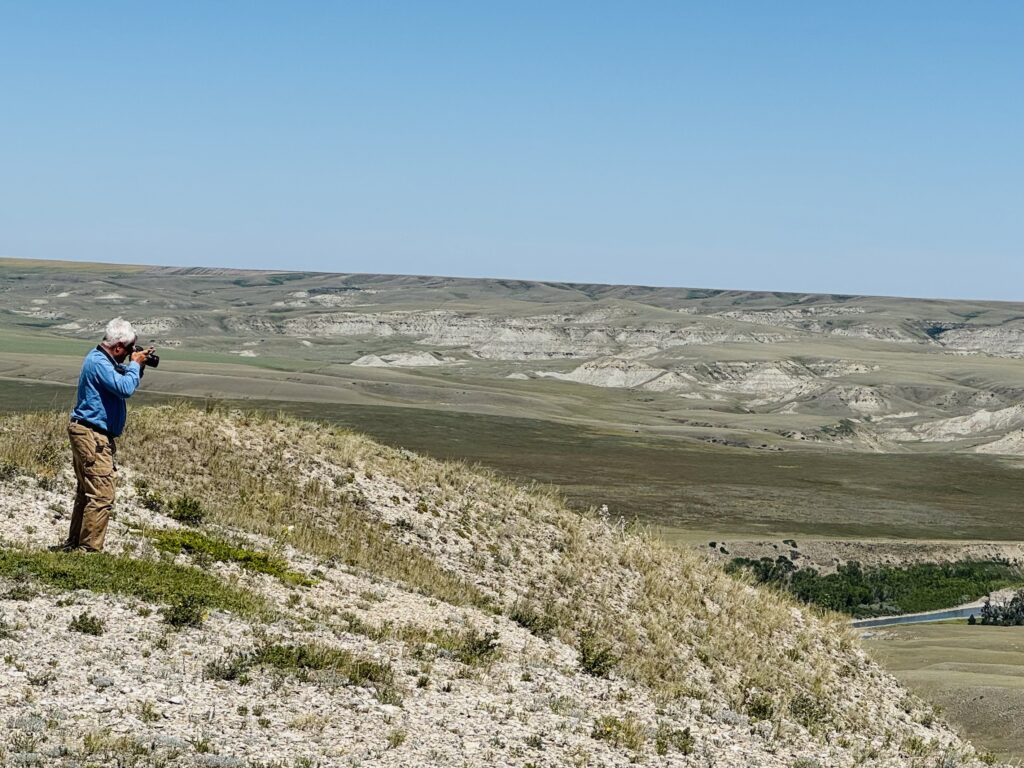
We weren’t with Lewis on July 26–27, 1806, of course, and it truly was (or became) a dangerous encounter, but as I read and reread the journals — Lewis’s is the only account we have — I nevertheless cannot banish the slight feeling that Lewis was a bit of a drama queen up there on Two Medicine Creek. Listen to his words. When he saw eight Natives and more than 30 horses, some of them saddled, he reckoned he was outnumbered many times to one. He wrote, “from their known character I expected that we were to have some difficulty with them…. In which case be their numbers what they would I should resist to the last extremity prefering death to that of being deprived of my papers instruments and gun and desired that they [Joseph and Reuben Field] would form the same resolution and be allert and on their guard.”
Two things seem certain to me. First, Lewis made a grave mistake when he ventured deep into Blackfeet country with so few expedition members at his side. Had he taken six men beyond himself, I very much doubt that the Blackfeet men would have attempted to snatch the firearms. If it had been seven against eight, I doubt the young men would have attempted the coup. They would not have been successful against such odds.
Second, if the young Blackfeet men had been willing to abscond with a single rifle (and perhaps a few horses), they probably would have been able to take back to their village a fabulous story of bravery and triumph. The firearms the Blackfeet had at this time were smoothbore muskets, not very accurate and certainly not at longer distances. If they had brought back Lewis’s rifle, for example, it would almost certainly have been the greatest firearm their band had. They were too ambitious — a typical young man’s mistake (worthy of Icarus in Greek mythology), and they paid a heavy price for trying to accomplish too much that morning. They would probably have been able to snatch a single rifle and run for it. There were plenty of places to hide. They were on their home turf. They had fast Indian ponies.
In other words, they overdid the raid. In trying to accomplish too much — exactly the kind of rookie mistake that these adolescent raids were designed to train Blackfeet men against — they wound up having to report the death of one and maybe two of their companions. Maybe they got away with enough white man’s horses to claim a partial triumph. One of them had Lewis’s horse, though he had only been riding it for a few weeks.
This little adventure on July 8 was not only one of the highlights of my 2025 Lewis and Clark tour of the country, but one of the highlights of my life as a Lewis and Clark scholar. There could be no better guides than Larry Epstein and Jack Gladstone. It was an honor to see the site through their eyes.
Then we were off to a cold beer and a good meal at a Mexican restaurant in East Glacier. As Thomas Jefferson said in another context, “if the day had been as long as a Lapland summer day,” we “would still have contrived means … to have filled it.”
So, when sloppy historians say “only one man died” on the Lewis and Clark trail (Charles Floyd, August 20, 1804, natural causes), they are exhibiting a kind of Eurocentrism that is no longer needed as we approach the 250th birthday of the United States.