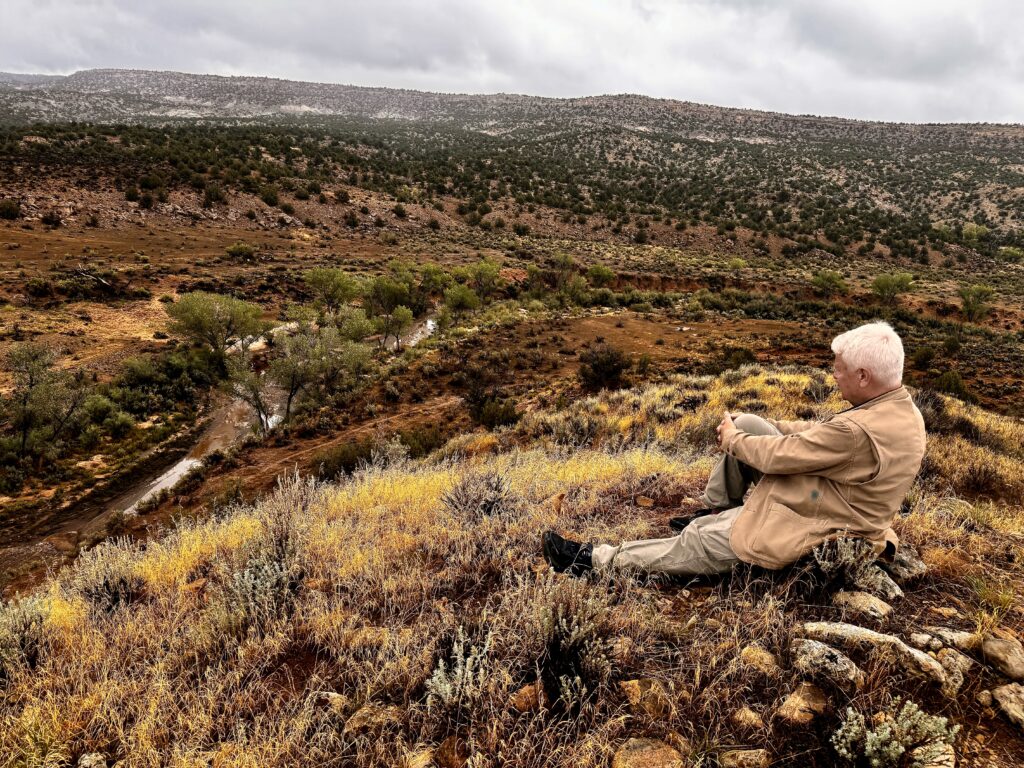
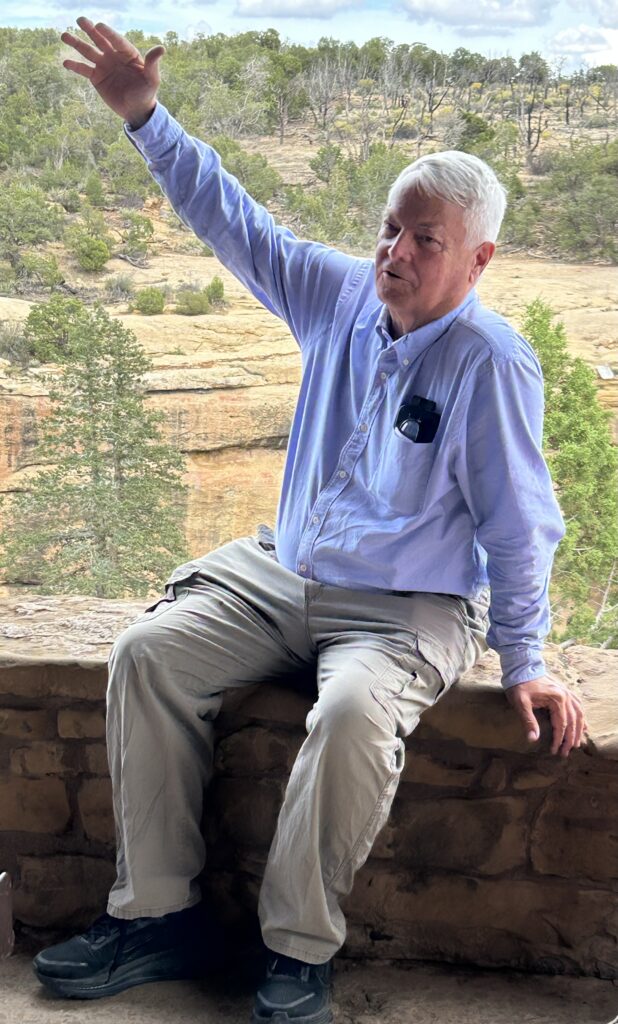
Alongside archaeologist Dr. Susan Ryan, Clay co-hosted a recent cultural tour of the Four Corners region to help guests get an “on-the-ground” look at the past and future of the National Monuments and Antiquities Act.
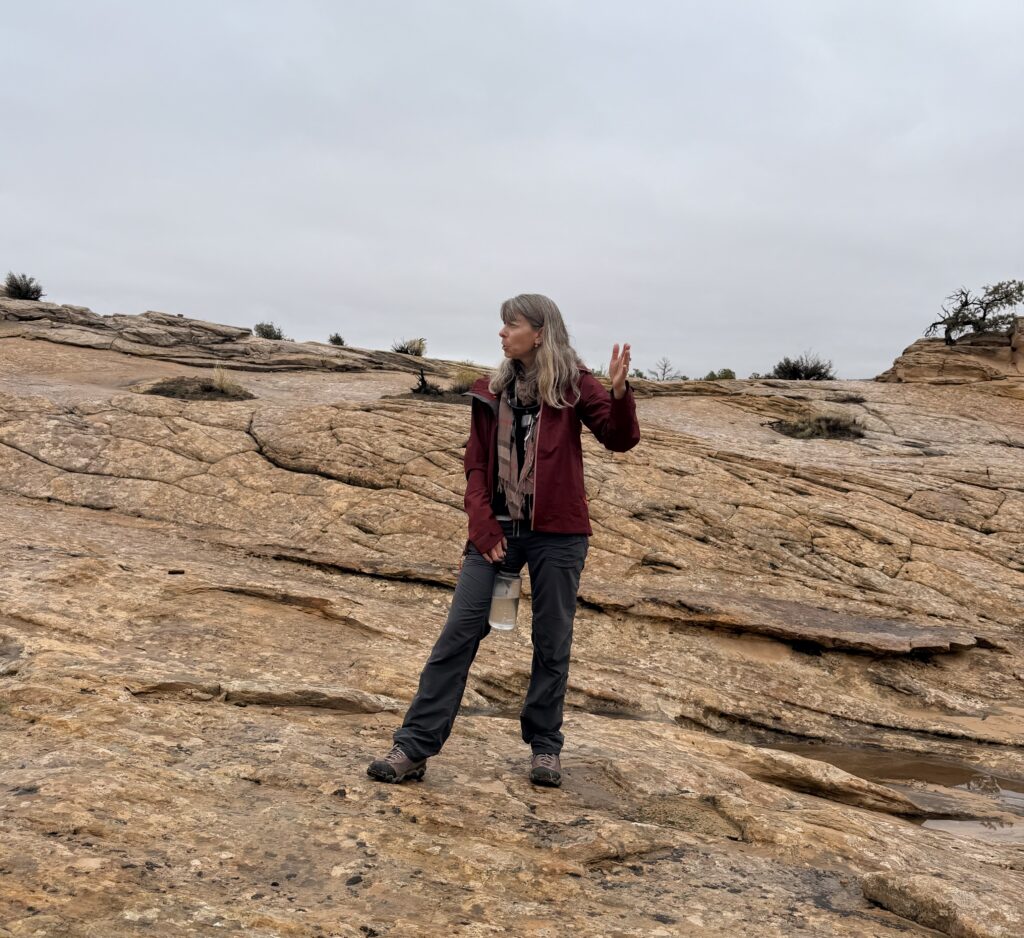
Last week I had the pleasure of co-hosting a five-day cultural field trip in southwestern Colorado and southeastern Utah with Dr. Susan Ryan of the Crow Canyon Archaeological Center in Cortez, Colorado. Our subject was the history and future of the National Monuments and Antiquities Act from its inception in June 1906 to today, when our public lands are in crisis. Dr. Ryan did most of the lecturing and commentary. She was spectacular. We had 19 curious, well-informed guests from across the United States, plus one from Great Britain.
The 1906 Antiquities Act gave the president of the United States unilateral power to designate National Monuments of any size by executive order alone. Although the legislation was probably intended to protect relatively small parcels, “in all cases … confined to the smallest area compatible with the proper care and management of the objects to be protected,” its first great practitioner, Theodore Roosevelt, broke open the gates with his 1908 creation of Grand Canyon National Monument at more than 818,000 acres. Whether a subsequent president has the authority to reduce or abolish a National Monument is not altogether clear. In reducing the acreage of Bears Ears National Monument and Grand Staircase Escalante National Monument by more than 90% each, President Trump has muddied the waters of one of America’s most extraordinary conservation tools.
Earlier Supreme Court cases and a 1938 Justice Department General Opinion indicate that a president is not authorized to reduce or eliminate monuments except under very particular circumstances. President Trump is no friend to legal or moral precedent. Whether this Supreme Court will take up the issue is unclear, but it would not surprise disconsolate public land advocates if the court affirmed Trump’s assault on the National Monuments.
When Dr. Ryan and I planned this cultural exploration program 18 months ago, we did not know the Antiquities Act would be endangered when we gathered in September 2026. Still, the current public lands crisis brought a lovely intensity to our weeklong deliberations and site visits.
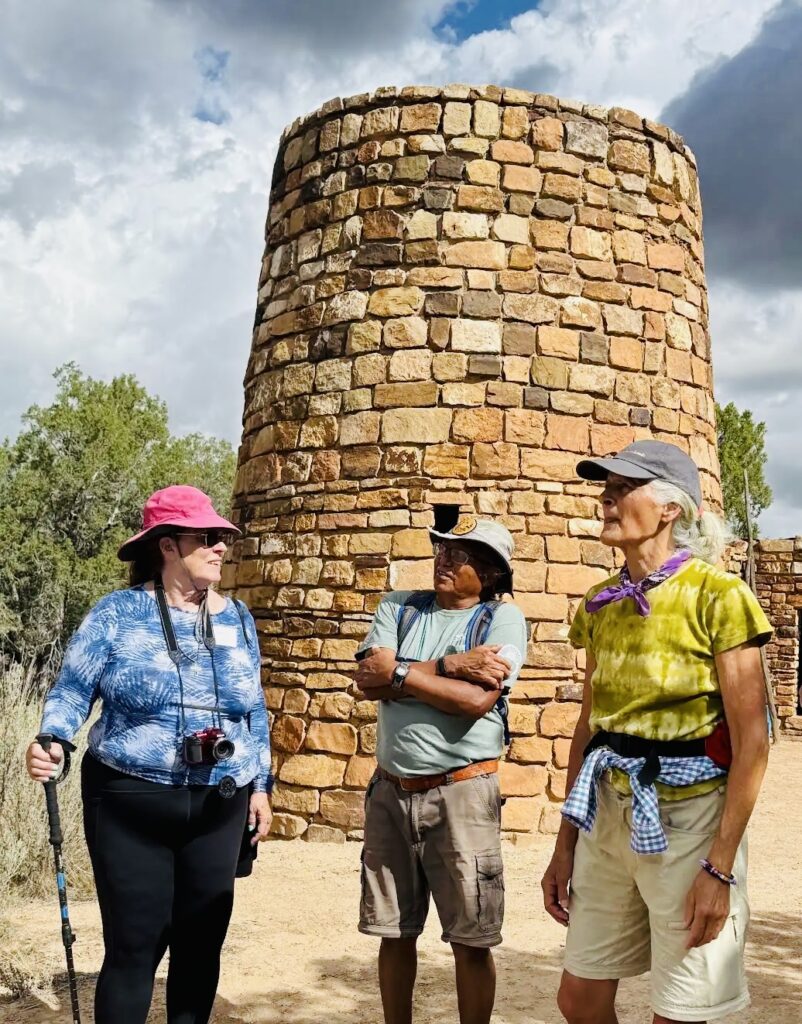
After a session at the center in which Dr. Ryan explained the origins of the Antiquities Act and I portrayed the 26th president of the United States, Theodore Roosevelt, we took to the road in a minibus and two extended vans. In the course of four days, we visited the Shields Archaeological Site northwest of Cortez; spent a day and a half at Mesa Verde National Park, established by Congress in 1906, including time in the Mesa Verde archives; visited a uranium mill at White Mesa; visited several sites in Bears Ears National Monument, including the Bears Ears Education Center in Bluff, Utah; and lingered at midday Friday at Canyon of the Ancients National Monument, established by President Bill Clinton at the end of his second term.
Our conversations were spirited, civil, probing, and thoroughly enlightening. I learned far more than I taught, and came away certain that these Utah monuments at their full embrace are a credit to American enlightenment, and no actual threat to any rational person.
Dr. Ryan’s commentary throughout was so outstanding that I hesitated to speak, lest I get in the way of her masterful discourse. She holds a PhD from the University of Arizona in archaeology. She has been at Crow Canyon Archaeological Center for 28 years. Her commentary is never abstruse or abstract. Everyone listened to her with rapt attention.
The Bears Ears Yoyo Nonsense
Bears Ears National Monument was established by executive order on December 28, 2016, in the last days of President Barack Obama’s second term. Fully authorized by the 1906 law, Mr. Obama set aside 1.35 million acres of public land in Utah to protect one of America’s most archaeologically rich landscapes. Under Obama’s leadership, a pioneering coalition of Native Americans, U.S. government employees, and other stakeholders was created to co-steward Bears Ears NM. Dr. Ryan informed us that there are well more than 100,000 ancestral Puebloan sites in the monument. You can hardly throw a pebble in the Four Corners area, she said, without striking an ancestral site.
When Donald Trump first became president of the United States, he reduced the Bears Ears footprint by 85%. That was December 4, 2017. On October 8, 2021, President Joe Biden restored the original acreage and added a bit more. When Trump returned for round two of his presidency after the 2024 election, he reduced Bears Ears by more than 90%. He also reduced Grand Staircase Escalante National Monument by more than 90%. President Bill Clinton established Grand Staircase NM on September 18, 1996.
The yo-yo effect of one president establishing a National Monument and a subsequent one reducing it (and back again and back again) is bad policy, confusing to the public, hurtful to Native Americans, and frustrating to those beleaguered BLM and other government employees whose duty it is to balance a range of interests in managing National Monuments.
Motives
Why would President Trump (and his unquestioning Secretary of the Interior Doug Burgum) reduce the size of these two National Monuments so severely? Here are a few possibilities. Choose the one(s) you think most likely to explain his actions.
- They were just too big. We met a couple of local mill employees with deep roots in the region who said the monument footprints were too large and that the most important sites fall within the jurisdiction of the remnant monuments.
- In the name of national security, we are told, we are going to need uranium from the region as well as rare earths if we are going to compete successfully with China. (Note: since Mr. Trump’s executive order on July 13, 2026, there have already been 16 filings for mining leases on the acreage he returned to basic Bureau of Land Management (BLM) status. Protecting archaeological sites is important — so the logic goes — but national security is paramount.
- Even though at least 60% of the people of Utah support the full acreage of Grand Staircase and Bears Ears and take pride in being a state of extensive National Parks, Monuments, Wildlife Refuges, parcels of wilderness, National Forests, and segments of Wild and Scenic Rivers, Governor Spencer Cox, the Utah legislature, and the Utah congressional delegation strenuously oppose any more “federal intrusion” within their state and express their satisfaction in the reductions. President Trump is undoubtedly listening to those political figures rather than the citizens of Utah (and beyond).
- There is now, and always has been, intense opposition to “federal occupation” of western states among some segments of the people of the American West. Some argue — erroneously — that federal public lands properly belong to the states, should be returned to them, and that the national government has no business holding a single acre that would benefit private parties. This widespread phenomenon is usually subsumed under the title Sagebrush Rebellion.
- As he campaigned in 2024, Donald Trump declared, “I am the retribution.” His loathing of Joe Biden and particularly Barack Obama is well known. Although 18 out of 21 presidents — of both political parties — have established National Monuments since 1906, there is a right-wing perception (or propaganda point) that it is liberal progressives who seek to “lock up the West.” If George W. Bush had established Bears Ears and Grand Staircase Escalante, I doubt that President Trump would be so determined to cut them down to size.
It’s one thing to discuss these things in a classroom; it’s entirely different to get out onto the land to look for ourselves.
We expected hot, dry weather, but we were graced with cooler temperatures and several days of intermittent rain. It is amazing to see the desert lands perk up when they get a drink of water. Suddenly, the landscape became gentler and more welcoming. Autumn colors exfoliated across the vast distances we covered. Water puddled on the ground. Creeks began to flow after months of bone dryness. Overnight, the San Juan River began to flow bank to bank, sodden with silt and partly clogged with detritus. The low cloud cover gave the landscape an enchanted aura. Water is life in the desert. It was a perfect time to visit Bears Ears and other protected sites in the Four Corners region.
Many false notions about the public lands of the American West persist. One of the most toxic of them is the idea that National Monument designation prevents other uses. In most cases, heritage grazing is protected, as well as recreation (including motorized), oil and gas extraction, and even mining. Monument status increases our collective ability to protect sensitive archaeological sites, limit the construction of new roads, and ensure that all of us who cross the boundaries into these Monuments understand that we are invited to show heightened respect for the land and the ancestral (and contemporary) peoples whose homelands we are visiting. The descendants of the ancestral Puebloans who built the great halls, the cliff palaces, the pit houses, the kivas, the apartment complexes, and the celestial observatories still consider this broad landscape their home.
The takeaway for me in all of this is that the Four Corners area is riddled with ancestral sites, that it is in our national and cultural interest to protect as much of this landscape as possible, and that Native people should play a much greater role — a pivotal role — in interpreting and managing these lands. Utah has plenty of land, including plenty of public BLM land. A 1.35 million-acre monument sounds colossal in the abstract. Still, once you drive through the rugged, arid landscapes, you realize the highest and best use of this parcel of the American West is to protect it from adverse industrial activity and simply let it be.
My Limited Contribution to The Week
My expertise, such as it is, is in the life and achievement of Theodore Roosevelt. God bless him. In the course of his seven years, 171 days as the 26th president, he set aside 230 million acres of the public domain for permanent protection under various headings. He set an important precedent by reading the Antiquities Act as broadly as possible. In subsequent U.S. history, no president has attempted to break the system. Until now.
The American people love their public lands: National Parks, National Recreation Areas, National Game Preserves, National Monuments, Wilderness, National Forests, and Wild and Scenic Rivers. Our public domain is the envy of the world.
My week with the excellent staff of Crow Canyon Archaeological Center and particularly Dr. Ryan gave me joy and hope. Joy to spend time among so many individuals intensely committed to the healthy future of the public lands. Joy to work with someone as talented as Dr. Ryan, and hope that the American people will pay attention to what is going on out there in the West and make their views known to their representatives. In any fair fight, America’s National Parks, National Monuments, and their other federal conservation cousins will win every time.