
Following the path of Meriwether Lewis, Clay notes that while the famous explorer could be an outstanding journal writer, he was frustratingly unreliable in keeping a daily account of his transcontinental travels. No known journals exist for about half of the 28-month expedition.

I have now completed my transit of the Ohio River corridor from Point State Park in Pittsburgh (the confluence of the Allegheny and the Monongahela and the “source” of the Ohio) to Cairo, Illinois, where the massive Ohio disembogues into the much more massive Mississippi River. I hugged river roads mostly with my pickup and Airstream. It rained every day, sometimes cats and dogs. I loved the Ohio River Valley, except for the heavy industrial footprint in some places and the thick forest canopy that obscures the river in most areas. Before this journey, I knew the Ohio was an impressive river, but I did not know how much water it carries (second only to the Mississippi in America). At the confluence with the Mississippi, it is jaw-dropping.

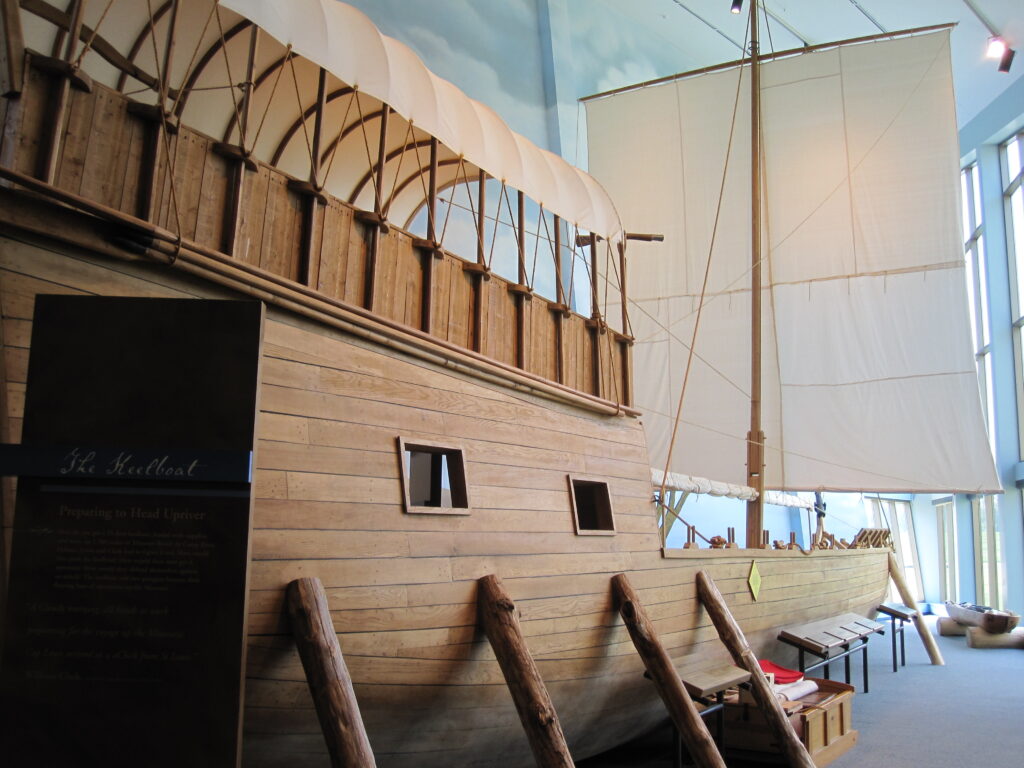
Along the way, of course, I have been reading the journals of the Lewis and Clark expedition. At this point, before he reaches the Falls of the Ohio, only Lewis is writing, and he is not a consistent journal keeper. Note: most of us begin reading the journals on May 14, 1804, when the expedition leaves St. Louis/St. Charles for points unknown. This makes sense, but a few years ago, Congress extended the Lewis and Clark trail from St. Louis all the way to Pittsburgh, where Lewis had the expedition’s main vessel constructed, a 55-foot barge (a keelboat). Lewis kept a solid and diligent journal from the day he started to float the Ohio, August 30, 1803, until September 19, when he went silent for no explicable reason; then, on November 28, he literally handed that physical notebook over to Clark. At that point, Lewis went more or less silent for 496 days. He did not pick up his journal again in a sustained way until April 7, 1805, when the expedition left its winter quarters among the Mandan and Hidatsa in today’s North Dakota and headed into Montana.
Good Start.
Phase One: August 31 – October 14, 1803
Lewis and a skeleton crew force the heavy keelboat down the shoals of the Ohio River. It was autumn, and the locals had never seen the river so low before. The keelboat drew more water than the river had to offer, so this phase of the journey was tedious, exhausting, and frustrating. The men spent part of every day in the river dragging and pushing the unwieldy 55-foot barge over riffles. Lewis wrote feelingly of the crew’s great fatigue and, on at least one occasion, rewarded them with an extra slug of whiskey. Sometimes, Lewis hired horses and oxen from riverside farmers to drag the boat through the shallows. He complained that the farmers were ripping him off. On at least one occasion, his crew had to sluice a trench through a sandbar and wait while the river carried away enough of the sand to force a passage. By the time Lewis reached the Falls of the Ohio on October 14, the river was deep enough to carry the keelboat downstream to its confluence with the Mississippi.
The Clark family had lived at the great falls of the Ohio for twenty years. Certainly, they knew the best way to get a vessel through the challenging rapids: 26 feet in two miles. I find it a little odd that Lewis hired local boatmen to ease the keelboat through the falls before he made contact with his old friend Clark. You’d have thought that Lewis would have connected first with the Clarks — who lived and worked there — and they’d have facilitated the passage. But Lewis was Lewis.
Phase Two: October 14 – October 26, 1803
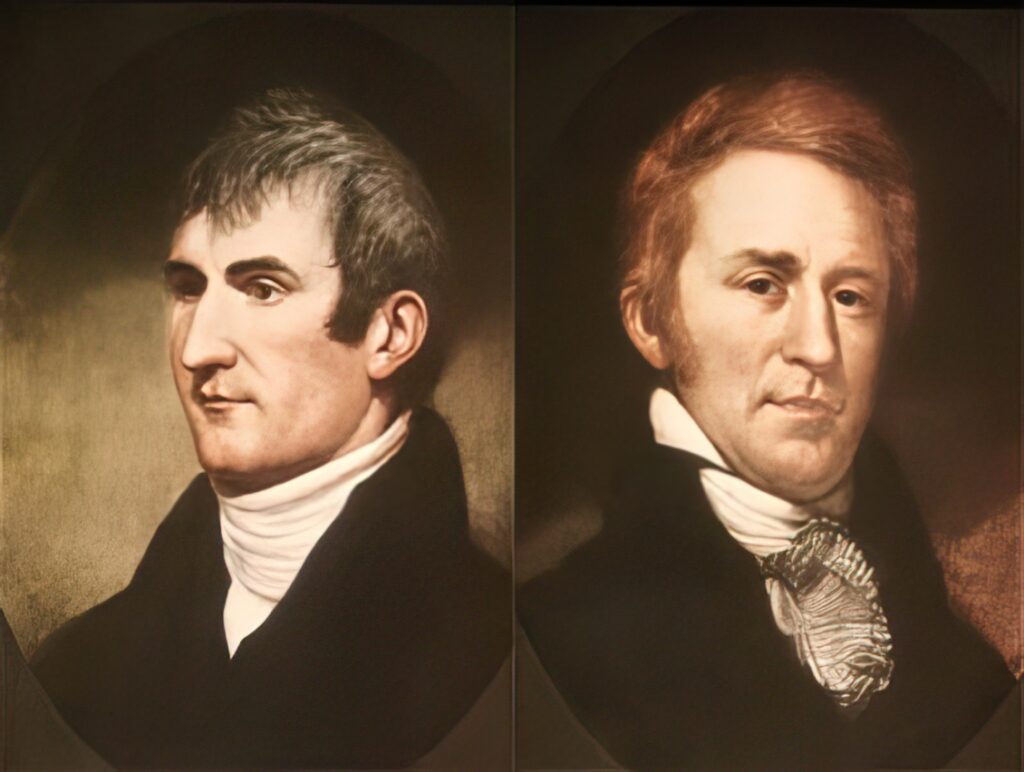
Reunion with William Clark. Lewis and Clark first met in 1795 in the U.S. Army in the “Ohio Country.” It had now been about seven years since they were last together. Lewis had felt no hesitation in inviting Clark to be his co-captain. However, he had taken the precaution of approaching another man, Moses Hooke, to serve as second in command in the event that Clark declined to join the expedition. Clark, who was at loose ends in his career, signed on with alacrity, thus propelling poor Hooke into oblivion and himself into American fame.
During the summer of 1803, Lewis and Clark exchanged a series of delightful letters about the proposed expedition:
Clark, July 18, 1803: “I will cheerfully join you in an ‘official Charrector’ as mentioned in your letter, and partake of the dangers, difficulties, and fatigues. … My friend I do assure you that no man lifes with whome I would perfur to undertake Such a Trip &C. as yourself.” Note: Clark did not win the 1804 Louisville, Kentucky, spelling bee.
Lewis, August 3, 1803: “I feel myself much gratified with your decision, for I could neither hope, wish, or expect from a union with any man on earth, more perfect support or further aid in the discharge of the several duties of my mission.”
It’s letters like these, coupled with journal entries where either captain speaks of his partner in discovery as “that estimable man,” that established the “best friends in American history” trope that the late Stephen Ambrose celebrated in his lectures and in his heroic commentaries for Ken Burns’ 1997 documentary, Lewis & Clark: The Journey of the Corps of Discovery.
Clark: “The enterprise &c. is Such as I have long anticipated.” It’s not clear what exactly Clark means by this. That he has for a long time imagined participating in an exploring expedition up the Missouri River deep into the American interior? Or perhaps that he has merely assumed that it was only a matter of time before some exploring party ventured into the interior? Is it possible that the two captains had discussed the idea of exploring the west together during their previous encounters in the army? Quite possibly, though there is no documentary evidence to support that view.
Meriwether Lewis would make an even more emphatic declaration on April 7, 1805, as the expedition left its winter quarters in today’s North Dakota. “Entertaing as I do, the most confident hope of succeading in a voyage which had formed a daling project of mine for the last ten years, I could but esteem this moment of my departure as among the most happy of my life.” For a man who would reach his 31st birthday a few months later, ten years is a very long time.
Silence
Lewis had been doing so well. He started his journal on August 30, 1803, and wrote every day through September 18. Then, he went silent for no clear reason. During this interim, he spent a week in Cincinnati and some time at Big Bone Lick, Kentucky, digging mastodon and mammoth bones for the president (president of the American Philosophical Society and third president of the United States). Lewis could have easily continued writing his journal throughout that period. Why did he go silent? If he kept a now-lost journal in those weeks, it was not recorded in what is now known as the Eastern Journal, which ends on November 28, after which the rest of the notebook was filled (much later) with material by Nicholas Biddle, the editor who prepared the journals for publication after the death of Lewis.
The day-to-day navigation of the Ohio River was not gripping drama. In other words, we haven’t lost that much by not having a full Lewis journal for this period. Still, during that silence, Lewis traveled 694 miles down the Ohio. The problem is not so much what is missing for this period but the early breakdown of the habit — essential to an explorer — of maintaining a daily or near-daily record of his journey. There is a huge hole in the documentary record. Lewis reached the Falls of the Ohio on October 14, 1803. It was there that he gathered William Clark into the fold of the expedition. They spent two weeks together at the Falls. Clark was getting his affairs in order. They surely talked (and talked endlessly) about the adventure they were about to embark upon together. Although Clark’s older brother, George Rogers Clark (1752-1818), was not at his best by 1803, he was almost certainly part of these anticipatory conversations. It is even possible that Clark’s enslaved valet, York, took part at some level in some of the talks. We’d give anything to have a full transcript of everything that transpired during those two weeks. We’d learn a great deal about both captains’ expectations for the journey. Among other things, we’d learn about how Clark recruited York and the so-called “nine young men from Kentucky” to participate in the “difficulties and fatigues” of the adventure. We’d have access to George Rogers Clark’s thoughts about the expedition, and no doubt we’d be treated to his vivid reminiscences of the American Revolution west of the Appalachians. When Jefferson approached George Rogers Clark about making a similar journey back in 1783, the hero of the Revolution said he’d take no more than a handful of men on such a journey, not wishing to seem like an invading force among the Natives of the Missouri River country. In January 1803, Congress had authorized a party of 12-15 men for the Lewis mission, but the two captains decided unilaterally in the late fall of 1803 to raise the initial crew number to 45 or more. There must have been some conversation around that.
Lewis was a good writer. He had an impressive vocabulary, the capacity to turn a phrase beautifully, and a deep curiosity about everything around him.
Clay Jenkinson
Stephen Ambrose writes: “Oh! To have been able to hear the talk on the porch that afternoon, and on into the evening, and through the night. There would have been whiskey — General Clark was the host and General Clark was a heavy drinker. … Unfortunately, we don’t have a single word of description of the meeting of Lewis and Clark.” Ambrose tends to gush a little when he gets to the most romantic moments of the expedition, but he’s right: “to have been able to hear the talk!”
Lewis’ September-October silence in 1803 casts an ominous shadow over all the silences that would follow. Lewis was a good writer. He had an impressive vocabulary, the capacity to turn a phrase beautifully, and a deep curiosity about everything around him. He seems to have written unhesitatingly — when he could be bothered to write. In my book, The Character of Meriwether Lewis: Explorer in the Wilderness, I argue that Lewis’ silences during but especially after the expedition brought on the crisis that led to his suicide on October 11, 1809. His silences frustrated, even angered, his mentor (and protector) Jefferson and caused bureaucrats in the War Department to question his fitness as the governor of Upper Louisiana. Lewis was on his way to Monticello and to the national capital in October 1809 — to explain himself and try to resuscitate his career — when he put a gun to his head at a crude hostelry in Tennessee.
Two weeks at the Falls of the Ohio. Probably, nobody in America knew more about the trans-Allegheny interior at this time than George Rogers Clark. He must have had complicated feelings as he watched the two younger men talk about the issues. He was too old now (50), too infirm, too wasted in alcohol, to make a transcontinental journey, but how could he not feel chagrin — that such a command had not come to him when he was in his prime? George Rogers Clark was one of Thomas Jefferson’s heroes. If for no other reason, this would have prompted Lewis to listen carefully to whatever the older Clark had to say.
The Enlightenment Explorer
Reading Lewis’ Ohio River journal entries today, in view of all that we know now that he could not know then, we encounter a Lewis who takes his position very seriously. With that diligent start, he appears to be establishing a steady habit of keeping careful and detailed accounts of his day-to-day progress. He also seems determined to prove that he possesses the necessary qualities to be an Enlightenment natural philosopher (i.e., scientist). He records temperature readings of both the water in the Ohio and the ambient air. He attempts to determine the cause of the heavy fog that shrouds the river most mornings. He comments on the heavy dews in the Ohio Valley. He makes note of what appears to be a seasonal migration of squirrels from the south to the north bank of the Ohio — perplexing to Lewis, as the quantity of acorns, their primary food, appears equal on both sides of the river. He reports on the size, population, and character of the few towns he encounters on the Ohio. He examined and described a massive mound, Grave Creek Mound, a few miles below Wheeling, West Virginia. His letter to Jefferson about the fossils of Big Bone Lick is a brief masterpiece of Enlightenment investigation.
Although most historians believe that Lewis hired two men who became permanent members of the expedition on the Ohio run — George Shannon and John Colter — he never named any of the members of his Ohio crew. He mentions some of the shore people he met at Wheeling, Marietta, and Cincinnati by name, but none of his traveling companions. Lewis’ pet Newfoundland dog, Seaman, makes his presence known — swimming out to drown and retrieve squirrels — but he is never named in the Ohio journal. Seaman cost Lewis $20 in Pittsburgh. When a Shawnee man downriver attempted to buy Seaman for three beaver skins at the mouth of the Ohio, Lewis was indignant.
Lewis stopped for a full week at Cincinnati (established in 1788) and made the journey 29 miles south to Big Bone Lick in Kentucky on behalf of the President of the United States. Since 1739, four years before Jefferson’s birth, Big Bone Lick had been known to contain the fossil remains of giant quadrupeds, including woolly mammoths and their cousins, the mastodon. Jefferson was boyishly fascinated by the idea of mammoths and mastodons, and, of course, he wanted some fossil remains for his “Indian Hall” at Monticello. Lewis dutifully did (or more likely, supervised) some serious digging at Big Bone Lick, collected several boxes of fossilized bones, and shipped them to Jefferson. At the same time, he wrote Jefferson what Stephen Ambrose wryly calls “a mammoth report on the mammoth,” including a 2,064-word description of “a tusk of an immence size.” The fossils never arrived at Monticello. How they miscarried is unknown, but the indefatigable Jefferson did not give up. Years later, after the expedition’s return, Jefferson convinced William Clark to conduct further excavations at Big Bone Lick, and some of those fossils are now housed in the Academy of Natural Sciences in Philadelphia, where I had the opportunity to view them up close just three weeks ago.
Character Matters
The Ohio Journal gives us three more important insights into the character of Meriwether Lewis. First, he had a temper. Stuck on a riffle on September 2, he writes:
“Suppose it best to send out two or three men to engage some oxen or horses to assist us — obtain one horse and an ox, which enabled us very readily to get over — payd the man his charge which was one dollar; the inhabitants who life near these riffles live much by the distresed situation of traveller, are generally lazy — charge extravegantly when they are called on for assistance and have no filanthropy or contience.”
When several of his crew botched a transaction involving 90 pounds of bread that a riverside woman had agreed to bake for him, Lewis delivered so “sharp [a] reprimand” that the next day, he feared the men had deserted.
Second, he was a naturally impatient man. When, out of the blue, William Ewing Patterson of Wheeling asked to join up as expedition physician, Lewis agreed, so long as Patterson would be ready by three p.m. the following day. When Dr. Patterson failed to appear at the appointed hour, Lewis let us know that he set out at 3 p.m. No cushion time for Dr. Patterson.
Third, Lewis was deeply committed to the enterprise and determined to succeed. He browbeat the drunken boatbuilder day by day in Pittsburgh to finish the expedition keelboat and, when it was finally ready, determined to float the Ohio even though local folks warned him that they had never seen the river so low. At times, his skeleton crew had to lift the massive keelboat over sandbars and other obstructions. Lewis wrote Jefferson to say that he would start down the river even if he made no more than one mile of progress every day. To another, he wrote that he would push forward even if he could only advance one boat length per day.
Conclusion
As we look back on Lewis’ journal writing and journal habits from a 200-year retrospect, a few things seem clear. First, he was an outstanding journal writer (when he wrote) but relatively unreliable in keeping up a daily account of his transcontinental travels. No known journals exist for more than 400 days of the 28-month expedition (about half). Second, like most of us, he was best able to stay current with his journal when he made notes frequently, perhaps on a daily basis. Missing a day or a week can become a slippery slope. Lewis’ silence between late November 1803 and April 1805 appears to me to be an unconscionable dereliction of responsibility. We know that once he picked up his quill pen again on April 7, 1805, he was able to keep a continuous journal until the expedition had completed its transit of the Bitterroot Mountains. Then, on August 26, 1805, he wrote an interesting journal entry about the expedition’s decision to abandon any plan to float the Salmon River and move through the Bitterroot Mountains with a horse herd purchased from the Shoshone. He writes of his uneasiness in depending on edgy Natives for the horses. Then he writes: “This morning Capt. C. and party” and put down his pen in mid-sentence. At this point, he was more or less continuously silent from late August to December 31, 1805. In what seems to be an unmistakable New Year’s resolution, Lewis took up his pen again on January 1, 1806, and kept at it continuously, without missing a day, until August 12, 1806, when he suspended it for the rest of the journey on account of having been shot in the buttocks on August 11, by the half-blind Pierre Cruzatte. Finally, a good excuse!
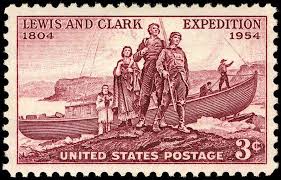
Lewis’ Ohio River journal was not discovered until 1915. Until then, the expedition started in St. Louis. We are fortunate to have that journal, fragmentary though it turns out to be. It was essential for the argument that the Lewis and Clark Trail should be extended all the way to Pittsburgh. Alas, that Lewis did not begin keeping a journal at Philadelphia or Monticello! The Ohio journal also indicates that Lewis was working very hard to prove to himself — to a skeptical Congress and to his great patron, Mr. Jefferson — that he had the right stuff to be an explorer in the manner of Captain James Cook, but in the terrestrial arena. The great mistake Lewis made was his failure to realize that a sustained daily journal, however rudimentary, is more important than the literary flourishes of which he was eminently capable — when he did bother to write.