
A recent visit to Arizona had me thinking about the legacy and prescience of Edward Abbey. With warts and all, he’s a kind of modern-day Henry David Thoreau.
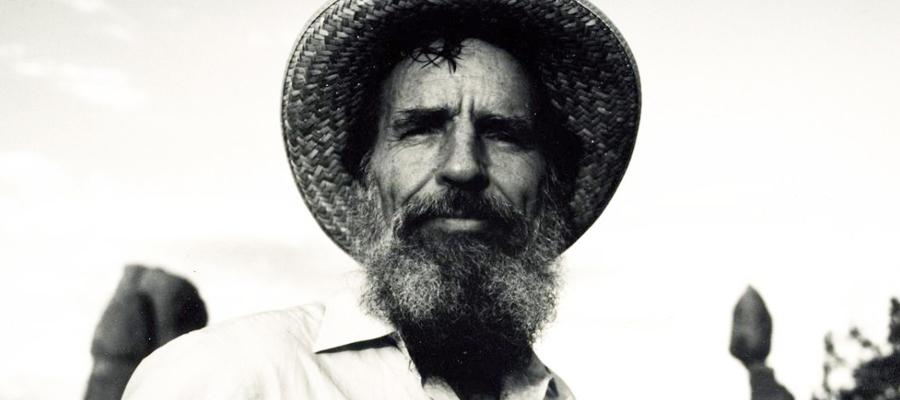
“The modern American lives in a society which is not free … a society dominated by technology, bureaucracy, and centralized power … a society in which the individual has been reduced to a unit in a mass, a statistic, a cog in a machine.”
Edward Abbey
I write this from Edward Abbey country, the Four Corners area of the American Southwest. Abbey has been dead now for nearly 40 years, but his voice continues to dominate our national environmental discourse. His warnings about environmental degradation and industrial tourism have more bite today than they did in his own time. Only 24,000 people visited Arches National Monument in 1957, when he was the park’s lone ranger. He considered that level of visitation excessive, and he assiduously pulled up the stakes that marked a proposed new entrance road. In 2025, 1,511,740 people visited Arches National Park, some of them after waiting in miles-long queues for many hours. Surely Abbey is rolling over in his grave, wherever that might be.
He wrote some of the best things ever written about the American outback, particularly the Southwest, which he loved with fierce and unyielding passion. He was the 20th century’s answer to Henry David Thoreau, equipped with a chainsaw (for billboards) and a much more pitiless strain of satire than his New England hero. He was, as he put it, a voice crying in the wilderness, and though he was not always polite or measured (in fact, seldom either), we revere him for defending America’s last wild places with as much zeal as the dam builders, mining corporations, power plant operators and home builders associations brought to their schemes to transform the West into profit.
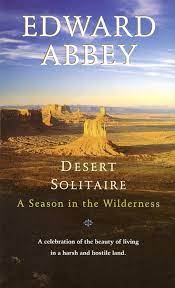
Desert Solitaire remains an environmental anthem almost 60 years after its 1968 publication. In my opinion, it’s the only book that deserves to be shelved alongside Walden, which it has outsold two to one in a third of the elapsed time. Thoreau can be preachy and peevish, but his prose is chaste and civil compared to Abbey on full rant. “Industrial tourism,” he wrote, “is a threat to the national parks. But the worst thing about it is that it is such a bore. It is a monumental vulgarity, a kind of spiritual obesity. The motorized tourists — pilgrims of the automobile — come to the parks not to experience the desert but to consume it, to gobble it up as they would a hamburger. … They are not really seeing the parks at all. What they see is a reflection of themselves — air-conditioned, deodorized, packaged, and controlled.”
The women in Thoreau’s Walden leave posies on the small desk of his cabin. The women in Abbey’s world leave their knickers — and their hearts.
It’s amazing that Abbey has survived the increased cultural sensitivities of our time. He said terrible things about Mexicans and all brown immigrants. Sometimes he sounds like a white nationalist, and in some respects, he was one. In Am I a racist? he wrote. “I suppose I must be, in the eyes of some, since I oppose mass immigration from Mexico. But I would call myself not a racist but a cultural conservationist.” On September 9, 1983: “Am I a racist? I guess I am. I certainly do not wish to live in a society dominated by blacks, Mexicans, or Orientals. Look at Africa, at Mexico, at Asia.” And he wrote, “Stop every campesino at our southern border, give him a handgun, a good rifle, and a case of ammunition, and send him home. He will know what to do with our gifts and good wishes.” He urged the United States to close its borders.
But he hated jazz, too. And conformity. And hypocrisy. And beatniks. The list is long.
In Desert Solitaire, Abbey wrote two chapters called Cowboys and Indians. In the second chapter, he describes Native Americans as victims of American colonialism and he admires the long and ingenious history of the Indigenous peoples of the American Southwest, dating back to the European Dark Ages. But he also ladles out deplorable stereotypes. “The Navajos sink ever deeper into the culture of poverty, exhibiting all of the usual and well-known symptoms: squalor, unemployment … broken families, disease, prostitution, crime, alcoholism, lack of education, too many children, apathy and demoralization, and various forms of mental illness.” At times, Abbey chooses to see these characteristics as inherent in the Navajo soul rather than the result of centuries of colonial oppression. Such generalizations seemed cringeworthy (to some) in 1968. They are merely deplorable now.
And then there are the legions of Abbey’s women. He took up with his fifth and last wife Clarke, when she was under 30. He was in his mid-50s. On March 21, 1975, with 14 years to live, he wrote, “The tragic fallacy of [the book] Joy of Sex and all other such training manuals is that what a man really desires is not 144 different positions, but 144 different women.” That’s probably a conservative estimate of his lifetime “achievement.”
That Edward Abbey was a sex addict who slept with as many new women as would have him doesn’t particularly bother me, but I do feel real sorrow for the women whose hearts he broke along the way, particularly his five long-suffering wives. He expresses some remorse for his infidelities in his Confessions and acknowledges waves of guilt, but that never stopped him from his priapic quests. Here’s a particularly stark and uninterrupted juxtaposition, his journal entry from January 1, 1980:
Renee walks out. Disaster. Catastrophe. (Etc.) “I’ll miss you,” she said. A straw for a drowning man. ‘Come visit me,’ she (L.) says.
Not much grieving time there. L. turns out to be the next (temporary) woman. Less than a month later, he writes, “Just spent a week here [Jackson Hole] with L., a beautiful, generous, brave, talented and clever woman. I first met her in Moab nearly three years ago.” As he might say, always keep one in the wings.
On a previous occasion (June 1968), he reflected on his life in the third person. “He loved them all, that was the trouble. Could never willingly give up any of them, could never forget. He wanted them all around him, all his life. Never did he want to lose one for another. But they, of course, never understood.” Actually, most of them understood perfectly well, at least in time.
Ok, so he was a cad. And at times, a racist. And perhaps even in some rare moments, a white supremacist. We have to acknowledge all of that and try to give such issues the weight they deserve in any final evaluation of his life and work.
And Yet
“Let your life be a counter-friction to stop the machine.”
Henry David Thoreau
For all of that — and these are very serious matters — I believe we would lose more than we gained by jettisoning him.
— What he said about industrial tourism — loving our National Parks and Monuments to death by overwhelming the most beautiful landscapes of America with soulless bourgeois recreational intrusion — is more pertinent now than it was in his own time. By magnitudes.
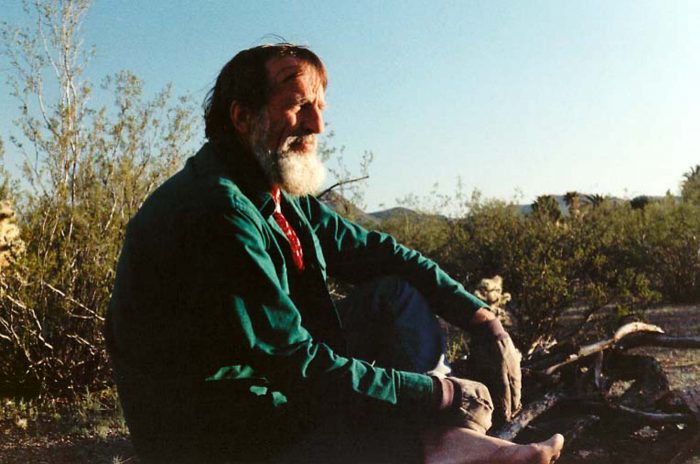
— His reform formula for the National Parks has proved to be prescient: No cars in the National Parks; No new roads in the National Parks; And put the rangers back to work on their legs rather than in government vehicles. The ranting demands of Abbey 1968 are being implemented in many of our National Parks today.
— If you think he was hard on Moab back then (i.e., 1968), imagine what Abbey would say now? (Well, at least it’s easier to get a drink these days.) I’ve been to Moab a dozen times in my life, at about four-year intervals. Each time I visit, there is more to deplore. I accept that Americans have wildly different views of what constitutes recreational pleasure, and to some extent, to each their own, of course, but the sheer number of off- and back-road outfitters and vehicles along the long main street is depressing. Main drag, he’d call it. One bookstore, 30 ATV rental outfits. I’m with Abbey that this is no way to explore the sublime. To let the whine of the internal combustion engine hover anywhere near the confluence of the Green and the Colorado rivers — one of the most stunning landscapes on earth — is travesty. For Abbey, the internal combustion engine is just another form of wilderness extraction, different in degree but not in kind from other varieties of industrialization — uranium mines, gold mines, gravel pits, ridgeline subdivisions, helicopter excursions over the canyons, dirt bike trails (and off-trail violations). The noise pollution alone is appalling.
If he had world enough and time, I’m guessing Abbey would have poured sugar or salt into the gas tanks of every ATV in Grand County, Utah. “Thermite, dynamite, sugar in the gas tank. Falling billboards, falling in flames. D.A.C. — direct action committee. What else can we do?” In Abbey’s view, an alpha male roaring and gear-grinding around on what’s left of the American outback in an ATV is as great a plague as a uranium miner or an absentee land developer. Wheeled locusts. Abbey told us we cannot experience the Southwest through the window of a car or pickup. You have to walk the land, sleep on it, gaze up at the stars, call back to the coyotes.
In his remarkable journals — misnamed Confessions of a Barbarian — Abbey declares that walking is the only forward transport that we don’t do sitting down: horses, cars, airplanes, snowmobiles, etc. He credits only those outback experiences we earn with our feet. He is surely right, except for the disabled, and I’m guessing he would say something snarky about that demographic, too.
The Continuity of Abbey and Henry David Thoreau
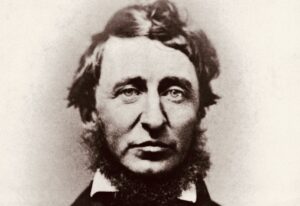
Abbey’s fascinating relationship with Henry David Thoreau is everywhere apparent in his writings. Desert Solitaire is full of direct and indirect references to Thoreau, particularly Walden. His famous essay, Down the River with Henry Thoreau (1980), is a sustained tribute to the master, with significant reservations. Abbey loved the anarchist in Thoreau, the philosopher of civil disobedience, and the hints of monkey wrenching in A Week on the Concord and Merrimack Rivers. He loved the pond-side smart-aleck who wrote such sentences as, “as if you could kill time without injuring eternity,” and “we do not ride on the railroad, it rides upon us,” and “thus men will lie on their backs, talking about the fall of man, and never make an effort to get up.”
But Abbey could not forgive Thoreau for being a celibate. He calls him a “poet-spinster” and makes it clear that he can never fully endorse an ascetic. It seems that Abbey was not so much contemptuous as simply mystified by Thoreau’s (or anyone’s) apparent sexlessness. He wondered how any vigorous man could not want to get laid as often as possible. Abbey was not alone (including in his trailer at Arches) nearly as much as he wants us to believe. He wrote his first wife, Rita (and their child), out of the final draft of Desert Solitaire, though she was with him there a good deal of the time, as were other … er visitors. Thoreau meant it when he wrote, “I never found the companion that was so companionable as solitude.” Abbey sometimes tried to imagine himself as a man of solitude, but his lust for life kept creeping in. In Down the River with Henry Thoreau, he ridicules the great chapter on “Higher Laws” in Walden. Chastity, vegetarianism, distaste for the animal in us, abstention from carnal appetites, an aversion to sensuality — in Abbey’s mind, what’s left? He accused Thoreau of puritanical sermonizing and made it clear he would have admired him more if he had welcomed overnight guests at his cabin.
We Need Him Now More Than Ever
In some respects, we need Edward Abbey now more than ever. It’s not just the glut of automobiles that are degrading the very idea of a National Park, but the RVs of our time bear almost no resemblance to the modest trailers he found so annoying 60 years ago. The $300,000-$500,000 coach RV is more luxurious than 95% of all the dwellings on earth. It is like dragging your dream house into the wilderness for the weekend. All you have to do is hook up your own sewer line! With more prosperous visitors come carping demands for greater amenities. And less time under the stars. Imagine what he would say about French drip coffee and frothing gizmos in the wilderness. Or solar cell phone chargers so we can check the stock market.
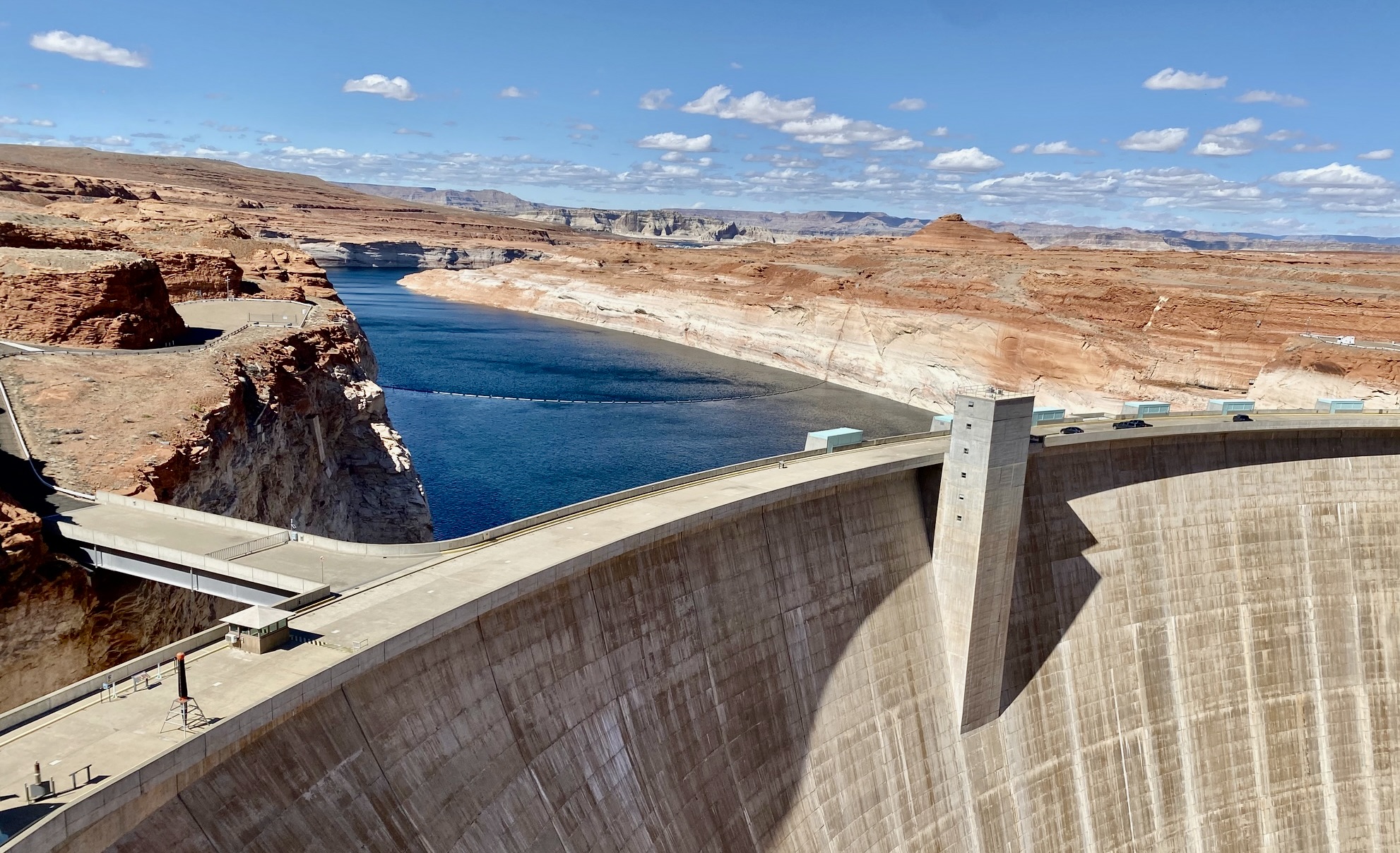
The author of The Monkey Wrench Gang would be delighted to see Glen Canyon Dam and Lake Powell fail. Not by way of environmental terrorism, though he fantasized about that, but because there is not enough water in the Colorado River system to keep both Lake Powell and Lake Mead viable, given climate change and the historic overallocation of the river’s flow. I’ve talked with water masters, irrigationists, and others who know the Colorado River watershed intimately. They agree that it might now actually make sense, hydrologically, to pluck Glen Canyon Dam down, or just let the water pass through the dam on its way to Lake Mead. Abbey would unquestionably regard the breaching of Glen Canyon Dam as one of the greatest achievements of the environmental movement, the fulfillment of the dream of hundreds of thousands, if not millions, of wilderness lovers worldwide. To the conservation community, it would represent the healing of the greatest development wound of the 20th century, David Brower’s sacrifice of Glen Canyon (The Place No One Knew) to save Dinosaur National Monument in 1956.
The Fierce Urgency of Now
Perhaps most significantly, Abbey would be ringing the town bell like Thoreau in Concord, and manning the rhetorical barricades as the current administration (inspired by Project 2025) attempts to privatize some of the public lands, scale back a number of National Monuments, and permit much greater resource extraction on BLM, National Forest, National Grasslands, and even National Monuments lands, while squinting too at the National Parks. He distrusted government at least as much as corporate capitalism. In Down the River, he wrote, “The government I call my own … is remote, anonymous, inscrutable, unresponsive … a colossal bureaucracy which has lost all sense of purpose except its own perpetuation.” And he wrote, “The modern American lives in a society which is not free … a society dominated by technology, bureaucracy, and centralized power … a society in which the individual has been reduced to a unit in a mass, a statistic, a cog in a machine.”
Where is that cog when we need it most?
For Thoreau, the issues were slavery and the Mexican War. For Abbey, it was saving what’s left of wild America from “improvement.” In his famous essay On Civil Disobedience, Thoreau wrote, “Let your life be a counter-friction to stop the machine.” That was essentially Edward Abbey’s mission statement, and along the way, he wrote more than 20 books, floated all the wild rivers of the American West, loved scores of women, and threw down his sleeping bag under the stars in desert places as often as possible.