
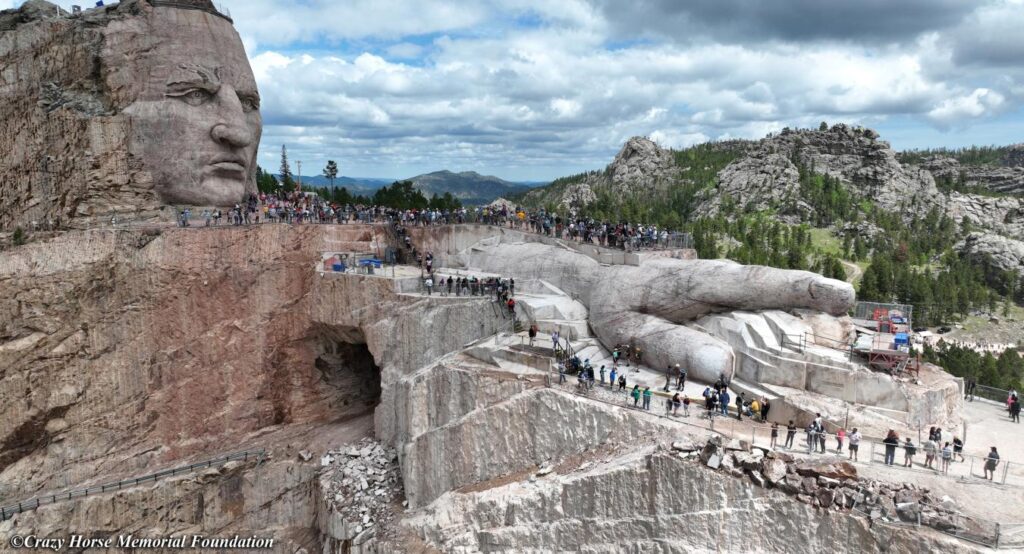
Clay shares his thoughts on the Crazy Horse Memorial begun in 1948, a privately funded monument under construction in the Black Hills of South Dakota. The monument depicts Oglala Lakota warrior Crazy Horse pointing toward his tribal lands. Once completed, it will be the largest mountain carving in the world, at 641 feet long, 563 feet high — larger than nearby Mount Rushmore.
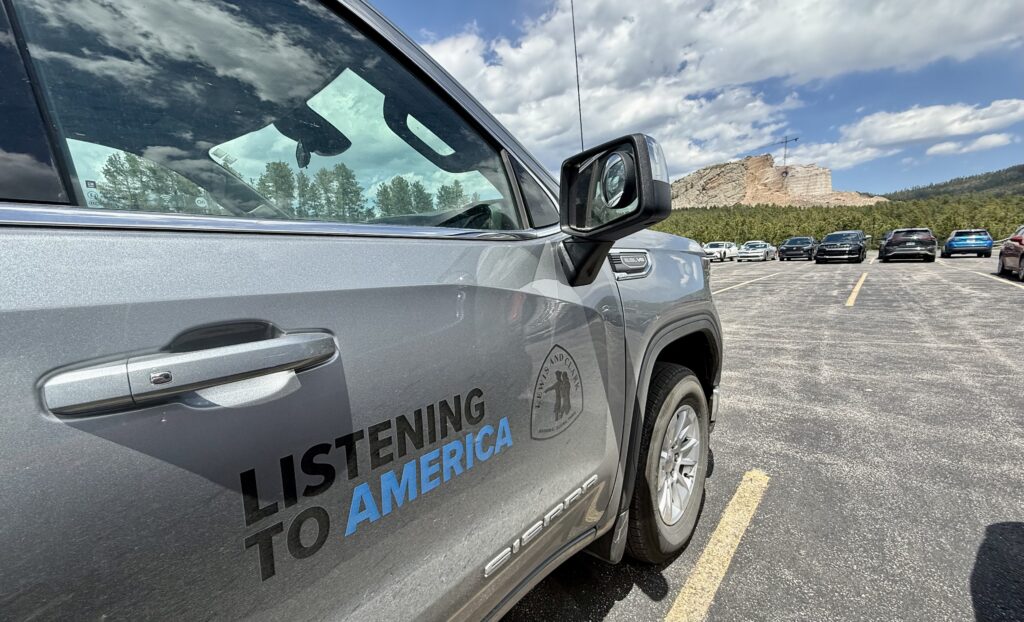
I have been visiting or just driving by the Crazy Horse Memorial in the Black Hills of South Dakota for 30 years or more, watching the Oglala war leader’s visage slowly emerge from the granite of Thunderhead Mountain. Even assuming you think the monument is a good idea, I’m not sure that it will ever, even if finished, capture the spirit of Crazy Horse (ca. 1840-1877), one of the principal figures in the Native American resistance in the 19th century.
There are no known photographs of Crazy Horse.
We don’t know what Crazy Horse looked like, except that he was not particularly tall, eschewed ornamentation, lived quietly, was not particularly social, had brown hair and a relatively fair complexion, and he had a scar on his face from a pistol bullet fired at close range by the angry husband of a woman Crazy Horse was courting.
If it is true that Crazy Horse refused to have his photograph taken, wouldn’t we want to honor that principle (and his privacy) in another artistic medium? If he didn’t want to hold still for 30 seconds in front of a wet or dry glass plate camera (a shadow catcher), how would he feel about being frozen for eternity in a colossal conjectural image carved with dynamite by the culture that stole the Black Hills and murdered him in a bungled arrest gambit on September 5, 1877?
Is this the highest and best use of the Lakota homeland?
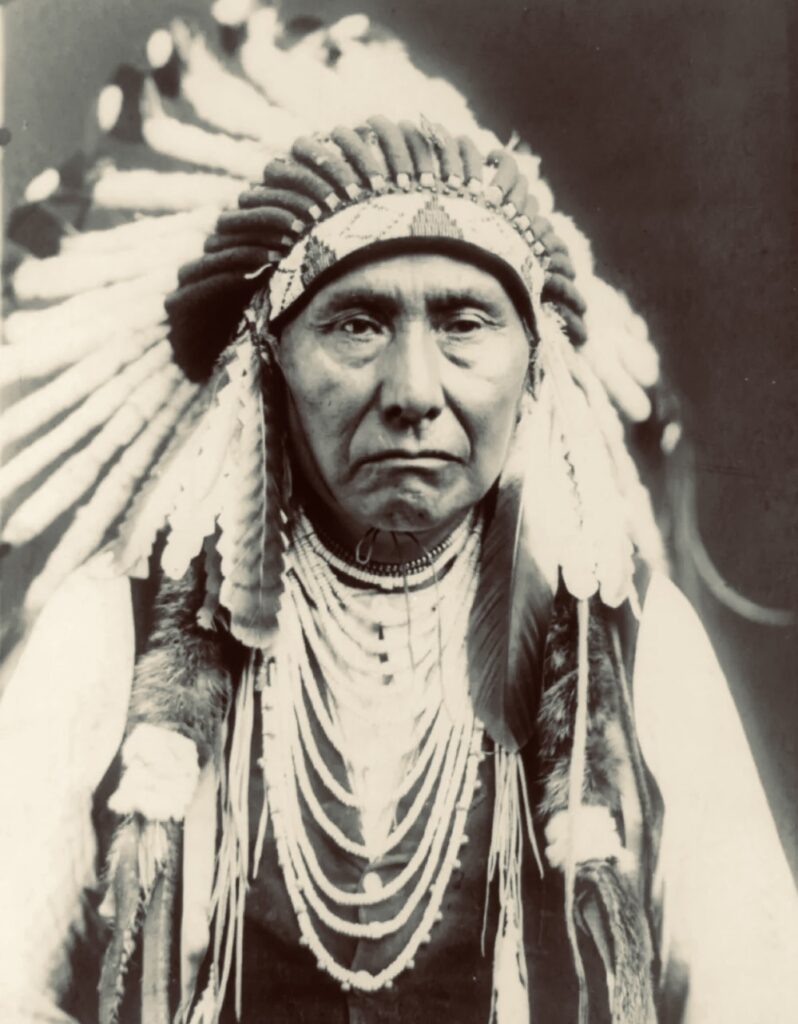
We have excellent photographs of Chief Joseph of the Nez Perce (Nimiipuu), Sitting Bull of the Hunkpapa Lakota, Geronimo of the Apache, and Red Cloud of the Oglala Lakota. A sculpture of one of them would be immediately recognizable in the Black Hills or elsewhere, but nobody seeing this visage for the first time without any historical background would say, “Oh, that must be Crazy Horse.” For most, it would appear to be a “generic Indian.” To my mind, what’s emerged so far looks a bit like a leaner Russell Means (1939-2012), who fought for the Black Hills every bit as passionately as Crazy Horse.
If Crazy Horse had been asked how America should honor him with a memorial, he would almost certainly have said, “How about get out of the Black Hills and the Powder River Country and don’t come back?” He would likely have agreed with the Connecticut painter and traveler George Catlin (1796-1822), who in the 1830s suggested that the entire Great Plains be set aside as a vast “Nations Park” for Indigenous people to live in their traditional lifeway, along with buffalo, grizzly bears, pronghorn antelope, bighorn sheep, elk, wolves, mule deer, and prairie dogs. In other words, America’s “manifest destiny” would find a way to work around a huge interior pan-Indian reservation. Catlin wrote:
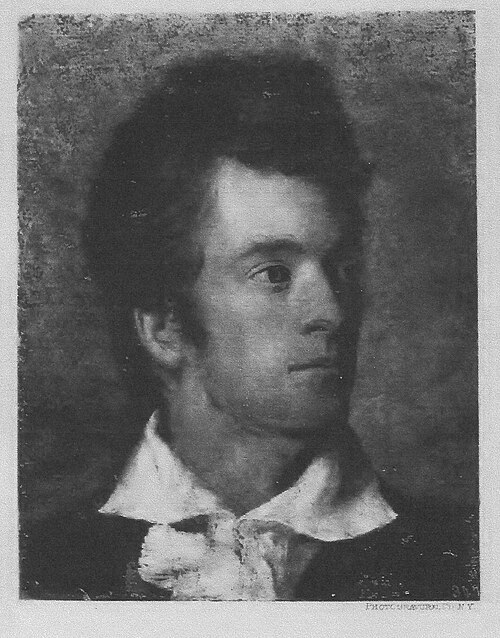
“And what a splendid contemplation too, when one … imagines them as they might in future be seen (by some great protecting policy of government) preserved in their pristine beauty and wildness, in a magnificent park, where the world could see for ages to come, the native Indian in his classic attire, galloping his wild horse, with sinewy bow, and shield and lance, amid the fleeting herds of elks and buffaloes. What a beautiful and thrilling specimen for America to preserve and hold up to the view of her refined citizens and the world, in future ages! A Nations Park, containing man and beast, in all the wild and freshness of their nature’s beauty!”
Try to imagine that America for a moment. Catlin may have been a dreamer, but he was not the only one. You have to shake your head at the idea that this is something that might possibly have happened. Imagine how different the history of the West would be if America had decided to share the continent with some of its Native sovereigns.
Ask yourself this. If we had asked Crazy Horse how well he would like a mountain in the Black Hills blasted into something like his likeness, what would he have said? Shouldn’t that count?
That Was Then, This Is Now
I don’t in any way wish to impugn the honorable intentions of those who undertook this massive project, and persevered over seven tough decades to bring it partway to fruition. I believe their hearts were good, that their purpose was and is to honor Crazy Horse and the Lakota people, and, in part, to offer a Native counterpoint to the four white men carved into a similar mountain on a smaller scale, just 10 miles away. The Crazy Horse project was conceived a very long time ago at the end of a simpler era in American history, just as white triumphalism was diminishing. It is impossible to imagine any family or entity today getting legal permission to dismantle a mountain in the Black Hills with bulldozers and dynamite. It was an audacious idea in 1939 (with Mount Rushmore still two years from completion), born of respect and without any commercial intent.
That was on the other side of the American Cultural Revolution, which widened the aperture of the American consciousness to embrace the lives and experiences of Native Americans, African Americans, Hispanic Americans, Asian Americans, women, gay Americans, disabled Americans, and Americans on the spectrum.
Our national cultural sensitivities are far more acute now. The objectification (on a gigantic scale) of an Indigenous person we can only depict in some generic way because we are not sure what he looked like would today be regarded as very problematic. Add to that, a giant statue of an Indigenous person who did not want to be depicted and who is not here to be consulted.
We should be very charitable in our approach to this question and value all perspectives, even those we think we have transcended.
I can actually imagine a scenario in which the Crazy Horse project is halted, partly because to complete it would take scores of years or even a century or more and the amount of rock that would have to be removed is staggering; partly because in some respects the monument would be more compelling left in a kind of unfinished, abstract state, like Michelangelo’s late Prisoners or Slaves. Maybe — in the name of postmodernism — even leave some scaffolding and a crane up on the site to signify our ambivalence about such public monuments: just as Crazy Horse is frozen in time, so too his monument. We could halt further excavation because we think about these things differently now and we regard an unfinished Crazy Horse Monument as a valuable artifact in the history of public memorialization.
If Crazy Horse Monument does get completed sometime in the 22nd century, it will attract hundreds of thousands of people from all over the world, and every one of them will inevitably enter into some sort of conversation about the relationship between Native people and the Black Hills. Visitors will recall what they once learned about Custer, the fight for the Black Hills, and what subsequently happened at the Battle of the Little Bighorn. Imagine how many children in the back seat will ask, “Why is there that huge Indian?” and their parents will try to explain. Talk about a conversation piece! “When will it be finished?” “Probably never.” “Why?” “Because we’ve changed our mind about whether it was such a good idea?” “Can we get some ice cream?”
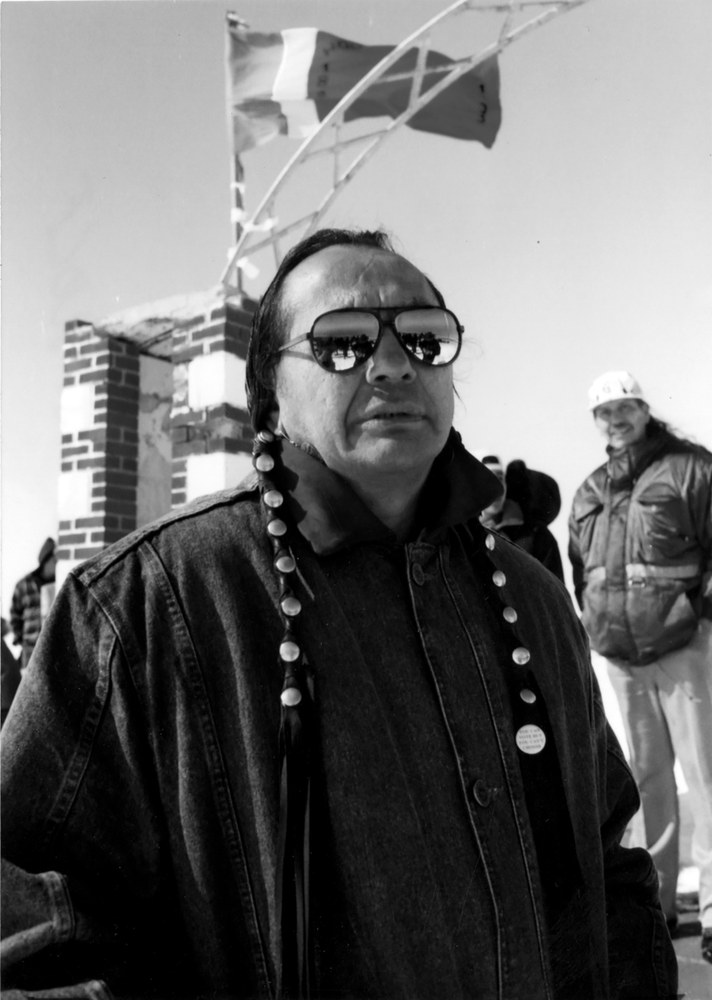
Russell Means spoke for many, but not all, of the Lakota people when he said, “The Crazy Horse Monument is a farce. … It’s a goddamn stone face in the Holy Land.”
So far the monument has cost more than $250 million, all of it private funding. So far we can see his face and his outstretched fingers. If the sculptors are determined to see this project through, to carve his chest all the way down to his narrow waist, to sculpt his hair flowing behind him, and his horse’s head, flowing mane, and muscled chest, the cost is going to be calculated in the billions, not hundreds of millions. And the timeline will span generations and centuries.
As I passed through the Black Hills a week or two ago, I decided to visit the site, pay my fee, and take a look around. It had been at least a decade since I was last there. I won’t say that the monument is nearly finished — in my view it will never be finished — but it has come a long way. The interpretive center has dozens of large-scale photographs showing the progress of the sculpting decade by decade. So far the “sculptors” have removed 10 million tons of mountain using the very industrial tools that enabled the United States to crush Native resistance between 1865 and December 29, 1889 (Wounded Knee). The paradoxes abound.
The Crazy Horse Monument campus has a restaurant and a snack bar, several museums and art galleries, an outdoor stage, and an educational and cultural center. As I approached the plaza, World Champion Hoop Dancer Jasmine Pickner-Bell (Hunkpati Oyate) and her family were performing a series of spirited hoop dances on the stage, accompanied by excellent historical commentary and Lakota drum music. Most of the hundred or so white people on the benches watched and listened with joy and awe, but a few tourists behind talked about recent and projected meals and gas costs, laughed in a forced way, and high-fived through the concert of what they apparently regarded as “performing Indians.” I was ashamed.
The indoor galleries are fascinating, in part because there is such a variety of good, bad, and indifferent paintings, a few of them velvet, mosaics, busts, vests, headdresses, etc. The collection just needs a refresh to make sure all the art is by Native Americans. The bookstore and souvenir shop is outstanding.
The Fight for the Black Hills
In 1868, after the Lakota defeated the U.S. Army in the War for the Bozeman Trail (Red Cloud’s War), the United States entered into a treaty with the Lakota that “granted” them the western half of today’s South Dakota in perpetuity, unless future U.S. government agents could convince three-quarters of all the adult males of the tribe to sign any new agreement. This has never happened. Six years later, Lt. Colonel George Armstrong Custer “discovered” gold during his problematic 1874 reconnaissance of the Black Hills. Prospectors immediately flocked to the hills. The U.S. government half-heartedly attempted to chase the miners off for a few months and then just gave up. Soon commissioners arrived from Washington, D.C. — in the usual way — to buy the Black Hills from the Lakota. But the Lakota wouldn’t sell Paha Sapa at any price. So the U.S. just took the Black Hills. Because it could.
In 1980 the U.S. Supreme Court, in an 8-1 decision, determined that the American government had illegally taken the Black Hills from the Lakota. Since the value of the Black Hills in 1877 had been estimated at $17.1 million, at 5% annual interest the money owed them (for a Fifth Amendment taking) had come to $105,994.52. That was 1980. At the moment, the U.S. owes the Lakota well over a billion dollars — and counting.
The Lakota refuse to take the filthy lucre. The Black Hills are not for sale. The 1868 Treaty is still in force. They vow never to cash the check. Crazy Horse refused to attend treaty negotiation meetings with white people. When he was asked by intermediaries if he would sell the Black Hills, he picked up a handful of earth and said, “One does not sell the earth upon which the people walk.”
The growing national Land Back Movement is going to catch up with the Black Hills one of these days. Most white people bristle (to put it mildly) at the idea of returning the Black Hills to the Lakota and Cheyenne, treaty or no treaty, on the basis of the “we stole it fair and square” principle. But since fully 60% of the 1.5 million acres in the Black Hills are publicly owned, it would be quite possible to deed large portions of it back to the Lakota without dispossessing the non-Natives who own the private 40%. At the very least, the public lands in the hills designated as National Monument, National Park, and National Forest could be co-managed by the Lakota Nation and the United States. Co-management is already practiced at Canyon de Chelly in Arizona, Bears Ears National Monument in Utah, and Glacier Bay National Park, among others.
What Now?
I know this will sound ornery to some, but I’d be happiest if Thunderhead Mountain had been left in its rugged geological state with a modest sign on the side of the road that said, “We thought of carving Crazy Horse on this Black Hills mountain, but then we realized that the greatest tribute we could offer him would be to leave the mountain alone, inviolable forever, as a sacred site belonging to the Indigenous people of America.”
What’s been done over the last 78 years cannot be undone. You cannot glue the mountain back together. Whatever we do next — finish it or leave it unfinished — we can agree to proceed with the utmost delicacy and respect, and to make sure that the Lakota are always at the table for any decisions we make together about what comes next.