
It felt like 1965. I sat looking at a small screen TV last week as Artemis II was launched on America’s first moon mission in over 50 years.
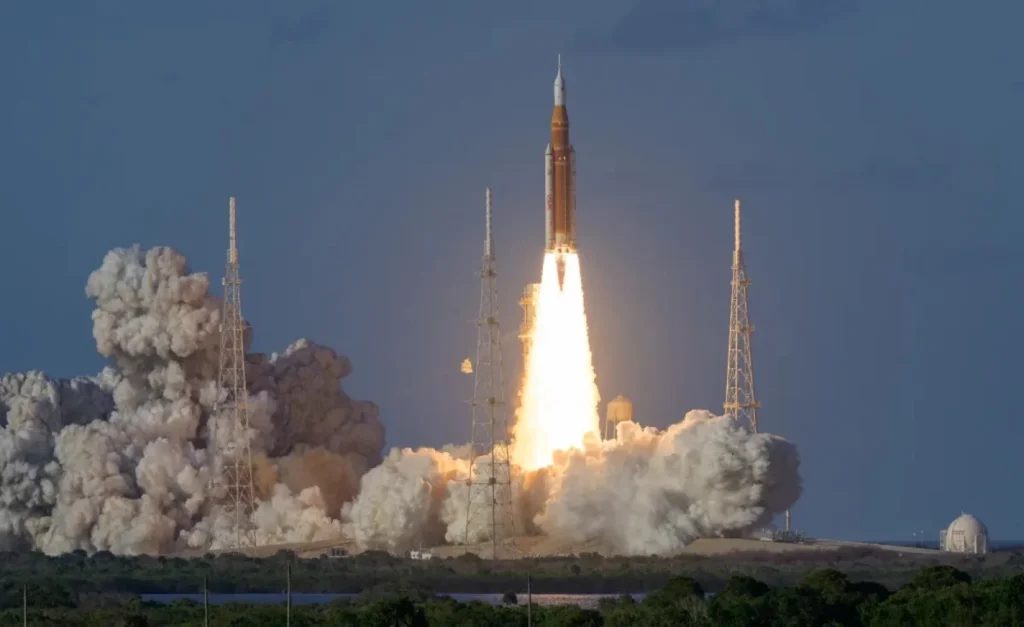
April 1, 2026: It was no April Fools. There was turmoil in the pit of my stomach. So many things can go wrong on top of a rocket filled with volatile fuels, before, during, and after liftoff. The American list is sobering.
— The Gemini 8 crisis on March 16, 1966, when Neil Armstrong and David Scott’s orbiting capsule spun out of control for several minutes before Armstrong found a very risky way to stop the spin. NASA scientists concluded that a few more minutes of that washer-dryer spin cycle would have killed the astronauts, even if the torque had not pulled their capsule apart. Problem: stuck valve.
— The Apollo I launchpad fire on January 27, 1967, killed Ed White, Gus Grissom, and Roger Chafee. Problem: a spark from worn electrical wiring and the cabin pressurized with pure oxygen.
— The Space Shuttle Challenger disaster occurred 73 seconds after liftoff on January 28, 1986, killing seven astronauts, including the schoolteacher, Christa McAuliffe. Problem: an inelastic O-ring on the launch rocket.
— The Space Shuttle Columbia disaster on February 1, 2003, that killed seven astronauts 16 minutes before landing. Problem: foam insulation broke off a booster during liftoff, damaging a shuttle heat shield panel, which allowed superheated plasma to work its way into the shuttle’s wing during reentry.
Seventeen astronauts.
It would have been such a setback if something terrible had gone wrong on April 1. A setback for space travel. A setback for America. Another setback for America. We’re about at tilt.
When the countdown was stopped at T-minus 10 minutes, I said out loud, “Well, that’s it for today.” I was about to turn off the television. But they “worked the problem” (as NASA lingo has it) and launched Artemis II within the designated safe launch window. Even then, every time one segment of the rocket array was jettisoned and another stage fired, the resulting exhaust plume reminded me of the Challenger, and I held my breath.
Hurray for public-private partnerships. We have entered a new Space Age, less dramatic than the first, more routinized, with infinitely better computer power, and vastly improved video resolution. China aims to land on the moon around 2030. India, Japan, Russia, and the European Space Agency are all vaguely planning moon missions. I no longer feel we have to get there first (again), but I would be appalled if we gave up the quest altogether, as I was during the decade when U.S. astronauts could only reach the International Space Station atop Russian Soyuz spacecraft (2011-2020).
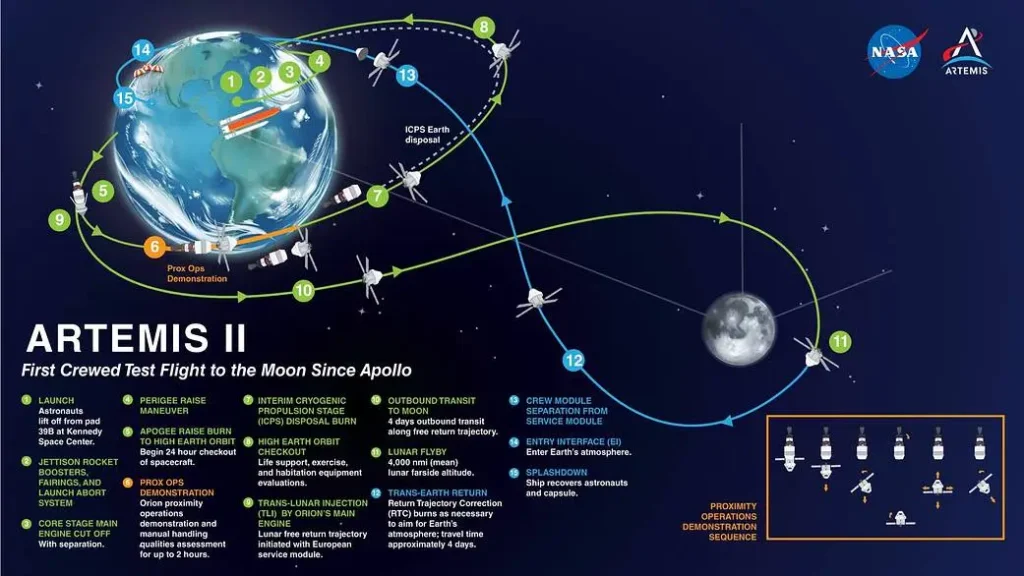
The four Artemis II astronauts will not orbit the moon. They will circle most of the way around and use the moon’s gravity to slingshot them back to Earth. They will not land on the lunar surface. The first planned landing mission will be Artemis IV, currently scheduled for 2028. But as they say on the Weather Channel, “Expect delays.”
Ho Hum
A friend of mine teaches the humanities at a prestigious college in New York state. The day after the launch, he was eager to talk with his students about the implications of this phase of space travel. What he discovered as he exulted in front of the class was that his students could not have been less interested in the Artemis II flight. Most had not watched the launch. Some had not even watched the inevitable highlight reels available on every social media platform. “Did you mock-shame them?” I asked. “No, I only mock-shame them for more important things,” he replied.
I checked the stats online. ChatGPT declared (Saturday, April 4) that Artemis II has not yet been launched (! — beware of early AI certitudes), but Google informed me that at least 10 million people worldwide watched the liftoff, and more than 400,000 were in Florida to observe the launch in person. Sound impressive? An estimated 650 million people worldwide watched the Apollo 11 moon landing on July 20, 1969, approximately one-fifth of the world’s population and 94% of American households.
As Hamlet senior puts it, “what a falling off was there.” I may have been holding my breath, but most of the American public was otherwise engaged.
One of the most interesting (and somewhat disquieting) phenomena of the last 50 years is the profound fragmentation of America. Dis-integration. This fissuring of America (and the American consciousness) means that we do not hold, see, do, or celebrate much in common anymore. The Super Bowl is perhaps our one remaining national ritual, with approximately 125 million viewers across the U.S., 100 million pounds of avocados purchased for guacamole, 12.5 million pizza deliveries, 325 million gallons of beer, and who knows how much legal (or illegal) marijuana is ingested. The Fourth of July still has something of a common feel across America (fireworks, brats, beer), and the Academy Awards get about 17 million viewers (down from 55 million in 1998, the year of Titanic). Long ago, we all used to watch The Wizard of Oz on the same Sunday in the spring, at the holidays, A Charlie Brown Christmas, and at Easter, The Robe. Those days are long gone. We used to fret about how much time young people spent watching television. Now we don’t. They are spending even more time on their devices.
When I was a child, we had only two (soon three) television networks, and you had to get up to change the channel. When something big happened in America or the world, we all tuned in to CBS Evening News to hear what Walter Cronkite would have to say about it, or North Dakota’s gift to the history of journalism, Eric Sevareid.
Now we are siloed into our echo chambers: FOX, MSNOW, NPR, PBS, Newsmax. Who has the depth, grace, wit, and insight of Eric Sevareid in our media today? Who can unite us in a moment of national triumph or national disgrace?
Unrepentant
I’m an unrepentant lifelong space program junkie. When I was a boy, I followed the Mercury, Gemini, and Apollo programs with obsessive zeal. I knew the names of all the astronauts. I knew throw weights, trajectories, types of rockets, and all the “firsts” (orbit, spacewalk, rendezvous, docking, woman in space), which, early on, went mostly to the Soviets. I was 100% certain that we must win the space race for national pride and global geopolitical dominance. We must prove the superiority of capitalism and freedom over godless communism! We go to the moon not because it is easy, but because it is hard! On launch days, our teachers would wheel in a clumsy metal rack with a small black and white television on top, and we’d watch the launch in grainy, low-resolution, with Walter Cronkite at his desk beyond the launch area intoning, “There has been another delay. These brave men, tucked into their specially designed seats high above Cape Canaveral, wait for the moment …”
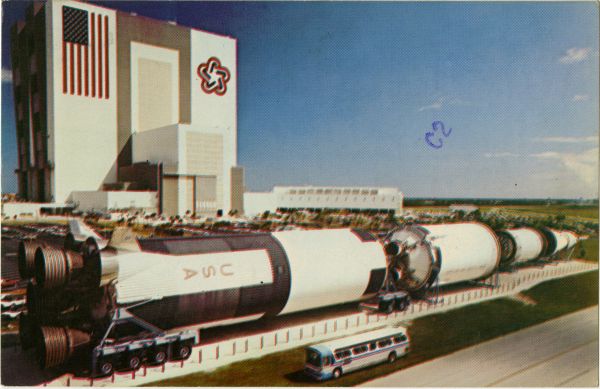
As we got closer to our New Frontier goal, I don’t think it’s too strong to say I worshipped the Saturn V rocket, Werner von Braun’s masterpiece. (He was a former serious Nazi. His motto was “We shoot for the moon,” but one of our best comedians altered it to, “We shoot for the moon and sometimes hit London.) Without von Braun’s rocket, we could not have ventured to the moon. The great Saturn V was as high as a 36-story building, with 7.5 million pounds of thrust. By the time it “slipped the surly bonds of earth,” the Saturn V could only deliver 107,000 pounds of stuff (a technical term) to the surface of the moon: the Lunar Excursion Module (LEM), the scientific instruments to be deployed, the U.S. flag (of course), two men in bulky spacesuits, a bit of food, cameras, and enough fuel to blast back up to the orbiting Command Module. Oh, and Buzz Aldrin’s communion kit. He was the first person ever to take communion on another celestial orb.
Twice I have visited the Kennedy Space Center in Florida, and both times I have walked the entire length of a standing Saturn V, filled with awe and wonder as I ran my hands over its smooth surface. When humans focus their energies, there is little they cannot accomplish. (Maybe we can save the Constitution.) The very idea of rocketing men and women to the moon is still flabbergasting after all this time. Among other things, it is a triumph of Newtonian mechanics. The Earth is rotating on its axis and orbiting the sun. The moon is orbiting the Earth. Launch a payload the size of a minivan from the rotating Earth 250,000 miles across the vacuum of space to another orb and (in the case of Apollo 12, November 1969) land it within 600 feet of its target. That’s like being on a fast-moving Merry-Go-Round and shooting a rifle at a pronghorn antelope running at 250 miles per hour, a mile away.
Then and Now
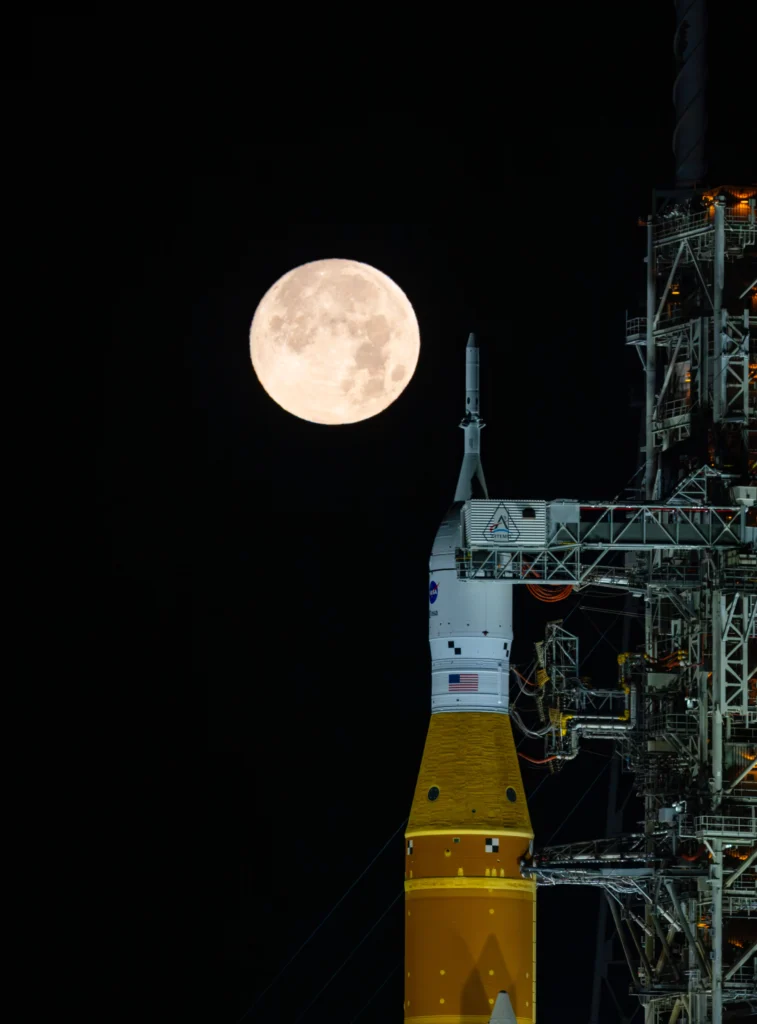
The Artemis II rocket bears the somewhat boring name of Space Launch System (SLS). It has a whopping 8.8 million pounds of thrust (1.3 million more than the Saturn V), even though it is 40 feet shorter than its more famous predecessor. During the countdown on April 1, I learned that four of the SLS rocket’s engines are recycled from the Space Shuttle program, and that the two external solid-fuel boosters are based on Shuttle program design.
What could go wrong?
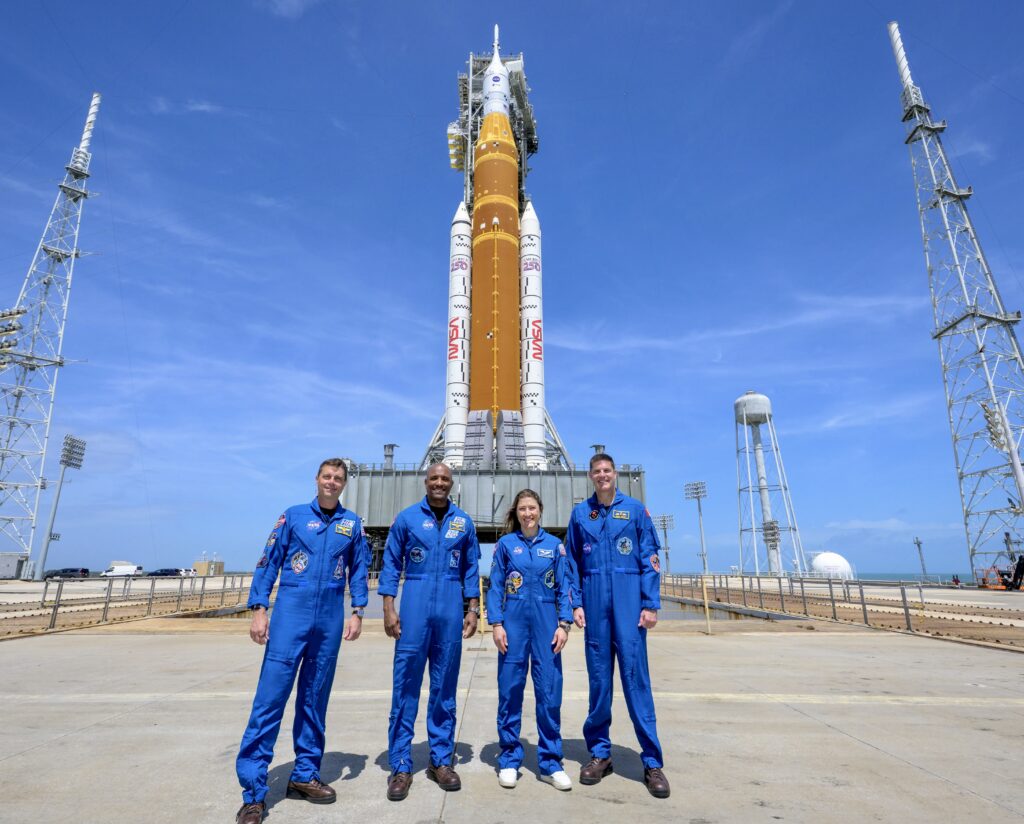
The new astronauts are undoubtedly extraordinary people, but I doubt that most Americans (including me) could name all four without looking them up. I do know these excellent facts, however: the first woman to the moon (Christina Koch); the first person of color to the moon (Victor Glover); the first Canadian to the moon (Jeremy Hansen); and the oldest person to the moon so far (Reid Weisman). I suppose he’ll be known as the Old Man of the moon hereafter.
We have come a long way. In 1961-62, NASA rejected the “Mercury 13” — women who trained just as strenuously as their male Mercury program counterparts. NASA’s logic (shared by John Glenn): astronauts needed to be test pilots, and since women could not be test pilots … And women may not have the “right stuff” to fly in space. Meanwhile, the Soviet Union sent its first woman cosmonaut, Valentina Tereshkova, on a three-day orbital mission on June 16, 1963. America’s first female astronaut in space was Sally Ride in 1983, fully two decades after the godless communists.
And So We Soar Into the Future
Artemis II is expected to splash down on Friday (April 10). I’ll be watching on my big home screen, anxious, expectant, thrilled. No guacamole, no beer. I hope I live to see us send a manned mission to Mars. I’ve been asked if I would go on a Mars mission (as the rare humanities scholar!) if there were no chance of returning to Earth. “In a second, without question, absolutely, where do I sign up?”
Further Reading
My home library has more than 200 books on the history of space travel, beginning with Sputnik 1957. If you are interested in reading more about humans in space, I especially recommend the following:
— Andrew Chaikin. A Man on the Moon.
— Norman Mailer. Of a Fire on the Moon.
— Thomas Jones. The Complete Idiot’s Guide to NASA.
— Tom Wolfe. The Right Stuff.
— Eugen Reichi. The Soviet Space Program.
— Margot Lee Shetterly and Robin Miles. Hidden Figures: The American Dream and the Untold Story of the Black Women Mathematicians Who Helped Win the Space Race.