
Clay interviewed noted historian and author Doris Kearns Goodwin at the Vail Symposium on August 25, 2026, about her newest book, An Unfinished Love Story: A Personal History of the 1960s.
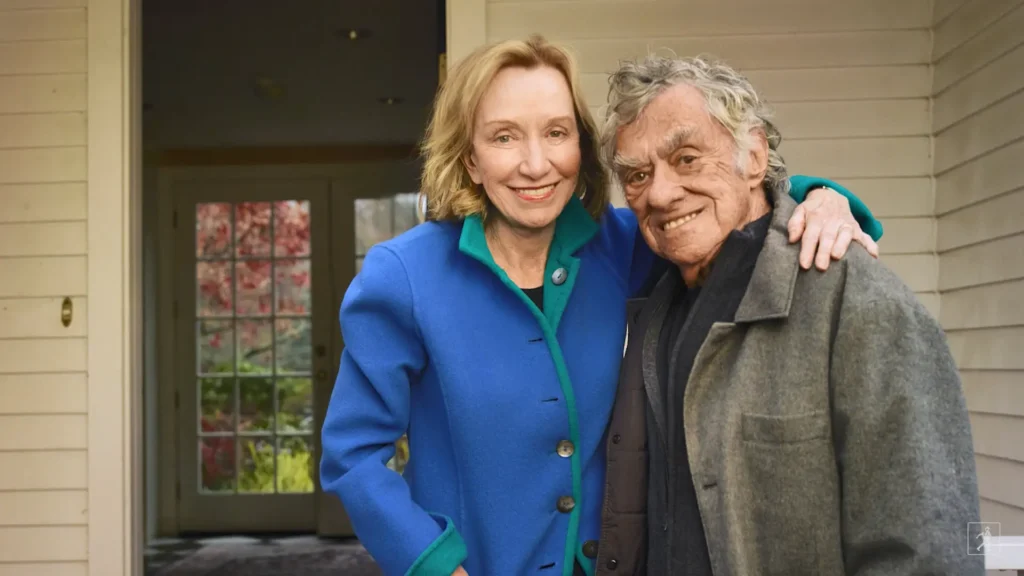
Last week I had the immense good fortune to spend 90 minutes on stage in Vail, Colorado, with one of America’s greatest historians, Doris Kearns Goodwin. She’s the author of nine highly regarded books, including her 1994 No Ordinary Time: Franklin and Eleanor Roosevelt: The Home Front in World War II, which won the Pulitzer Prize for History.
I’ve had the honor of working with her film production company twice — once on her 2022 two-part History Channel documentary miniseries Theodore Roosevelt, and more recently on her History Channel eight-part series, Kevin Costner’s The West.
Her most recent book, An Unfinished Love Story: A Personal History of the 1960s, is outstanding in every way. Never judge a book by its cover — or its title. When I first heard of a book by Doris Kearns Goodwin entitled An Unfinished Love Story, I groaned inwardly, but I read it immediately merely because she is one of my favorite authors. I loved it. I read it again recently, and now I am in love with it!
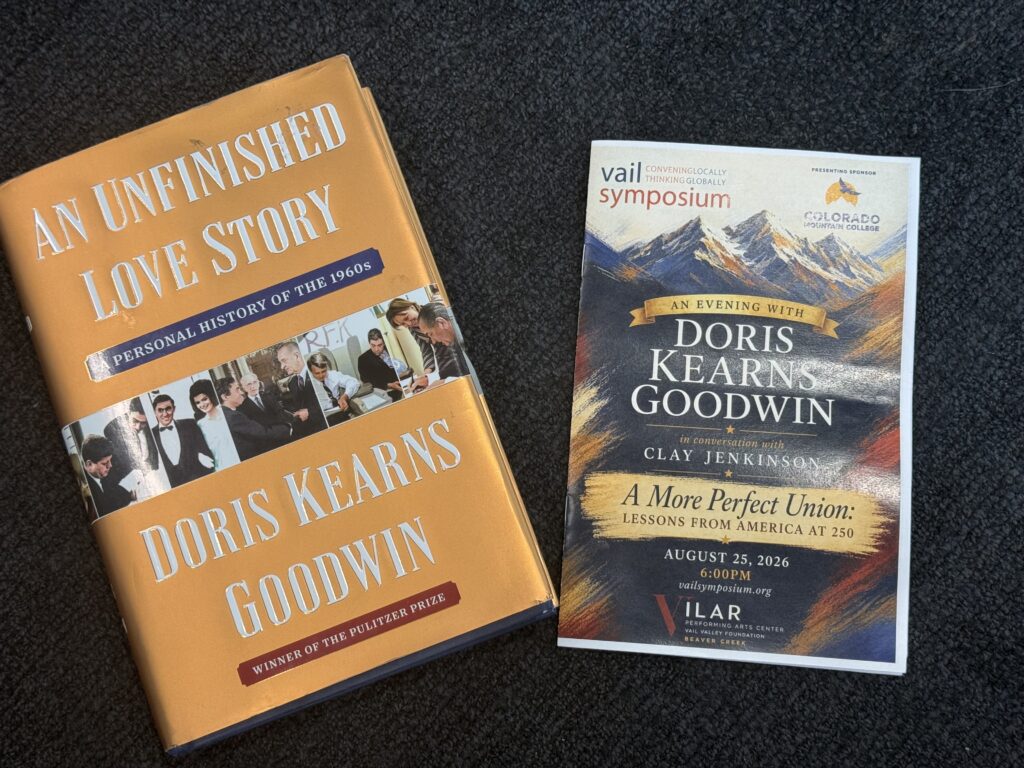
I recommend it without hesitation to anyone who wants to know more about the 60s, Lyndon Baines Johnson, the Kennedys, and what an exceedingly successful, mutually generous, mutually productive, and happy marriage can be. Unfinished Love Story is a celebration of the life and achievement of her husband Richard Goodwin (1931-2018), a principal adviser and speechwriter for two presidents and several other top-tier political figures of that amazing, chaotic, and violent era.
In truth, Goodwin was one of the great men of the post-World War II period in American history. He deserves a much more prominent place in American memory. Fortunately, he married a woman who could remind us of the stature he deserves in a single, splendid volume, full of great, often amusing, anecdotes, and the best kind of “you are there with us in the room” lucidity.
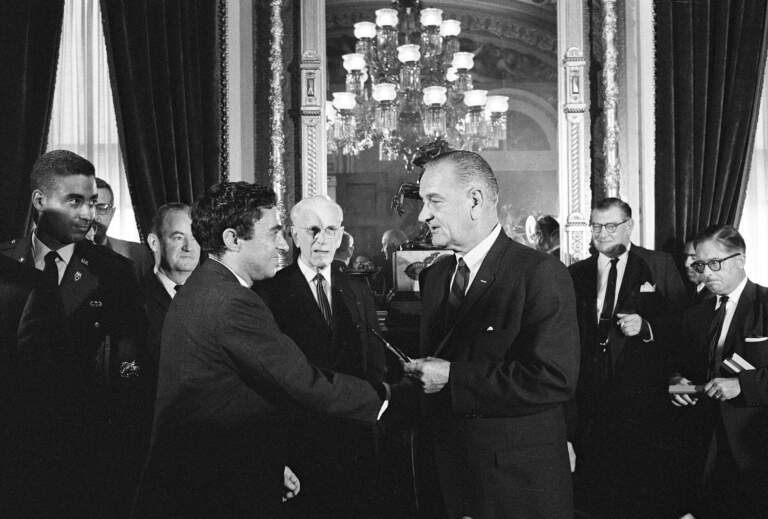
To call Richard Goodwin a speechwriter does serious injustice to his genius. He wrote most of LBJ’s greatest speeches, including “the Great Society” (May 22, 1964), the magnificent “We Shall Overcome” speech (March 15, 1965), and “To Fulfill These Rights” (June 4, 1965). The day after LBJ delivered the “We Shall Overcome” speech, Dr. Martin Luther King sent the president a telegram:
“Your speech to the Joint Session of Congress last night was the most moving, eloquent, unequivocal and passionate plea for human rights ever made by any president of this nation.”
Dr. Martin Luther King
Richard Goodwin didn’t just transform Johnson’s deep passion for social, economic, and racial justice into English prose. He invented the phrase “Great Society,” and fastened on the last line (“we shall overcome”) of the president’s great civil rights speech after hearing it sung on the streets around the White House after spending almost an entire night composing the joint address to Congress. To call Goodwin a speechwriter is like calling him a “wordsmith.” There are hundreds of speechwriters, but only a handful of the truly great ones who find a way to embody the soul of their boss at the same time they discern the dynamics of the zeitgeist — Peggy Noonan, Theodore Sorenson, and Goodwin. Goodwin was himself a passionate idealist who worked with two idealistic presidents, one a cool and somewhat detached idealist (JFK), the other a man who was not a natural orator, certainly not a rhetorician, but who believed in American justice much more viscerally than did his predecessor (LBJ). It’s one thing to write a competent speech for a political leader, but it is a far greater gift to be able to find the language to make another person’s most authentic vision of the world soar off the teleprompter. LBJ was not (much) exaggerating when he said Goodwin was “my voice, my alter ego, my mind.”
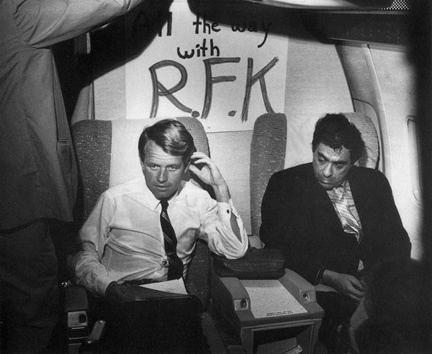
Goodwin was a Forrest Gump figure for the 1960s. He spent 60 days on the campaign plane Caroline as John F. Kennedy crisscrossed the country in quest of the Democratic nomination for president. “It was 60 straight days, unremitting, sleepless nights,” Goodwin wrote, “on the Caroline, which was a twin-engine propeller-driven plane, bouncing around the country.” He helped prep JFK for the critically important and (it turns out) consequential first debate with Richard Nixon. He played a role in the early development of the Peace Corps, one of JFK’s greatest New Frontier programs. He helped to shape and implement JFK’s Alliance for Progress, his attempt to reset U.S. relations with Central and South America. While attending a conference in Montevideo, Uruguay, on August 17, 1961, Goodwin met for more than three hours in the middle of the night with the Argentine-born Cuban revolutionary Che Guevara. This was just after America’s disastrous participation in the Bay of Pigs invasion on the south coast of Cuba. Guevara, whose immediately recognizable visage graced the dorm walls of about half of America’s college students in the 1960s, especially young men, told Goodwin that the Bay of Pigs fiasco was actually a blessing for Cuba, because the Cuban people immediately rallied around Fidel Castro and solidified his regime.
Goodwin was in the White House (not Dallas) when John F. Kennedy was assassinated on November 22, 1963, and at Jacqueline Kennedy’s indirect request sprang into action to make sure the funeral echoed Abraham Lincoln’s April 1865 funeral as closely as possible, including the construction of a nearly identical catafalque in the East Room. He also scrambled heroically to meet her request that an eternal flame be ready (on impossibly short notice) to light at the burial in Arlington National Cemetery. He was with Robert Kennedy at a Malibu beach house on the day of the critical California Democratic primary just hours before Sirhan Sirhan killed the New York Senator. He witnessed the mayhem of the Democratic National Convention in Chicago in the summer of 1968.
And so on. And the question you inevitably ask after reading all of this is how JFK’s speechwriter Theodore Sorenson can be so well remembered and Goodwin not so much. WE are fortunate that Doris KG has rebalanced our understanding of the decade.
They were married for 42 years. He died in 2018 before they could work through all the 300 boxes of his “papers.”
I’ve spent the last months trying to think of another person who has done greater service for a deceased spouse than Doris Kearns Goodwin. She has resurrected Dick Goodwin from the oblivion that one of our mutual heroes, Theodore Roosevelt, said engulfs virtually every historical figure, no matter how exceptional, except perhaps (said TR) Napoleon, Julius Caesar, Lincoln, or George Washington. In doing so she has also provided one of the best windows we have on the fabulous and tumultuous 1960s, and despite all the really horrific things that happened during that decade (assassinations of JFK, RFK, Martin Luther King, Malcolm X; the catastrophe of Vietnam; the race riots that burned out the core of the majority of major American cities, the use of vicious dogs and fire hoses against nonviolent protestors in Birmingham and Selma. …) has written a deeply compelling and delightful memoir.
Who could have revived our admiration of Dick Goodwin better than Doris KG? I’ve read several of his books (including Promises to Keep: A Call for a New American Revolution), and though they are good, the fact is that his spouse is a better writer than he was, at least of full-length books. (I can hear her scolding me a little for this opinion, but it’s true.) I read her first book, Lyndon Johnson and The American Dream, when I was still a college student, and was shocked to learn how crude and bullying such a great man could be (among other things, conducting meetings, including with her, while he was relieving himself on the toilet). I’ve read every one of her books now, some twice, and I can attest that she has become a better and better writer over the decades. By the way, according to Google Analytics, she has published 5,389 pages and 1,795,000 words — so far. And yet, she has not written a book about the Founding Fathers, including one of the best of them, Thomas Jefferson. There is still time, Doris!
Richard Goodwin had a reputation (well deserved, apparently) of being brash, aggressive, sometimes arrogant, and he was rarely seen not chomping even on the cigars he hadn’t lit. I try to imagine how such a lovely, generous, self-effacing, and decent woman negotiated a successful relationship with a man with such an oversized personality (it’s none of my business, of course). Still, I think Dick Goodwin’s larger-than-life soul contributed to Doris’ intellectual toughness and rigor.
But here’s the amazing thing about her memoir, The Unfinished Love Story. It would have been a great book even if she never mentioned her late husband. Doris Kearns witnessed that revolutionary decade even before she fell in love with Dick Goodwin. Here’s just one of her origin stories.
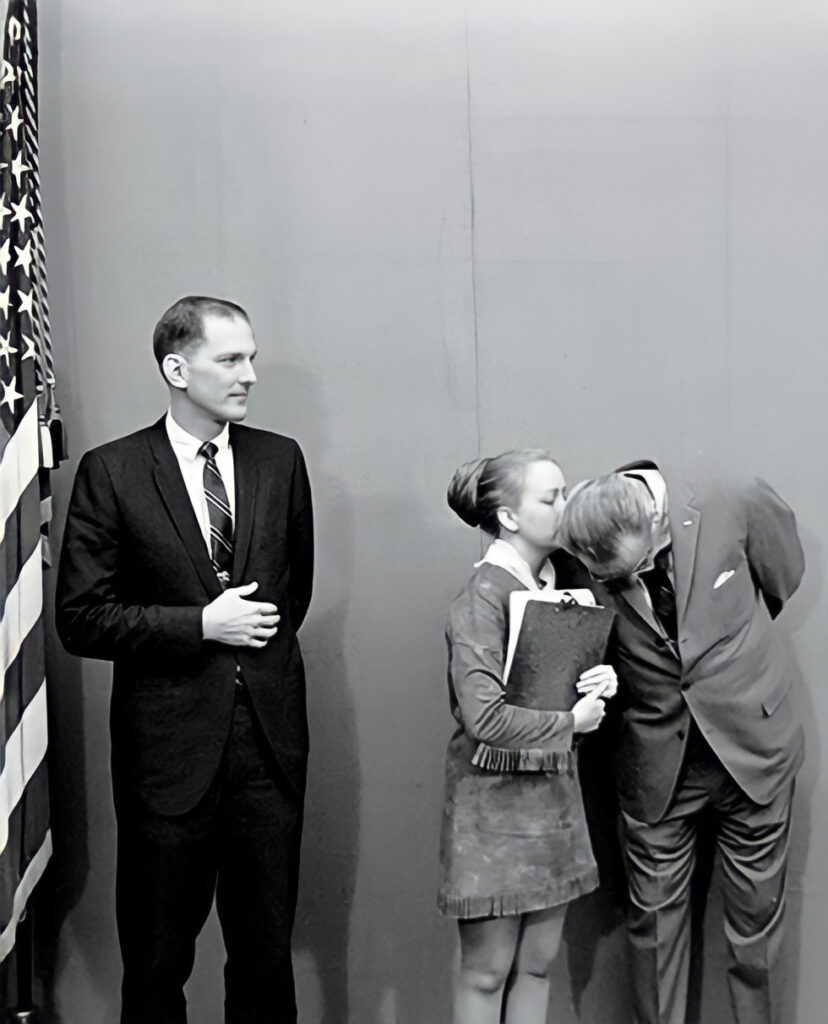
At the beginning of her career, at age 24, while she was still finishing up her doctoral program at Harvard, she was selected as a White House Fellow. She, too, was a young radical, deeply committed to civil rights, becoming alarmed by the escalation of America’s colonial war against North Vietnam, and the way the war distracted from the promise of the Great Society. Just when she was selected for the prestigious fellowship (one of the tiny handful of women at the time), she had co-written a snarky op-ed piece for the New Republic that the left-leaning journal chose to print (May 13, 1967) under the incendiary title, “How to Remove LBJ in 1968.” Doris was deeply embarrassed, certain that her fellowship would be rescinded, and worried, too, that LBJ might cancel the whole White House Fellows program in a pique of rage. Instead, at an introductory dinner for the Fellows, LBJ danced with her, made it clear that he was aware of her insurgency, and told her she would be going to work for him.
He told an aide, “Oh, bring her down here for a year, and if I can’t win her over, no one can.”
Thus was launched the career of one of America’s best-loved historians.
During her thoughtful and often enchanting commentary in Vail, Doris was interrupted by strenuous applause a dozen times, and at the end she received a thunderous standing ovation.
In all that time, she did not say a single negative thing about anyone, including Richard Milhouse Nixon. That takes some real grace! The audience of thoughtful, prosperous, and centrist Colorado citizens was visibly relieved to hear her essential message — we will get through this — from someone who has written about some of the most challenging moments in American history — the Civil War (Team of Rivals), World War II (No Ordinary Time), and the calamitous 60s.
There is no Pollyanna in Doris Kearns Goodwin. She is fully aware of how serious the current crisis is — a runaway presidency, a paralyzed Congress, media tribalism, a distracted and bewildered public, loss of public respect for almost every national institution, and a 40 trillion dollar national debt that is going to eat the American economy. But her profound understanding of our history suggests to her that we will, to invoke a trope not used by Richard Goodwin — see light at the end of the tunnel one of these days.
Afterward, at a small reception in one of Vail’s House Beautiful mountain homes, I quoted her old friend Sanford Levinson, one of America’s premier scholars of the Constitution. We brought Levinson (now emeritus at the University of Texas at Austin) to Vail a few months ago to talk about the crisis of the U.S. Constitution (“Is It Broken?), along with my close friend Beau Breslin of Skidmore College in New York, who has written excellent books on the subject and is a regular guest on our podcast Listening to America. They both believe the U.S. Constitution is broken.
As we closed a spirited evening conversation about the Constitution, I asked Levinson what it will take to turn the American republic around (assuming we can still call whatever this is a republic). He paused for a moment and said one word: catastrophe. The audience gasped and laughed nervously, but he meant it. It would take economic collapse or a serious war (serious for us!) or something even more grave than 9-11 to inspire (force?) the American people to get serious again.
Doris Kearns Goodwin shook her head. “I have great respect for Sandy, and I see him from time to time when he is teaching or lecturing at Harvard, but I don’t agree with him on this.”
We must all hope she is a great prophet as well as a great historian.