
Last week, I spoke at a symposium on race and the American Revolution. This essay is the result of my deliberations for that event and is one in a series of essays I’m writing reflecting on a range of issues as America approaches its 250th birthday.
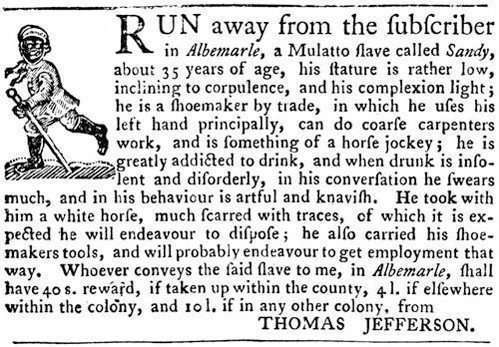
You don’t have to be a fan of the 1619 Project to know that race has been one of the handful of most troubling and still unresolved issues of American history. If you place the beginning of America at the landing of English settlers at Jamestown, Virginia, in 1607, it wasn’t even 20 years after the “founding” that enslaved Black Africans first arrived on the shores of Virginia, to be sold as an unpaid workforce to white colonists, mostly planters. Thomas Jefferson, the “apostle of liberty,” was born in 1743. By then, there were just under a quarter of a million enslaved persons in the colonies. By 1790, 694,207. By 1826, the 50th anniversary of the soaring Declaration of Independence, which declared that “all men are created equal,” about 1.7 million. By 1860, on the eve of the Civil War, just under 4 million Americans were held in bondage, bought and sold like other plantation property and livestock. In his Second Inaugural Address, Abraham Lincoln was struck by the cruel irony of white people “wringing their bread from the sweat of other men’s faces.”
It’s uncomfortable to talk about this — the “original sin” of America — but how can we celebrate, commemorate or observe (take your pick) the 250th birthday of the United States without acknowledging that slavery, racial injustice, discrimination, apartheid, extra-legal torture, whippings and lynching are central to any understanding of the sweep of American history? The preferred narrative of white Americans goes something like this: A) slavery is bad. B) Lincoln freed the slaves with the Emancipation Proclamation (Jan. 1, 1863). C) For a long time, the South did everything it could to resist the 13th, 14th and 15th amendments, the first of which abolished slavery (1865), the second, which defined American citizenship and extended the Bill of Rights into the states (1868), and the third, which granted Black males the right to vote (1870). The resistance included Jim Crow laws, including poll taxes and rigged literacy tests, Black Codes and “separate but equal” public facilities. D) But beginning with Brown v. Board of Education in 1954, and the Civil Rights laws of 1964 and 1965, the problem was mostly “solved.”
So, Get Over It Already!
This is about as far as most white people are willing to go, and if there were a pop quiz on the history of race in America, a large percentage of white Americans would get low or failing grades. Nor is the “consensus” narrative quite accurate. The Emancipation Proclamation of 1863, which almost no American is unaware of, didn’t “free all the slaves.” Lincoln’s great pronouncement was intended only to free slaves in the states that were in rebellion (the Confederacy), and in Southern states the Union armies had subjugated, not in any states that had remained in the Union. Besides, there was no enforcement mechanism to ensure the proclamation achieved its goal.
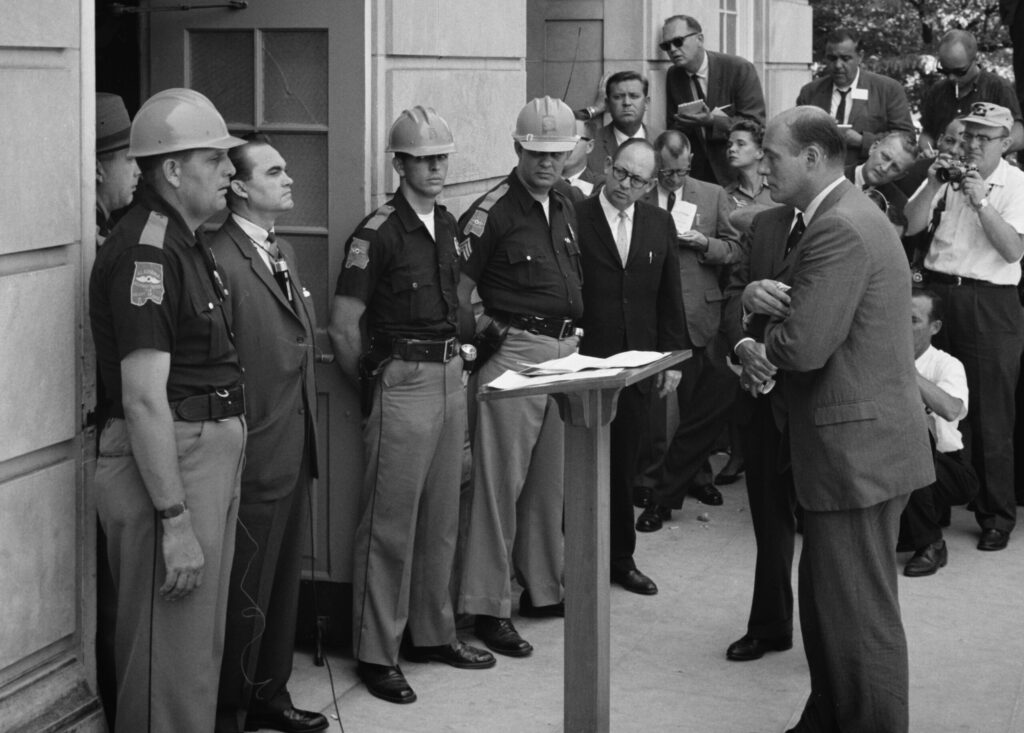
Brown v. Board of Education (1954) sought to integrate America’s public schools, especially in the South, but it was resisted with all the ingenuity of determined bigotry. The great majority of white children were pulled out of public schools throughout the South and placed in all-white or nearly all-white private schools. It took the arrival of federal troops to enforce Brown v. Board of Education in K-12 public schools and also at Southern universities. We all remember that Alabama Gov. George Wallace, whose inaugural promise (Jan. 14, 1963) was “segregation now, segregation tomorrow, segregation forever,” stood in the doorway of the University of Alabama to prevent two Black students, Vivian Malone and James Hood, from entering. And it was not just the South. Some of the worst anti-busing riots of the era occurred in Boston between 1974 and 1976. Much of the American South is still essentially segregated, particularly in housing.
How Far We’ve Come
Only three African Americans were ever featured in the 249 episodes of The Andy Griffith Show (1960–68), two on Leave It to Beaver (234 episodes, 1959–63), none on The Adventures of Ozzie and Harriet (435 episodes, 1952–66), and only a tiny handful in the 431 episodes of Bonanza (1959–73). As every Star Trek lover knows, the first interracial kiss on American television came on Nov. 22, 1968, when Capt. James T. Kirk kissed Lt. Uhura in an episode called Plato’s Stepchildren.
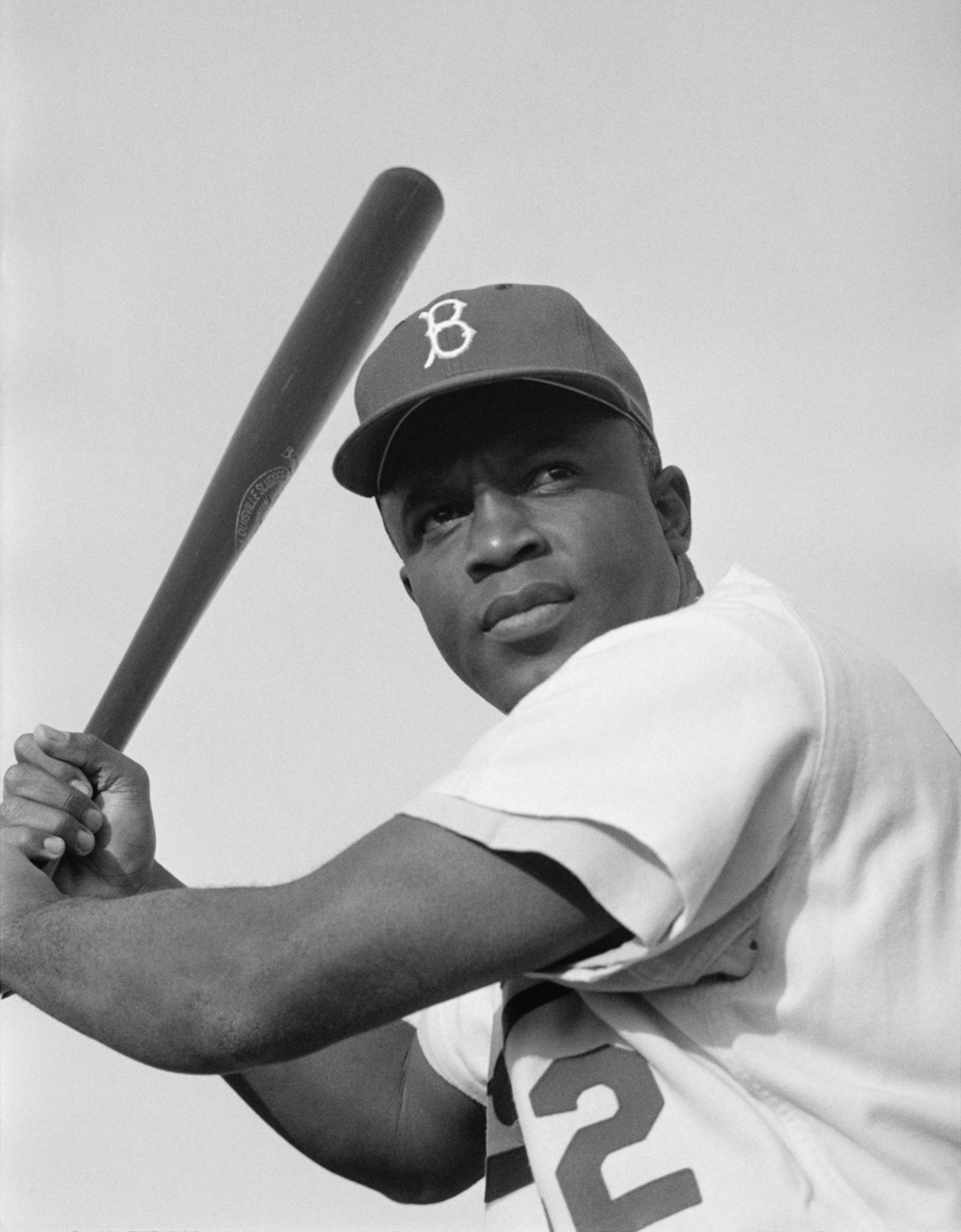
Jackie Robinson broke the color barrier in professional baseball in 1947. That didn’t exactly open the floodgates. The last team to integrate was the Boston Red Sox, and not until 1959, a dozen years later. As late as the late 1970s, African Americans who ventured into the “wrong” casinos in Las Vegas were met by plainclothes security guards, escorted “politely” to the door and told that they would “be more comfortable” if they moseyed down the street to one of the few casinos that admitted Blacks.
It is not all bad news, of course. Despite the far right’s current attempt to roll America back to a mythical white supremacist past that never was, there is really no turning back. I write this on a busy Saturday morning in a popular coffee shop on Granby Street in Norfolk, Virginia, where Black people and white people mingle in easy harmony. I see plenty of interracial friends and interracial couples walking on the street and gathering in clusters, and nobody is jeering. And yet, yesterday, at the America at 250 symposium I’m attending, we were informed that one in four Black residents of Norfolk (population 231,000) lives in poverty. In Norfolk, there are still predominantly Black neighborhoods, including Huntersville, Broad Creek and Titustown, among others.
We’ve come a long way, but there is a long way to go to achieve racial equality and racial harmony. On any given day out in the heartland, I can hear a white person say, “We’ve done what we can. Now it’s time for Black people to get their act together, build stable families and stop committing crimes.” OK, sure, but the hard work of creating a nation of racial reconciliation and harmony is going to have to be done mostly by us white folks. We weren’t kidnapped from our birth countries, torn from our families and friends, crammed shackled into fetid slave ships where one in five or two in five perished in transit, sold in a foreign land to the highest bidder, whipped (or lynched) for looking crosswise at a white woman and generally terrorized for four centuries to make sure we knew our place in America.
Many white people will say, “That was then, and this is now.” And yet every few months (and only thanks to the ubiquity of video cameras) we hear of another appalling incident of race violence perpetrated by angry white men or trigger-happy cops: Trayvon Martin, Florida, 2012; Michael Brown, Missouri, 2014; Breonna Taylor, Kentucky, 2020; George Floyd, Minnesota, 2020. White parents don’t have to lecture their teenage sons on how to survive a routine traffic stop — driving while Black is a potentially dangerous gamble in many of our cities.
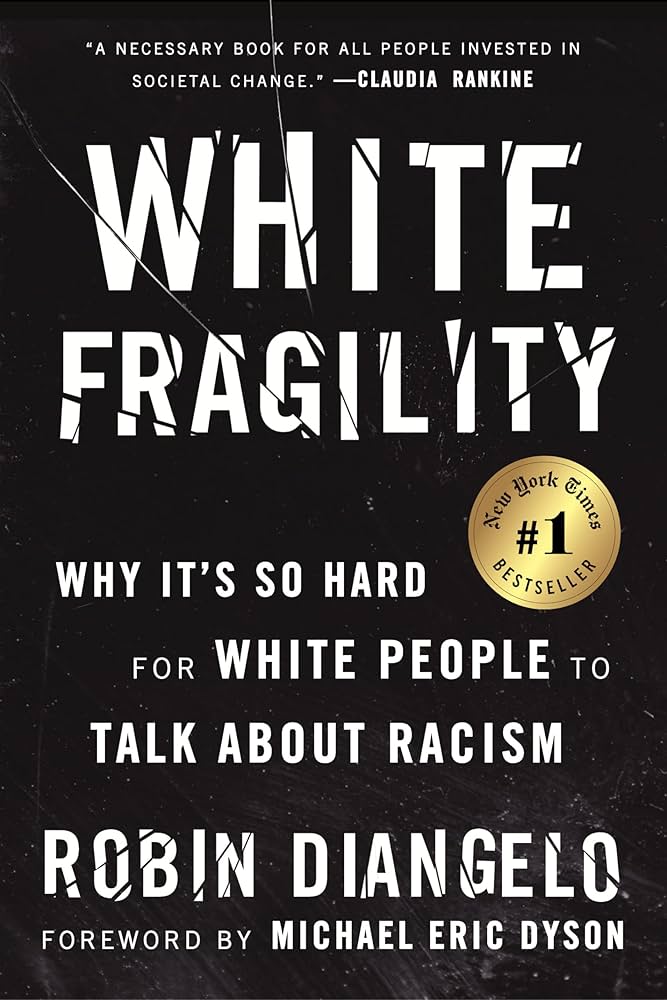
After the George Floyd killing on May 25, 2020, I decided it was time to do some serious reading and even more serious reflection. Within a month or so, I read Robin DiAngelo’s White Fragility: Why It’s So Hard for White People to Talk About Racism and Carol Anderson’s White Rage. I recommend them highly to everyone who cares about this issue. White Fragility begins by outlining all the ways white people bat away their (our) complicity in the unresolved race tensions and discriminations of America: “I don’t have a racist bone in my body;” “Hey, I have Black friends!” “I ain’t ever owned no slaves;” “All that happened 150 years ago;” “My forebears came from Germany (Italy, Ukraine, Poland, etc.) long after the Civil War;” “Only bad people are racist and I’m not a bad person;” “Structural racism is a crock.” Etc.
I can attest to the accuracy of DiAngelo’s summation. A few years ago, I encouraged a privileged white family in the Seattle area with three highly educated daughters to read White Fragility with me and then have a Zoom meeting to talk about it. (By the way, I do not present myself as emancipated from racial insensitivities and complicities: not at all.) My friends all said they read the book carefully and with an open mind. And yet when we Zoomed and the discussion began to flow, they all (some more than others) trotted out exactly the evasions, dodges and firm denials of DiAngelo’s opening chapters as if on cue. Turns out they didn’t have a racist bone in their bodies.
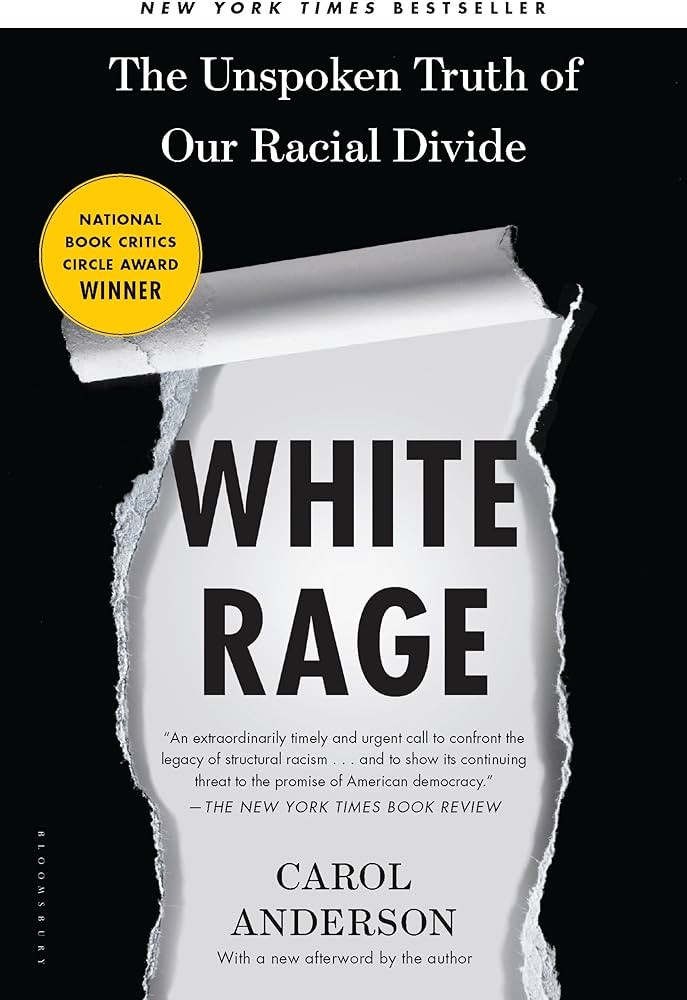
If White Fragility is an analysis of how hard it is for us, white people, to talk about this vexed subject, White Rage is even harder to absorb. The book is essentially a history of Black America’s relations with the larger white community. It’s a profoundly disturbing litany of white hatred, white discrimination and white violence against African Americans, from 1619 through the presidency of Barack Obama. Summary? A significant proportion of white people have never wanted to share America with Black people unless they can control the whole range of Black activities and aspirations in a way that secures their permanent subordination or even subjugation. As I reread White Rage last week preparing for the symposium I’m attending on Black lives during the American Revolution, I had to get up every few pages to shake off what might be called my triple shame: first, that white treatment of Black Americans over the last 400 years, and even recently, even now, has been much worse than we think. Second, though I regard myself as a pretty well-educated person, my ignorance of Black history is appalling. In fact, I’m making up a quiz to distribute among my friends (those who wish it) about incidents in American history that every American should know. I’d score C or C-. Third, I won’t say we are all complicit (you have to decide for yourself), but I know that I am complicit in the race tragedy of American history. Even if we “don’t have a racist bone,” from earliest childhood we absorb a long series of notions, misrepresentations, mythologies, stereotypes, inadvertent racial insensitivities and real or inadvertent bigotries that we are largely unaware of, in questions of crime, dress, music, sports, language, politics and much else.
Suppose we could all start over and wipe away the coding and cultural constructions we carry around, like bystanders in the Men in Black movies. In that case, we can begin again now with dramatically better social results. But we cannot escape history. We can only work hard to acknowledge our complicities and struggle to overcome them.
Even the deeply racially compromised Thomas Jefferson, who wrote in his only book, Notes on the State of Virginia, of “this unfortunate difference of color,” acknowledged that his own racism was formed by the institution of slavery, in which he was deeply complicit. He wrote, “The whole commerce between master and slave is a perpetual exercise of the most boisterous passions, the most unremitting despotism on the one part, and degrading submissions on the other. Our children see this, and learn to imitate it; for man is an imitative animal. This quality is the germ of all education in him.” He said, “The man must be a prodigy who can retain his manners and morals undepraved by such circumstances.” This was the closest Jefferson ever came to acknowledging his guilt for owning slaves, buying and selling them furtively, tracking them down when they tried to escape and having sexual relations with at least one of the people he owned. Jefferson freely acknowledged that his ownership of slaves was a fundamental violation of his core values and of the ideals of the American Revolution. And, in Notes on Virginia, he said that God was unquestionably on the side of the oppressed slaves (and free Black men and women), “and his justice cannot sleep forever.” And yet he only freed eight (of approximately 600) enslaved people he owned in his lifetime.
I write about this uncomfortable subject not because I take any joy in it, but because I have spent the last couple of years wandering America, interviewing a wide range of people and reading about our history. I believe it would be irresponsible (and tragic) to commemorate our 250th birthday without wrestling hard with the “elephants in the room,” of which this is only one of four or five that any responsible civilization must address as it looks to its past and attempts to envision its future. I know some of my readers will reject some or all of what I have written here, but I simply ask that you join me in reading these books (or others), discussing these issues with your family and friends and not just throwing up your hands or shaking your fists. We have a lot to answer for as a nation, if not as individual Americans.