
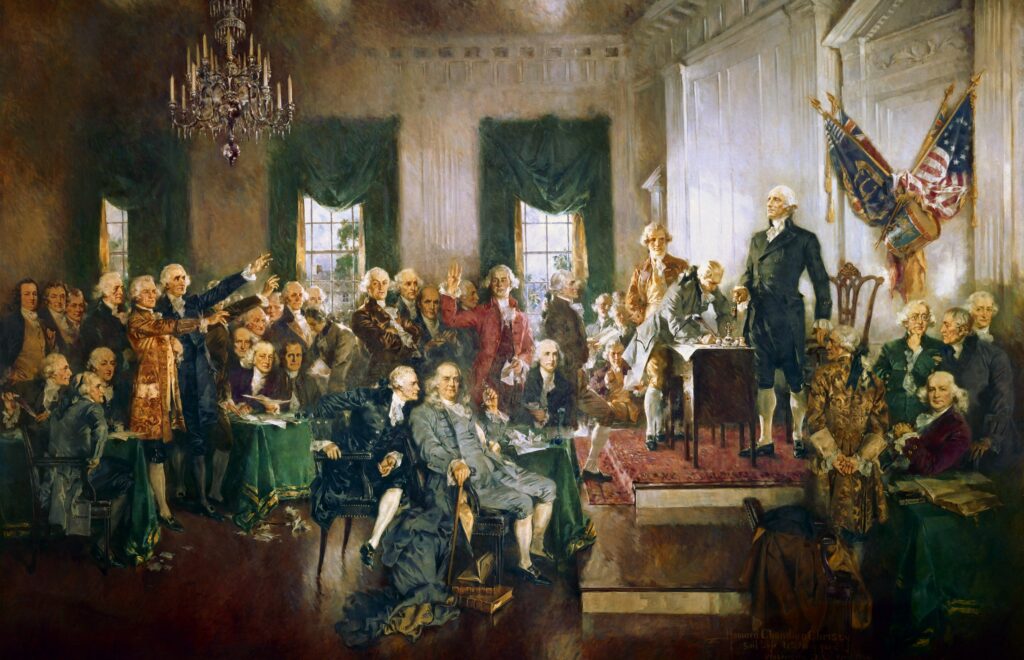
When the Founding Fathers met in Philadelphia in the summer of 1787 to craft a new constitution, they worked strenuously to cage the “dogs of war” by way of constitutional restraints.
For me, it is just this simple. What gives the United States the right to assassinate the leader of another sovereign nation? How can that ever be legitimate? Under what interpretation of international law can it be ok for one nation to kill the leader of another? We didn’t do this with Hitler or Mussolini or Stalin or Fidel Castro (though apparently we tried with Castro). We Americans have been through this sort of decapitation in my lifetime. When John F. Kennedy was assassinated on November 22, 1963, it changed the whole tenor of American life. Do we expect Iran just to absorb this blow? What would we feel compelled to do if some other nation (not approving of our leader or our international policies or our religious system) assassinated our president? There will be desperate ramifications in the days, months, and years ahead. Just what those ramifications will be we don’t yet know, but we cannot expect Iran to shrug this off or dance in the streets around liberty poles.
Have we as a nation thought through what Iran and the Middle East are likely to be a year from now, five years from now, in the aftermath of this act of appalling aggression? We get it that the people of Iran are oppressed. If that were our criterion for foreign interventions and assassinations, the list of countries to bomb would be very large.
It’s worth wondering if our air attacks on Iran were the work of the United States (as a great collective of 340 million individuals) or of one petulant and erratic man. The most democratic of our Founding Fathers, Thomas Jefferson, believed that power is legitimate only when it is diffused among and across multiple individuals and entities. Power concentrated in the hands of a single person is always dangerous and open to self-dealing, delusion, whimsy, miscalculation, and corruption. No one person can see enough, know enough, or consider enough to be trusted with unilateral power, especially military power. A five-hour meeting of the key American stakeholders would have raised all of the questions we should have worked through before lobbing the first cruise missile at Tehran. That consultation would have spread the wisdom around, and, this is important too, the responsibility for our actions. Diffuse power through a cabinet, the Joint Chiefs of Staff, the Congressional Gang of Eight, international organizations (including the U.N. and NATO), the House and the Senate, and you are much more likely to avoid colossal mistakes.
Obviously, if there is a clear and present danger to American security or the likelihood of an imminent attack on the United States itself, the president must have the authority to act with minimal hurdles. Even then, any sane president would seek all the advice he could get in short order, including the advice of skeptics and dissenters.
The Gravity of War
War is so grave that the Founding Fathers did everything in their power to prevent any one individual from going it alone. Some of these restraints were built into the Constitution of 1787. Others are implicit in the idea of a republic and norms born of the long history of human geopolitical disasters. Here’s a list of how republics could attempt to avoid what just happened:
— If the president (any president) had to send one of his sons or daughters into any war he started, how many wars would we fight? When the Roman Republic was at its best, when the British Empire was at its best, the nation’s leaders understood that they must be willing to put their own children in harm’s way if they went to war. You can imagine what a sobering effect this would have on any war that is not absolutely necessary. Our own Theodore Roosevelt sent all four of his sons into World War I. He would have gone to France himself — leading one last volunteer unit of Rough Riders — if President Woodrow Wilson had permitted it, but TR told his sons they were not only going to war in Europe and the Middle East, but they must not let their commanders keep them safely at desk jobs behind the lines. They must face the mayhem at the front like any other American soldiers. All four were wounded; one (Quentin) was killed in battle.
— If we had to pay for every one of our wars with ready money — a direct and immediate increase in taxation — and could not just charge the costs to the national debt, how many wars would we fight? Imagine if, in 2003, President George W. Bush had gone on national television to say, we need to go to war against Iraq and Saddam Hussein, so I’d like you to take out your checkbook and write a check for $28,500 per household, for that’s what it’s going to cost. Knowing they would have had to pay for it, do you think the American people would have chosen to go to war to rid Iraq of its “weapons of mass destruction”?
— If we had a national draft, so that every able-bodied man or woman between the ages of 18 and 45 would be placed in a lottery, from which the great majority of our soldiers would be recruited, with virtually no deferments, how many wars would we fight? Our all-volunteer army is mostly populated by young men and women from working class and heartland backgrounds, young patriots who believe in national service and (for the most part) are attempting to get a leg up economically (generous signing bonuses, good wages, the G.I. Bill of Rights when they return, student loan repayment, food and housing allowances, veteran health care benefits for life). Take even a couple of those economic incentives away, and how many soldiers could we recruit per annum?
— If we never went to war without a resolution of endorsement from the United Nations, how many wars would we fight?
— If we had to get the endorsement (not just grudging acquiescence) from NATO (which we created in 1949) and the majority of our closest friends in the world (Canada, Britain, Germany, Italy, France, Australia), how many wars would we fight?
War is Uniquely Problematic
War is the gravest thing a nation might ever have to do. It’s not like funding or defunding the Department of Education, or building a national highway system, or engaging in a space race to the moon. It’s about sending our sons and daughters, our grandsons and granddaughters, into harm’s way, from which they might never return or might return with grievous mental and bodily injuries. We are asking them to kill other human beings if necessary and to take the risk of being killed themselves in the process. This is not something that a responsible national leadership would ever do without 1) exhausting all possible peaceful options through diplomacy and negotiation, and then exhausting them again; 2) engaging in a serious national debate before undertaking it; 3) carefully informing the American people not only of the justification for the use of force but of possible costs and consequences; 4) discerning what the U.S. Constitution says about how wars should be initiated, prosecuted, and resolved, and then strictly adhering to those codes; 4) not only consulting Congress but seeking explicit Congressional authorization before firing the first shots.
Do you think we would have gone to war against Iran if those conditions had been met?
The Wisdom of the Founders
When the Founding Fathers met in Philadelphia in the summer of 1787 to craft a new constitution, they worked strenuously to cage the “dogs of war” by way of constitutional restraints. Why? Because they wanted a republic not a monarchy; because they knew from their painstaking study of history that letting a single individual take a people into war is a formula for disaster, national bankruptcy, and moral degeneration; and because they believed passionately that war is so grave that it must actually represent the “will of the [whole] people” not the opinion or whimsy of a single individual or a small group of insiders.
Accordingly, they insisted that wars must be authorized (declared) by the Congress of the United States, which is the body of the national government closest to the people. After all, it is “the people” who fight our wars and “the people” who eventually pay for them. They also insisted that the House of Representatives (the people’s house) must take the lead in appropriating funds to prosecute wars. Under a balanced budget provision, this would be a very serious check on any executive’s desire to go to war. Unfortunately, when you can just print or borrow the money instead of seeking explicit Congressional funding, you take the will of the people out of the equation. The Founders went one step further. They insisted that Congress must re-authorize the U.S. military once every two years (Article I, Section 8) so that no executive could go to war without the explicit support of Congress.
By 2026, and certainly thanks to the war President Trump has now undertaken with Iran, without Congressional debate, authorization, or even consultation, the war powers provisions of the Constitution are essentially a dead letter. And yet, preventing just this sort of un-debated, un-authorized war was precisely what the Founding Fathers sought to achieve! The Founders were attempting to engineer both positive and negative goals in Philadelphia. On the positive side, they wanted to bind together the 13 original states into a workable national government “in order to form a more perfect Union, establish Justice, ensure domestic Tranquility, provide for the common defence, promote the general Welfare, and secure the Blessings of Liberty to ourselves and our Posterity.” And on the negative side, they wanted to build guardrails to prevent us from making the same bloody mistakes that European nations, almost all monarchies, had been making for millennia.
The Founders understood, and we certainly understand, that in a dangerous and fast-moving world, the president, who is designated Commander in Chief in the Constitution (Article II, Section 2), must have the authority to respond immediately in the case of attack or national emergency. We all accept that. But we have heard no claim that the U.S. was under any imminent threat from the mullahs of Iran.
Our Sorry Record
When America’s war hawks were attempting to pressure the United States into an unnecessary war in Cuba in 1897-98, President William McKinley, who had served as a major in the Civil War, resisted their jingoism as long as he could before he reluctantly asked Congress (April 11, 1898) for a declaration of war against Spain. McKinley said, “I have been through one war; I have seen the dead piled up; and I do not want to see another.”
Think of the number of wars the United States has fought that were unnecessary. Or wars based on bogus justifications. Here’s a short list.
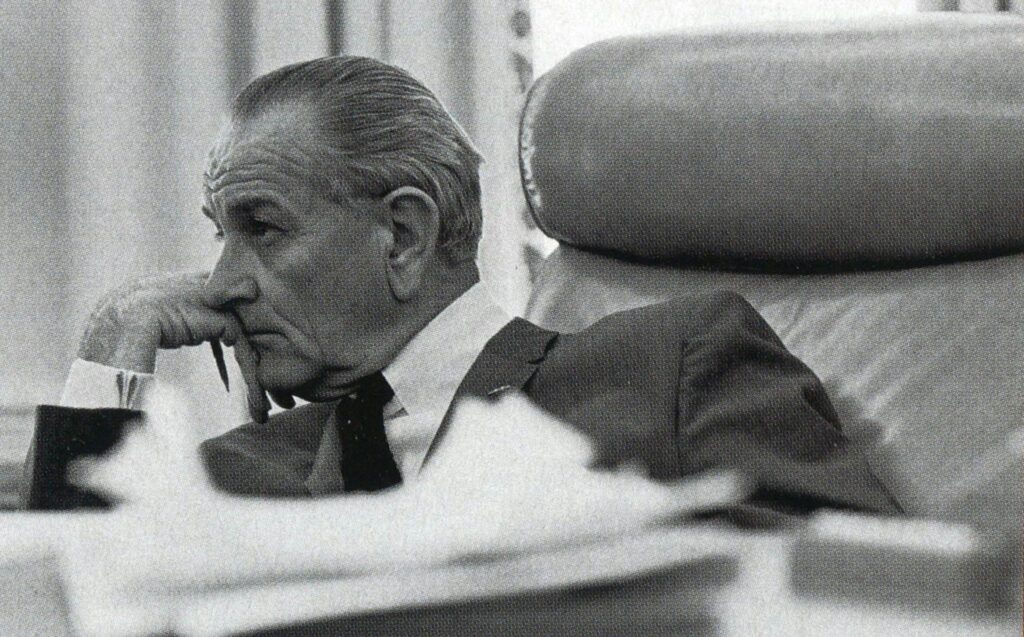
Vietnam (1964–1975). Johnson, Nixon, Ford. We now know — and knew almost right from the beginning — that the Gulf of Tonkin incident (August 2 and 4, 1964) was a trumped-up affair. It led to the Gulf of Tonkin Resolution in Congress on August 7, 1964, just three days after the “incident.” The war cost $1.2 trillion in 2026 dollars, killed 58,220 Americans (and wounded 300,000 more), killed more than 2.5 million Vietnamese, poisoned much of the landscape of Vietnam, damaged America’s standing in the world, and was one of the primary causes of the Great Disillusionment that followed. If a picture is worth a thousand words, how about these four: the Buddhist monk who immolated himself in Saigon (June 11, 1963); “Napalm Girl” Phan Thị Kim Phúc running in terror after a napalm attack (June 8, 1972); the summary extra-judicial execution of Viet Cong officer Nguyễn Văn Lém on the streets of Saigon on February 8, 1968; and the queue for the helicopter on top of the American embassy when we finally gave up (April 29, 1975)? Result of the war? The minute we pulled out, North Vietnam overran South Vietnam, reunited the country under communist rule, and the name of Saigon was changed to Ho Chi Minh City.
Grenada (October 25–November 2, 1983). Reagan. No Congressional authorization. Justification? To protect American medical students on the island. Casualties were low: 19 Americans killed, 116 wounded; 45 Grenadians killed, 258 wounded. Cost: about $400 million in 2026 dollars. Result? Most Americans have never thought about Grenada again.
Gulf War II (2003–2011). G.W. Bush, Obama. There were 4,431 Americans killed, approximately 32,000 wounded. Iraqis: somewhere between 300,000 and 500,000 killed. Justification: to seek out and destroy Saddam Hussein’s “weapons of mass destruction” and prevent Iraq from building nuclear weapons. Results? We toppled Hussein (soon executed by the Iraqi government), found no weapons of mass destruction, and destabilized the entire region. Is Iraq better off for our massive intervention? The U.N. refused to endorse Bush’s war, and almost all of our allies were deeply skeptical, but the U.S. Senate approved. Hillary Clinton’s pro-war vote probably cost her the presidency in 2008.
The Cost to the Iranian People
Just a couple of closing thoughts. First, the chances that the Iranian people can now topple their fundamentalist and oppressive government, I’d put at about 5%. In fact, a bloodbath may follow our meddling in their internal affairs. Second, assuming the Trump administration really wanted to help Iranians achieve self-government, how likely are we to stay the course long enough to help make that happen? Just ask the people of South Vietnam, Iraq, or Afghanistan how reliable we have been when we make wild promises to the people who help us in the nations we invade, and how long we are willing to stay to make things right.
Finally, the war he has initiated (on our behalf) halfway across the world without the slightest attempt to follow Constitutional provisions or national and international norms is the single most monarchial thing Donald Trump has done in his presidency, and that is precisely, exactly, explicitly what the Founding Fathers most wanted to avoid.
If we were in any meaningful sense still a republic, this could not have happened.