
There are between 6 and 9 million garage sales per year in the United States, approximately 165,000 per week, with total sales of $220 million annually. Such affairs seem especially popular here in North Dakota.
Bismarck, North Dakota — My friend Eileen across the street is my favorite neighbor. She has been living in Bismarck for 25 years now. It’s the rural health story. She and her husband were farmers in an isolated part of North Dakota south and east of Bismarck — what is affectionately known as the Sauerkraut Triangle because it was settled mostly by Germans from Russia — German nationals who were lured, beginning in 1762, by Catherine the Great to settle on the steppes of Russia. When some of their most cherished privileges were revoked in the 1870s, they emigrated to the steppes of America (and Canada).
Eileen and her husband moved to Bismarck about the same time I did, not because they were finally ready to enjoy the vibrant night life of the state capital — the jazz dives, avant-garde galleries, clothing boutiques, independent cinema, the Nigerian, Tasmanian, Samoan, and Sicilian restaurants, and the opium dens — but because his health was failing and driving 90 miles to clinic appointments three days per week had become a burden. She has told me many times that they would have preferred to live out their life on the farm or in the nearest town — a typical rural North Dakota town of about 1,200 people. Unfortunately, he died four or five years after they moved to the metropolis. After the funeral, Eileen decided to stay in Bismarck, in the big new house, and she has been my subdivision pal ever since. If I’m home and it snows, I often shovel her driveway, though that is something of a competition among several of us neighbors.
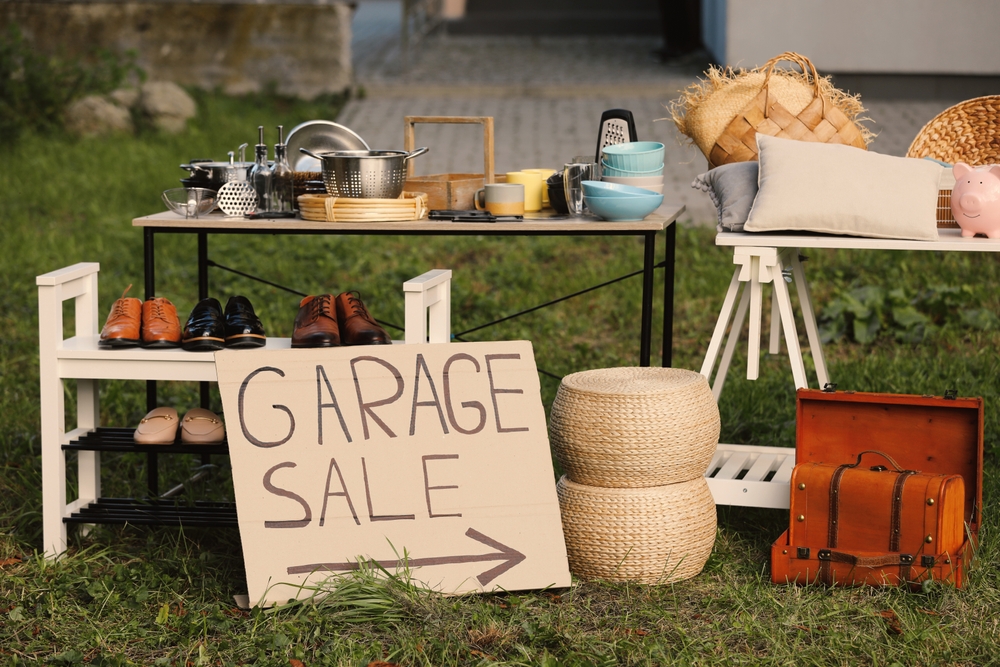
For the past five days Eileen has been up to no good in her garage. I’ve been wondering what she is doing over there. It dawned on me a day or two ago that she’s been prepping for a yard sale. Now today, an early Saturday in August, there has been more traffic on my street than in the entire last year. I don’t know what it is like elsewhere, but here in Dakota people flock to these yard sales. You would think Eileen had put a gold coin at the bottom of one of the 300 plastic bins now gracing her driveway. It’s a feeding frenzy over there. It must have been advertised for 8 a.m. today because by 7:15 there were 10 cars parked in front of her house and mine, on both sides of the street. It was like the Oklahoma Panhandle Land Run of 1889. It was like Black Friday, but with a bunch of superannuated stuff Eileen is trying to get rid of.
Meanwhile, I have been doing some necessary spring cleaning on my side of the street. This is not quite the right word because it is so profoundly understated, but I have been “tidying up” my house for a visit from a friend whose eyebrows, I reckon, are poised for subtle expressions of bewilderment and derision. (And he’s only junior runner-up of the supercilious.) I’ve been gone more or less continuously since late April (and not much home before that), so things have gotten a little out of hand, even for me. After each extended trip, I tend to dump a bunch of things in my entryway, wash a few loads of clothes, open the score of Amazon boxes, half-empty one giant suitcase or just pluck another out of the garage, reload, head to the airport, or hit the blue highways of America. The only thing I always know how to locate in the house is my passport, because without it, I’m toast.
Sometimes, if I leave my front door unlocked when I am taking a friend or my daughter on a daylong errand, they say, “Aren’t you going to lock your door?” To which I invariably reply: “No, I just want to put up a sign on the front door saying, ‘Take whatever you want and be sure to tell your friends.’”
A big thing is happening at my house on December 19, so that gives me approximately 130 days to restore order. I’ve been working like a dervish for four days now, and as I walk around the house I feel like Winston Churchill on November 10, 1942: “Now this is not the end. It is not even the beginning of the end. But it is, perhaps, the end of the beginning.”
As I look around, I estimate that if a magic and very decent tornado lifted the roof off my house and three car garage carefully (and set it aside) and then randomly whisked away a full half of everything I own (dishes, sheets, books, notebooks, camping gear, electronic gizmos, posters and other artwork, clothes, and furniture), and then carefully replaced the roof, the following conclusions would be inevitable:
1) Upon returning home, it is not clear that I would notice that anything was missing.
2) If the insurance company promised to pay full replacement value of every item I could itemize on a spreadsheet, and “library” was considered a single item, I’d be flummoxed after a few pages. Most of what I once owned would never be reimbursed because I would not be able to list more than a small percentage of what I own and once purchased and later stuffed into a nook, a cranny, a closet, or a garage bay.
3) The house would still be much too full of stuff, not including books.
And yet, I regularly lead seminars, online courses, and retreats about my hero Henry David Thoreau, that annoying minimalist.
I could, I suppose, have a giant garage sale, but the idea of hauling all that stuff out onto the driveway, front yard, side yards, back yard, and the empty lot I own behind my house sounds like a 13th labor the Greek god Hercules would reject. He cleaned the Augean Stables, but my house is more like Hydra: clean one room and two more seem to spring up magically. It would be smarter to wait until next year and have a garage sale every Saturday for 12 weeks.
There are days when I think a smarter plan would be to rent a large U-Haul, put everything in it I just have to keep — everything I would be terribly sad to let go — and then pour kerosene over the house and light a match. It would have to be very cleverly done to avoid jail time, not to mention fool the insurance company, but I think I would actually be quite relieved. Everyone who is ever asked about this says the one thing they would grab is the photo albums. Well, I have 247,000 photographs on my smartphone, so all I need to grab is my phone charger.
Most of my adult life I have entertained fantasies of starting completely over — pointing that U-Haul south and west and finding a town of about 35,000 people with a small college or university, buying a modest townhouse, changing my name to Diedrich Straus, and taking language courses without ever divulging a single fact of my previous life. That would solve some problems, for me, and especially for my daughter, who — when she visits — looks around with a long series of sighs, because the moment is coming when she will have to deal with all of this and the tool she will need is not a shovel or even a wheelbarrow, but a Bobcat skid steer. One man’s treasure is the next person’s junk.
Across the Street
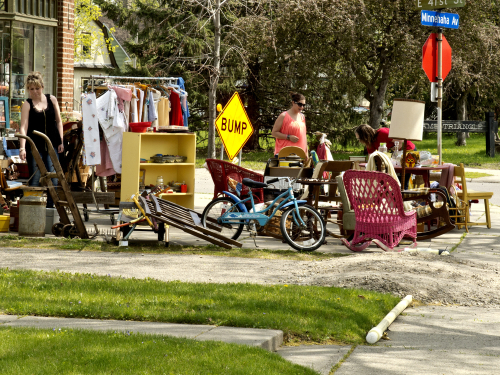
Meanwhile, all day minivans and pickups have rolled up on both sides of the street, and groups of two, three, and sometimes five have jumped out with what looks like well-rehearsed zeal. A few people walk up her driveway timidly, and others lunge at the nearest table to snatch up bargains before someone else arrives. Since I began writing this essay, at least 20 cars have rolled up, and so far nobody has left without hauling a bin or a pile of stuff to their car and taking it home to add to the glut of their own house. Undoubtedly they are planning a garage sale for next summer about this time.
I just looked it up on the internet. There are between 6 and 9 million garage sales per year in the United States, approximately 165,000 per week, with total sales of $220 million annually.
I see wives seductively gesturing before end tables, rocking chairs, dressers, and table lamps to persuade their less excited spouses that what their house most needs, what their house has always most needed, is someone else’s old 78 rpm console stereo or a cutting board in the shape of Alaska. Who doesn’t need a giant plastic closet shoe organizer? Who can live without a bin full of Readers Digest Condensed Books? “Hey, there’s the Odyssey in just forty pages!” Just now, a husband has been working overtime to convince his wife that they need a 4-foot beer stein depicting German maidens in lederhosen looking very agreeable. “The wife,” as she is frequently called in North Dakota, finally frowned her acquiescence and he is now very quickly putting the stein into the trunk of their car before she can change her mind.
Even if I could convince myself to have a garage sale, I’d probably still balk, because I would find it hard to see waves of strangers picking through my possessions and — as often as not — indifferently tossing them back onto the pile. “Hey, I bought that Guayabera shirt in Little Havana in Miami. How dare you just toss it down. At least refold it, wouldja?”

I remember when my grandfather, a Minnesota dairy farmer, got too old to work the 80-acre farm anymore. They had a giant farm auction — vintage tractors, seeders, old boxes of paper quarts of oil, nicked and greasy tools, rolls of baling twine, milk cans, spare parts still in their boxes, faded red five-gallon gas cans. … Everything that others might want, and some things that you’d think nobody would want, and yet they all still sold.
But when it came to auctioning off the 16 Holstein dairy cows, cows with names like Petunia, Pal, Daisy, Brownie, Ginger, Whitey, Rose, and Delilah, my grandfather — famous for his gruffness and at times roughness — broke down and walked silently up into the old farmhouse and into bed.
When my mother died 10 years ago, my daughter and I cleaned out her house. We each kept a few things (strangely, not her complete 63-year run of TV Guide), gave away what we could to Goodwill, and threw away a very large amount of what might be summarized as “stuff.” As we did so, we knew that my mother, were she still alive, would be shaking her fist at us with sometimes real and sometimes mock anger. My daughter said, “You’re lucky. If you predeceased grandma, she would just have hired five of those giant trash container units for your driveway and saved nothing except your Lewis and Clark books and a few things she’d claim you borrowed many years ago and never returned.” To which I replied, “Is that what you are planning to do when I croak?” “No, I cannot believe you think I am that kind of daughter. What do I need with a bunch of old Lewis and Clark books?”
A few final anthropological notes from across the street in a typical Great Plains community on a Saturday in August:
— So far as I can tell, not a single poor person has appeared today in this quintessentially American pageant. All the cars are new or newish, many with automatic hatch openers to absorb the merch.
— The yard sale uniform for a couple is wife in shorts and flip-flops looking as if she at least thought about it, husband in an old t-shirt and what might be called the trademark North Dakota man-shorts — tan, boxy, extending so far down the leg, well over the knee, that they might pass for capris, ending only a few inches above black socks.
— The average stay is about 17 minutes.
— So far today, nobody has left without a purchase.
— Occasionally, some long-suffering husband just stays in the car scrolling. After about 10 minutes, he performs a quick warning honk. Time’s up, dear.
— There has been some haggling, but on the whole it appears that the seller subscribes to the “no reasonable offer refused” philosophy of downsizing.
— Even though North Dakotans are law-abiding folks, very few cars leave by driving around the block. Most perform what must be an approved U-turn, perhaps to shorten the drive to the next yard sale on the list.
The Yard Sale Addiction
I know people — friends of mine — who spend part of every single Saturday between May and October spending three or four morning hours driving all over Bismarck and Mandan to every promising yard sale. (Most have done their homework.) This is their standard weekend habit, followed by brunch at Cracker Barrel or the locally owned Kroll’s Kitchen.
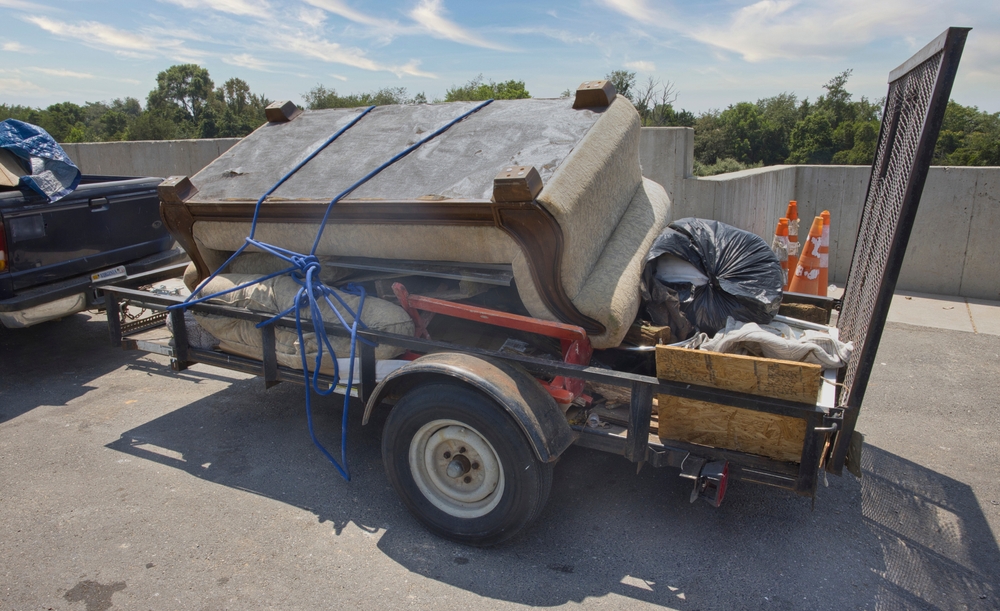
Here in Bismarck, twice a year, one day in October and one in April, the garbage people will haul away almost anything you can lug out to the curb — old refrigerators, black and white tube type television sets, a plethora of “lightly used” exercise equipment, including — of course — rowing machines, mattresses, lawn mowers, old printers, sewing machines, dead Barcaloungers. …
If I’m in town, I always take advantage of this amazing community service. The good news about this biannual ritual is that the rest of the population trolls the whole city street by street for three or four days looking for things to take possession of. I love this redistribution system. What could be better than repurposing things to homes where they will be better appreciated? Once, when I hauled an outdated wide screen television out to the curb (it no longer interfaced with my cable system), a man knocked on my door and demanded to know if “there’s anything wrong with it. I’m not taking it if it don’twork.” It was a pretty rude question, if you think about it. I had to suppress my inner Mad Magazine “Snappy Answers to Stupid Questions” impulse. “Sir, it works perfectly. It’s such a beautiful day I just thought it needed a bit of sun.” “Sir, thanks for alerting me. I don’t know how it got out here. I guess it’s trying to make a run for it.” “Sir, you’ll find my limited 15,000-mile drivetrain guarantee taped to the back.” “Sir, it works just fine. Every year I vow to quit watching TV for the rest of my life. This is getting very expensive.”
He took the TV.
All Things Must Pass
The day grows late. Dusk is approaching. The traffic is down to two or three cars every 10 minutes. No more double parking. Several times today I have had the urge to stroll across the street to inspect the wares. But I knew if I did, I’d not be trying to find a place in my house for a paperweight from the 1964 World’s Fair and the 16-volume set of Life’s History of Mechanical Transportation.