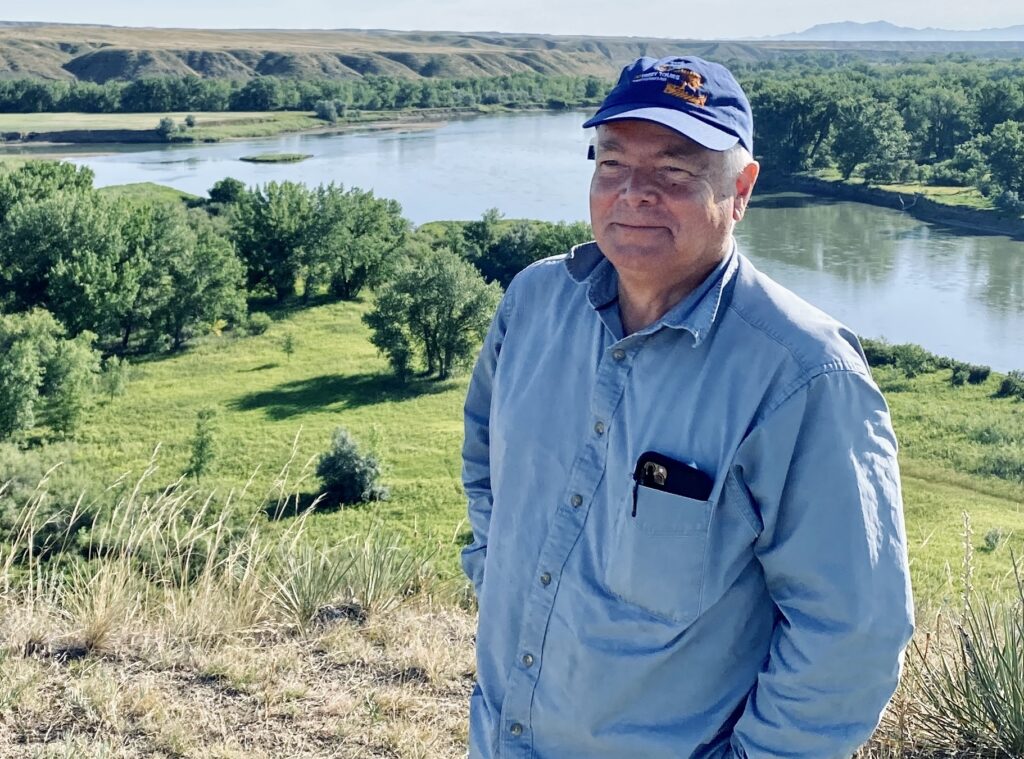
I’ve just wrapped up the 26th summer leading my Lewis and Clark cultural tour. Days canoeing remote sections of the Missouri River and hiking the Bitterroot Mountains in the footsteps of Lewis and Clark never fail to inspire in me the majesty and promise of America.
It was the Greek presocratic philosopher Heraclitus (ca. 500 BCE) who said you can never walk into the same river twice. You are a different person, and you are wading into a different river. I have been a lover of rivers all my life. I grew up on a miserable little plains creek called Heart River in western North Dakota. But only 35 miles to the west flows the magical Little Missouri, which is where I feel the spirit of place most intensely. The Little Missouri is a tributary of the Missouri River proper, which, depending on how you count, is the longest river in America and the fourth or fifth largest in the world. The Little Missouri starts at Devils Tower in Wyoming and disembogues into the mighty Missouri at Twin Buttes, North Dakota. I have walked it in its entirety, with one more coming.
As I write this, I’m sitting in the “library” of a log cabin lodge on the Lochsa River in eastern Idaho. For the past 10 days I have been leading my 26th annual Lewis and Clark Cultural Tour in Montana and Idaho. We had 22 guests this year, all of them new to the experience. One woman, from Japan, had never been camping before, had never been in a sleeping bag, had never used an outhouse, had never slept in a tent (had never zipped up a tent!). Welcome to America, Grace! What she was doing with us is unclear, but she seems to have had a great time, and we very much enjoyed her presence among us.
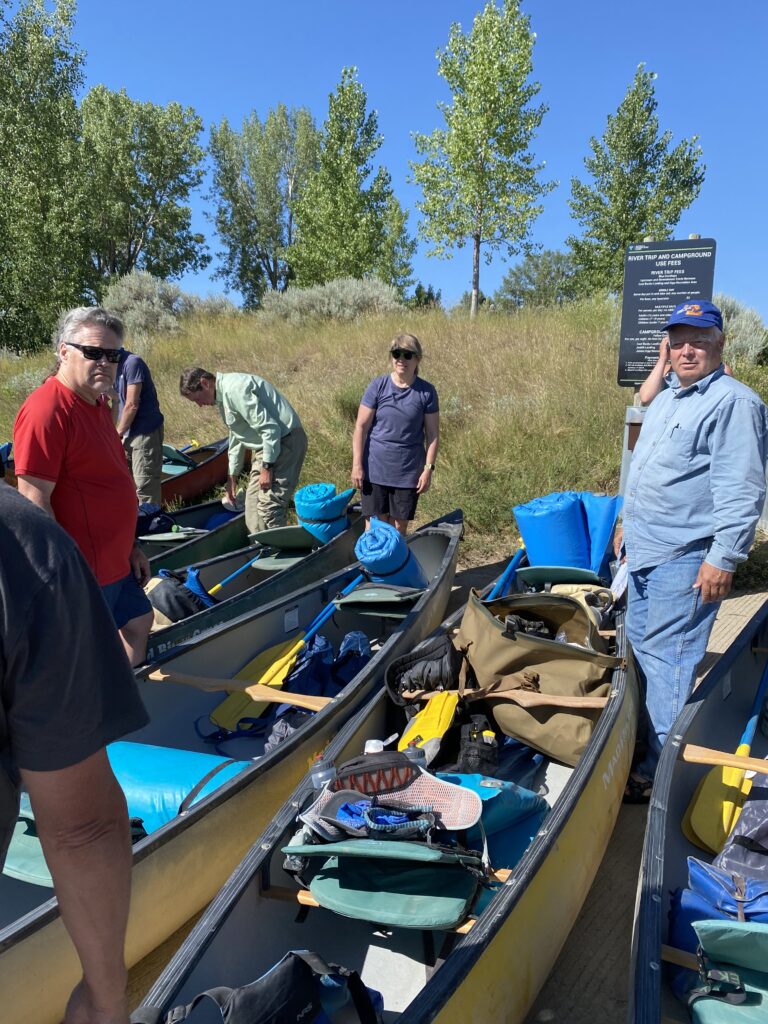
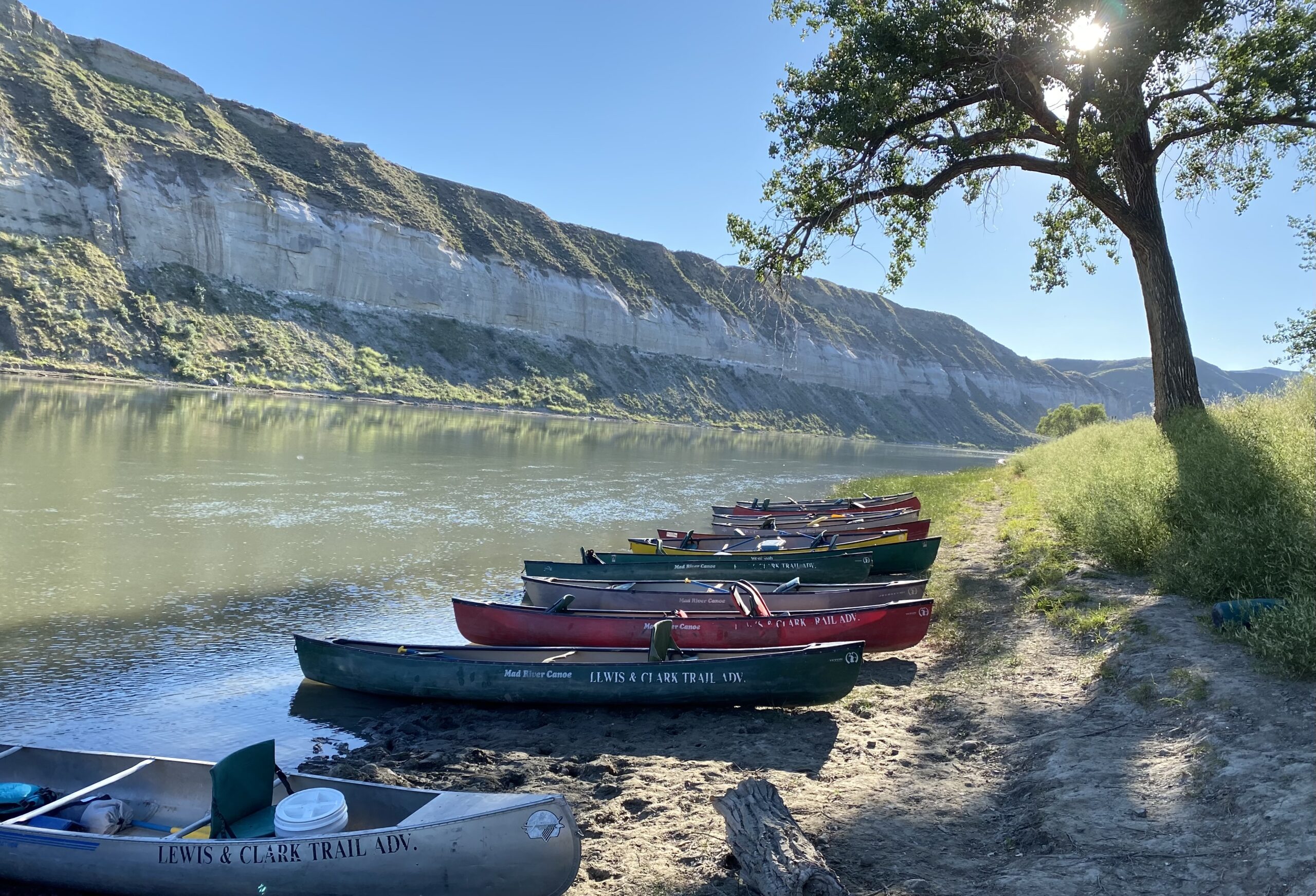
So, 26 summers in a row I have canoed from Coal Banks Landing (near Fort Benton, Montana) to Judith Landing. This is easily the most beautiful section of the entire Missouri River, and the one that still looks more or less as it would have looked to Meriwether Lewis in 1805. He famously called the White Cliffs “scenes of visionary enchantment.” He likened the white cliffs to ancient ruins of castles and fortifications. I’m always happiest on the second day on the river, a 22-mile float, when in mid-afternoon the ambient temperature is about 90 degrees (zero humidity) and the water is just cool enough to be bracing. At every stop we wade out into the river to cool off. Up here you could walk all the way across the Missouri River if you really wanted to, though the current in the middle is brisk. I’m happiest when the winds are calm, and we could drift down the river towards Bismarck, North Dakota, Pierre South Dakota, Sioux City, Iowa, Omaha, Nebraska, Kansas City and St. Louis, Missouri and then on to New Orleans, Louisiana and the sea. The vast primordial silence of Montana is broken only by the occasional light hum of a commercial airplane at 38,500 feet.
My canoe partner Russ is a brainy taciturn fellow. He likes to keep moving. We spent 12 hours together on the canoe portion of the cultural tour, he in front, I in back, with only our dry bags and diet beverages as freight. I don’t think we exchanged more than five minutes total of talk this year. That’s a very good friendship. He pretends to be grumpy, and I pretend to be quiet.
The second part of the journey is up on the Lolo Trail (the Nez Perce Trail) through the northern neck of Idaho, west of Missoula, Montana but short of Orofino, Idaho. After a good night of food, drink, and rest at Lochsa Lodge, we are driven to the put-in point for the annual ordeal, what I call the Wendover Death March (with sincere apologies to families of men who endured the Bataan Death March in April 1942). The WDM is 7.5 miles more or less straight up from the Lochsa River to the Lolo Trail, 3,500 feet higher in the Bitterroot Mountains. Captain Lewis was not the sort of explorer who employed switchbacks, so the hike is always difficult and it can be something of an ordeal. I joke with our guests that every time I complete the hike I vow “never again,” but that is not really true. I will continue to lead this annual tour until I can’t hack it anymore. But at my age, I have to spend part of my day on that hike wondering if it is for the last time. That day is surely coming.
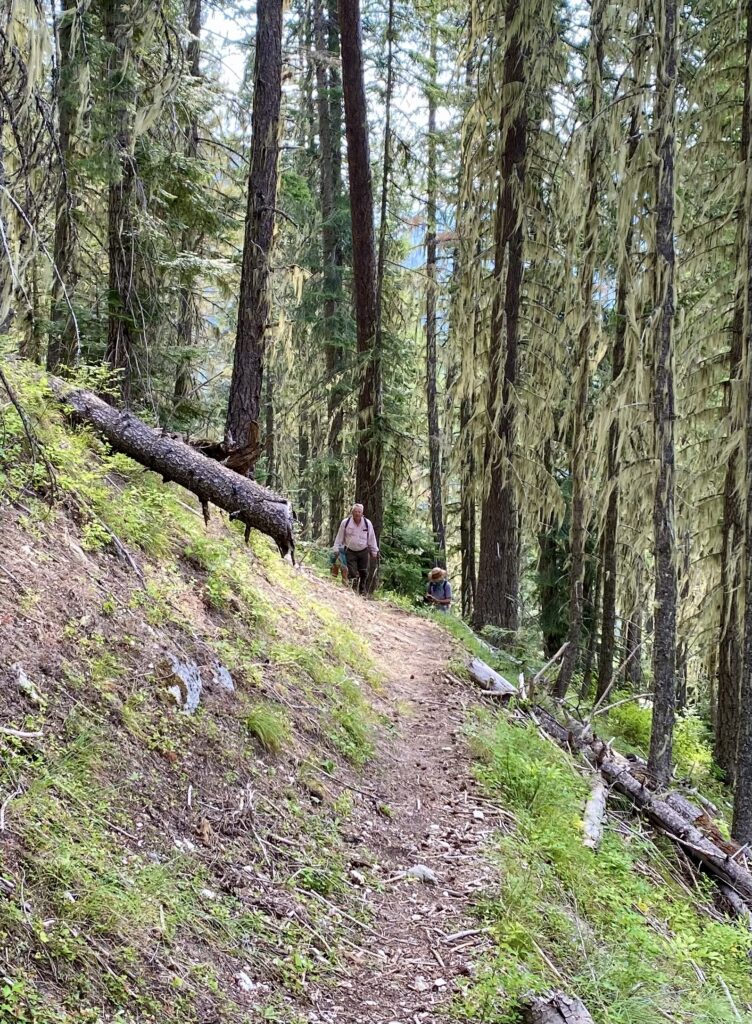
I regard the Wendover hike as my “same time next year” moment, when I step back to assess the state of my mind, body, heart, and spirit. This year’s hike was not as hard as some in previous years, but I can definitely feel the dynamics of physical decline. It kills me to think that you apparently have to use your body to keep it alive! Every year about halfway up the mountain I vow to 1) lose weight; 2) get fit; 3) do serious training; 4) take practice hikes up steep hills; 5) and next year scamper up that trail with only a couple of hydration stops, and then perform some Rocky Balboa victory gestures at the top. Then suddenly it is the week before the hike and I wonder if I will collapse halfway up.
For a range of reasons, my spirit is in a happy and expansive state. My mind is alive and well, except for the increasingly prolonged episodes of memory lapse, in which I spend an hour trying to remember the name of a book or an author or a musician or an actor. A few months ago it took me an hour and 20 minutes to remember the name of Whoopi Goldberg, even though I don’t care a bit about Whoopi Goldberg, but refused to look it up no matter if it was the last brain freeze of my life.
We’ve been off the grid. For the last 10 days I have not spent a single moment dwelling on the national situation — the political paralysis, the partisan wrangling, the degradation of civility, the culture of grievance and retribution, the Crisis of the Reflecting Pool, etc. When I turned my phone on again this morning, I immediately encountered the headline: “Trump Holds Off Airstrikes in Hopes of an Early Agreement.” Hey, I could have seen that exact headline a week ago, a month ago, five months ago. So this is no Venezuela. Not much changes when you shut down the newsfeed for a few days. Oh, and LeBron has broken Cleveland’s heart again. And Christopher Nolan’s Odyssey is getting mixed reviews.
The American Assurance
This year, more than any other in 26 years, I have been aware of what a blessing it is to live in the United States of America, where we had the foresight to set aside significant chunks of the national landscape, especially in the West, for permanent protection from industrial extraction and intrusion. Our National Parks, Monuments, Forests, Game Preserves, and Wildlife Refuges are the envy of the world. We are a very young country compared to our European counterparts. It was too late in the history of those nations to preserve their most sublime landscapes when America invented the National Parks and Monuments system just after the Civil War. Yellowstone National Park 1872.
I know that if I fetch a backpack out of my garage, and stuff it with a sleeping bag, a miniature cooker, some freeze dried food packets, a headlamp, some camp moccasins, and a bar of soap, and strap my kayak on top of my vehicle, I can within a couple of hours be all alone in the badlands of North Dakota, where there are plenty of places to camp and scores of places to sit in the Little Missouri River with or without a book. Within a day’s drive of my home in Dakota, I can go to the White Cliffs in Montana, Black Elk Peak in the Black Hills of South Dakota, Glacier National Park, the Boundary Waters in northern Minnesota, or Grasslands National Park in Saskatchewan.
Theodore Roosevelt was certain that urbanized men and women need to have wild places to visit to clear their minds, refresh their souls, get back to basics, and renew their love of America. He set aside 230 million acres of the public domain for permanent protection. We owe TR more than we can possibly acknowledge. When I hear people who seek to condemn Roosevelt for a few of the less attractive qualities of his life and mind, I think of what America would be like without his five National Parks and 18 National Monuments, 150 million acres of National Forest, and 51 Wildlife Refuges. Roosevelt did what William McKinley did not do, what William Howard Taft didn’t do, nor Woodrow Wilson, nor Calvin Coolidge, nor William Harding, nor Herbert Hoover. The thing I have most missed about America when I am abroad is the West — Monument Valley, the Yellowstone River cottonwoods in early October, Chaco Canyon, the Little Bighorn, the stunning abruptness of the High Sierra, the redwoods. … Yes, in most English villages you can buy the complete works of Charles Dickens or Jane Austen at a convenience store, but where in England can you stare down into the abyss of the Grand Canyon or gaze up at Mount Shasta?
Public Lands Under Assault
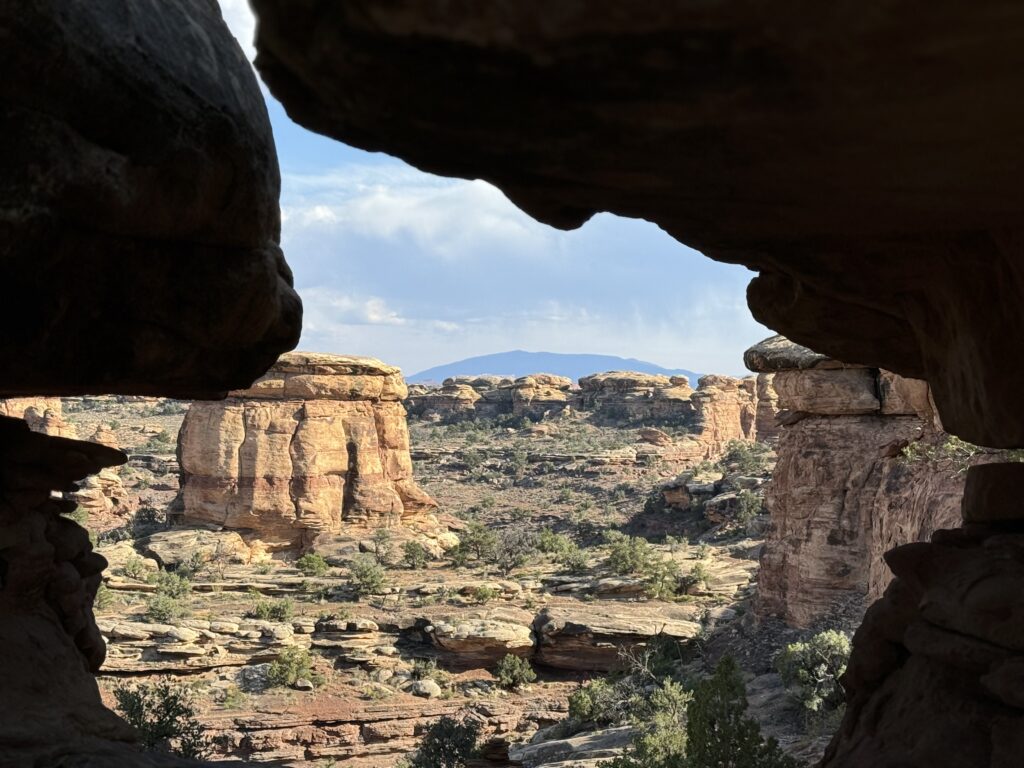
I am particularly attuned to America’s public lands this summer because they are under attack. There are forces on the far right of the American political spectrum that seek to reduce or eliminate some of our National Monuments, permit mineral extraction in the National Parks, and privatize parcels of the public domain that promise extractive wealth. They are completely serious about shattering the public lands “settlement” of the last 150 years, selling off some of the most beautiful places in the West to their gazillionaire cronies to be gated off for their own private enjoyment. And they have friends in very high places.
To permit them to get away with this land grab would be a national tragedy. Even if you don’t visit Grand Teton National Park in Wyoming or Big Bend in Texas, you are saner and better off knowing they are there waiting for you to drive through their portals with a sigh of anticipation. In my opinion, America without its carefully protected landscapes is just a wealthy country with a diminished soul. If they allowed jet skis and motorboats through the White Cliffs of the Missouri River, they would destroy it. We saw viewsheds on the Wendover hike that would make a great place for a five-star resort — if your vision of America were of privileged people locking up the best of it for their exclusive pleasure grounds.
I know this. Americans love their National Parks and Monuments. In any honest plebiscite, the American people would vote overwhelmingly to preserve all of the public domain, appropriate more money for the maintenance of these treasures, and declare the public lands off limits to the forces of greed and exploitation. This does not guarantee that the “developers” will accept the will of the American people. We live in a time when the idea of democracy is endangered and the most potent and self-satisfied economic entities are gunning to take what is left to turn the American Eden into luxury subdivisions or uranium mines.
We, lovers of the American outback, are going to have to make our voices clear, unambiguous, and — if necessary — loud. Once you privatize a parcel of the West, you can never return it to its primordial glory. No small group of greedy individuals can be allowed to dictate the future of America’s public lands. Thoreau said, “In wildness is the preservation of the world.” There is infinite blessing in sitting around a campfire way beyond the reach of the grid, drinking camp coffee, eating bacon and scrambled eggs, maybe taking a snort of some powerful beverage, looking up to see the constellations as they wake up the night, and listening for the freedom-call of the coyotes and talking about Life.
I’ll be back to the Wendover Death March at the end of July 2027. I’ll be fit as a fiddle, strong as a bull moose, muscled up, and ready for any contingency. … Or perhaps just as slipshod and pathetic as this last week! And yet I have never whined about the strain, not once in a quarter century.
Same time next year.