
On July 13, 2026, President Trump issued orders reducing Bears Ears and Grand Staircase-Escalante national monuments for a second time. Grand Staircase-Escalante was reduced by approximately 1.69 million acres, representing a 90% reduction of the monument’s land area, shrinking its total size from roughly 1.87 million acres to 181,541 acres. Bears Ears National Monument was reduced from 1.36 million acres to 121,100 acres.
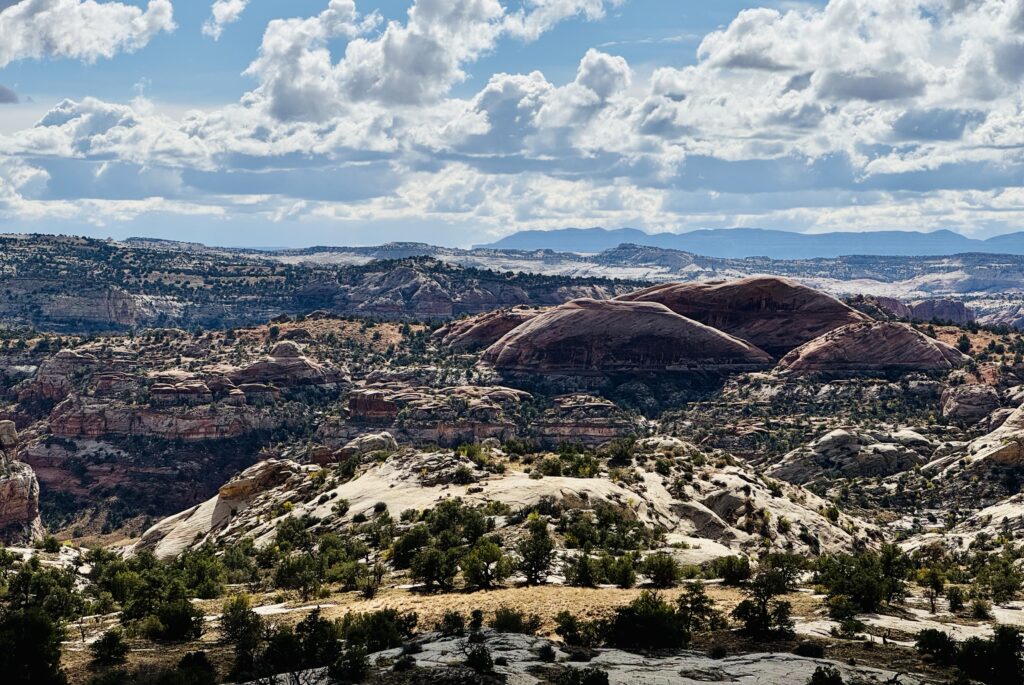
I was terribly saddened to learn that President Trump has signed proclamations reducing the Grand Staircase-Escalante National Monument from 1.87 million acres to just 181,500 acres, and reducing Bears Ears National Monument from 1.36 million acres to just 121,500 acres. Both are in Utah. He’s also going after the protective perimeter around one of America’s greatest Indigenous community sites: Chaco Culture National Historic Park in northwestern New Mexico.
This follows Secretary of Interior Doug Burgum’s earlier 2026 arbitrary withdrawal of existing Bureau of Land Management (BLM) grazing permits for the fabulous American Prairie project in north-central Montana, a public-private partnership that seeks to create a free-range pasture for up to 35,000 bison — bison that could live their entire lives without encountering a fence.
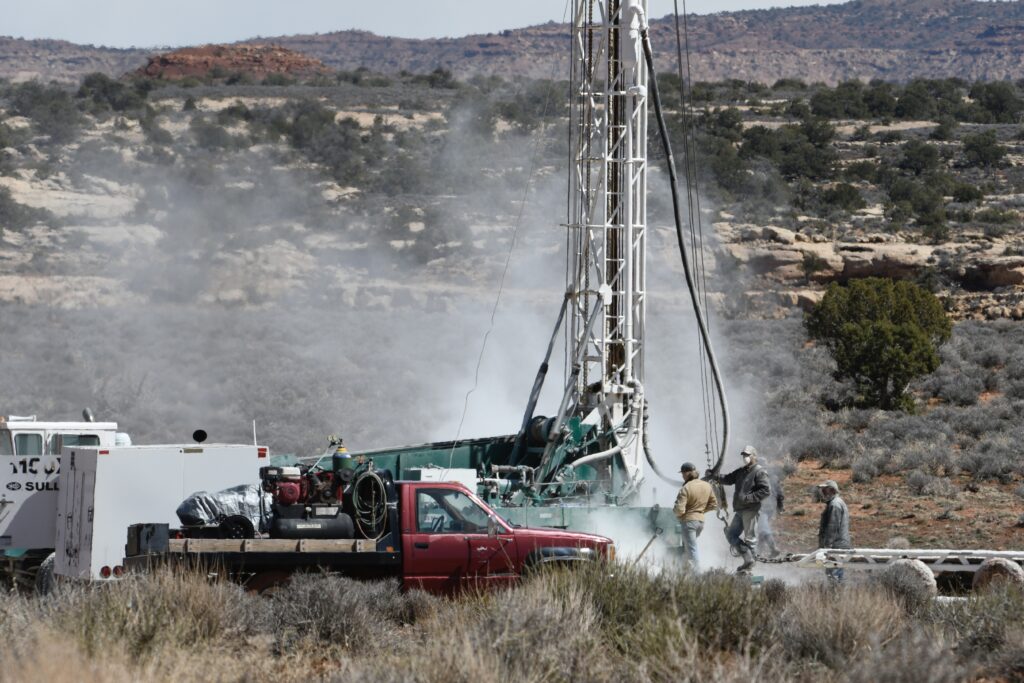
These arbitrary and probably illegal executive actions come straight out of the right wing’s Project 2025 playbook, which seeks to allow dramatically greater mineral extraction from America’s public lands (your lands), including on National Monuments and National Parks, and seeks also to privatize swaths of the public domain.
Here are a few things to think about.
First, it is not clear that President Trump’s proclamations reducing these National Monuments are legal. The landmark Antiquities Act, passed by Congress and signed into law by President Theodore Roosevelt on June 8, 1906, gives the president of the United States unilateral authority to designate National Monuments. Roosevelt named the first 18. Now we have more than 160. Nothing in the enabling legislation gives another president the power to reduce or abolish a National Monument once designated. A 1938 clarifying ruling by then Attorney General Homer Cummings declared that later presidents do not have the right to abolish National Monuments, but Trump’s Justice Department has issued an opinion saying the power to create is also the power to rescind. At some point the Supreme Court will weigh in on this issue. Given the current makeup of the Court, I would not be surprised if they uphold President Trump’s authority to shrink these and other National Monuments. I believe that would be a clear violation of the language and the spirit of the Antiquities Act. And a national tragedy.

Interior Secretary Burgum, formerly Governor of North Dakota, has argued that the Antiquities Act was intended to protect small parcels, what he calls “Indiana Jones-type” archaeological sites. This is clearly nonsense. It is true that Section II of the Antiquities Act specifies that National Monuments “shall be confined to the smallest area compatible with the proper care and management of the objects to be protected,” but just what constitutes the “smallest area compatible” is in the eye of the beholder and has never been made more specific by federal court interpretation or Congressional amendment. Presidents of both political parties have been quite willing to define “smallest area compatible” in very expansive terms. Theodore Roosevelt created Grand Canyon National Monument on January 11, 1908, at 818,560 acres. In 1918, Woodrow Wilson named Katmai National Monument in Alaska, at 1,080,000 acres. Jimmy Carter named Wrangell-St. Elias National Monument in Alaska in 1978, at 10,950,000 acres. George W. Bush designated the Papahānaumokuākea Marine National Monument on June 15, 2006, encompassing 89.5 million acres near the Hawaiian Islands. Bill Clinton named Grand Staircase-Escalante National Monument in 1996, and Barack Obama named Bears Ears National Monument in 2016.
Secretary Burgum not only misunderstands or deliberately misinterprets the Antiquities Act (and the history of monument designation), but one would hope that the cabinet official in charge of managing America’s public lands would have a better understanding of the science of archaeology than what can be gleaned from a Hollywood action-adventure movie.
One of the glories of America’s public lands designations has been that they have been almost entirely nonpartisan in nature. The public lands are one of the handful of greatest treasures of the United States. Filmmaker Ken Burns called the National Parks “America’s Best Idea,” and that of course includes National Monuments, National Forests, National Wildlife Refuges, National Game Preserves, and Roadless and Wilderness Areas. Theodore Roosevelt famously said that the Grand Canyon, the redwoods, the Rocky Mountains, and other scenic wonders are “America’s cathedrals,” and they should be protected with as much loving care as the French lavish on Notre Dame or the Italians’ St. Peter’s.
The forces of economic development do not sleep. Until recently, we have counted on the government of the United States to cherish and protect the public lands. It is now clear that the American people are going to have to fight to protect these magical and spectacular landscapes.
Perhaps it is time for Congress to reconsider the Antiquities Act’s vagueness about how much acreage should be protected by presidential order alone, but that debate should be careful and systematic, based on expert testimony, respectful of precedent, and grounded in the historical background of the 1906 legislation. Any review of the Antiquities Act should be conducted by Congress, not by a handful of anti-conservation bureaucrats of a single and unpopular presidential administration, and only after a genuine and prolonged national conversation about the status and future of the 640 million acres of America’s public lands. Before any rash decisions are made, Congress needs to convene extensive listening sessions throughout the United States and gather testimony from all the stakeholders: Native Americans, Sagebrush Rebels, conservationists, state government officials, mining corporations, ranchers, recreationists, historians, philosophers, and the outstanding superintendents and rangers who manage the public domain.
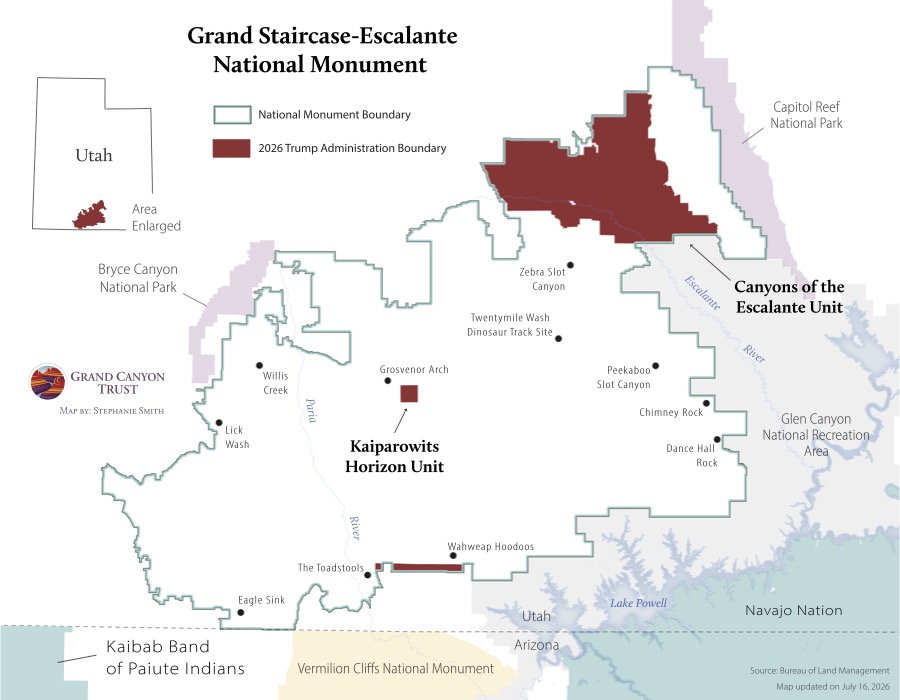
Second, what President Trump has done to these National Monuments feels mostly like retribution. In 2023, he proclaimed to a conference of MAGA Americans, “I am your warrior. I am your justice. And for those who have been wronged and betrayed: I am your retribution.” In my view, he is clearly more interested in “giving it to the libs” than in rational public lands policy. He severely reduced Grand Staircase-Escalante and Bears Ears National Monuments during his first term. His successor, Joe Biden, restored the monuments to their full size. Now, Trump has reduced them much more severely than in his first term: Grand Staircase-Escalante is now down to just 10% of the original designation and Bears Ears to just 9%. Trump is clearly playing to his base and the fiercest advocates of the Sagebrush Rebellion, who resent any federal authority over lands within the western states.
Trump’s view seems to be that if there is wealth to be extracted from the public lands (oil, natural gas, coal, grass, uranium, heavy metals), the government of the United States should strew roses before the bulldozers of the extraction industries and tell the rest of us to go jump in the lake. What Donald Trump actually knows about the fragility of America’s public lands and the compelling reasons to protect them from grotesque economic exploitation would not fill a Dixie Cup. His idea of nature ends on the 18th hole of a golf course. His hatred of all things Obama is unmistakably clear. His view of America has no room for the idea that natural places have a right to be left alone. We have spent more than 100 years learning how to protect a small fraction of American landscapes from adverse economic development. To undo that hard-fought, decades-long national conservation settlement (the envy of the world) is perverse, vindictive, irrational, and mean-spirited.
The American people love their public lands for a variety of good reasons. If we conducted a national plebiscite on this question, the response would be resounding. Keep Your Hands Off the Public Lands!
Third, the yoyo effect of recent presidential proclamations (designate, reduce; re-designate; re-reduce) creates intolerable confusion for public land managers, the American public, recreationists, and Native Americans. I have a good friend who creates maps of the American Southwest. He’s afraid to include the boundaries of the Grand Staircase-Escalante and Bears Ears National Monuments on his excellent maps for fear they will be obsolete after the next presidential election. This is no way to run the railroad. We need stability in our understanding and designation of public lands. How can public lands managers perform their duties when they don’t know whether the lands they protect will be withdrawn, their site budgets gutted without consultation, or their jobs DOGE’d by an unelected crony of the president?
Fourth, President Trump’s public lands retribution campaign is especially offensive to Native Americans. Bears Ears and Grand Staircase-Escalante embrace tens of thousands, literally, perhaps hundreds of thousands of important Indigenous sites, many of them sacred, all of them endangered by industrial extraction. At a time when the American people are finally ready to engage in deliberate healing actions with Native Americans our forebears shouldered off their sovereign homelands in pursuit of what we used to call our “manifest destiny.” The president’s attack on some of the most important archaeological treasures of North America is as cynical as it is indifferent to their legitimate concerns. The “Indian Wars” continue, this time by way of executive orders.
We are better than this.
My hope is that the Supreme Court will take up the issue of whether reducing or eliminating National Monuments is constitutional as soon as possible. Since much of the Trump agenda finds its way to the court’s queue-breaking “shadow docket,” I hope the court will soon invalidate these monument reductions and instruct Congress to take up the issue in the deliberate way of democracy, rather than acquiescing in yet another unitary executive power grab.
If, as some legitimately believe, we have over-designated the size of National Monuments or if “we have enough of them, already,” then we should address these issues in a responsible, deliberate, sane, and generous way. Not by a quadrennial roller coaster regimen. And not by vindictive proclamation from the set of a Harrison Ford movie.
Discover more on these topics at Listening to America