
As the country approaches its 250th birthday, Clay profiles the 33-year-old Thomas Jefferson, the youngest member of the Virginia delegation, as he made his way to the Second Continental Congress and his date with immortality.
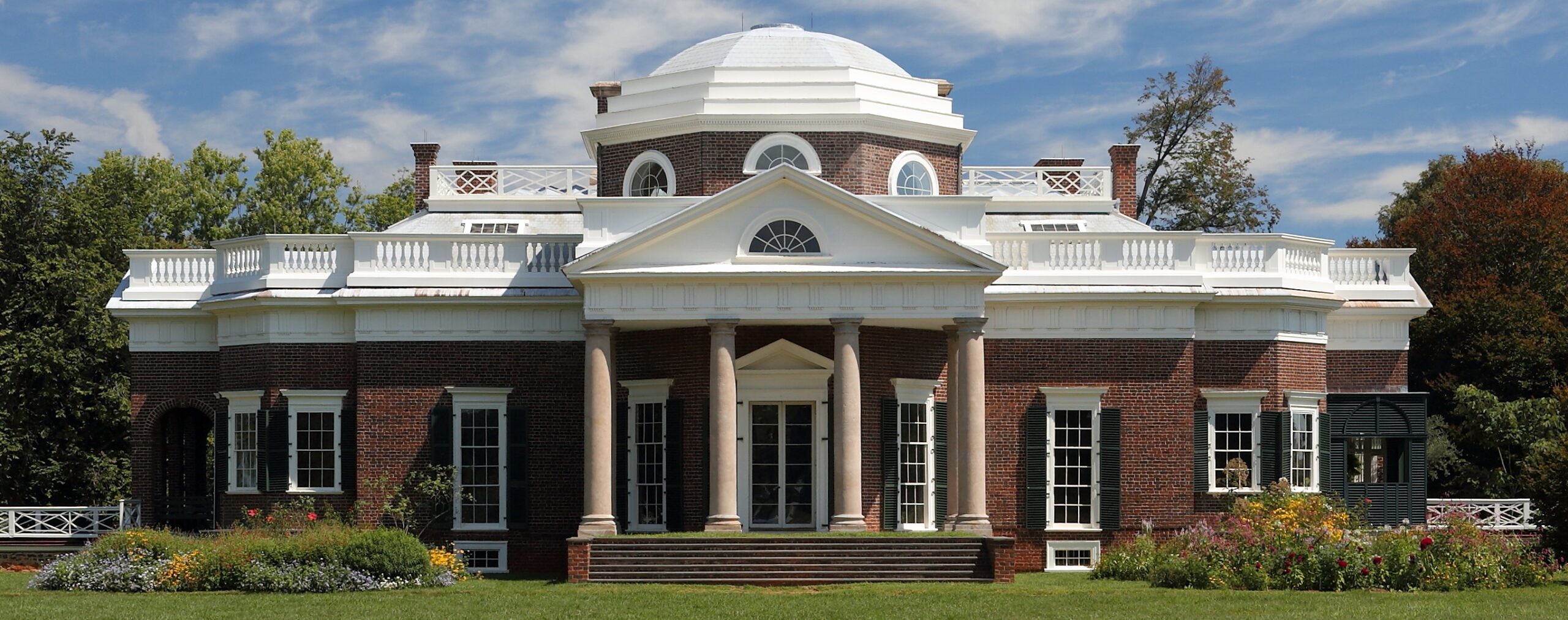
“… It seemed as if from his youth he had placed his mind, as he had done his house, on an elevated situation, from which he might contemplate the universe.”
Chevalier de Chastellux, French vistor to Monticello
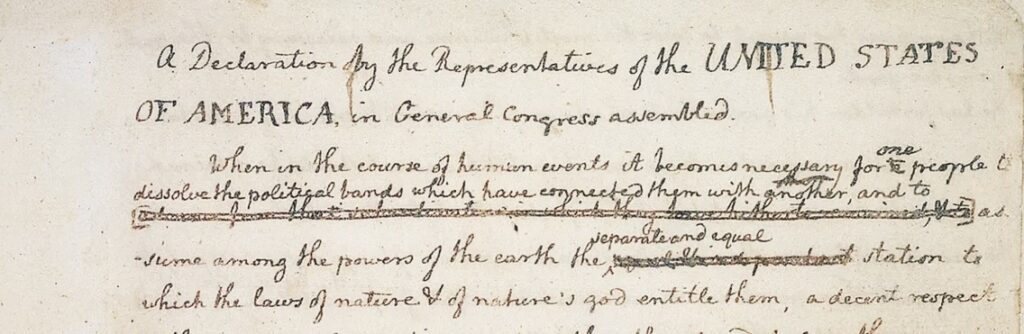
We all know that Thomas Jefferson wrote the Declaration of Independence, which was approved by the Second Continental Congress on July 4, 1776. He could not know at the time that it would become the most important document in American history — more central to America’s idea of itself than the 1787 Constitution or Abraham Lincoln’s Emancipation Proclamation of January 1, 1863. Jefferson was not a famous man at the time of the assignment, but he had a reputation for being a talented penman who knew the long and tangled history of humankind’s quest for liberty.
He performed the task before him with his characteristic discipline and promptitude, then handed his draft over for committee debate. He was dismayed when his fellow delegates rewrote parts of his text and excised some of his preferred language, but he never rose in Congress to defend what he had written. That would not have been gentlemanly. When the final draft was ratified by unanimous consent, Jefferson quietly returned to committee work. It wasn’t widely known until a quarter century later, until the election of 1800, that Jefferson had been the principal author of the Declaration of Independence. With characteristic modesty, Jefferson said his purpose had been merely to express the sentiments of America, “to place before mankind the common sense of the subject, and to justify ourselves in the independent stand we are compelled to make.”
John Adams, who respected, admired, and eventually loved Jefferson (in spite of everything), later said that during the time they spent in the Second Continental Congress, he never heard him “utter three sentences together.” While others, including the voluble, assertive, and ornery Adams, pontificated and jostled for primacy in the Philadelphia state house, Jefferson took a few notes and dreamed of the future of the American agrarian republic.
Who Was This Man?
Who was Thomas Jefferson in the first months of 1776, and where was he?
He was a homebody, and he lingered at home in Albemarle County, Virginia, until almost too late. As the purple hyacinths began to bloom on his private mountain that March, he could not know then that within four months he would write the most celebrated document in American history.
Jefferson was an exceedingly well-educated man with what John Adams called “a peculiar felicity for expression.” He was just 33 years old in 1776, the youngest member of the Virginia delegation to the Second Continental Congress. For more than two decades, he had read deeply in seven languages, sometimes for 12-15 hours per day. He was a shy, private, and sometimes secretive man who carefully curated his public persona. He wanted to be known to the world as a Man of Letters who would rather be tinkering with his agricultural practices or reading the Roman historian Tacitus than listening to ambitious men “talk by the hour,” mostly to hear themselves speak. Jefferson disliked conclaves of every sort. His favorite mode of engagement with the world was to sit alone in a room on his mountaintop with a plain sheet of paper and a carefully trimmed goose quill pen.
Jefferson invariably thought of his array of public services — governor, ambassador, secretary of state, vice president, and third president of the United States — the way we do jury duty. He wanted to be known as a brainy and aesthetically masterful man who found politics degrading and depressing. How he must have relished the famous description of him written by the French traveler and philosophe, the Chevalier de Chastellux, who visited Monticello in the spring of 1782, “… a philosopher, in voluntary retirement from the world, and public business, because he loves the world, inasmuch only as he can flatter himself with being useful to mankind.” Chastellux wrote, “Mr. Jefferson is the first American who has consulted the fine arts to know how he should shelter himself from the weather.” In his usual graceful way, Jefferson gently rebuked Chastellux for such flattering nonsense, but he could not have been more pleased with this portrait of his life and character. “No object had escaped Mr. Jefferson,” Chastellux wrote, “and it seemed as if from his youth he had placed his mind, as he had done his house, on an elevated situation, from which he might contemplate the universe.”
The Joys and Sorrows of Domestic Life
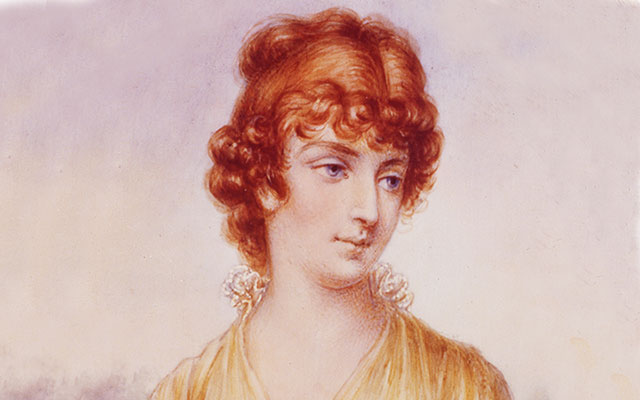
In 1776, Jefferson was known to be exceptionally devoted to his wife, Martha, and concerned about the state of her health. She would die six years later, in September 1782, at the age of 33, worn down by six births and more than six pregnancies. They had been married for just four years in 1776. By then, she had given birth to two children, Martha (Patsy), who would outlive her father by 10 years, and Jane Randolph, who had died in infancy the previous September. While he was writing the Declaration of Independence in June 1776 in Philadelphia, in a boarding house on Market Street, Jefferson was so anxious about his wife’s precarious health back in Virginia that he could scarcely concentrate on the task at hand. He was frantic for news from home at a time when the late colonial communications infrastructure was maddeningly primitive. To his friend John Page back in Virginia, Jefferson wrote, “Every letter brings me such an account of the state of her health, that it is with great pain that I can stay here.”
In the spring of 1776, Monticello was, as it would always be, a building site. The bulk of the first version was habitable, but it didn’t look much like the Monticello we know today. There was no dome yet. That wouldn’t come until after Jefferson’s return from France in November 1789, when he ordered the house pulled apart and reworked with architectural innovations he had studied in Paris. The house would never be finished, though it achieved its mostly final shape by 1809. One of his guests, Anna Thornton, after visiting Monticello in 1802, wrote, “Mr. J. has been 27 years engaged in improving the plans, but he has pulled down and built up again so often, that nothing is completed, nor do I think ever will be.” She said Mr. J. was “a very long time maturing his projects.”
Building his Palladian villa on a remote mountaintop was a quintessentially Jeffersonian notion. What in the 18th century would have been called quixotic. There would be decades-long problems with the water supply at that elevation. Everything he acquired in the next 50 years had to be lugged up the mountain on the five miles of sinuous roadways he had constructed, and everything produced there had to be lugged down the mountain to the Rivanna River, a tributary of Virginia’s principal commercial artery, the James. And it wasn’t Jefferson who did the lugging.
The first step, in 1768, had been to level the top of the 867-foot mountain. How do you level a mountaintop in the 1770s? You assign gangs of black men and women to labor for months to remove the erratic contours and haul the dirt somewhere else. In spite of his well-known rhetorical opposition to slavery, Jefferson showed no discomfort in forcing black men and women to do this grunt work in furtherance of his private pursuit of happiness, apparently assuming that this is the sort of labor a subject race should be expected to do.
All the hundreds of thousands of bricks that made Monticello one of the most extraordinary private homes in American history were shaped and baked by black slaves. So, too, the timbers. Even the exquisite finishing work at Monticello — the cornices and the entablatures and the cabinetry — was performed by enslaved craftsmen, some of whom Jefferson carefully trained himself.
“Mr. J. has been 27 years engaged in improving the plans, but he has pulled down and built up again so often, that nothing is completed, nor do I think ever will be.”
Anna Thornton, after visiting Monticello.
Et in Arcadia Ego
Jefferson’s mother, Jane Randolph Jefferson, died on March 31, 1776. She was 56 years old. His father, whom he idolized, had died when Jefferson was just 14. Peter Jefferson represented everything his son admired: physical strength, a desire to improve himself through books, a capacity for friendship, a quiet commitment to public service, mastery as a surveyor and cartographer, and an orientation towards the West. Of his mother, Jefferson wrote, “They [the Randolphs] trace their pedigree far back in England & Scotland, to which let every one ascribe the faith & merit he chooses.”
Historians are not quite sure how Jefferson felt about his mother. As usual, he maintained a mostly stoic silence about things close to the heart. A few months after her death, Jefferson wrote to her brother: “The death of my mother you have probably not heard of. This happened on the last day of March after an illness of not more than an hour. We suppose it to have been apoplectic.”
And yet, after his mother’s death, Jefferson suffered for weeks from the first and longest of what he called his “periodical headaches,” possibly migraines, which were so debilitating that he sometimes had to sit motionless in a darkened room from dawn to dusk for days on end. He lingered so long in Virginia that spring that he risked missing his world-historical moment. The delegates to the Second Continental Congress were well aware of Jefferson’s gifts as a writer, but had he lingered much longer in Virginia, they would certainly have found someone else to write what Walter Isaacson has called “the greatest sentence ever written.”
Date with Destiny
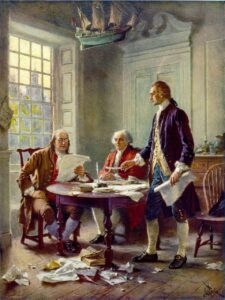
Jefferson finally left Monticello in the first days of May 1776 for Philadelphia, 257 miles north and east, to take up his duties (whatever they might be) at the Second Continental Congress. He traveled in a two-wheeled horse-drawn carriage with the assistance of a 14-year-old slave, Robert Hemings. A journey like that over primitive roads scratched out of the wilderness took between one and two weeks, and the amenities of the time were appalling. Nevertheless, Jefferson took delight in recording daily distances with his groovy new odometer. Master and slave arrived in Philadelphia on May 14, 1776, just 51 days before Congress unanimously approved the final draft of the Declaration of Independence.
As he lurched along at about 3 miles per hour, what did Jefferson think was about to happen in Philadelphia? He was pretty sure the colonies needed to declare independence — that there was no turning back — but he had no idea that he would be called upon to write the revolutionary document. He knew that some state (colonial) delegations were reluctant to cross that Rubicon, still hoping things could be worked out with the home country across the wide Atlantic. He also knew that, in his absence, Virginia was going to write its first state constitution — and he was pretty sure that would be a much more important business than anything that might happen in Philadelphia. Shortly after arriving in Philadelphia, Jefferson wrote to Thomas Nelson, “In truth [constitution writing] is the whole object of the present controversy; for should a bad government be instituted for us in future it had been as well to have accepted at first the bad one offered to us from beyond the water without the risk and expence of contest.”
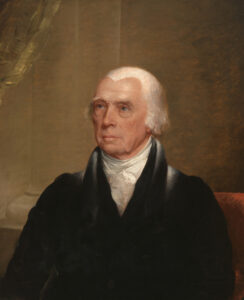
Jefferson always prided himself on being the best-prepared person in every room. (With the possible exception of his closest friend James Madison). He had read the great texts of the Enlightenment more intensely than any other member of his learned generation. He had worked assiduously for years to hone his prose style into a tool of tight, lucid, and forthright persuasion. Two years earlier, he had written an essay (a pamphlet) making the case for American independence, which was printed without his explicit permission as A Summary View of the Rights of British America. He had thus carefully laid the groundwork for what he was about to undertake.
In other words, Thomas Jefferson was ready. A complex and emotionally detached man, a creative genius, fundamentally compromised by his complicity with slavery, so deeply attached to his fragile wife that his fellow Virginians shook their heads, the embodiment of an agrarian utopian vision of republican life, a highly evolved and pacific man with no real understanding of military exigencies, was about to write this sentence:
“We hold these truths to be self-evident, that all men are created equal, that they are endowed by their Creator with certain unalienable Rights, that among these are Life, Liberty and the pursuit of Happiness.”
In the course of his long and exceedingly creative life, Jefferson could not reach the ideals he set for us — and for all of humanity thereafter. Neither have we, as a chosen people, achieved the ideals of our mission statement. We have miles to go before we sleep. Until quite recently, I thought we were still lurching forward on an arc that would inevitably lead us and the world towards justice. Now I’m not so sure.