
One of my friends contacted me not long ago and said, “Hey, you’re going to be in the Ken Burns documentary on Henry David Thoreau in March. I just saw you in the trailer. Are you going to do anything to be ready for when it comes out?” Truth told, I knew there was a Thoreau documentary coming sometime in 2026, but I wasn’t sure when.

So I woke up.
Walden is many things. A critique of American industrial capitalism, a severe diatribe against slavery, including the ways we enslave ourselves. It is one of America’s first self-help books. It is a call to a higher life. It contains hundreds of fabulous passages about nature.
This last week I have read Walden for the umpteenth time. I don’t know quite how many times: 15 at least, perhaps more. I first read it in a directed reading course in high school and I thought then it was tedious and booooor-ing. A leaf here and a muskrat there, some snark about the railroad, and a bunch of maxims of the sort you get on a graduation card: “If a man does not keep pace with his companions, perhaps it is because he hears a different drummer.” The maxim that spoke to me most back then was, “Beware of all enterprises that require new clothes.”
After that unpropitious beginning, I’m a little surprised that I ever picked Walden up again, but on the third or fourth reading it began to speak to me. At some point I realized it wasn’t just a book about nature, but a mirror we’re invited to look into to discover who we are, what we value, what chokes our spirit, and how we might thrive if we reorganize our habits and our priorities.

I won’t say I know as much about Walden as anyone, but I am quite sure I know it better than most, if only because along with Hamlet, Robinson Crusoe, Gulliver’s Travels, and Great Expectations, it is the book I return to most, once every two years at least, and for the last decade every single year.
I define a classic not with Mark Twain, “something that everyone wants to have read and nobody wants to read,” but as a great book that is newly great and greatly new every time you read it. Hamlet, Crime and Punishment, Huckleberry Finn, the Iliad, Absalom, Absalom!
Now every time I read Walden I find new things to admire, and things I thought I knew speak to me in a new way. This week alone, I have come upon at least a dozen excellent passages that seemed brand new to me. I took extensive notes. I’ve been writing short commentaries on aspects of Thoreau all week.
In my travels, whenever I get the chance where it might be appropriate, I recite my favorite passage from Walden, from the chapter “Where I Lived and What I Lived For.” When I clear my throat, my closest friends groan and say, “Here we go.” You’ll recognize at least parts of the passage right away:
I went to the woods because I wished to live deliberately, to front only the essential facts of life and see if I could not learn what it had to teach, and not when I came to die, discover that I had not lived. I did not wish to live what was not life, living is so dear, nor did I wish to practice resignation, unless it was quite necessary. I wanted to live deep and suck out the marrow of life, to live so sturdily and Spartan-like as to put to rout all that was not life, to cut a broad swath and shave close, to drive life into a corner and reduce it to its lowest terms, and, if it proved to be mean, why then to get the whole and genuine meanness of it, and publish its meanness to the world; or if it were sublime, to know it by experience, and be able to give a true account of it in my next excursion.
When I was young I was most drawn to the intensely dramatic sentence beginning, “I wanted to live deep and suck out all the marrow of life.” I am old enough now to know how little marrow I have in fact sucked out of life, though life has sucked quite a bit of marrow out of me. So far I have not had to practice resignation. What speaks to me most now is a phrase that I didn’t really notice until a couple of years ago and now it haunts me: “learn what it had to teach and not, when I came to die, discover that I had not lived.”
It haunts me to think I might, on my deathbed, discover that I had just skated over the shallow surface of life and never really drawn from it what it has to offer those who are fully present, those who notch their stick with the nick of time, as Thoreau puts it.
A Genuine Thoreauvian
I know a splendid young man in Montana who is currently living in an old sprinter van. He is a river guide during the summers, all over the American West, and in the winter he finds all the temporary work he needs in western Montana. He travels extensively. When I last spoke with him a week or two ago as we soaked in one of the pools at Jerry Johnson Hot Springs west of Missoula, he was about to leave for 28 days on a raft trip through the Grand Canyon. He keeps his expenses low, parks the van in his friends’ driveways for a few days at a time, and works hard in short intervals to maximize his opportunity for travel and adventure. He inspires me. I told him as we sat back and gazed up at the tall pines that embrace the hot springs that I have followed a very different path, which has been satisfying, but part of me envies him. Thoreau would certainly admire him. Every time I see him and we have time to talk I say to myself, and sometimes to him, quoting Thoreau, “As long as possible live free and uncommitted.” My friend knows that at some point he is going to need his 40 quarters of W-2s to qualify for Social Security and he knows too that few river guides are still plying their oars after they reach 50, but that’s a long way off, and for the moment he is leading a very intentional Thoreauvian life. Except that he’s a babe magnet and Thoreau, well, wasn’t.
I hope one of these days he discovers Thoreau’s Walden. I refuse to urge him to read it because that might make it seem like task work, like an assignment, a geezer’s book recommendation.
I wonder what circumstances would have taken me down my young friend’s path, and if I would have had the courage to live with less economic security. I doubt it frankly, not merely because I have the character of an English major, but because I think it takes a very disciplined person (or a knucklehead) to challenge the juggernaut of American conformism.
Simplify Simplify Simplify and Annoy Annoy Annoy
Thoreau can be annoying. And occasionally he just seems nuts, as when he announces that thousands of wasps have moved into the cabin with him and he’s not that concerned, but he has noticed that fewer of his friends from Concord are coming to visit him now. I’ve have a pretty good Thoreau-dar for what in Thoreau rubs most people the wrong way. He can be preachy and self-righteous. He can milk any object in nature for a metaphor, sometimes a strained metaphor. He’s pretty scathing about people who choose more conformist lives. His wit sometimes gets away from him. There is almost nothing he cannot wring some transcendental insight out of. And yes, he did take his laundry to town.
These things no longer bother me, if they ever did. But I routinely see them bother adult first-time readers. To make sense of Thoreau you have to hack your way through the first and most important chapter in Walden, the 78-page Economy. Heck, Thoreau doesn’t even start building his cabin until page 83. I believe strongly that the first chapter is the most important chapter in Walden (along with the last) and that you cannot really understand what he is trying to determine unless you come to terms with those long introductory remarks. Thoreau went to the woods in 1845 to conduct an experiment in spartan living. You have to read Economy with the closest attention to understand the nature of that experiment: “Is it possible to combine the hardiness of … savages with the intellectualness of the civilized man?”
I regard Walden as a sacred book that needs to be placed on the same shelf as the Koran, the Pentateuch, the New Testament, the analects of Confucius, the Upanishads, the Bhagavad Gita, and Black Elk Speaks. Thoreau asks the big questions that matter to me, (I speak only for myself) provides the right spiritual and meditative material to chew on, and never grows old. Walden has never failed me, in part because Thoreau wants to crow like Chanticleer rather than scrape his body with a pot sherd like the Old Testament’s Job. I cannot imagine my life without this book in it.
On this read, it is Thoreau’s radicalism that has impressed and surprised me the most. His critique of the railroad is well known, but he is certain that capitalism more generally damages everything it touches, and he excoriates the United States government for picking a war against Mexico merely to grab more territory in the West, and for protecting and perpetuating the institution of slavery. He tells self-satisfied philanthropists that he’d take them more seriously if they gave away 90% of their income rather than 10%, since what they have they stole from their neighbors. He dismisses most of the people of his New England as conformists and moral cowards. He’s a political anarchist and he’s completely sure that our elders have nothing useful to teach us. He makes fun of the Bible and regards the nations’ newspapers as having nothing fit to print.
The ChatGPT Experiment
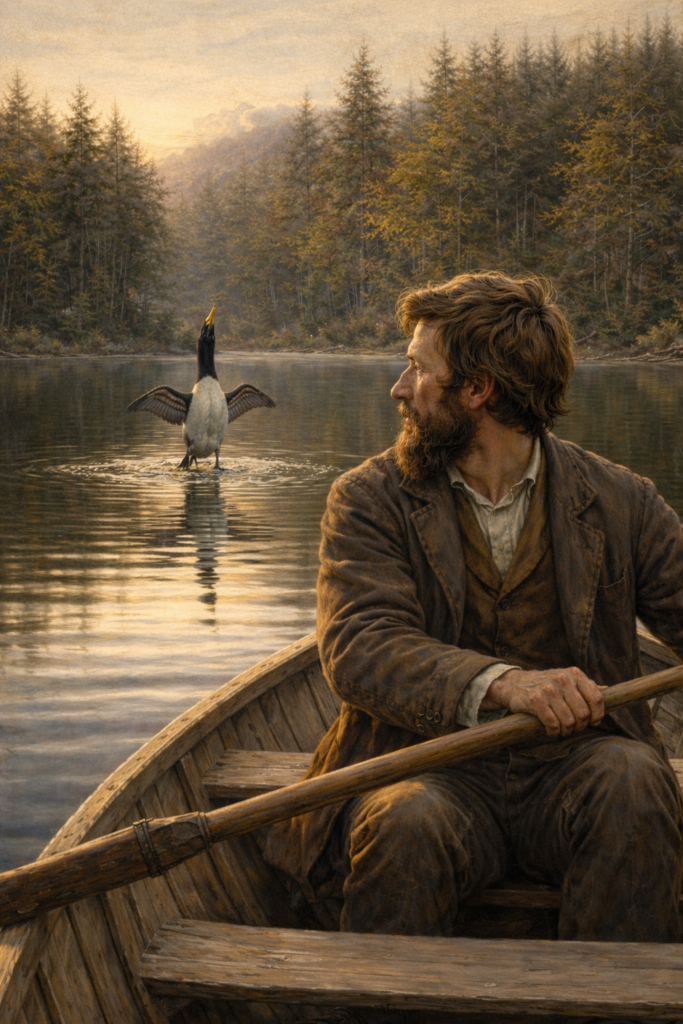
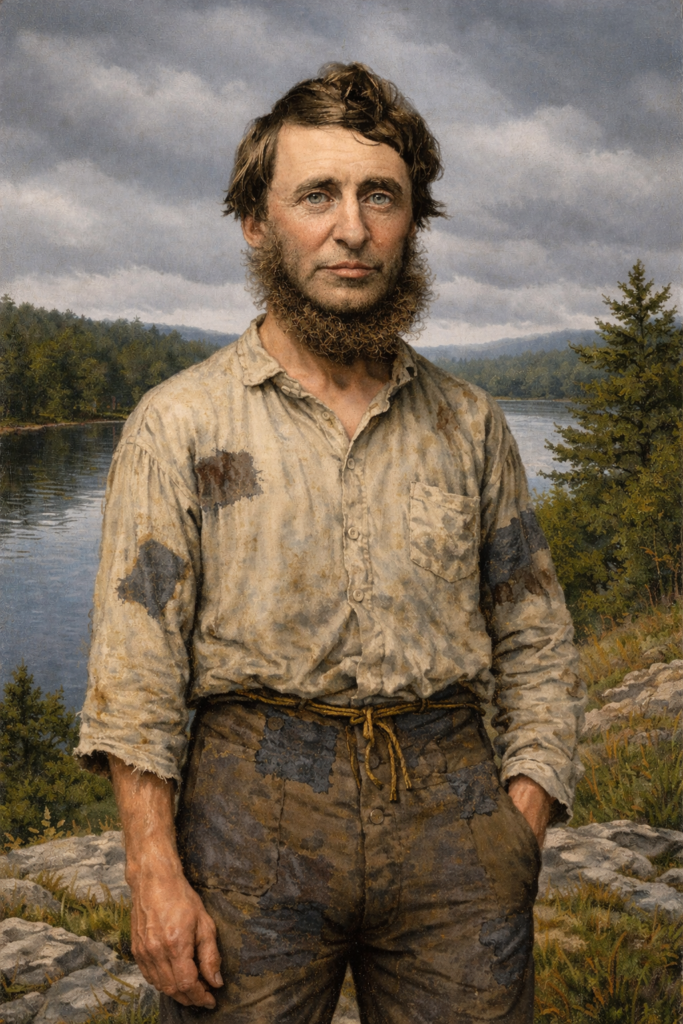
I know this doesn’t sound very Thoreauvian, but I have been trying to make sense of AI lately, specifically ChatGPT, and I have greatly enjoyed asking the program to paint pictures of my favorite scenes in Walden. These images — which one of my young friends tells me are killing the planet one pixel at a time — help me explore Thoreau’s microcosm at the pond. They illustrate and actually help me interpret passages that I find fascinating or perplexing. To get one of these AI-generated images right I have to have read the passage very carefully, tease out its details and nuances, and determine Thoreau’s attitude to the phenomenon he is observing.
I’m sharing a few of these images with you here. Whether we like it or not AI is here to stay. It is going to revolutionize the world more completely than the printing press, the automobile, or the internet. We had better all work to tame it and come to terms with it, because if we don’t master it, those who seek to use it for bad ends will surely master us.

And So to the Movies
I’m as eager as anyone to see Ken Burns’ documentary on Thoreau. I no longer remember what I said when his excellent crew flew out to Dakota to interview me two years ago, and I have no idea how many of my comments will have made the film, the great bulk of them, of course, squirming on the cutting room floor. “You want to be in my films?” he said once, “stick the landing.”