
Clay contemplates the enduring JFK Camelot myth and our longing for a Kennedyesque savior to restore constitutional order, norms, and mutual respect in our current state of the republic.
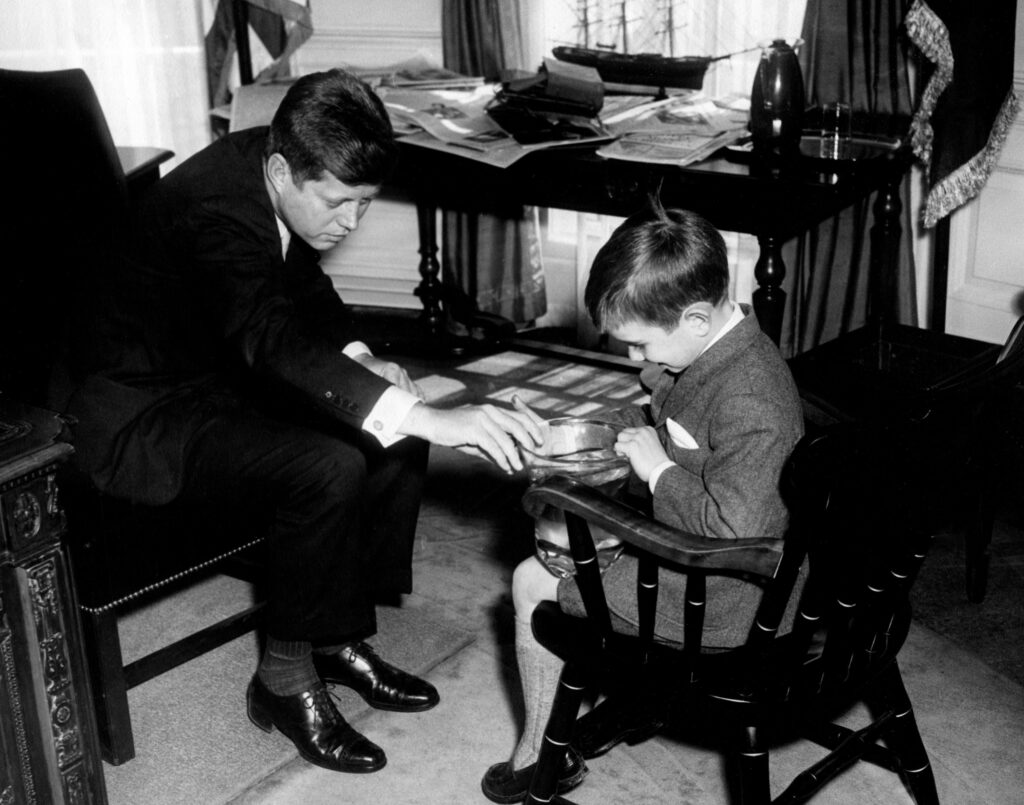
In my downsizing, a few days ago I came across a stack of about 20 historical photographs printed on the kind of poster-sized fiber board you get at Staples or Office Max. They are exhibit photos from a public humanities symposium on the 1960s I moderated 10 or so years ago at the local polytechnic university. Many of the photographs are of President John F. Kennedy. We see him huddled with his brother during the Cuban Missile Crisis. We see him in the rocking chair. We see John, Jr., crawling through the secret door in the Oval Office desk. We see Jacqueline Kennedy standing numb in her pink dress when LBJ was sworn in on Air Force One.
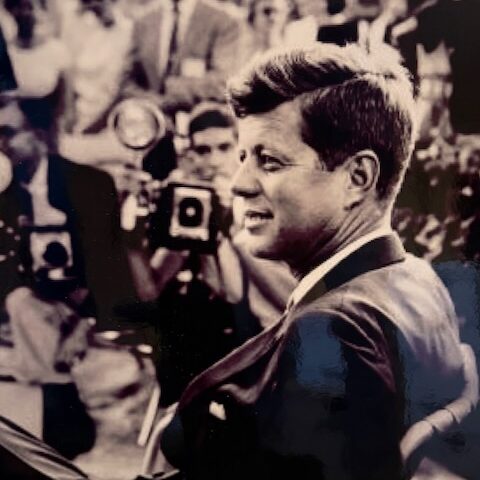
My favorite photograph (which you’ll see here) is of JFK in profile, black and white, across from a cluster of photojournalists snapping away with their large-format cameras. Kennedy looks extremely intelligent, confident, slightly bemused, pleased, and perhaps a little surprised to be America’s political rock star. He’s Hollywood handsome with the signature Kennedy hair — but not as disheveled as the distracted mop his brother Robert patented.
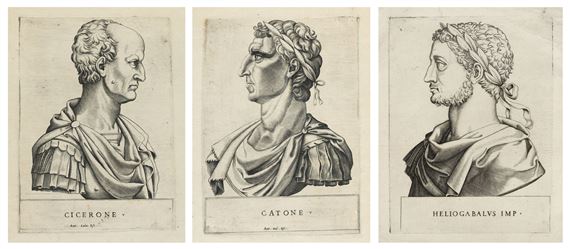
To gaze at this photograph fills me with deep sadness. From time to time you just have to step back and ask, “What happened to us? What went wrong in America between 1960 and November 2025?” “How did this downward spiral happen and can it possibly be turned around?” Place photos of the young JFK side by side with a photograph of any current political leader — all the way to the top — and you feel the bitterness of the Roman senator Cicero, witnessing the agonizing political collapse of Rome, when he wrote (46 BCE) about the stubbornly anachronistic republican Cato the Younger: “He talks like he’s living in Plato’s Republic and not Romulus’ shithole.”
How Did It Come to This?
Think of what we lost on November 22, 1963, irrespective of your political affiliation. The loss of a young, charismatic progressive national leader, a Cold War warrior-progressive. Deep sadness for what his assassination did to the country. For almost everyone who lived through it, there was a sense that something died in the soul of America that day in Dallas, just when the ’60s were dancing the Twist in the decade’s mostly exuberant phase and the Beatles were just becoming the biggest cultural phenomenon in the world. I feel sadness, too, for the traumatic multi-generational impact of the twin assassinations, JFK and his brother cut down within five years, and who was left to take their place?
Don’t get me wrong. I am not a Kennedy idolator. I have read all the literature and I know the catechism. He covered up his illnesses, especially Addison’s disease. Published a Pulitzer Prize-winning study of political courage, which was mostly written by his ghostwriter Ted Sorensen, the source of much of the Kennedy verbal magic right up to Ted’s later concession. Ted, August 12, 1980: “For me, a few hours ago, this campaign came to an end. For all those whose cares have been our concern, the work goes on, the cause endures, the hope still lives, and the dream shall never die.”
The dream shall never die.
I think maybe it did.
The whole Kennedy alchemy, the Kennedy hold on the American imagination, is encapsulated in this five-word phrase.
We know about the women, including his statement to British prime minister Harold Macmillan in 1961: “If I don’t have a woman for three days, I get a terrible headache.” We know he slept with an East German operative (during the Cold War!). We know he dropped acid in the White House (our commander in chief). We know that he had been more or less a playboy U.S. senator (1953–1960) and that at the time of his death in 1963 his legislative achievement was thin. We know that he was late and lukewarm on civil rights.
Etc.
These are serious issues (and character flaws). But this important historical revisionism about “the man who was JFK” has not displaced the 35th president from his place near the top of American mythology. What he symbolizes about youth, wit, grace, glamour, idealism, and even vitality (vig-ah as he called it) still resonates with the American people. When we think of Kennedy, we think of him playing football barefoot in the surf at Hyannis Port, not the man who used crutches when he was out of sight of the media. JFK is the avatar of the lost promise of the 1960s, populated in American memory with John Glenn and the space race, with the Beatles in their early “yeah yeah yeah” phase, with Barbra Streisand and Maxwell Smart, with the early James Bond movies, or with the Interstate Highways (mostly the work of President Eisenhower). The longing we feel when we watch a clip of a Kennedy news conference is not for Kennedy himself, but for the longshot idea that a Kennedyesque figure will rise up out of the ashes of our broken politics and lead us confidently into an American renaissance. When I look at this fabulous photograph I have to literally shake off my reverie, because it is almost swallowed up by the abyssal current state of our democracy.
And who is the most Kennedyesque figure on our national stage? Gavin Newsom? Andy Beshear? Josh Shapiro?
This is a different era. Our cynicism is so complete now that most people scoff at the idea of a charismatic and idealistic young American hero riding out of Hyannis Port — or Hope, Arkansas, or Chicago — to embody our dreams and inspire our future. All that was on the other side of the Fall (Vietnam, Watergate, the Frank Church hearings in the Senate, the Iranian hostage crisis, Iran-Contra, Grenada, Monica Lewinsky, the Iraqi War, our departure from Afghanistan). In the last 60 years the American people have lost respect for almost every national institution, including the presidency.
Imagine a politician today saying, “Ask not what your country can do for you, but what you can do for your country.” He or she would be laughed off the stage. In his great inaugural address, JFK said, “Let every nation know, whether it wishes us well or ill, that we shall pay any price, bear any burden, meet any hardship, support any friend, oppose any foe to assure the survival and the success of liberty.” That was then. Now, just ask the people of Ukraine, Hong Kong, or (coming soon) Taiwan.
A Mixed Record
For all that can be put forward to discredit JFK, I wish to defend much of his public record. He was as good a Cold War president as we ever had. He handled the Berlin Crisis sensibly in 1961. In my view Kennedy and Nikita Khrushchev saved the world in October 1962 when the trigger-happy militarists on both sides were urging their man to be tougher, not to shrink from the direct military confrontation that must come at some point or other, so let’s just get it over with. That was General Curtis LeMay’s position. He is said to have pounded his fist on the table at the most critical decision points over those thirteen days, and he told Kennedy to his face that he would be committing treason if he failed to vanquish the Soviets in some visible and measurable way. LeMay, who was chief of staff of the U.S. Air Force, estimated that the nuclear exchange he regarded as inevitable would kill more than 100 million Russians, about half that many Americans. When Premier Khrushchev agreed to pull the nuclear missiles out of Cuba, Secretary of State Dean Rusk famously said “We’re eyeball to eyeball and I think the other fellow just blinked.” The truth is that both leaders blinked, both drew back from the abyss. They saved the world together. And — coincidence — both were taken out of power by the end of 1964.
Kennedy’s Peace Corps is one of America’s best ideas. I am not sure that it always helps the host population (usually does), but I am very sure that it has a deeply admirable effect on almost all of the Americans who sign up, particularly the young and still impressionable ones.
I wish we could be more sure that Kennedy was planning to pull back from Vietnam after the 1964 election. There is evidence in both directions, but the view that he would not have escalated the war is, I believe, mostly our delusional effort to turn back to the other side of the tumults of Vietnam and the madness of the late ’60s, and to cling to the possibility that after his re-election Kennedy would have explained to America that we really have no significant stake in what happens in Southeast Asia, as long as Japan is OK.
Camelot
I’ve never been a fan of the whole Camelot trope. For one thing I don’t believe that JFK would have wanted his life to be wrapped in that gauze. He was an emotionally detached man and his sense of irony was always just under the waterline. “Camelot” was the invention of his widow Jacqueline who, just one week following the events in Dallas, summoned Life magazine journalist Theodore White to the Kennedy compound in Massachusetts and instructed him to write that the Kennedy administration was Camelot and JFK, well, King Arthur. White was skeptical, though not as much as his editors back in New York, but Mrs. Kennedy got on the phone while White was dictating his essay, “For President Kennedy: An Epilogue,” and told his editors that Camelot was non-negotiable.
On a number of occasions over the last 70 years historians and pundits have pronounced the Death of Camelot, though it never wholly convinces the American people. There is still a hunger for something nobler, more idealistic, more humane, more faithful to the rule of law in American life. People want a little poetry in their leader. Ronald Reagan had some of that. Barack Obama had that capacity in great measure. But nobody had it like JFK.
Most presidents are caretakers (Millard Fillmore, Benjamin Harrison, Gerald Ford). A few are larger than life in every way: FDR and his cousin Theodore. And an aura of American mythology hovers over a few. Kennedy mythology is bigger than John F. Kennedy, just as George Washington mythology is larger than the 18th-century plantation owner (1732–1799) who resided at Mount Vernon between his various public assignments, and the mythology embracing our “national savior” Abraham Lincoln is far larger than the gimcracking politician who emerged from the Kentucky and Illinois backwater. My history professor David Noble used to quip that in secular terms, George Washington was God the Father, Abraham Lincoln God the Son and Thomas Jefferson the nation’s Holy Spirit
We cannot stop longing for something better in our national life. John F. Kennedy is not the only embodiment of that aspiration and from a historian’s perspective he is not a perfect embodiment. But we can’t let him go. The previous death notices for Camelot were premature. This one seems to be more definitive. The public life of JFK’s nephew perhaps resonates best with a line from Hamlet: “O what a falling off was there.”
We should think of John F. Kennedy by way of Ted Kennedy’s eulogy for his brother Robert.
“My brother need not be idealized, or enlarged in death beyond what he was in life; to be remembered simply as a good and decent man, who saw wrong and tried to right it, saw suffering and tried to heal it. … Those of us who loved him and who take him to his rest today, pray that what he was to us and what he wished for others will some day come to pass for all the world.”