
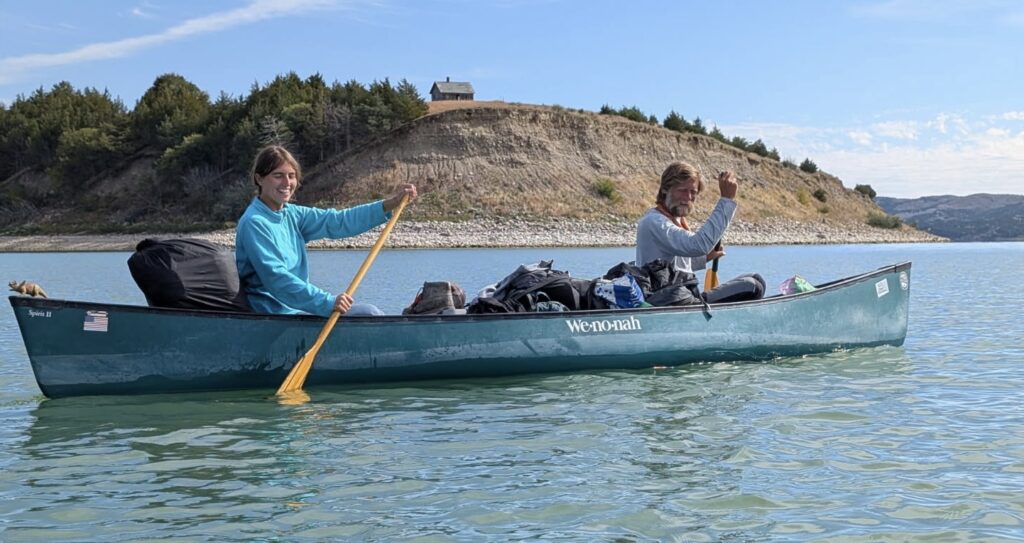
Featured on our podcast last week, LTA followers have asked for an update in the saga of Nat and Mikey, a couple of Brits currently paddling from Montana to New Orleans.

Listening to America followers have taken a great interest in the Adventure of Nat and Mikey, two Brits who are floating the Missouri and Mississippi Rivers from Three Forks, Montana, to New Orleans — if they survive!
They are currently just south of Sioux City, Iowa. That means that they have paddled 1,400 miles so far. Ahead, if they make it to New Orleans, just 2,012 miles to go!
I met them by accident in August at Fort Union, up at the confluence of the Missouri and Yellowstone Rivers, southwest of Williston, North Dakota. I was heading to a float trip in the breaks country of the Missouri, east of Judith Landing in Montana. I was triply surprised when they told me what they were doing.
1) They are British. One associates this sort of crazy adventure with the Germans or the French or the South Africans, but not the British. 2) They knew almost nothing about Lewis and Clark. I assumed that anyone who undertook such a journey would have a deep interest in the Lewis and Clark story, but I soon learned they were riffing more on Mark Twain’s Adventures of Huckleberry Finn than on the Lewis and Clark expedition. Back in England, they actually thought of trying to run the Missouri-Mississippi with a wooden raft! Everything they knew about Lewis and Clark, they learned on the river. 3) They had almost no prior experience in a canoe.
What Could Go Wrong?
Nat is Natalia. Mikey is Michael. They are a couple in early mid-life. They are schoolteachers in England. They flew to Denver (cheapest flight to USA heartland). Then they hitchhiked to Bozeman, Montana. The fact that they survived that Kerouacian journey is remarkable in itself. They bought a canoe with the help of a local expert. They bought rice and stuff. They put in on the Jefferson River at Three Forks. On day two, they capsized for the first and only time.
I had the opportunity to interview Nat and Mikey a couple of weeks ago when they were holed up north of Pierre, South Dakota, stymied by high winds on giant Lake Oahe, one of the colossal mainstem reservoirs on the Missouri. They were upbeat. They showed no indication of losing heart or giving up. They seem to be having the time of their lives. Several of our podcast listeners have chided me for calling them “idiots” and “morons” on the podcast, but I was only quoting them!
I heard from them a few nights ago (October 22). They had made it to Sioux City. This was in itself a tremendous achievement. To get there, they had to float their way across the great Missouri reservoirs: Fort Peck Lake (134 miles), Lake Sakakawea (178 miles), Lake Oahe (231 miles), Lake Sharpe (80 miles), Lake Francis Case (107 miles), and Lewis and Clark Lake (25 miles). More than half of their journey so far has been a lake expedition, not a river float.
When they checked in this week, they were staying in some kind of warehouse provided for them by a local Samaritan in Sioux City. They have been helped all along the way — portaging around dams, meals delivered, errands run, trips to the nearest village, water shoes replaced — by perfect strangers. This speaks well of America. It is true, of course, that Americans are suckers for a fine British accent. Nat and Mikey are young, handsome, well-spoken, and above all, English. Crikey!
It’s now late October. I had asked them to text me after their first really cold night. Since then, we’ve had a fair number of cold nights in North Dakota and very high winds. The cottonwood leaves have grayed out and fallen, and I see frost on my windshield when I run errands in the morning. I have thought about Nat and Mikey often these last few weeks and worried about them. I want them to succeed. I do want America and the mighty Missouri to test them, of course, but despite the arrival of chilly and drizzly fall weather on the northern plains, no “oh my God!” text has come my way. They have the right stuff.
When they texted me a few days ago, they were off on a shopping spree in Sioux City. They needed a new tent (the winds had played havoc with their tent poles), a new stove (gunked up with river sand), and a new sleeping pad.
There is good news and there is a fair amount of bad news. Good news first: They are out from the last of the big dams and reservoirs on the Missouri. From Sioux City on down to St. Louis, the river flows more or less like a river, if you discount the levees and jetties that the Corps of Engineers constructs (and repairs) to prevent flooding and keep a navigation channel open from St. Louis to Sioux City. They no longer have to paddle endlessly on reservoir slack water, on man-made lakes that can get a kind of Great Lakes effect from wind and high waves.
The bad news: Winter is coming. They are moving south at about 20-25 miles per day, but when true winter comes, there will be a fair quantity of misery. I know. I have done some winter camping, and (for me) that raises some existential questions along the line of “not enough sense to come in out of the rain.” I have serious doubts that they can float the lower Missouri and the Mississippi in an American winter. They are really smart and savvy individuals, Nat and Mikey, but I fear that, as denizens of England (where the temperature rarely dips below freezing), they don’t yet know what an American winter is like.
More bad news. The Mississippi River is not for the faint of heart. To put it lightly. It is massive, wide, wild, capricious, dangerous, and full of barge traffic. Remember that Huck and Jim were nearly killed when their raft was unceremoniously run over by a steamboat (Chapter 12). I’d be anxious plying the Mississippi in a canoe. Why? The Mississippi River basin covers 1.2 million square miles, an area larger than India. At its mouth in Louisiana, the Mississippi discharges an average of 593,000 cubic feet of water per second. It carries approximately 400 million tons of sediment to the Gulf of Mexico per year. In some places, the lower river is 200 feet deep. More than 175 million tons of freight move up and down the river every year. A single towboat can push up to 50 barges (1,000 semitrailer trucks’ worth).

Checking In
I do hope they make it. What a triumph that will be. Nat and Mikey are smart and funny, full of the best kind of naivete, willing to risk all for this once-in-a-lifetime adventure. They plan to get to New Orleans for Mardi Gras (February 17).
When they checked in, I asked them for a brief report. Here’s what they wrote:
“The vast majority of time has been exceptionally fun and generally we have found that any slump in fortune is generally presaging a total change in our circumstances. We had an incredible pizza in the shed of a man who we thought was going to kick us off his land but instead drove out of his way to help us. We have enjoyed the beauty and solitude of the lakes and, on the other end, enjoyed the conversation of the loads of Americans who have just come up and taken an interest in us — like Larry yesterday who was looking after Sioux City’s feral cat population and the 80-year-old woman who flagged us down in a restaurant and said ‘they’re lucky I didn’t have that idea when I was younger, I would have been right out there on the water.'”
So far, so good.
“The not so great stuff has included being shot at in South Dakota (not properly, just to scare us which it did), our tent pole breaking before a big wind storm, getting soaked to the skin in Springfield [South Dakota] (a man let us warm up in his car) and having absolutely no control over the canoe because the waves were so strong on Lake Francis Case which, despite only lasting about three minutes, absolutely terrified us.”
Shot at! Welcome to America. That wouldn’t happen on the Thames.
So, off they go again, with spanking new equipment. The Missouri River is astonishingly beautiful below Sioux City. It braids out, flows like one of the world’s great rivers, leaves the treeless plains country and enters midwestern forests and prairies. There are more riverside villages, towns, and even cities, should they need a break, and their confidence is growing as they ply the river like voyageurs of the heroic era of North American history.
I try to imagine what their lives will be like when they return to Great Britain sometime in 2026. Re-entry can be a challenge. Meanwhile, I salute them for their amazing spirit. As they check in downriver, I’ll provide more updates. You can follow their adventures and a map of their current location on their blog.
Roll on, Nat & Mikey. Roll on!