
Our Lewis and Clark explorer, Clay Jenkinson, says that Great Falls’ reputation for being one of the less attractive places to visit in Montana is highly unfair. He shares his “must see” stops.
Great Falls has a reputation for being one of the less attractive places in Montana, but that seems truly unfair to me. The city of 60,442 residents, founded around 1884, is not handsome along its main drags. Few cities are. On those arteries, Great Falls has the charm of Williston, North Dakota, or Gillette, Wyoming. Still, if you get off the main roads, you find charming older pre-plastic-siding houses, lots of city parks, and — of course — the “mighty and heretofore deemed endless Missouri River” runs through it.
Lewis and Clark spent about six weeks in total time here, mainly on the outbound journey of 1805. It was here, approximately 2,300 miles from St. Louis, that the Corps of Discovery reached a place on the Missouri River they could not float through with their flotilla of six dugout canoes and one rowboat-like pirogue. They’d have to make their first portage in more than a year of travel. On June 13, 1805, moving ahead of the rest, Meriwether Lewis “discovered” the great falls of the Missouri River. Needless to say, the falls had been known to Native Americans for millennia, so the word “discovery” takes on a somewhat ironic cast as we think about explorers in the twenty-first century. In two days of reconnaissance, Captain Lewis “discovered” not one but five impassable falls bunched together. He also experienced, on June 14, 1805, what I think might have been the greatest day of his short life. But that’s for another time.
From my point of view, here are the must-see stops in Great Falls, some but not all related to Lewis and Clark.
1. The Lewis and Clark National Historic Trail Interpretive Center. It is one of the very best Lewis and Clark interpretive centers in the country. Everything is accurate and expertly illustrated. Because the center is perched against the north bank of the Missouri on several levels, you can stand inside above or below a full-sized dugout canoe attached to a makeshift wagon with 22-inch cottonwood wheels, perched at an impossible angle, with expedition mannequins exerting nearly superhuman force to push it up the steep bluffs of the Missouri. Lewis reported that whenever the leadership called a halt during the portage, the men would collapse exactly where they were and fall instantly asleep. The center has photographs of the five waterfalls before and after industrial intrusion. Outside is a replica of Lewis’s infamous iron-framed boat, the “Experiment”, i.e., an experiment that failed. While we were there, an older man, a firearms expert, explained the guns of the expedition with considerable firmness. If you only have time to visit one Lewis and Clark interpretive center in America, you could not go wrong with this one. The shop and bookstore are not what they used to be during the Bicentennial of the Lewis and Clark expedition (2003–2009), but that was a high-water national experience not likely ever to be reached again.
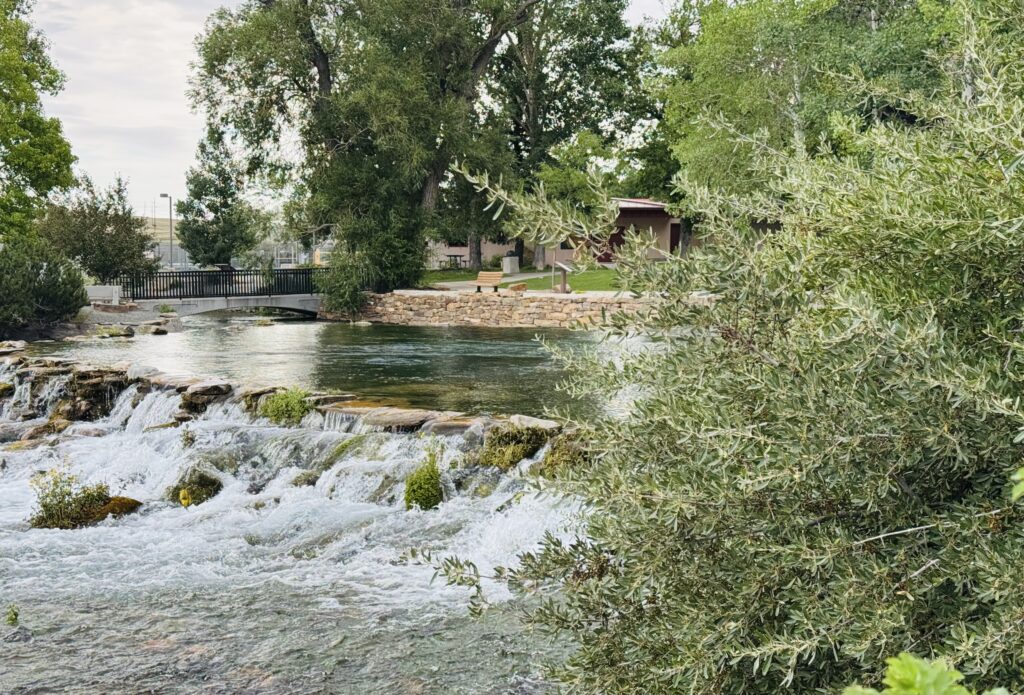
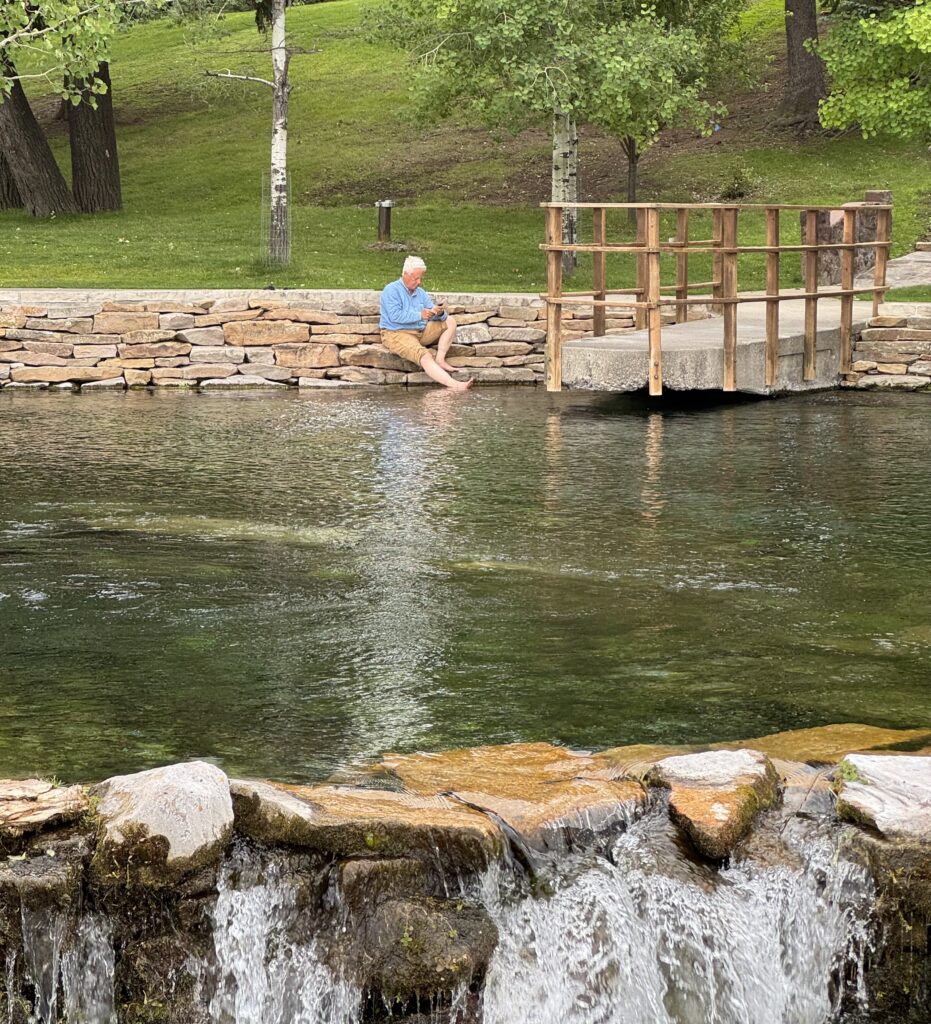
2. The Giant Spring. Lewis and Clark expedition member John Ordway said the giant spring delivered the best water he had ever tasted. It is colossal, releasing 150 million gallons of water into the Missouri every day. Lewis and Clark had never seen anything like it back east. The site infrastructure has the feel of a WPA or CCC project, and its amazingness is now somewhat compromised by concrete “improvements,” including a snack bar. It’s still awe-inspiring, but we wondered what it must have looked like when Clark and Lewis first happened upon it right next to the river. You can dip your feet in the spring pool, which is perfectly transparent to a depth of more than four feet. The giant spring creates what is regarded as one of the shortest rivers in the world, about 50 yards long.
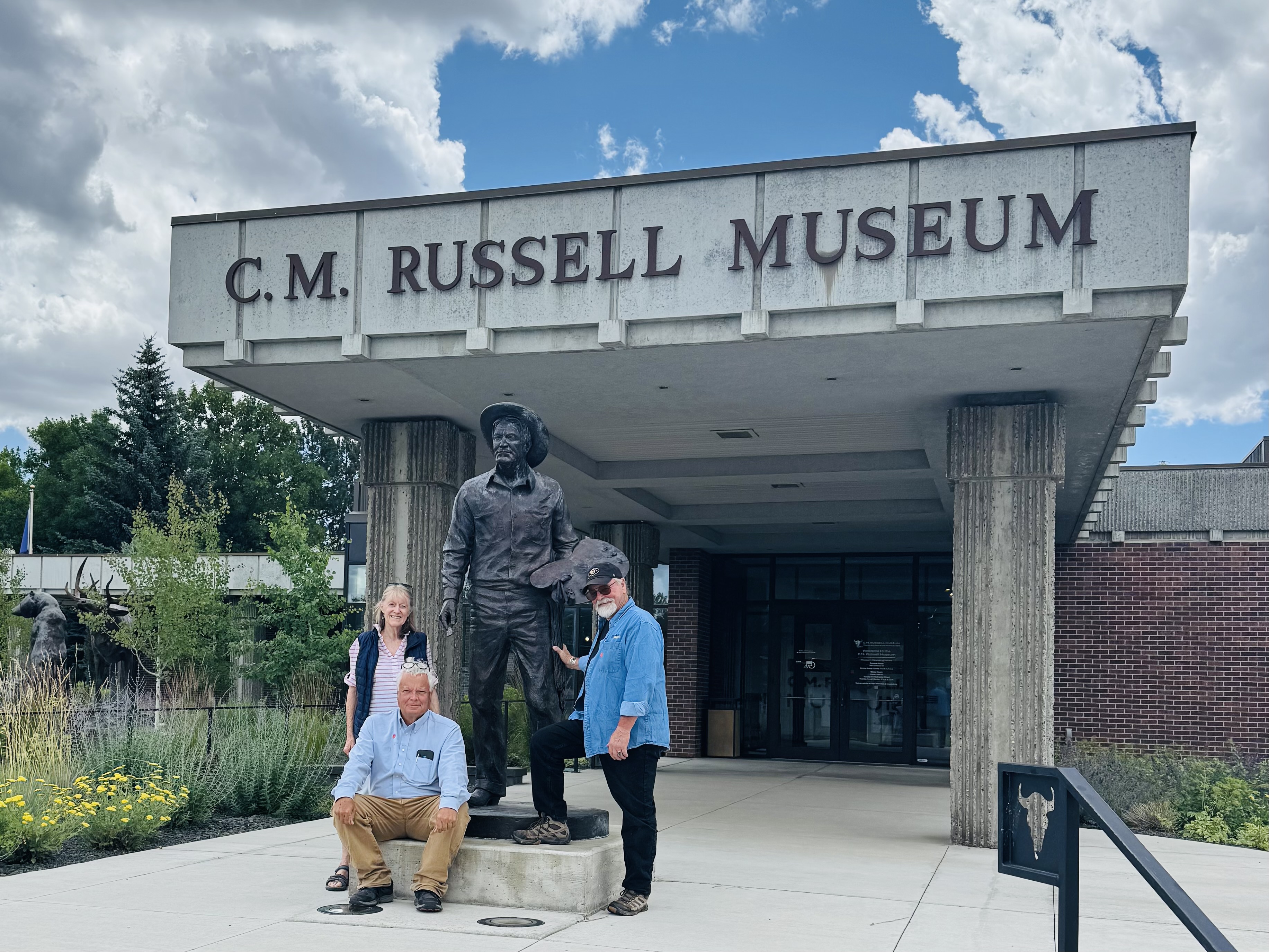
3. The C.M. Russell Museum. Located in the old center of Great Falls, this gallery is in every way outstanding. It features an extensive display of Russell’s paintings, sculptures, drawings, and his delightful illustrated letters, as well as the work of later artists who incorporated his style. Russell’s Victorian house still stands right outside the museum, and it’s open to visitors, as well as his perfectly preserved painting studio, jam-packed with the tools and other accoutrements of his trade. The atelier is so evocative you half-expect Charlie to return at any moment, wiping his lips after taking a snort at the Mint Bar in downtown Great Falls. The shop is outstanding. We were fortunate to see an exhibit of Robert Osborn’s oversized black-and-white photographs of Indigenous people, mostly Crow (Apsáalooke), including his stunning portrait of Margo Real Bird. If you come to Great Falls and don’t give yourself a few hours at the C.M. Russell Museum, your priorities may need an “adjustment.”
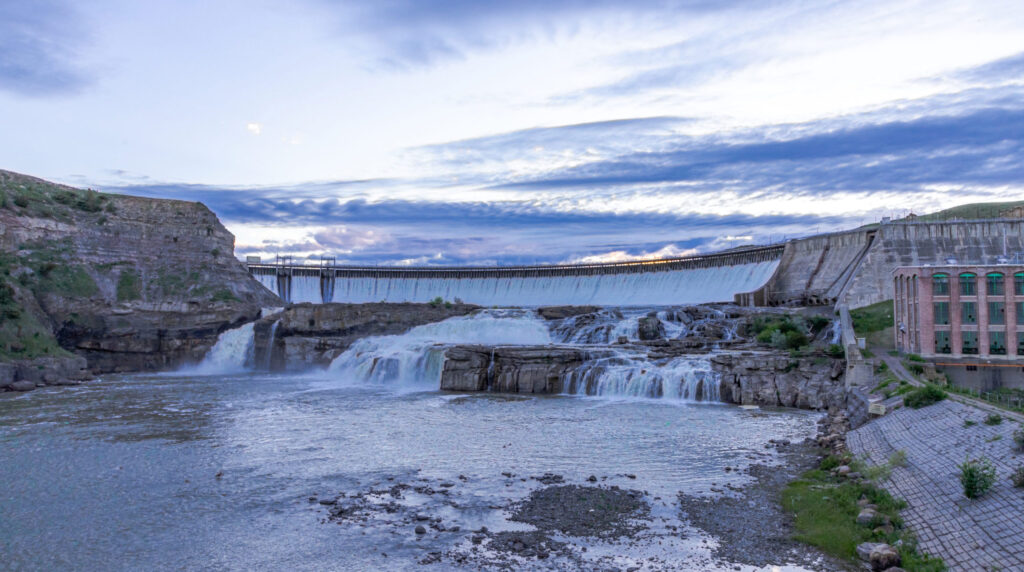
4. Ryan Dam at the Great Falls. All of the waterfalls at Great Falls have been compromised by industrial development, most notably hydroelectric dams that helped give the town the moniker “The Electric City.” When Meriwether Lewis observed the first of the falls for the first time on June 13, 1805, he called it “the grandest sight I ever beheld.” Sitting on a rock shelf below the orgiastic cascade, Lewis wrote one of his most celebrated journal entries in his attempt to do justice to “this truly magnificent and sublimely grand object, which has from the commencement of time been concealed from the view of civilized man.” That was then. Today, Ryan Dam inevitably diminishes and perhaps ruins the sublimity. Still, it was thoughtfully designed in 1915 to let water cascade over its rim, and the craggy rocks below were to a certain degree incorporated into the base of the dam. If you squint, you can almost imagine what the falls looked like when Lewis first visited them. It would be a truly great thing if Ryan Dam were removed — in fact, all five of them — in the name of America’s purple mountain majesty. Lewis said the 80-foot waterfall was second in magnificence only to Niagara. In the twenty-first century, the existing hydro dams are about as effective as a Betamax videotape or an 8-track tape player, more interesting as a kind of General Electric “bring good things to life” heritage site than for power production. The dams here contribute nothing to flood control.
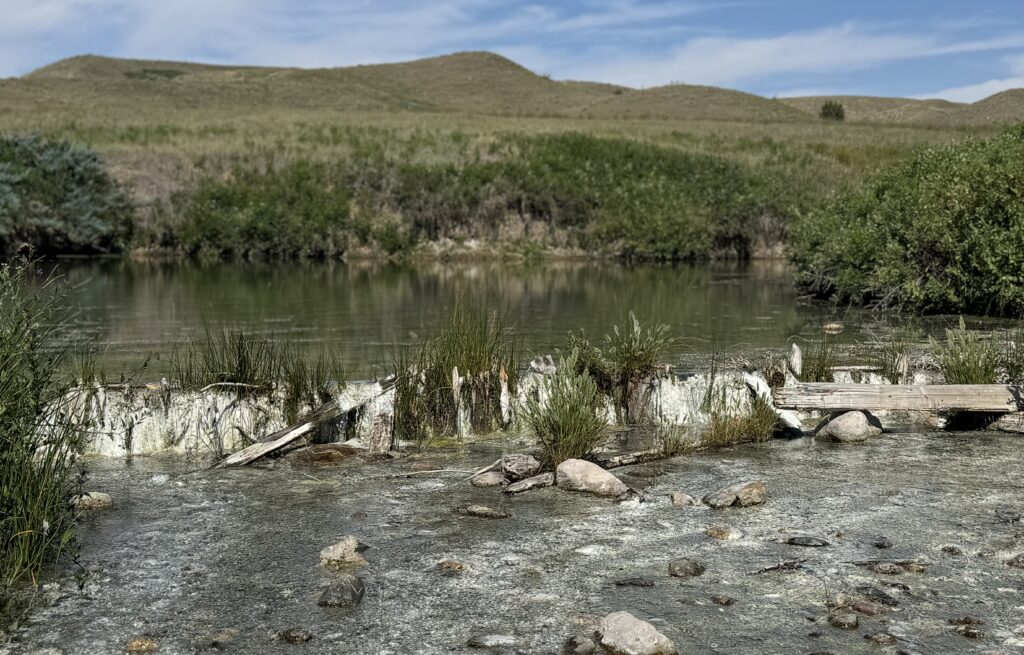
5. Sulphur Spring. The Shoshone-Hidatsa woman Sacagawea became dangerously ill beginning on June 10, 1805, at the mouth of the Marias River, and appeared to the captains to be close to death. The medical practices of the time were so primitive that Thomas Jefferson once quipped, “Whenever I see two doctors gathered in a public road, I look up to see whether there are turkey vultures flying overhead.” Medical historians now believe Sacagawea was suffering from a pelvic inflammatory condition. Lewis, whose mother, Lucy Marks, was an herbalist, had spotted (more likely sniffed) a sulfur spring just across the river from the expedition’s Lower Portage Camp, and he reckoned the mineral water might help cure Sacagawea. He caused her to drink a copious quantity of the impregnated water. By June 19, she had mostly recovered. Whether Lewis’s remedy had an ameliorative effect is uncertain (and unlikely). Sacagawea survived her gynecological ordeal (medical historians suspect that her ne’er-do-well husband Charbonneau gave her an STD) because she was young, healthy, fit, and determined to live. The hike from the parking lot to Sulphur Spring is 1.8 miles, and the views of the Missouri River (including, surprisingly, a series of real rapids) are achingly beautiful. From the aromatic spring, you can look across the Missouri and see Belt Creek, which was the coulee up which expedition members lugged their gazillion tons of baggage (and canoes) up to the 18.25-mile portage trail.
Finally,
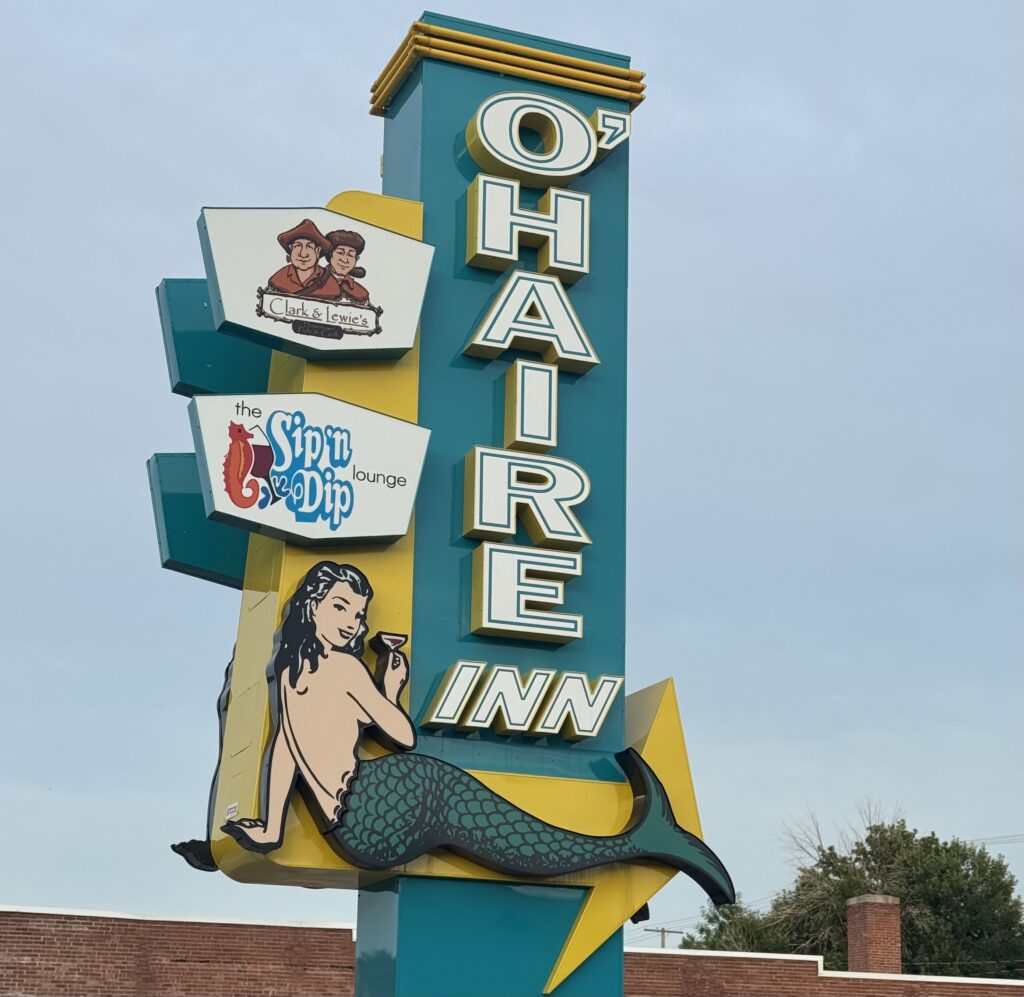
6. The Sip ’n Dip Lounge. Located in a motel in downtown Great Falls, the legendary Sip ’n Dip is a retro Tiki lounge with faux Polynesian décor. Behind the bar is a human aquarium in which a lovely mermaid swims, rolls, blows kisses, and cavorts. To the extent that an indoor swimming tank with a woman in a halter and set of fins can be said to be tasteful, this qualifies. A family we met visited the bar before happy hour. The lounge dates to 1962, shortly after jet airplanes and the statehood of Hawaii created a national Polynesian chic. Think of Marlon Brando and a Tahitian woman wearing little more than a lei overcoming their language barrier with a James T. Kirk kiss. There is bar food at the Sip ’n Dip for those who wish it, and the drinks are inexpensive. The Sip ’n Dip experienced a social media renaissance in 2003 when it was declared to be one of the top ten bars in the world and “the #1 bar… worth flying” to. Thomas Jefferson said the Natural Bridge in Virginia was “worth a trip across the Atlantic” to see (and paint). Whether you should book a flight from Milan or Prague to sip at the O’Haire Motor Inn while one of the six professional mermaids dips six feet in front of you from behind glass is unclear. We tipped our mermaid generously, and she performed some nifty underwater entrechats just for us.
Such are the wonders of Great Falls, Montana. If you are a Lewis and Clark buff, you’ll find more “you are there” sites in and around Great Falls than in any other location in America. The national Lewis and Clark Trail Alliance has its headquarters in Great Falls. It publishes the glossy quarterly We Proceeded On, for which I serve as the national editor. I invite you to subscribe.
Just outside Great Falls lurks Malmstrom Air Force Base, which maintains an array of 150 nuclear-tipped ICBMs (Inter-Continental Ballistic Missiles). The other two ICBM Air Force wings are in North Dakota (Minot Air Force Base) and Wyoming (F.E. Warren Air Force Base). Thus, simultaneously, the greater Great Falls area is one of the most potent platforms for mass destruction in the world and one of the first targets for Putin, Xi, and Kim Jong Un, should they ever decide to launch mayhem at the United States. That would remove the dams!